How to Automate Cardiac Telemetry Workflows in 2026
Last updated: July 13, 2026
Key Takeaways
Cardiology practices in 2026 manage fragmented OEM portals, manual EHR transcription, and unfiltered alert volumes that complicate cardiac telemetry monitoring.
A 12-step automation roadmap addresses these issues through vendor-neutral data ingestion, AI-powered alert triage, bi-directional EHR integration, and CPT-compliant billing capture.
Key prerequisites include EHR connectivity via HL7, access to all manufacturer device data, defined staffing roles, HIPAA compliance, and a realistic implementation timeline.
Documented outcomes include greater than 99.9% data transmissibility, 80% reduction in critical-alert response time, elimination of manual transcription, and up to 300% increase in captured revenue.
Talk with Rhythm360 to implement automated cardiac telemetry monitoring workflows and improve your cardiology practice operations.
Readiness Checklist Before You Automate
Confirm readiness across four domains before you start implementation.
EHR connectivity: Confirm that your EHR (Epic, Cerner, Athenahealth, eClinicalWorks, Greenway Health, or others) supports HL7 messaging for bi-directional data exchange.
Device data access: Identify all OEM portals in use, such as Medtronic, Boston Scientific, Abbott, and Biotronik, and document which patient populations each serves.
Staffing roles: Assign clear ownership to administrators, electrophysiologists (EPs), cardiac device technicians (CCTs), and billing staff before go-live.
HIPAA considerations: Verify that any new platform is HIPAA-compliant and supports a full audit trail for all patient communications and data access events.
Timeline: Plan for a few days to a few weeks for full EHR integration and onboarding, depending on practice size and existing infrastructure.
Once you confirm readiness in these areas, you can move into a structured rollout using the 12-step roadmap below.
12-Step Automation Roadmap for Cardiac Telemetry
Conduct a workflow audit. Map every current touchpoint, including OEM portal logins, manual data pulls, transcription steps, alert routing paths, and billing documentation handoffs. Highlight where staff time is consumed and where critical events could be delayed.
Assess your device population. Catalog all implanted and wearable devices by manufacturer and model. This inventory reveals which devices support remote transmission and which require in-office interrogation, a key distinction because only remotely transmitting devices can feed automated workflows. The complete roster you build here determines which OEM data feeds you configure in the vendor-neutral ingestion layer at step 3.
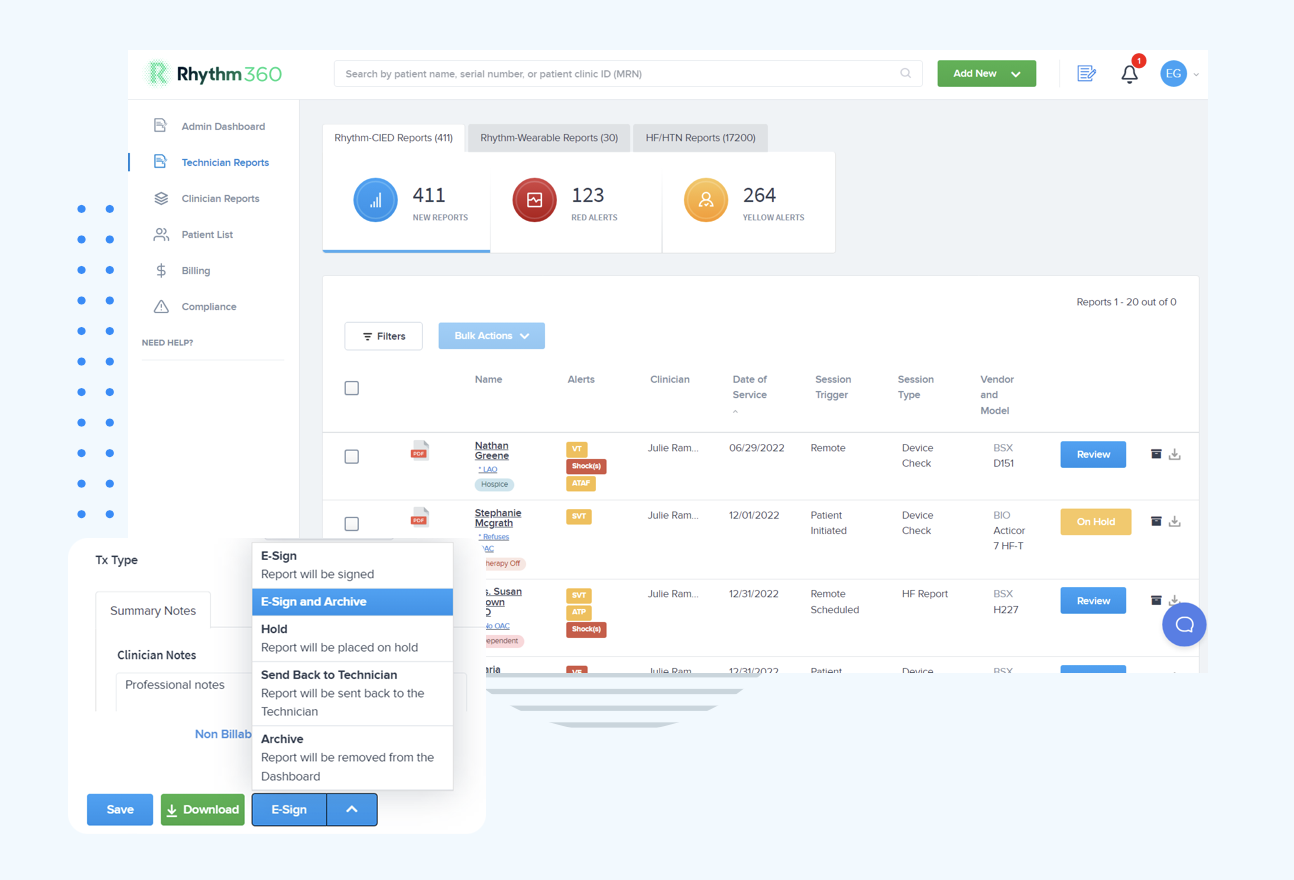
Establish vendor-neutral data ingestion. Connect Rhythm360 to all OEM data feeds using API, HL7, XML, and PDF parsing via computer vision. The platform normalizes disparate data formats into a single structured record, achieving greater than 99.9% transmissibility through redundant data feeds and AI-powered extrapolation.
Integrate with your EHR. Configure bi-directional HL7 integration between Rhythm360 and your EHR. This connection removes manual transcription and keeps device data, clinical notes, and billing documentation flowing automatically between systems.
Assign CCT oversight and escalation pathways. Decide whether your practice will use in-house CCTs, Rhythm360’s optional 24/7/365 certified cardiac technician oversight, or a hybrid model. Define escalation paths for critical events so that every alert reaches the right clinician within a defined response window.
Automate report generation. Configure Rhythm360 to generate near-real-time reports for routine transmissions and urgent alerts. Automated reporting removes manual documentation burden and creates the audit-ready records required for CPT billing compliance.
Activate automated EHR documentation. Enable bi-directional write-back so that reviewed and signed reports populate directly into the patient’s EHR record. This step removes transcription entirely and keeps documentation complete at the time of clinical review.
Configure CPT-compliant billing capture. Map each monitoring activity to its corresponding CPT code, including 93298, 93299, 99453, 99454, 99457, 99458, and others, within the Rhythm360 billing dashboard. Automated tracking of transmission days, management minutes, and 30-day billing windows prevents the documentation gaps that trigger claim denials.
Enable the HIPAA-compliant mobile application. Deploy Rhythm360’s mobile app so that EPs and CCTs can review transmissions, sign reports, and coordinate care from any location. This capability closes common weekend and on-call coverage gaps in device clinics.
Establish KPI monitoring and continuous improvement cycles. Define baseline metrics before go-live and track them monthly, including critical-alert response time, staff hours per transmission review, patient compliance rates, and billing capture rates. Use the Rhythm360 administrative dashboard to spot workflow gaps and refine triage rules over time.
Critical timing note: The low intervention rates cited in step 6 have real operational consequences. Without AI triage in place, practices receive an undifferentiated stream of alerts that can consume more than a third of clinical staff time. Configure triage rules at step 6 before you activate full alert volume to prevent staff desensitization.
Side-by-Side View of Manual vs Automated Telemetry
The table below compares legacy manual processes with automated equivalents using Rhythm360. All metrics come from RhythmScience platform data and documented client outcomes.
Rhythm360
Workflow Area
Legacy Manual Process
Automated with Rhythm360
Documented Outcome
OEM data access
Staff log into separate portals for each manufacturer (Medtronic, Boston Scientific, Abbott, Biotronik, etc.).
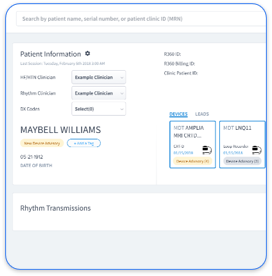
Single unified dashboard ingests all OEM data via API, HL7, XML, and computer vision PDF parsing.
Elimination of redundant logins and manual data retrieval.
Data transmissibility
Dependent on individual OEM server uptime, with gaps when manufacturer systems are down.
Redundant data feeds and AI-powered extrapolation maintain continuous data availability.
Greater than 99.9% transmissibility (as noted in step 3).
Alert triage
All OEM-generated alerts routed to clinical staff without filtering, creating a high volume of non-actionable notifications.
AI-powered triage filters non-actionable alerts and prioritizes clinically significant events.
80% reduction in critical-alert response time.
Report generation
Manual compilation of device data into clinical reports that is error-prone and time-intensive.
Near-real-time automated report generation for routine and urgent transmissions.
Significant reduction in staff hours per report and scalability to 73,000+ reports annually as documented at University of Chicago Medicine.
EHR documentation
Manual transcription of device data and clinical findings into the EHR, with duplicate entry risk.
Bi-directional EHR integration writes reviewed reports directly into patient records.
Elimination of manual transcription and a complete audit trail.
Critical event escalation
Delayed identification due to manual review queues and weekend or on-call gaps.
Optional 24/7/365 CCT oversight with defined escalation pathways and mobile app access for on-call clinicians.
Earlier intervention and the ability to call patients in for evaluation rather than waiting for scheduled visits.
Patient communication
Ad hoc phone calls and manual logging with no unified audit trail.
Integrated Twilio-powered messaging with automated reminders and a full communication audit trail.
Reduced redundant outreach and documented coordination across the care team.
CPT billing capture
Manual tracking of transmission days and management minutes, with billable minutes lost due to incomplete time logs.
Automated CPT code mapping and 30-day billing window tracking within the platform.
Up to 300% increase in captured revenue.
Multi-condition monitoring
Separate workflows for CIED, heart failure, and hypertension patients with no unified view.
Integrated service lines for Rhythm-CIED and HF/HTN RPM in a single centralized workspace.
Comprehensive population health management across rhythm disorders and chronic cardiometabolic conditions.
Mobile and remote access
Clinicians tethered to workstations with limited ability to review transmissions off-site.
HIPAA-compliant mobile app enables transmission review, report signing, and care coordination from any location.
Continuity of care during on-call and weekend coverage periods.
Clarifying Cardiac Telemetry and Remote Monitoring
What is the difference between cardiac telemetry monitoring and remote cardiac monitoring?
Cardiac telemetry monitoring traditionally refers to continuous inpatient ECG surveillance transmitted to a central monitoring station for patients with active arrhythmias, post-procedure status, or high-risk presentations. Remote cardiac monitoring covers outpatient surveillance of implanted devices (CIEDs) and wearable sensors that transmit data from the patient’s home to a clinical team. In practice, the workflows overlap significantly because both require alert triage, documentation, and escalation protocols. Automation platforms like Rhythm360 support both environments by normalizing data from implanted devices, wearables, and physiologic sensors into a single review workflow.
Implementation Timing, Costs, and Guidelines Alignment
How long does implementation take, and what does it cost?
Rhythm360 implementation, including EHR integration, typically takes from a few days to a few weeks depending on practice size and the number of OEM data feeds you connect. RhythmScience uses a SaaS-based pricing model that scales with clinic size and platform usage, which avoids the high upfront costs associated with on-premise systems. Manual workflows often lose billable RPM minutes because of incomplete time logs and under-capture billing codes on eligible patient-months. Automation that raises billing capture above 90% can generate substantial incremental annual revenue.
How does Rhythm360 align with 2026 AHA and CMS guidelines for cardiac monitoring?
The 2017 AHA scientific statement on electrocardiographic monitoring in hospital settings (Sandau et al.) remains the primary evidence-based reference for indication-based monitoring decisions. The 2026 CMS Physician Fee Schedule introduced new RPM codes (99445, 99470) that allow billing for shorter data collection periods of 2–15 days, which expands reimbursement eligibility for patients who do not consistently meet the prior 16-day transmission threshold. Rhythm360 automates compliance with these requirements by tracking transmission days, management minutes, and documentation standards for each applicable CPT code and by generating the audit-ready records that CMS and OIG audits require. The OIG announced a formal audit of Medicare Part B RPM billing in December 2024, so automated documentation and transmission logs now play a central role for practices billing these codes.
What staffing model is required to operate Rhythm360?
Rhythm360 reduces dependence on specialized “super-users” and supports business continuity when staff turn over. The platform consolidates data from all OEM portals into a single dashboard that any trained CCT, NP, PA, or EP can navigate. For practices without sufficient in-house CCT coverage, a documented challenge as staffing and technician turnover affect device clinics across the country, Rhythm360 offers optional 24/7/365 oversight by certified cardiac technicians supervised by physicians. This hybrid model lets practices scale monitoring capacity without proportional headcount increases.
30-Day Implementation Checklist for Rhythm360
The 12-step roadmap above provides the conceptual framework for automation. The following checklist translates those steps into concrete actions for your first 30 days, combining some steps and adding operational details such as BAA execution and staff training.
Complete workflow audit and document all current OEM portal logins and manual steps.
Finalize device population inventory by manufacturer and transmission capability.
Execute BAA and confirm HIPAA compliance documentation.
Initiate EHR integration configuration with HL7 messaging setup.
Connect all OEM data feeds to the Rhythm360 ingestion layer.
Configure AI alert triage thresholds for critical arrhythmias and device events.
Define escalation pathways and assign a CCT oversight model (in-house, Rhythm360-supported, or hybrid).
Train administrative, clinical, and billing staff on the unified dashboard.
Activate automated report generation and EHR write-back.
Configure CPT code mapping for 93298, 93299, 99453, 99454, 99457, 99458, and applicable 2026 codes.
Deploy the mobile app for EP and CCT on-call access.
Establish baseline KPIs and schedule the first monthly performance review.
Revenue Impact and CPT Code Capture Strategy
Cardiac telemetry monitoring generates reimbursement across multiple CPT code families, yet manual workflows consistently under-capture these codes because of incomplete transmission logs, missed time thresholds, and documentation gaps. The following codes sit at the core of a complete billing strategy for CIED and RPM programs.
93298: Remote interrogation of implantable cardiovascular physiologic monitor, up to 30 days, professional component.
93299: Remote interrogation of implantable cardiovascular physiologic monitor, up to 30 days, technical component.
99453: Initial device setup and patient education; reimbursed at approximately $21.71 per episode of care under the 2026 Medicare fee schedule.
99454: Device supply with automatic data transmission, each 30 days (requires at least 16 transmission days); reimbursed at approximately $46.83–$52 per month in 2026.
99458: Each additional 20 minutes of RPM management; reimbursed at approximately $41.42 per unit (2026 Medicare non-facility rate).
99470: New 2026 code for 10–19 minutes of RPM management with at least one interactive communication.
93296: Remote pacemaker/ICD monitoring technical component; automation can generate additional annual revenue for CIED programs when 90-day billing windows are tracked automatically.
A correctly stacked billing workflow for a complex cardiac patient on an ICD and RPM generates substantial revenue per patient. Manual tracking often fails to capture all eligible codes, which leaves significant revenue unrealized. Automation closes this gap by raising code capture rates above 90% and eliminating documentation deficiencies that trigger claim denials, so theoretical billing potential converts into actual revenue.
Validation Metrics and KPI Tracking
The following KPIs provide a measurable framework for evaluating automation success. Establish baselines before go-live and review them monthly.
Critical-alert response time: Target an 80% reduction from baseline, consistent with documented Rhythm360 outcomes.
Transmission review volume: Track total reports reviewed per quarter; University of Chicago Medicine processed more than 18,000 reports per quarter through Rhythm360 in 2025.
Staff hours per transmission review: Measure time from data receipt to signed report and compare automated performance to manual workflows.
Patient compliance rates: Monitor the percentage of enrolled patients meeting transmission thresholds required for CPT 99454 billing.
Billing capture rate: Track the percentage of eligible patient-months with successfully billed 99457 and 99454 codes and target above 90%.
Claim denial rate: Monitor rejections attributable to documentation gaps; automated transmission logs and time tracking should reduce denials substantially.
Alert dismissal rate: Treat high dismissal rates as a structural feature of safety-first remote monitoring rather than a failure indicator and track the ratio of actionable to non-actionable alerts to validate triage rule calibration.
The 12-step roadmap applies across practice sizes, with the following adaptations.
Solo practices: Rhythm360’s SaaS pricing scales to small patient panels. The mobile app and optional CCT oversight help solo EPs manage on-call coverage without dedicated device staff.
Mid-size EP clinics: The primary gain comes from consolidating multi-OEM data into a single dashboard, which removes the administrative burden of managing separate portals for each manufacturer’s patient population.
Large health systems: Implementation at scale, as shown in the University of Chicago Medicine case study cited earlier, requires phased rollout with dedicated program management. Change management between phases keeps workflows stable.
Mixed-vendor populations: Rhythm360’s vendor-neutral ingestion layer accommodates device changes over time without re-architecture, which preserves continuity as practices add new OEM relationships.
On-call and weekend coverage: The HIPAA-compliant mobile app addresses documented weekend coverage gaps in device clinics by enabling clinicians to review and act on critical alerts from any location.
Advanced Optimization After Go-Live
After the initial 30-day rollout, practices can apply these optimization steps to maximize clinical and financial outcomes.
Refine AI triage rules: Review monthly alert dismissal and escalation data to identify thresholds that generate non-actionable notifications. Adjust sensitivity settings for specific arrhythmia types based on your patient population’s risk profile.
Expand into HF/HTN RPM service lines: Rhythm360’s integrated HF/HTN service line lets practices launch remote physiologic monitoring for heart failure and hypertension patients using the same platform infrastructure, creating new recurring revenue streams through 99454, 99457, and 99458 billing.
Scale the centralized dashboard: As patient volume grows, use the administrative dashboard to monitor population-level compliance, identify patients at risk of falling below transmission thresholds, and intervene before billing eligibility is lost.
Use AI-assisted clinical decision support: As data volumes grow, AI-assisted decision support becomes increasingly valuable for identifying patterns across large patient populations that individual clinician review would miss.
Frequently Asked Questions About Rhythm360
Is Rhythm360 compatible with all major CIED manufacturers?
Yes. Rhythm360 is a vendor-neutral platform that ingests data from all major device manufacturers, including Medtronic, Boston Scientific, Abbott, and Biotronik. The platform normalizes data from each OEM’s proprietary format into a single unified record, which removes the need for staff to maintain separate logins and workflows for each manufacturer’s portal.
How does Rhythm360 handle alert fatigue from high-volume CIED monitoring programs?
Rhythm360 applies AI-powered triage to filter non-actionable alerts before they reach clinical staff. The platform prioritizes clinically significant events such as new-onset atrial fibrillation, ventricular tachycardia, lead malfunction, and ERI/RRT indicators and suppresses routine notifications that do not require immediate intervention. Practices can also use optional 24/7/365 oversight by certified cardiac technicians who perform initial triage under physician supervision, which further reduces the burden on in-house clinical staff.
What documentation does Rhythm360 generate for CPT billing compliance?
Rhythm360 automatically generates the audit-ready documentation required for CPT billing, including transmission logs showing qualifying days for 99454, time logs for 99457 and 99458 management minutes, signed clinical reports, patient consent records, and ICD-10 code linkages. The platform stores this documentation with a full audit trail and can produce it in response to payer audits, including the OIG’s active audit of Medicare Part B RPM billing.
Can Rhythm360 support both CIED monitoring and chronic disease RPM on the same platform?
Yes. Rhythm360 provides distinct but integrated service lines for Rhythm-CIED, which covers implantable devices including pacemakers, ICDs, CRT devices, and implantable loop recorders, and HF/HTN remote physiologic monitoring. Both service lines operate within the same centralized workspace, so practices can manage rhythm disorders, heart failure, and hypertension patients without switching between separate systems.
Conclusion: Turning Telemetry Complexity into a Repeatable System
Automating cardiac telemetry monitoring workflows in cardiology requires a structured approach that addresses data fragmentation, alert fatigue, documentation burden, and billing leakage at the same time. The 12-step roadmap above, from workflow audit through advanced optimization, provides a repeatable implementation path for practices of any size. Rhythm360 delivers the vendor-neutral ingestion, AI-powered triage, automated documentation, and billing capture detailed in that roadmap. Practices that have implemented this approach, including the University of Chicago Medicine case study cited earlier, show that scalable, safe, and financially sustainable cardiac monitoring is achievable with the right platform infrastructure.