

Last updated: July 14, 2026
Each code below has its own timing rule, and missing that rule is what causes most denials. The table maps every applicable code to its billing requirement and 2026 reimbursement rate, based on CMS CY 2026 Physician Fee Schedule valuations and the AMS Solutions Electrophysiology Billing Guide 2026.
| CPT Code | Service Description | Key Billing Requirement | 2026 Reimbursement Note |
|---|---|---|---|
| 93294 | Pacemaker remote interrogation (single- or dual-chamber) | Reportable no more than once every 90 days (max 4 times per year), with the report provided by a physician or other qualified healthcare professional. | 2026 Medicare national average non-facility reimbursement is $29. |
| 93295 | ICD remote interrogation (single-, dual-chamber, CRT-D) | Once per 90-day period. Billing twice in 90 days triggers a CO-18 duplicate denial. | 2026 Medicare reimbursement is $37 (non-facility national average). |
| 93296 | Technical component for pacemaker or ICD remote monitoring | Billed with 93294 or 93295. Covers data receipt, processing, and formatting. | Paired technical component |
| 93297 | Implantable cardiovascular monitor (loop recorder) remote interrogation | Once per 30-day period per device per patient. | 30-day billing cycle |
| 93298 | Subcutaneous cardiac rhythm monitor remote interrogation | 2026 update reduced the minimum monitoring period, allowing reimbursement on shorter windows such as post-ablation. | 30-day billing cycle; updated 2026 rules |
| 99454 | RPM device supply, 16+ days of transmission in a 30-day period | Minimum 16 days of data transmission. One device supply code per 30-day period. | Roughly $52 per month nationally. |
| 99445 | RPM device supply, 2-15 days of transmission (new 2026) | Mutually exclusive with 99454. Covers shorter transmission episodes effective January 1, 2026. | Roughly $40 to $50 per episode, in parity with 99454. |
| 99457 | RPM treatment management, first 20 minutes, live interaction | Cannot be billed with 99470 in the same month. Live phone or video is required. | Monthly; add 99458 per additional 20-minute block |
| 99470 | RPM treatment management, first 10 minutes, live interaction (new 2026) | Live interactive communication is mandatory. Asynchronous messaging does not qualify. Mutually exclusive with 99457. | New CY 2026 code; bill when documented time is under 20 minutes |
Cardiology practices implanting devices from Medtronic, Boston Scientific, Abbott, Biotronik, and other manufacturers run into a structural problem. Each OEM operates a separate, non-interoperable portal. Staff must log into multiple systems, reconcile conflicting data formats, and manually transcribe findings into the EHR. The 2019 HRS White Paper on Interoperability of Data from Cardiac Implantable Electronic Devices confirms that traditional EHRs handle CIED data poorly, and each manufacturer uses proprietary nomenclature and protocols that standalone products struggle to normalize.
A March 2026 CliniComp survey of health system CIOs found that cost and fragmentation remain significant barriers to interoperability. That finding lines up with a broader pattern: the World Economic Forum estimates that 97% of all data produced by hospitals each year goes unused, much of it trapped in siloed systems like the ones described above.
Rhythm360 pulls data from all major OEMs via API, HL7, XML, and AI-powered PDF parsing through computer vision, and consolidates every transmission into one dashboard. The platform's redundant data feed architecture maintains greater than 99.9% transmissibility even when an OEM server goes down. Clinicians and device technicians get one unified view of their entire CIED population, with no redundant logins and no manual transcription.
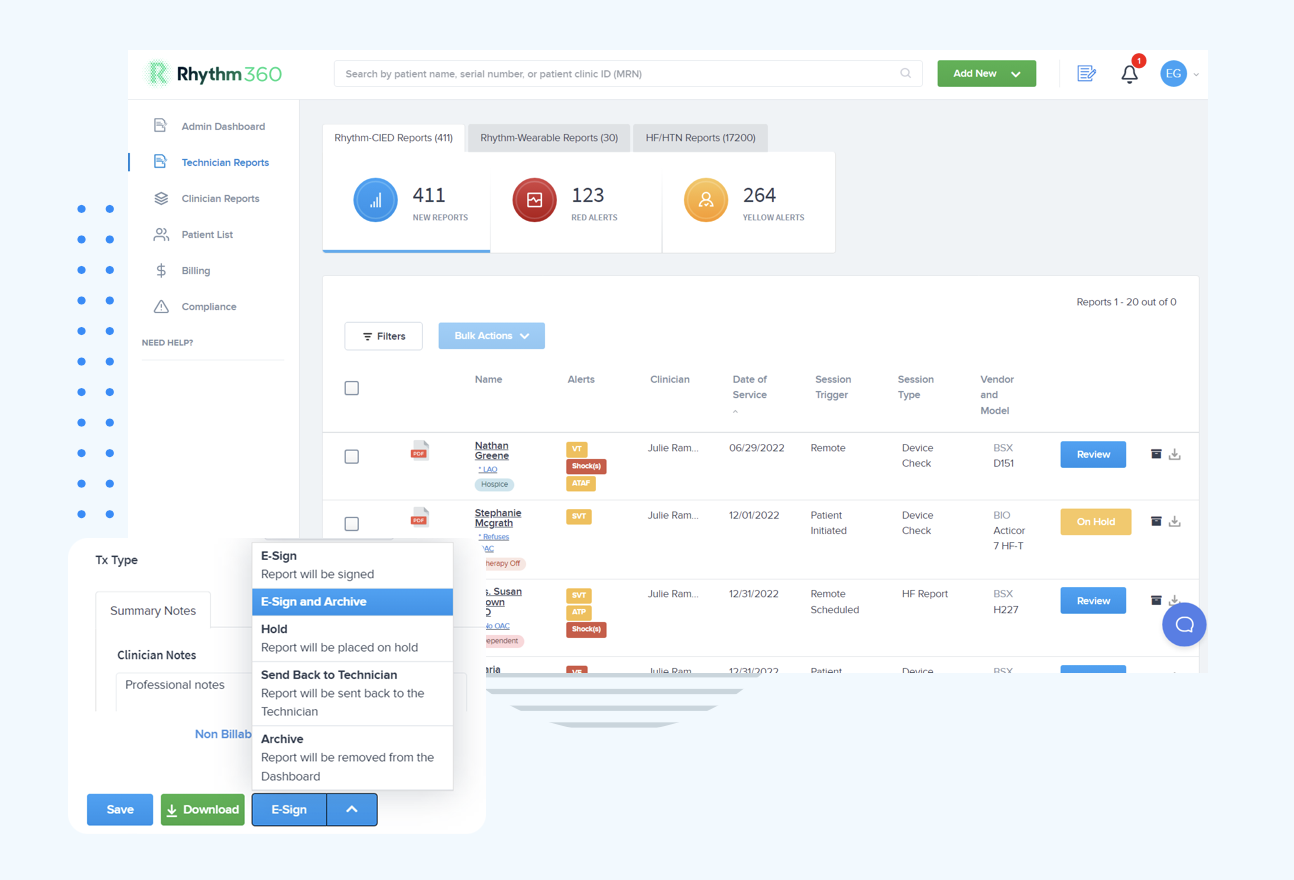
Accurate billing for CIED remote monitoring means tracking monitoring period windows, transmission counts, and documentation elements at once across hundreds or thousands of patients. A typical cardiology practice can capture substantial annual recurring revenue from properly billed remote monitoring using CPT codes 93294, 93295, and 93298. Missed remote monitoring billing is one of the largest preventable revenue leaks in electrophysiology practice.
Manual workflows introduce systematic errors. Billing 93295 more than once in a 90-day window for the same patient triggers a CO-18 duplicate denial. The 2026 CPT update introduced new codes 99445 and 99470 alongside 418 total code-set changes. Remote patient monitoring is now one of the highest-risk areas for technical denials.
Rhythm360 automates compliant charge capture for the full CIED and RPM code set, from 93294 through 93298, plus 99454, 99445, 99457, and 99470. It tracks monitoring period eligibility, transmission day counts, and documentation completeness in real time. The platform generates audit-ready reports that satisfy CMS LCD documentation requirements, including device manufacturer and model, transmission dates, interrogated data summaries, physician interpretation, and clinical actions taken.
Denial costs stack up fast once you follow the numbers. Hospitals and health systems spent an estimated $25.7 billion contesting claim denials in 2023, up 23% from $19.7 billion in 2022, with roughly $18 billion potentially wasted on claims that should have been approved at submission. Reworking each denied claim costs more on top of that. The average rework cost ranges from $25 to $118-181 per claim, and about 63% of denied claims are recoverable on average. That recovery rate matters most when the denial is preventable in the first place.
For CIED billing specifically, denial risk concentrates around period-window miscoding, missing documentation elements, and NCCI bundling errors. Many practices still have limited AI or automation in their billing workflows, which is exactly where these errors take root.
Rhythm360's automated documentation engine performs pre-submission claim scrubbing by cross-referencing transmission data against CPT eligibility rules before a charge goes out. It flags period-window conflicts, missing interpretation notes, and bundling risks, addressing the documentation gaps behind most CIED-specific denials. The platform's AI-driven alert triage also cuts critical response times by up to 80%, so actionable clinical findings get documented and billed within filing windows.
EHR integration is a common concern for practices evaluating cardiac billing software. A March 2026 CliniComp survey found that 47% of health system CIOs cited integration expense as the top barrier to vendor-agnostic interoperability, and 42% pointed to vendor unwillingness and delays.
Rhythm360 offers bi-directional integration with Epic, Cerner, Athenahealth, eClinicalWorks, Greenway Health, and other EHR systems via HL7. Implementation, including configuration, workflow setup, and staff training, typically finishes in days to a few weeks. That timeline works because Rhythm360 operates as an overlay to existing systems rather than a replacement. It uses read-compatible HL7 connections that skip core EHR reconfiguration entirely.
Transmission findings, interpretation notes, and billing documentation generated in Rhythm360 sync back into the patient's EHR record automatically. This eliminates duplicate entry. Practices keep their existing practice management and billing infrastructure while gaining automated CPT capture.
Integration solves one problem, but staff still face a flood of alerts once transmissions start flowing in. Only 10-20% of clinical alarms in hospital settings require any intervention. The Joint Commission documented 98 alarm-related sentinel events between 2009 and 2012, 80 of which resulted in patient death. In CIED remote monitoring programs, the volume of non-actionable transmissions from legacy OEM portals compounds the problem further, creating conditions for both missed critical events and staff burnout.
The same pattern shows up in RPM programs broadly. RPM data flooding into EHRs creates alert fatigue, buried information, and clinician resistance. Successful programs design workflows where the right person sees the right data at the right time without drowning in alerts. Manual billing workflows add a second layer of burden on top of that. Device technicians and nurses who spend hours on data retrieval and charge documentation have less time for direct patient care.
Rhythm360 addresses both problems at once. Its AI-powered alert triage filters non-actionable transmissions and surfaces clinically significant events, such as new-onset atrial fibrillation, ventricular tachycardia, lead malfunction, or ERI/RRT indicators, as prioritized notifications. AI-based algorithms can detect subtle abnormalities in heart rate variability and multi-parameter signals that conventional threshold-based alarms miss. Automated report generation and bi-directional EHR sync remove the manual documentation burden, so clinical staff can focus on patient care. Optional 24/7/365 oversight by certified cardiac technicians, supervised by physicians, adds a further safety layer for high-volume programs.
The table below pulls together the outcomes described in each section above, so you can see how the platform performs across data handling, alerts, revenue, and integration in one place.
| Feature | Rhythm360 Capability | Metric / Outcome | Source |
|---|---|---|---|
| Data Transmissibility | Redundant data feeds, computer vision OCR, AI-powered gap extrapolation across all major OEMs | Greater than 99.9% transmissibility | RhythmScience platform specifications |
| Critical Alert Response Time | AI alert triage with optional 24/7/365 CCT oversight | Up to 80% reduction in response times | RhythmScience platform outcomes |
| Revenue Improvement | Automated CPT-compliant charge capture for 93294-93298, 99454, 99445, 99457, 99470 | Up to 300% increase in revenue generation | RhythmScience platform outcomes |
| EHR Integration | Bi-directional HL7 integration with Epic, Cerner, Athenahealth, eClinicalWorks, Greenway Health, and others | Implementation in days to weeks | RhythmScience integration specifications |
| OEM Coverage | Vendor-neutral ingestion from Medtronic, Boston Scientific, Abbott, Biotronik, and others via API, HL7, XML, and PDF parsing | Single dashboard for full device population | RhythmScience platform specifications |
| Annual Report Volume (UCM) | Centralized transmission review at academic medical center scale | Greater than 73,000 reports reviewed annually; greater than 18,000 per quarter | University of Chicago Medicine, 2025 |
| Compliance and Security | HIPAA-compliant cloud platform with full audit trail; mobile app for remote clinician access | Auditable documentation for every transmission | RhythmScience platform specifications |
The report volume and revenue figures above played out concretely at University of Chicago Medicine. Andrew Beaser, MD, Associate Professor of Medicine at UCM, noted that the platform let clinicians review more transmissions daily and identify more abnormalities, shifting the program from reactive to proactive patient management. Stable dismissal rates at that volume show the approach scales in a high-volume academic setting, not just a small practice. UCM's own summary of the change was direct: "we have improved billing and accountability for our patients after the integration."
Rhythm360 automates charge capture for the full set of CIED and remote physiological monitoring CPT codes relevant to cardiology in 2026. That includes the pacemaker and ICD interrogation codes (93294, 93295, 93296), the loop recorder and subcutaneous monitor codes (93297, 93298), and the RPM device supply and treatment management codes (99454, 99445, 99457, and the new 99470). The platform tracks monitoring period windows, transmission day counts, and documentation completeness automatically, flagging eligibility and generating audit-ready reports before a charge is submitted.
Rhythm360's implementation, including EHR integration, workflow configuration, and staff training, typically completes in days to a few weeks. This applies to bi-directional integrations with Epic, Cerner, Athenahealth, eClinicalWorks, Greenway Health, and other HL7-compatible systems. Because Rhythm360 overlays existing systems instead of replacing them, it skips core EHR reconfiguration and extended data prep. Most practices start reviewing consolidated transmissions in a single dashboard within days of go-live.
Rhythm360 automates the documentation and pre-submission scrubbing steps where errors most often occur. It cross-references each patient's transmission data against CPT period-window rules, transmission thresholds, and required documentation before a charge is generated. This catches period-window miscoding, such as duplicate 93295 submissions within a 90-day window, missing physician interpretation notes, and bundling conflicts that would otherwise trigger CO-18 or technical denials. The result is a higher first-pass acceptance rate and less time spent reworking denied claims.
Rhythm360 is vendor-neutral and ingests data from all major cardiac device manufacturers, including Medtronic, Boston Scientific, Abbott, and Biotronik. Data from API feeds, HL7 messages, XML files, and unstructured PDFs gets normalized into a single dashboard using computer vision and AI. A redundant data feed architecture maintains greater than 99.9% transmissibility even when an individual OEM server goes down, so no transmission is lost to a manufacturer-side outage.
Yes. Rhythm360 provides distinct but integrated service lines for CIED monitoring (Rhythm-CIED) and remote physiological monitoring for chronic conditions including heart failure and hypertension (HF/HTN). Practices manage rhythm disorders, heart failure, and hypertension patients from one centralized workspace. The platform includes patient onboarding checklists and automated billing support for RPM codes such as 99453, 99454, 99445, 99457, and 99470, letting practices launch new recurring RPM revenue streams with minimal overhead alongside an existing CIED program.
Fragmented OEM portals, manual documentation workflows, and incomplete CPT capture are not isolated inconveniences. Together they create a compounding revenue and compliance risk. The 2026 CPT updates bring new codes, shorter billing windows, and stricter documentation requirements, which raises the cost of manual workflows even further. Practices managing hundreds or thousands of CIED patients cannot sustain the overhead of multi-portal logins, manual charge entry, and reactive denial management.
Rhythm360 consolidates multi-OEM transmissions, automates CPT-compliant documentation across the full 2026 code set, and integrates bi-directionally with major EHR systems in days to weeks. It delivers the alert response and revenue outcomes described above, and University of Chicago Medicine's experience at scale shows the approach works for both individual EP clinics and high-volume academic centers.





