Last updated: July 14, 2026
Practices implanting devices from more than one manufacturer inherit a multi-portal problem immediately. Each CIED manufacturer uses proprietary nomenclature, technical standards, and communication protocols for similar device features. Staff end up logging into Medtronic CareLink, Boston Scientific Latitude, Abbott Merlin, and Biotronik portals separately. Traditional EHR systems aren't built to manage CIED data, and standalone products have mixed success unlocking proprietary formats.
The operational cost is real. Cardiac device clinics manage remote monitoring data across multiple vendor portals, requiring manual downloads, report generation, review, and transfer into EMR systems like Epic, Allscripts, and Cerner. CRT devices make this worse because they generate heart failure and arrhythmia diagnostics in one data stream. EP teams typically follow a 91-day review cadence while HF teams need 31-day monitoring, so unsegmented streams risk leaving clinically relevant HF data unreviewed for weeks.
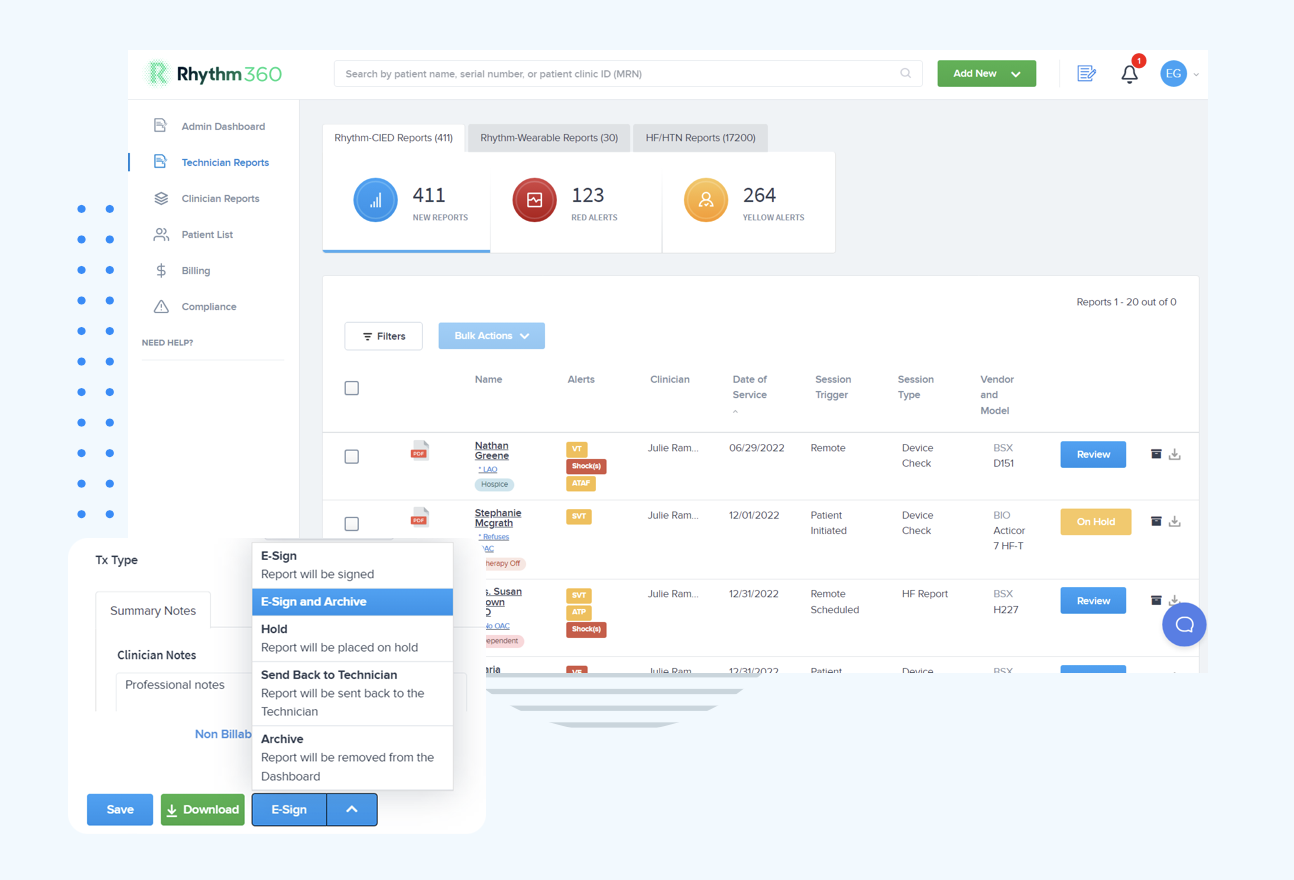
This cadence mismatch is exactly what vendor-neutral aggregation is built to fix. Rhythm360 ingests data from all major OEMs, Medtronic, Boston Scientific, Abbott, and Biotronik, via API, HL7, XML, and PDF parsing through computer vision, normalizing every stream into one dashboard. Gaurav A. Upadhyay, MD, FACC, FHRS, Director of the Pacing & Defibrillation Device Clinic at the University of Chicago Medicine, said: "That was a big piece for us, to have an integrated review of data from trained personnel."
A vendor-neutral aggregation deployment typically follows these steps:
Alert fatigue is a structural feature of legacy remote monitoring, not an occasional glitch. A cross-manufacturer analysis of 2,659 rhythm episodes from 1,710 patients with ICMs from Medtronic, Biotronik, Abbott, and Boston Scientific found AI-equipped devices still generated 32.9% non-actionable episodes, presented at the 2026 EHRA Congress. Episodes labeled cardiac "pause" events were a major driver of false positives caused by R-wave undersensing.
Niraj Varma, MD, PhD, Professor of Medicine and Consultant Electrophysiologist at the Cleveland Clinic, put it directly: "False-positive alerts remain one of the biggest operational challenges in remote cardiac monitoring. Every episode flagged by an implantable cardiac monitor must be reviewed by a clinician, yet even devices equipped with manufacturer AI algorithms still generate a substantial number of non-actionable alerts." A cloud-based AI layer applied after device-level filtering closes that gap. This additional layer maintained 98.3% sensitivity in AI-equipped devices while filtering out most non-actionable alerts, meaning clinicians see far fewer notifications without losing the ones that matter.
The stakes for timely triage are high. In the LINK-HF2 trial, 95% of AI-generated alerts from a wearable chest-patch system were reviewed within 24 hours, and 26.7% led to clinical action such as adjusting therapy. At the University of Chicago Medicine, Andrew Beaser, MD, Associate Professor of Medicine, explained: "We are able to address these issues earlier; rather than waiting for a 3-month visit, we can call patients in for evaluation." Rhythm360's AI-powered triage, paired with optional 24/7/365 oversight by certified cardiac technicians, cuts critical response times substantially.
Setting up AI alert triage typically involves:
See Rhythm360's AI triage in action for your practice.
EHR integration is a decisive factor in choosing a platform for 2026. Integration with Epic, Oracle Health (Cerner), Athena, and eClinicalWorks requires FHIR R4, SMART on FHIR, and HL7 v2.x messaging, with specific FHIR resource mapping for Device, Observation, and DiagnosticReport resources. Vendors vary widely in how deeply they meet these standards, how bidirectional their data flow is, and how fast they onboard.
Rhythm360 meets those standards with bi-directional integration for Epic, Cerner, Athenahealth, eClinicalWorks, Greenway Health, and others via HL7. Patient demographics, orders, and clinical notes move from the EHR into Rhythm360, while completed reports, alert documentation, and billing-ready records flow back automatically. This eliminates manual transcription on both ends. Gaurav A. Upadhyay, MD, at UCM, observed: "We have improved billing and accountability for our patients after the integration."
Rhythm360's onboarding follows a structured sequence:
The CMS CY 2026 Physician Fee Schedule Final Rule was released October 31, 2025, and published in the Federal Register on November 5, 2025. The relevant 2026 RPM codes for cardiology include:
Layering RPM with CCM under 2026 codes generates approximately $215 to $300 per patient per month, and adding BHI for qualifying patients pushes that to $350 to $400 or more. Capturing this revenue depends on accurate documentation, which gets more complex once CIED-specific codes like 93298 and 93299 (for device interrogation and report generation) stack alongside RPM and CCM billing. Vague documentation is the leading cause of denials and audit findings for RPM in 2026, so automated, audit-ready reporting is a financial necessity, not just a compliance nicety. Rhythm360 captures billable events in real time and generates compliant records, helping practices recover previously lost revenue and increase profitability by as much as 300%.
Find out how much revenue your practice may be missing.
The table below shows why practices choose Rhythm360 over piecing together multiple point solutions: one platform covers device aggregation, alert triage, EHR integration, and billing documentation with measurable outcomes attached to each.
| Capability | Rhythm360 Specification / Outcome |
|---|---|
| Alert Response Time Reduction | Substantial reduction in critical event response times |
| Revenue Lift | Up to 300% increase through optimized CPT capture, improved staff efficiency, and added RPM service lines for HF/HTN |
| EHR Onboarding Timeline | Full bi-directional integration (Epic, Cerner, Athenahealth, eClinicalWorks, Greenway Health, and others via HL7) thanks to this rapid onboarding process described above |
| Mobile Access | Secure, HIPAA-compliant mobile app for transmission review, report signing, and care coordination from anywhere |
| Multi-Condition Support | Integrated service lines for Rhythm-CIED (pacemakers, ICDs, ILRs, CRT/CCM, CardioMEMS) and HF/HTN RPM in one vendor-neutral dashboard |
| Data Transmissibility | Over 99.9% transmissibility via redundant data feeds, computer vision (OCR), and AI-powered extrapolation across all major OEM formats |
| Annual Report Volume (UCM) | More than 73,000 reports reviewed annually at University of Chicago Medicine, averaging over 18,000 per quarter |
Rhythm360's onboarding minimizes disruption to active clinical workflows. EHR integration, OEM portal connections, staff training, and go-live validation wrap up within days to a few weeks, not the months typical of enterprise software deployments. The SaaS-based pricing model scales with clinic size and usage, so practices of any volume avoid high upfront setup costs.
Effective software consolidates data from every implanted device manufacturer, applies AI-driven triage, integrates bi-directionally with the practice's EHR, and automates CPT documentation. Rhythm360 meets all four requirements in one HIPAA-compliant cloud platform. It supports pacemakers, ICDs, loop recorders, CRT and CCM devices, and CardioMEMS monitors, plus RPM service lines for heart failure and hypertension, all from one dashboard or mobile app.
Yes, and it solves a real clinical need. Patients with CRT devices generate arrhythmia and heart failure data in the same stream, and hypertensive patients with concurrent heart failure or AFib need coordinated monitoring across conditions. Rhythm360 keeps Rhythm-CIED and HF/HTN RPM as distinct but integrated service lines, so alert thresholds, monitoring cadences, and billing documentation stay separate within one workspace, supporting accurate CPT capture without administrative overlap.
Fragmented OEM portals, manual data reconciliation, and weak alert triage aren't inevitable. They're solvable workflow problems. Rhythm360 delivers vendor-neutral aggregation across all major CIED manufacturers, AI-powered alert prioritization, rapid EHR integration, and automated CPT documentation that helps practices recover meaningfully more revenue. Andrew Beaser, MD, at the University of Chicago Medicine, put it this way: "Decision support, including AI-assisted decision support, will become increasingly important as data volumes grow." A unified platform is the practical foundation for meeting that demand now.
Talk to our team about consolidating your monitoring workflows.