Best Cardiac Remote Monitoring Platform for CIED & RPM
Last updated: August 24, 2026
Key Takeaways for 2026 Cardiac Remote Monitoring
A unified cardiac remote monitoring platform must ingest multi-OEM CIED data, normalize it into one workspace, automate CPT documentation, and deliver AI-prioritized alerts to eliminate fragmented workflows.
Rhythm360 meets 12 key RFP criteria, including multi-OEM ingestion, AI alert triage, bi-directional EHR integration, automated CPT capture, and HIPAA-compliant mobile access.
Medicare 2026 reimbursement for CIED and RPM codes ranges from $29–$36 per period, and Rhythm360 automates documentation to close gaps and recover revenue.
AI triage in Rhythm360 suppresses non-actionable alerts and cuts critical-event response times by up to 80%, reducing alert fatigue and enabling same-day intervention.
Medicare reimbursement for remote monitoring spans two distinct code families, cardiac-specific CIED interrogation codes and general physiologic RPM codes, each with its own rate structure and documentation threshold.
Rhythm360
2026 Medicare conversion factor: $33.57 for qualifying alternative payment model participants and $33.40 for all other providers, applied to all codes paid under the Medicare Physician Fee Schedule.
CPT 93294 (pacemaker remote interrogation): CPT 93294 reimburses approximately $29 from Medicare per 90-day period (national average, non-facility). Rhythm360 auto-populates device type, monitoring dates, interpretation note, and action taken.
New 2026 RPM codes 99445 and 99470: Cover 2–15 days of transmitted home data in a 30-day period and 10–19 minutes of management time in a calendar month, respectively. Rhythm360 tracks transmitted-data days and management minutes automatically.
Annual revenue potential: A typical cardiology practice managing device patients can generate substantial annual recurring revenue from CIED interrogation codes. Rhythm360's automated CPT capture helps practices recover more revenue by closing documentation gaps.
New 2026 2–15-day RPM codes: Codes 99445 and 99470, effective January 1, 2026, cover shorter monitoring intervals and shorter treatment-management time thresholds within a 30-day period. Rhythm360's RPM service line for HF and HTN patients tracks transmitted-data days and management minutes in real time and triggers documentation when thresholds are met.
Mutual exclusivity of 93294 and 93295: Billing both codes for the same patient on the same date results in claim denial. Rhythm360's rules engine prevents simultaneous submission.
Audit-Ready Documentation for Remote Patient Monitoring
Complete, auditable documentation is the most common reason remote monitoring claims are denied or recouped, and Rhythm360 auto-populates each required field at the point of clinical action.
Dates of the monitoring period: The monitoring start and end dates must appear in the claim documentation. Rhythm360 timestamps every transmission and populates the period dates automatically.
Clinical rationale: Documentation must include the clinical rationale for monitoring. Rhythm360 surfaces the patient's diagnosis codes and device indication within the report template.
Who performed the work and time spent: The performing provider and time spent must be documented. Rhythm360 logs the reviewing clinician's identity and timestamps each workflow step in a full HIPAA audit trail.
Patient demographics: Patient demographics are a minimum documentation requirement for 93294–93298 claims. Rhythm360's patient-identity reconciliation engine maintains a master record that resolves conflicts across OEM feeds.
Manual CIED billing workflows require staff to log into multiple OEM portals, transcribe device data by hand, track billing windows in spreadsheets, and assemble documentation from disconnected systems, and each step introduces errors and missed revenue. Rhythm360 eliminates this fragmentation by executing five discrete automation steps for every CIED interrogation claim under CPT codes 93294–93298.
Transmission ingestion and normalization: Data arrives from Medtronic, Boston Scientific, Abbott, Biotronik, and other OEMs via API, HL7, XML, or PDF parsed by computer vision. Rhythm360 normalizes each feed into a canonical patient record and removes manual transcription.
Billing-window tracking: The platform maintains a per-patient, per-device calendar that enforces 90-day windows for 93294/93295 and 30-day windows for 93297/93298, preventing duplicate submissions and CO-18 denials.
Documentation pre-population: Device type, manufacturer, monitoring dates, diagnosis codes, and device indication are pulled from the normalized record and inserted into the interpretation note template before the clinician opens the report.
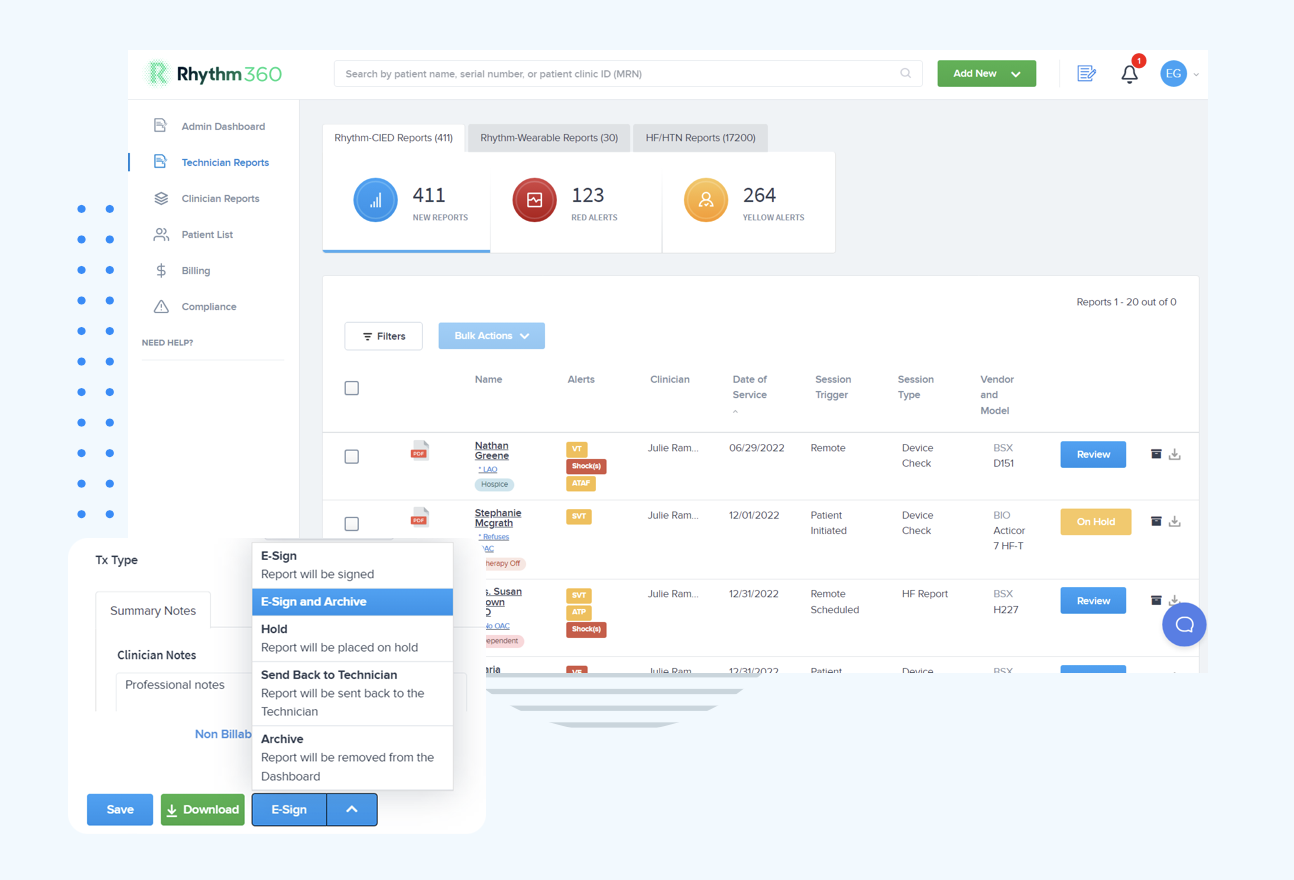
Clinician review and one-click sign-off: The reviewing EP, cardiologist, or NP receives a prioritized, pre-populated report. Sign-off is available on desktop or the HIPAA-compliant mobile app and captures the provider identity and timestamp required for the claim.
Audit-ready claim packaging: The completed record, including all required fields, the interpretation note, and the full communication log, is stored with a HIPAA audit trail and made available for billing submission, which reduces the documentation gaps that cause claim rejections.
Alert fatigue creates a patient-safety risk because when every transmission, actionable or not, demands clinician attention, critical events are buried in noise. Rhythm360's AI triage layer changes that pattern by filtering and prioritizing alerts before they reach the care team.
Transmission-level filtering: Rhythm360's AI evaluates each incoming transmission against clinical significance thresholds and suppresses non-actionable readings before they reach the clinician queue. Multicentre studies have shown that AI activation on ILR transmissions can reduce clinician-facing alerts.
Priority stratification: Remaining alerts are ranked by clinical urgency, so ventricular fibrillation, new-onset AFib, lead malfunction, and ERI/RRT indicators surface at the top of the queue, while routine checks appear below.
Staff-capacity release: By suppressing non-actionable alerts, AI triage can release substantial physiologist review time annually, and Rhythm360's AI triage applies this same logic across the full CIED and RPM population.
Optional CCT oversight layer: For practices that want an additional safety net, Rhythm360 offers 24/7/365 oversight by certified cardiac technicians supervised by physicians, ensuring no critical alert goes unreviewed regardless of staffing gaps.
The core technical challenge of any unified cardiac monitoring platform is reliable, complete data ingestion from manufacturers whose systems were never designed to interoperate. Fragmented workflows that require staff to log into multiple proprietary OEM portals create manual data transfer steps that are time-consuming, error-prone, and lead to missed billing events. Rhythm360 resolves this through four ingestion methods and a redundant architecture.
API connections: Direct, structured data feeds from OEM servers where manufacturer APIs are available, which enables near-real-time transmission ingestion with minimal latency.
HL7 messaging: Standardized clinical messaging for OEMs and EHR systems that support HL7 interfaces, enabling bi-directional data flow with Epic, Cerner, Athenahealth, eClinicalWorks, Greenway Health, and others.
XML parsing: Structured file ingestion for OEMs that deliver data in XML format, normalized into Rhythm360's canonical patient schema.
Redundant data feeds: If an OEM's server is unavailable, Rhythm360's redundant feed architecture acts as a fail-safe and maintains >99.9% transmissibility across the patient population. The platform's capacity at high-volume scale is demonstrated by the University of Chicago deployment mentioned earlier.
The highest-stakes test of any cardiac monitoring platform is a critical arrhythmia detected outside business hours, and the following step-by-step sequence shows how Rhythm360 handles that scenario from transmission to clinical action.
Data ingestion (automated, continuous): A patient's ICD transmits a ventricular tachycardia episode on Saturday morning. Rhythm360 ingests the transmission via the OEM's API within minutes, normalizes the data, and cross-references it against the patient's master record.
AI triage (seconds): The AI engine classifies the event as clinically significant, suppresses any co-occurring non-actionable readings, and places the alert at the top of the on-call clinician's prioritized queue.
CPT assignment (automated): The platform identifies the applicable CPT code, such as 93295 for ICD interrogation, confirms the 90-day billing window is open, and pre-populates the interpretation note with device type, transmission date, findings, and the clinician's identity.
Mobile notification and sign-off (one click): The on-call EP receives a push notification on the HIPAA-compliant mobile app, reviews the pre-populated report, and signs off from their smartphone with no VPN or workstation required.
Care coordination and audit trail (immediate): The signed report triggers an automated patient communication via Rhythm360's integrated Twilio messaging framework. The full sequence, including ingestion timestamp, AI triage classification, CPT assignment, clinician sign-off, and patient contact, is logged in the HIPAA audit trail. By Saturday afternoon, the patient is on anticoagulants or has had their device reprogrammed, and without this workflow, the event might not surface until a scheduled visit weeks later.
AI-driven alert filtering is becoming a clinical standard: The multicentre ILR findings discussed earlier are now becoming a clinical standard across all device types. Rhythm360's AI triage layer applies this filtering logic across the full CIED and RPM population, not just ILR patients, and delivers the same capacity gains at practice-wide scale.
CIED and RPM billing are converging into a single workflow: New 2026 codes create additional billing pathways for shorter monitoring intervals, and Rhythm360's unified billing engine manages both code families simultaneously, enforces applicable rules, and captures every eligible event without double-billing risk.
Value-based care metrics require longitudinal, multi-condition data: Practices participating in value-based arrangements need continuous data on arrhythmia burden, HF decompensation signals, and hypertension control across the same patient population. Rhythm360's integrated service lines for Rhythm-CIED and HF/HTN RPM provide a single workspace for rhythm disorders, heart failure, and hypertension and give administrators and clinicians the longitudinal data needed to demonstrate outcomes and justify program investment.
Which companies are leading in cardiac remote patient monitoring?
The cardiac remote monitoring market includes a range of platforms, among them Murj, Implicity, Rhythm Management Group, and Octagos, and each addresses portions of the CIED and RPM workflow. Rhythm360 by RhythmScience is designed as a comprehensive, vendor-neutral platform that covers the full spectrum, including multi-OEM CIED data ingestion, AI-powered alert triage, automated CPT documentation for both cardiac-specific codes 93294–93298 and physiologic RPM codes 99453–99470, bi-directional EHR integration, and a HIPAA-compliant mobile app for on-call sign-off. University of Chicago Medicine processed more than 73,000 reports annually through Rhythm360 in 2025, which makes it one of the most validated platforms for high-volume academic and community cardiology environments.
What is the current trend in remote cardiac monitoring?
Three trends are reshaping remote cardiac monitoring in 2026. First, AI-driven alert filtering is moving from optional to expected, because practices managing hundreds or thousands of CIED patients cannot sustain manual review of every transmission, and AI suppression of non-actionable alerts is now a core platform requirement. Second, CIED and physiologic RPM billing are converging, as new 2026 Medicare codes for shorter monitoring intervals mean that practices managing heart failure and hypertension alongside implanted devices need a single billing engine that enforces code-family exclusivity rules automatically. Third, value-based care arrangements are pushing practices to demonstrate longitudinal outcomes data across multiple conditions simultaneously, a requirement that fragmented OEM portals cannot meet. Rhythm360 is built to address all three trends within a single platform.
Is RPM covered by insurance?
Medicare has covered remote patient monitoring since 2018. To qualify, a patient must have a chronic or acute condition requiring monitoring and must meet the 16-day transmission threshold described earlier in this guide. Medicare pays for RPM through a set of procedure codes covering device setup and education 99453, device supply 99454, and treatment management 99457 and 99458, with new 2026 codes 99445 and 99470 covering shorter 2–15-day monitoring intervals and 10–19-minute management sessions. Most commercial payers follow Medicare's lead, though coverage terms vary by plan. Rhythm360 tracks each patient's transmitted-data days and management minutes in real time, flags non-compliant patients before the billing window closes, and auto-populates the documentation required for both Medicare and commercial claims.
Fragmented OEM portals are not just a workflow inconvenience, because they also create a patient-safety risk and a revenue problem. Practices that rely on manual portal logins, manual transcription, and manual billing tracking consistently miss critical events, generate incomplete documentation, and leave significant reimbursement uncaptured.
Rhythm360 addresses each failure point directly with >99.9% data transmissibility across all major OEMs, AI triage that cuts critical-event response times by up to 80%, automated CPT capture for both CIED interrogation and physiologic RPM codes, and a HIPAA-compliant mobile app that keeps clinicians connected regardless of location. Practices implementing Rhythm360 have recovered up to 300% more revenue through stronger CPT documentation and have processed tens of thousands of reports annually without sacrificing alert quality or clinical response speed.