Last updated: August 24, 2026
The 2026 CPT changes and active OIG audits place new pressure on cardiac remote monitoring programs. The four criteria below reflect where most denials, revenue leakage, and workflow breakdowns occur. A platform that performs well on these dimensions supports both compliant billing and safe, timely clinical care.
1. Automatic CPT Evidence Capture for 99453, 99454, and 93298
CPT 99454 requires that the patient transmits device readings on at least 16 separate days within the 30-day billing period. Manual tracking fails this standard because staff must retrospectively count transmission days across multiple OEM portals, often discovering mid-cycle gaps too late to intervene. When practices rely on passive monitoring and manual tracking, they miss the 16-day threshold for many patients and leave billable cycles unclaimed. A compliant platform must generate timestamped transmission logs, physician orders, and patient consent records in real time, which removes the need for manual reconstruction at billing time.
2. Vendor-Neutral CIED Integration
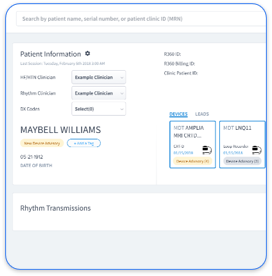
A cardiology practice often manages implants from multiple manufacturers, each with its own remote monitoring portal. The required architecture must consolidate transmissions from all major CIED manufacturers into one unified view so day counting remains device-agnostic. Only one CPT 99454 claim is billable per patient per 30-day period even when multiple devices are used; qualifying days from all devices are combined but only one claim is submitted. A vendor-neutral platform prevents double billing while still capturing every eligible day.
3. AI-Driven Alert Triage
Only 10–20% of clinical alarms require any clinical intervention, yet unfiltered alert volumes create fatigue that obscures genuinely critical events. Artifact removal and clinical filters based on severity and duration can substantially reduce the number of alerts per patient per day in continuous home monitoring. Platforms must filter non-actionable noise while preserving sub-one-business-day response to red alerts so clinicians can act quickly on true emergencies.
4. Bi-Directional EHR Integration
Cardiology clinics using disconnected systems experience a lag between service and submission because of documentation review, manual coding, and data re-entry. Bi-directional integration shortens that lag, reduces denied claims, catches undercoding before submission, and enables faster appeals of underpayments. It also keeps clinical and billing teams aligned on a single, current record of each monitoring episode.
The table below shows how Rhythm360 performs against each of the four evaluation criteria, with supporting evidence and quantified revenue impact. Other platforms operate in this space, yet this analysis focuses on the capabilities that distinguish a compliance-ready, multi-OEM solution from basic monitoring tools.
| Criterion | Rhythm360 Score | Evidence | Revenue Impact |
|---|---|---|---|
| Automatic CPT Evidence Capture (99453/99454/93298) | ✔ Full automation | Rhythm360 provides automated CPT code documentation and billing support for 93298, 93299, 99454, 99453, and 99457 | A practice with 200 monitored patients losing one CPT 99454 cycle per patient per quarter faces substantial annual lost revenue from device supply billing alone |
| Vendor-Neutral CIED Integration (Medtronic, BSc, Abbott, Biotronik) | ✔ All major OEMs | Rhythm360 aggregates CIED data from all major OEMs using APIs, HL7, XML, and computer vision for PDF parsing | Eliminates multiple OEM logins; practices report up to 300% increase in revenue generation through more complete CPT code capture and improved staff efficiency |
| AI-Driven Alert Triage | ✔ AI-powered prioritization with optional 24/7 CCT oversight | University of Chicago Medicine reviewed more than 73,000 reports annually through Rhythm360 in 2025, with stable dismissal rates | 80% reduction in critical alert response times, enabling same-day clinical intervention and preventing adverse outcomes that generate downstream costs |
| Bi-Directional EHR Integration | ✔ Epic, Cerner, Athenahealth, eClinicalWorks, Greenway Health via HL7 and SMART on FHIR | Rhythm360 offers bi-directional EHR integration with Epic, Cerner, Athenahealth, eClinicalWorks, Greenway Health, and GE Centricity via HL7 and Smart on FHIR APIs | Integrated EHR systems reduce service-to-submission lag to 1–2 days, shortening the revenue cycle and reducing denied claims |
CPT 2026 introduced code 99445 to report device supply and data transmission for remote physiologic monitoring occurring 2–15 days within a 30-day period, and CPT 2026 introduced code 99470 to report remote physiologic monitoring treatment management services requiring 10–19 minutes of clinical staff or physician time per calendar month.
The 16-day rule for CPT 99454 remains the single most common RPM denial trigger. Each calendar day counts as one qualifying day only if the FDA-cleared device automatically records and transmits at least one reading; multiple readings from different devices on the same day count as only one data day toward the threshold.
Audit-ready documentation for CPT 99454 must include:
On the CIED side, the CMS CY 2026 Physician Fee Schedule includes updates to technical components for remote cardiac monitoring codes. Documentation supporting CPT 93294/93295/93296 billing requires a timestamped physician interpretation note paired to each remote transmission within the 90-day billing period, along with proof that the monitoring period met the 30-day minimum. Documentation compliance failures occur among some remote cardiac monitoring providers, and the OIG's current audit project targets patterns including enrollees not receiving all three RPM components and claims lacking ordering-provider data. These compliance requirements directly shape how platforms handle time-sensitive clinical events and structure daily workflows.
A high-volume EP lab managing 1,200 patients across four OEM device types needs reliable weekend coverage. On a Saturday morning, Rhythm360's AI triage layer flags new-onset atrial fibrillation in a pacemaker patient. Because Rhythm360 achieves greater than 99.9% data transmissibility through redundant data feeds and AI-based gap filling to ensure no critical transmissions are lost during OEM downtime, the alert reaches the on-call clinician's HIPAA-compliant mobile app within minutes. By Saturday afternoon, the patient is on anticoagulation therapy, instead of waiting until Monday's manual portal review.
This scenario illustrates the clinical and financial duality of Rhythm360's architecture. The 80% reduction in critical alert response times functions as both a patient safety metric and a billing compliance metric. Every captured transmission that crosses the 16-day threshold within the billing window represents a defensible CPT 99454 claim. University of Chicago Medicine's implementation of Rhythm360 resulted in improved billing and accountability for patients after integration, with the institution managing more than 73,000 reports annually at stable dismissal rates, which shows that AI-assisted triage can scale without sacrificing documentation quality.
“Decision support, including AI-assisted decision support, will become increasingly important as data volumes grow,” a UCM physician noted in the white paper documenting the implementation.
Implementation timelines for Rhythm360 run from a few days to a few weeks, including EHR integration setup, which contrasts with legacy on-premise systems that require months of configuration. The SaaS-based pricing model scales with clinic size and platform usage and removes high upfront setup fees.
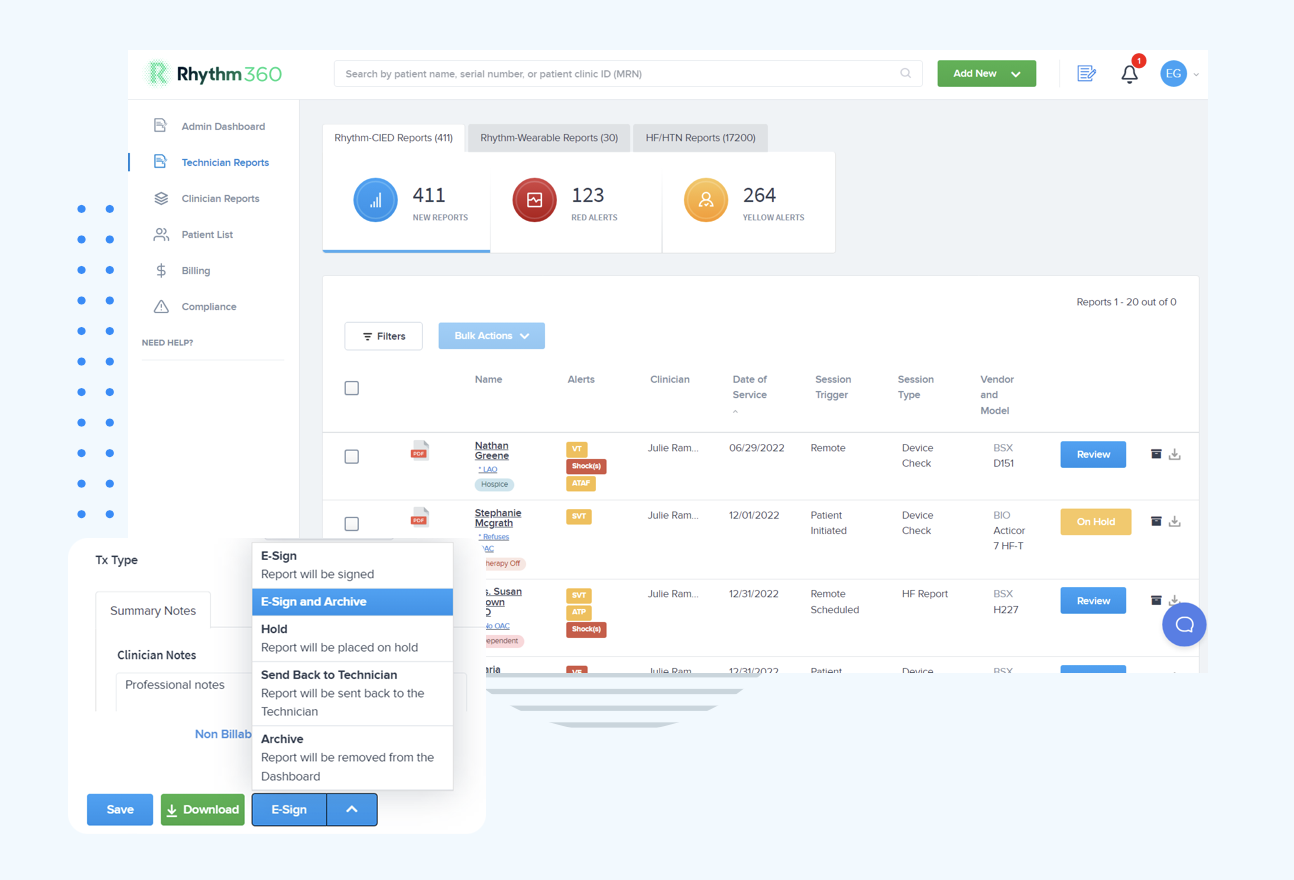
Operational savings compound quickly. The American Medical Association reports that physicians spend nearly two hours on documentation and administrative work for every hour of direct patient care, and manual RPM compliance tracking across multiple manufacturer portals increases that burden. Rhythm360 reduces this overhead by consolidating all OEM data into a single login, which eliminates time spent switching between portals. The platform then automates report generation from that unified data stream and surfaces the results in a real-time dashboard that tracks patient compliance, critical alerts, and captured versus potential revenue by CPT code, giving administrators a complete operational view without manual data assembly.
Revenue gains stem from three main sources. Practices capture previously missed CPT cycles, reduce staff time per patient through automation, and expand into new RPM service lines for heart failure and hypertension management, which are billable under 99453, 99454, 99457, and the new 2026 codes 99445 and 99470.
The checklist below helps you assess whether your current platform can withstand 2026 OIG audit scrutiny and support complete revenue capture. If any item is unchecked, your practice carries measurable audit and revenue risk.
The decision path is straightforward. Practices managing devices from more than one OEM, or practices that cannot confirm automated 16-day threshold documentation for every patient in the current billing cycle, require a platform purpose-built for vendor-neutral compliance. Rhythm360 provides that vendor-neutral, audit-ready foundation.
The OIG's current audit project targets specific documentation failure patterns, including claims where enrollees did not receive all three RPM components and claims lacking ordering-provider data. Rhythm360 addresses this by generating complete, timestamped audit trails automatically at the point of data ingestion, not reconstructed at billing time. Every qualifying transmission day is logged with date, reading type, and data receipt confirmation. Physician interpretation notes are paired to each transmission within the applicable billing window. Patient consent, physician orders, and ICD-10 diagnosis linkages are stored and retrievable per patient per period. Because this documentation is generated continuously rather than assembled manually before a claim is submitted, it meets the evidentiary standard CMS and OIG reviewers apply during post-payment audits.
Rhythm360 supports automated documentation for the full range of cardiac remote monitoring codes. For CIED interrogation, this includes 93294 (professional component for pacemakers), 93295 (professional component for ICDs including CRT-D), 93296 (technical component for pacemakers, ICDs, or ILRs), 93297 (professional component for ILR/ICM), and 93298 (technical component for ILR/ICM). For physiologic RPM, the platform supports 99453 (setup and patient education), 99454 (device supply for 16 or more transmission days), 99445 (device supply for 2–15 transmission days, new in 2026), 99457 (treatment management, first 20 minutes), 99458 (additional 20-minute increments), and 99470 (treatment management, 10–19 minutes, new in 2026). The platform's code logic automatically applies mutually exclusive rules, such as preventing simultaneous billing of 99445 and 99454 for the same patient in the same 30-day period, which reduces denial risk before claims are submitted.
Rhythm360 includes a secure, HIPAA-compliant mobile application that allows electrophysiologists, cardiologists, nurse practitioners, physician assistants, and device technicians to review transmissions, sign reports, and coordinate care from their smartphones. The mobile app is particularly valuable for on-call coverage. When Rhythm360's AI triage layer flags a critical arrhythmia outside business hours, the responsible clinician receives a prioritized notification and can initiate anticoagulation protocols, order device reprogramming, or escalate to emergency services without returning to a workstation. All actions taken through the mobile app are logged with timestamps and user identity, which preserves the audit trail required for both clinical governance and billing compliance.
Rhythm360's implementation process, including EHR integration setup with systems such as Epic, Cerner, Athenahealth, eClinicalWorks, and Greenway Health, typically takes from a few days to a few weeks depending on practice size and the number of OEM data feeds being connected. The platform ingests data from Medtronic, Boston Scientific, Abbott, Biotronik, and other manufacturers via APIs, HL7, XML, and computer vision-based PDF parsing, so practices do not need to wait for OEM cooperation to begin consolidating data. Onboarding includes patient population migration, alert threshold configuration, and staff training on the unified dashboard. Because Rhythm360 is cloud-based with a SaaS pricing model, no on-premise hardware requirements extend deployment timelines.
The four criteria that define a defensible, revenue-maximizing cardiac remote monitoring billing platform in 2026 are automatic CPT evidence capture, vendor-neutral CIED integration, AI-driven alert triage, and bi-directional EHR integration. Each criterion maps directly to a documented audit risk or revenue leakage pattern that CMS and OIG are actively targeting.
Rhythm360 by RhythmScience is engineered to address all four simultaneously. Its near-perfect data capture, AI-powered alert prioritization, automated compliance documentation, and deep EHR integrations convert fragmented multi-OEM data into a single, auditable source of truth and turn every qualifying transmission into captured, defensible revenue. As the University of Chicago Medicine's implementation demonstrates, this architecture scales to tens of thousands of reports annually without sacrificing the documentation quality that protects practices during audits.
Compare Rhythm360's capabilities against your current workflow in a personalized demo.