Last updated: July 14, 2026
Cardiology billing works differently than almost any other specialty. The 2026 industry average denial rate sits between 9–15%, while best-in-class practices hit a net collection rate of 96% or higher against an average near 90%. That gap is the widest of any tracked specialty. Best-in-class practices also keep AR under 30 days and clean claim rates above 95%, while average practices lag on both.
Prior authorization failures drive a large share of these denials. Because roughly 65% of denied claims nationally are never reworked, these failures often turn into permanent write-offs rather than temporary delays. The same permanence hits timing-based errors. CIED transmissions not billed within the 90-day cycle, and RPM transmissions that miss the 16-day threshold for CPT 99454, both result in revenue that cannot be recovered later.
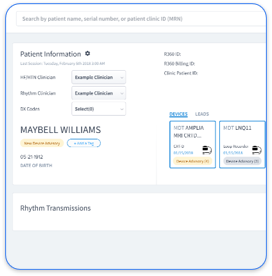
Multi-device practices feel this compounding effect the most. Staff logging into separate OEM portals from Medtronic, Boston Scientific, Abbott, and Biotronik deal with fragmented data, manual reconciliation, and documentation that lags clinical events by days or weeks. This fragmentation is often the root cause behind the other billing failures described above.
Schedule a demo to see how Rhythm360 addresses these challenges for your practice.
OEM-native platforms such as Medtronic's CareLink tie closely to their own device ecosystems, which limits flexibility for practices running multiple manufacturers. Staff must navigate separate, non-interoperable portals to retrieve patient data. This creates administrative burden, data silos, and transmission gaps that directly suppress billable event capture.
Rhythm360 consolidates data from all major device manufacturers, including Medtronic, Boston Scientific, Abbott, and Biotronik, into one platform. The system reaches over 99.9% transmissibility using redundant data feeds, computer vision (OCR), and AI-powered extrapolation to normalize data arriving via API, HL7, XML, and unstructured PDF formats. If an OEM server goes offline, the redundant feed architecture prevents lost transmissions. University of Chicago Medicine has processed a high volume of reports through Rhythm360, validating the platform's reliability across high-volume, multi-OEM environments.
Modifier errors rank among the most costly and preventable sources of cardiology revenue leakage. Splits between -26 and -TC codes, multiple procedure discounting, and laterality modifiers account for a substantial share of denials in cardiology groups. CO-97 denials happen when both professional and technical components get billed after the global fee has already been paid, a common error on echo studies at hospital-based clinics.
Rhythm360 automates CPT capture and modifier logic inside the documentation workflow. The platform applies modifier rules, including -26/-TC splits, -59 for distinct procedural services, and modifier 24 for E/M visits during global periods, at the point of documentation before claims go out. Skipping modifier 24 on E/M visits during the 90-day global period for cardiac device procedures causes those visits to bundle into the procedure payment, a permanent loss. Rhythm360's automated documentation layer catches this at the point of report generation.
Cardiology carries one of the highest overall denial rates in medicine, 14–20%, with prior authorization denials for procedures ranging from 18–25%. Stress tests, cardiac catheterizations, imaging-guided procedures, device implantations, and EP studies drive most of these requirements. The average practice loses significant revenue every year to prior authorization denials on high-value procedures.
Rhythm360 cuts this exposure through automated, payer-specific authorization checks built into the pre-service workflow. One 6-physician cardiology group saw annual denial write-offs drop from $340K to $52K after adopting prior-auth automation, with average prior-auth time falling from 3.5 hours to 22 minutes. Surfacing requirements before scheduling eliminates the most common failure modes: expired authorizations, mismatched CPT codes, and missing authorization numbers.
Device clinic billing runs on two cycles most general RCM platforms cannot track together. CIED remote monitoring follows a 90-day cycle per patient under CPT codes 93294–93298. RPM services follow a monthly cycle under CPT 99453, 99454, 99457, and 99458. Manual workflows cannot solve the bookkeeping mismatch between these two cycles.
The 2026 CMS Final Rule added device supply code 99445 for 2–15 days of data transmission, opening billing for shorter monitoring periods that most practices haven't implemented yet. Some cardiovascular groups have captured meaningful additional recurring revenue by integrating device telemetry feeds with automated billing software and using these short-period RPM codes. Rhythm360 supports both the 16-day threshold for CPT 99454 and the 2–15 day window for CPT 99445, with automated validation that blocks billing of insufficient data and enforces correct code selection.
Top cardiology practices in 2026 hit net collection rates of 96% or higher, days in AR below 35, and clean claim rates above 95%. The gap between top performers and average practices represents money left on the table. At a $5M practice, a 5% net collection rate gap equals $250,000 in annual recoverable revenue written off.
These benchmarks explain why the underlying automation matters. As noted earlier, optimized CPT capture, cleaner modifier logic, and prior-auth automation are what drive the up-to-300% revenue lift some Rhythm360 practices report. A clinician at University of Chicago Medicine said the practice "improved billing and accountability for our patients after the integration."
| Capability | Rhythm360 Specification | Documented Outcome |
|---|---|---|
| Multi-OEM Device Integration | Vendor-neutral ingestion via API, HL7, XML, and AI-powered PDF parsing; supports Medtronic, Boston Scientific, Abbott, Biotronik, and others | High-volume report processing validated at University of Chicago Medicine |
| Data Transmissibility | Redundant data feeds with computer vision and AI extrapolation | Over 99.9% transmissibility rate |
| CPT & Modifier Automation | Automated capture of CIED codes (93294–93298), RPM codes (99453, 99454, 99445, 99457, 99458, 99470), and modifier rules (-26/-TC, -59, -24) | Drives the revenue lift described above |
| Alert Response Reduction | AI-powered alert triage with optional 24/7/365 CCT oversight | 80% reduction in critical alert response times |
| Prior Authorization Automation | Payer-specific authorization determination integrated into pre-service workflow | Denial write-offs fell from $340K to $52K in one documented case |
| EHR Integration | Bi-directional integration with Epic, Cerner, Athenahealth, eClinicalWorks, Greenway Health, and others via HL7 | Eliminates manual re-entry; implementation in days to weeks |
| Implementation Timeline | Streamlined onboarding including EHR integration | Days to a few weeks to go-live |
The right configuration depends on how many devices and providers you manage. Use this breakdown to see where your practice fits and what challenges Rhythm360 addresses at each size.
| Practice Profile | Device Volume | Primary RCM Challenge | Rhythm360 Fit |
|---|---|---|---|
| Solo EP / Small Cardiology Practice (1–3 providers) | Under 200 active devices | Higher denial rates and longer AR days than mid-size groups; manual OEM portal management unsustainable | High. Unified dashboard eliminates multi-portal burden; SaaS pricing scales to practice size |
| Mid-Size Cardiology Group (4–10 providers) | 200–1,000 active devices | Modifier errors, 90-day cycle tracking, and prior auth gaps across multiple payers | High. Automated CPT capture, modifier enforcement, and prior auth automation address core denial drivers |
| Large EP Clinic / Integrated Health System (10+ providers) | 1,000+ active devices; multi-OEM | Data fragmentation across OEMs, alert fatigue, scalable billing documentation | Highest. Over 99.9% transmissibility, AI alert triage, and scalable architecture validated at academic medical center volume |
Schedule a demo to discuss which Rhythm360 configuration fits your practice volume.
Confirm these capabilities exist before committing to any cardiology device clinic billing platform:
| Modifier | When to Apply in Cardiology | Common Error & Consequence |
|---|---|---|
| -26 (Professional Component) | Cardiologist bills interpretation only when hospital owns equipment (e.g., echo at hospital-based clinic) | Omitting -26 when hospital bills TC triggers CO-97 duplicate-claim denial |
| -TC (Technical Component) | Facility bills equipment and staff costs separately from physician interpretation | Billing globally when only one component was performed produces duplicate claim denials |
| -59 (Distinct Procedural Service) | Separate, distinct procedure performed same session not ordinarily reported together (e.g., diagnostic cath distinct from PCI) | Incorrect -59 vs. -XS on simultaneous echo and stress procedures drove an 18% denial rate in one practice |
| -24 (Unrelated E/M During Global Period) | E/M visit during 90-day global period for pacemaker (33206–33208), ICD, or CRT implant unrelated to the procedure | Omitting -24 bundles the E/M into the procedure payment, a permanent loss |
| -22 (Increased Procedural Service) | Complex EP cases: long AF ablations with multiple cardioversions, re-do ablations with significant scar, VT ablations in structural heart disease | Properly documented, quantified additional effort can increase base EP reimbursement; underdocumentation results in denial |
| LT/RT (Laterality) | Procedures with bilateral applicability where laterality must be specified | Missed laterality modifiers contribute to modifier-related denials in cardiology groups |
Implementation speed carries real financial weight. For a practice running 100 cases per month, a six-month RCM implementation delay equals six months of lost revenue cycle performance. Rhythm360's onboarding, including bi-directional EHR integration with Epic, Cerner, Athenahealth, eClinicalWorks, and Greenway Health, completes in days to a few weeks, not months.
Pricing follows a SaaS model that scales with clinic size and platform usage. This avoids the high setup fees and rigid licensing structures common in legacy on-premise systems. The cloud-based architecture needs no on-site IT infrastructure, and the HIPAA-compliant mobile app lets clinicians review transmissions, sign reports, and coordinate care from any smartphone.
Practices implementing specialty-specific platforms typically see operational improvements within 30–90 days, with measurable gains in collection rate, AR days, and denial rate in that same window. Given this timeline, the next step is figuring out whether Rhythm360 fits your specific situation.
Use these steps to decide whether Rhythm360 fits your practice.
Bring your denial data to a demo and see exactly where revenue is being left on the table.
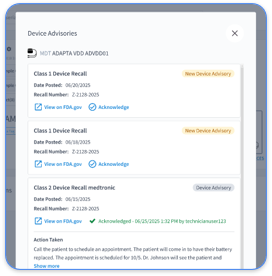
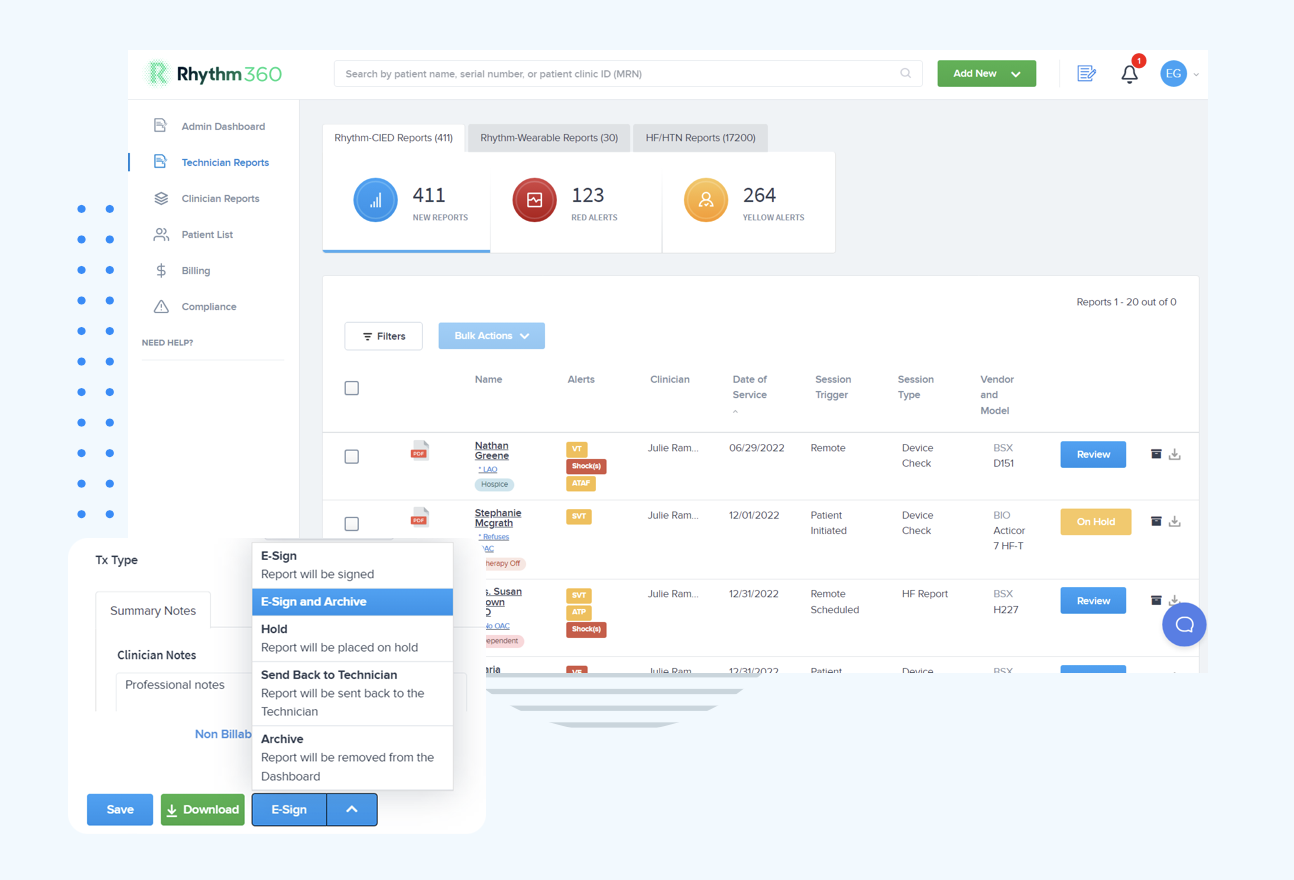
Rhythm360 ingests and normalizes data from all major CIED manufacturers through one unified interface. It connects via API, HL7, XML, and AI-powered PDF parsing, so data in any format from any OEM gets normalized automatically. Staff use one dashboard instead of logging into separate manufacturer portals, and redundant feed architecture prevents lost transmissions during OEM downtime.
The system evaluates incoming transmissions and classifies them by clinical significance before they reach the care team. Routine device checks get filtered and queued separately from significant events like new-onset atrial fibrillation, ventricular tachycardia, lead malfunction, or ERI/RRT indicators. Clinicians see prioritized alerts instead of an undifferentiated stream. Optional 24/7/365 oversight by certified cardiac technicians adds a further triage layer for practices that want staffed monitoring support.
For CIED remote monitoring, the platform produces structured reports capturing patient demographics, device type, monitoring period dates, device function status, and clinician interpretation notes, the elements required for compliant billing under CPT codes 93294–93298. For RPM services, it tracks transmission day counts against the relevant thresholds, logs cumulative clinical staff time, and enforces bundling rules that prevent double-counting with CCM or other care management services. All documentation pushes directly into connected EHR systems without manual re-entry.
The rule added CPT 99445 for shorter monitoring windows of 2–15 days and CPT 99470 for the first 10–19 minutes of RPM treatment management per month. Practices that haven't implemented these codes are leaving compliant revenue uncaptured. Rhythm360 supports both with automated validation that prevents overlap between codes and enforces the 2026 unbundling requirement replacing the obsolete G0511 code.
Implementation, including EHR integration setup, typically completes in days to a few weeks, far faster than enterprise RCM deployments that can take six to twelve months. Rhythm360 integrates bi-directionally with Epic, Cerner, Athenahealth, eClinicalWorks, Greenway Health, and other systems via HL7. Onboarding includes workflow configuration, integration testing, and staff training, aimed at minimal disruption to clinical schedules.
Multi-OEM data fragmentation, modifier complexity, prior authorization delays, and evolving CPT requirements combine to create a billing environment most general RCM platforms cannot handle. Average practices collect 6.8 percentage points less than best-in-class peers as a direct result. That gap compounds further through prior authorization denials and permanently forfeited CIED revenue when transmissions fall outside the 90-day window without automated tracking.
Rhythm360 is a vendor-neutral, HIPAA-compliant platform built for exactly this environment. It unifies multi-OEM device data into one source of truth, automates compliant CPT documentation and modifier logic, enforces 90-day CIED and monthly RPM billing cycles, and cuts critical alert response times by 80%. Implementation completes in days to weeks, not months, so practices start capturing gains fast.