Last updated: August 24, 2026
Medicare has covered remote patient monitoring since 2018, and patient volume has grown every year. CMS structures RPM reimbursement around three separately payable components rather than a single bundled code.
The three billable components are:
Coverage scope: Medicare covers RPM for any type of physiologic data using a wide range of devices for both chronic and acute conditions. Cardiology practices can bill for CIED interrogation, heart failure weight monitoring, and hypertension management under the same regulatory framework, as long as each service meets its specific documentation threshold.
Tactical takeaway: CMS’s three-component billing structure creates a compliance burden centered on documentation density. Each component requires a separate, timestamped, auditable record that links transmitted data to a clinical action. Without automation, staff must build and maintain these records manually for every encounter, which makes incomplete documentation the single largest source of claim denials in cardiac remote monitoring programs. Platforms that automate this chain, from transmission receipt to signed report to CPT code drop, eliminate that manual documentation bottleneck.
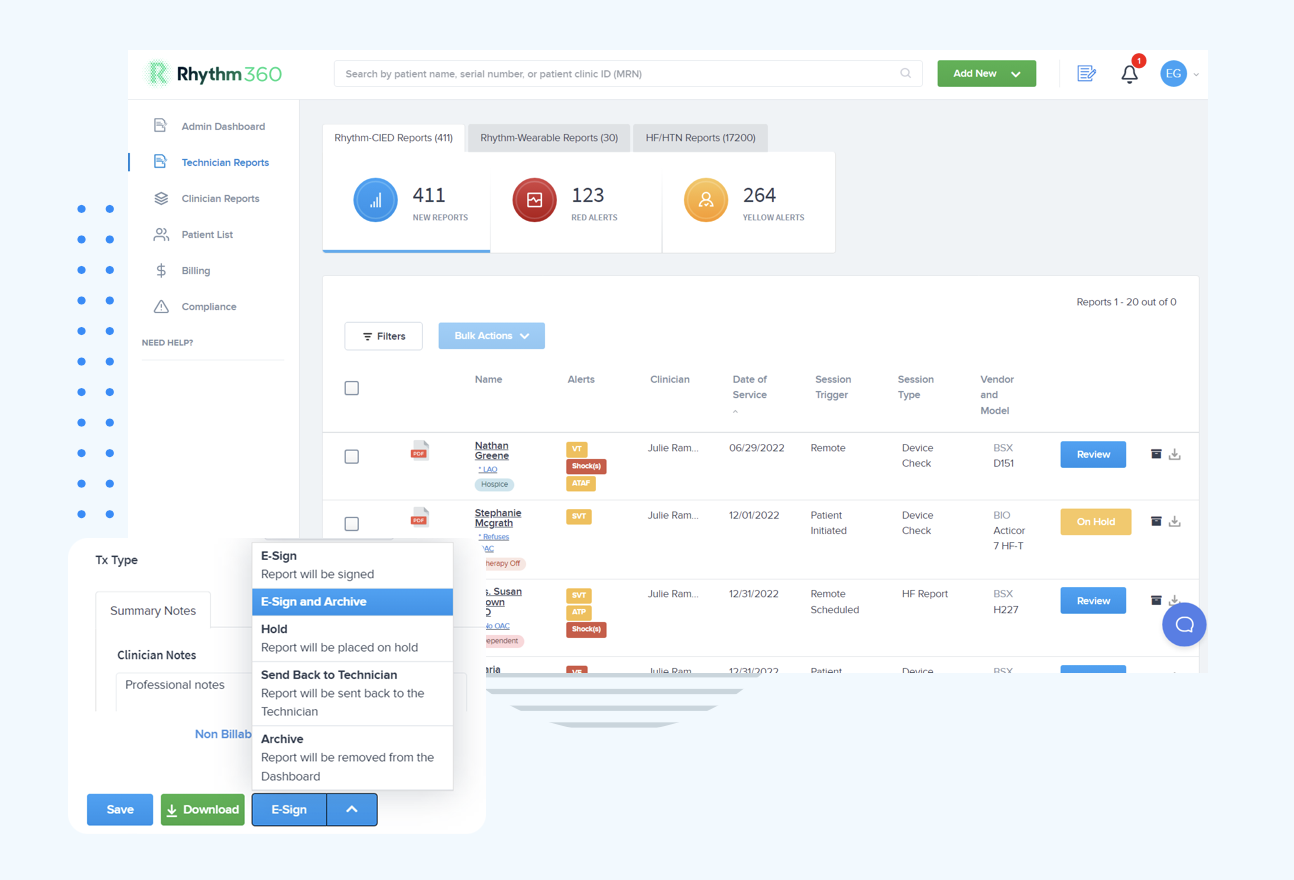
RPM profitability rises with your billing capture rate. Practices that rely on manual documentation consistently under-bill because staff cannot track every qualifying transmission across multiple OEM portals at once. Rhythm360 automates the documentation chain for the CPT codes below, converting previously missed encounters into captured revenue.
| CPT Code | Automated Documentation Step | Rhythm360 Support | Revenue Impact |
|---|---|---|---|
| 93298 | Pacemaker/ICD remote interrogation report generation on transmission receipt | Automated report creation with AI-normalized OEM data, bi-directional EHR push on e-signature | Captures previously missed interrogation billing cycles across all OEM device types |
| 93299 | Remote monitoring of implantable cardioverter-defibrillator with or without pacing function | Unified dashboard flags qualifying transmissions, report auto-populates for physician review | Eliminates manual identification of billable ICD transmissions across fragmented portals |
| 99453 | Patient education and device onboarding documentation | Onboarding checklist with timestamped completion audit trail | Ensures setup encounters are documented and billed at program launch |
| 99454 | 16-day device supply and transmission compliance tracking | Automated compliance counter with patient messaging triggers for disconnected devices | Prevents revenue loss from patients who miss the 16-day transmission threshold |
| 99457 | First 20 minutes of RPM treatment management per calendar month | Time-tracking module logs clinician review minutes and alerts staff when the threshold is approaching | Converts time already spent reviewing data into documented, billable management encounters |
Practices implementing Rhythm360 have documented up to a 300% increase in revenue generation through optimized CPT code capture, improved staff efficiency, and the addition of new RPM service lines for heart failure and hypertension management. As Gaurav A. Upadhyay, MD, FACC, FHRS, Director of the Pacing & Defibrillation Device Clinic at the University of Chicago Medicine, noted after implementation, “We have improved billing and accountability for our patients after the integration.”
Schedule a demo to review a billing capture analysis specific to your practice’s device mix and patient volume.
Cardiology teams can monitor pacemakers remotely from one dashboard when the platform is genuinely vendor-neutral. Most practices implant devices from at least two manufacturers, and many manage four or more OEM device lines at the same time. Each OEM runs a proprietary portal with its own data format, alert taxonomy, and transmission schedule. Without a unifying layer, staff reconcile conflicting data structures manually, which introduces both error and delay.
Rhythm360 ingests data from Medtronic, Boston Scientific, Abbott, Biotronik, and other manufacturers using a combination of APIs, HL7 messaging, XML feeds, and AI-powered computer vision that parses unstructured PDF reports. The platform produces a normalized, single-dashboard view of every pacemaker, ICD, implantable loop recorder, CRT device, and CCM device in the practice’s population, regardless of manufacturer. A redundant data feed architecture acts as a fail-safe when an OEM server experiences downtime, maintaining greater than 99.9% transmissibility.
The University of Chicago Medicine processed more than 73,000 reports annually through Rhythm360 in calendar year 2025, averaging more than 18,000 reports per quarter, a volume that would be operationally impossible to manage across separate OEM portals without significant additional staffing.
Tactical takeaway: When you evaluate any remote monitoring platform, require a live demonstration using devices from at least three different manufacturers. If the vendor cannot display normalized data from all three in a single view without manual intervention, the platform is not truly vendor-neutral.
Unifying device data into a single dashboard solves fragmentation, but it does not solve the volume problem created by constant alerts. A cross-manufacturer analysis of 2,659 rhythm episodes from 1,710 patients presented at the 2026 EHRA Congress found that even AI-equipped devices still produced 32.9% non-actionable episodes. Every one of those episodes requires clinician review time that could instead support patients with genuinely urgent needs.
The downstream consequences are well documented. As Niraj Varma, MD, PhD, Professor of Medicine and Consultant Electrophysiologist at the Cleveland Clinic, stated, “False-positive alerts remain one of the biggest operational challenges in remote cardiac monitoring. Every episode flagged by an implantable cardiac monitor must be reviewed by a clinician, yet even devices equipped with manufacturer AI algorithms still generate a substantial number of non-actionable alerts.”
Platform-level AI triage operates differently from device-level AI. Device-level AI filters alerts at the point of transmission, before data leaves the implant, and applies only the manufacturer’s proprietary algorithm to that single device’s data. Platform-level AI, by contrast, aggregates alerts across all OEM devices after transmission, applies a standardized clinical priority framework that works the same way regardless of manufacturer, and surfaces only the events that require immediate action. The system separates routine transmissions from urgent arrhythmia notifications, lead malfunction warnings, and battery depletion alerts, delivering the response-time improvement highlighted in the key takeaways above.
Andrew Beaser, MD, Associate Professor of Medicine at UCM, noted, “Decision support, including AI-assisted decision support, will become increasingly important as data volumes grow.” For practices already managing tens of thousands of annual transmissions, that future has arrived.
Rhythm360 also offers optional 24/7/365 oversight by certified cardiac technicians supervised by physicians. This service adds a human triage layer for practices that want clinical backup on nights and weekends without expanding internal headcount.
Bi-directional EHR integration allows data to flow in both directions. Patient demographics, orders, and clinical context move from the EHR into the monitoring platform, while completed reports, diagnoses, alert notifications, and billing codes return to the EHR automatically after e-signature. Staff do not re-enter information at either end.
Rhythm360 supports bi-directional integration with Epic, Cerner, Athenahealth, eClinicalWorks, Greenway Health, and other systems via HL7 messaging. A device technician reviewing a transmission in Rhythm360 does not need to open the EHR separately to document the encounter. The signed report pushes directly to the patient record, and the associated CPT code drops to the billing queue without additional staff intervention.
At the University of Chicago Medicine, this integration enabled clinicians to review more transmissions daily and identify more abnormalities. Andrew Beaser, MD, explained, “We are able to address these issues earlier; rather than waiting for a 3-month visit, we can call patients in for evaluation.”
The mobile dimension of integration matters just as much. Dr. Beaser also highlighted, “I am more likely to sign off on these while in meetings because I can easily access them on my phone.” Rhythm360’s HIPAA-compliant mobile application allows physicians to review transmissions, sign reports, and coordinate care from any location, turning previously deferred reviews into same-day completions.
The integration timeline aligns with the overall onboarding window noted earlier, with most of the work focused on security review, BAA execution, and clinical validation rather than custom engineering.
Tactical takeaway: Before you sign any monitoring platform contract, confirm that the integration is bi-directional and request a reference from a practice running the same EHR system. One-way integrations that only pull data from the EHR still require manual documentation on the return path.
Implementation timelines depend on practice size, device mix, EHR complexity, and whether you are adding CIED monitoring only or launching a full multi-modality program that includes heart failure and hypertension RPM. The scenarios below outline typical ranges.
Solo EP clinic or small practice (1–3 physicians), CIED-only:
Mid-size group practice (4–10 physicians), CIED plus HF/HTN multi-modality:
Large integrated health system (10+ physicians, multiple sites):
Rhythm360’s SaaS-based pricing scales with clinic size and platform usage. A solo EP clinic does not pay for enterprise infrastructure it does not need, and a large health system is not constrained by a pricing model built for small practices.
Schedule a demo to receive an implementation timeline estimate tailored to your practice’s size, EHR system, and device population.
Rhythm360 uses a SaaS-based pricing model that scales based on clinic size and platform usage. There is no rigid, one-size-fits-all licensing fee. Solo EP clinics pay for the capabilities they use, while large health systems access enterprise-level infrastructure at a proportional investment. RhythmScience does not publish a standard rate card because the right configuration depends on device volume, selected service lines (CIED-only versus multi-modality HF/HTN), and EHR integration requirements. Practices that want a specific cost estimate can request a demo, at which point the RhythmScience team scopes the engagement and provides a value-adjusted proposal.
For most practices, Rhythm360 onboarding, including EHR integration, completes within the timelines outlined in the implementation section above. The implementation runs in parallel with existing workflows rather than replacing them mid-cycle, so staff continue using current processes while the new platform is configured and validated. Larger practices can use a phased go-live approach, launching CIED monitoring first and adding HF/HTN RPM service lines in a later phase. RhythmScience provides dedicated implementation support throughout, and the platform’s intuitive design keeps the training burden low for clinical and administrative staff.
Rhythm360 is a fully HIPAA-compliant, cloud-based platform. Data security is built into the architecture at multiple layers through encrypted data transmission, role-based access controls, a complete audit trail for every clinical action and patient communication, and a HIPAA-compliant mobile application for clinicians accessing data outside the office. The platform’s redundant data feed system, which maintains greater than 99.9% transmissibility, also functions as a data integrity safeguard so OEM server downtime does not create gaps in the patient record. RhythmScience executes a Business Associate Agreement with every client practice as part of standard onboarding.
Yes. Rhythm360 is genuinely vendor-neutral, ingesting and normalizing data from Medtronic, Boston Scientific, Abbott, Biotronik, and other manufacturers. The platform uses a combination of direct APIs, HL7 messaging, XML feeds, and AI-powered computer vision to parse unstructured PDF reports from OEMs that do not offer structured data exports. A practice implanting devices from four different manufacturers sees all patient data in a single dashboard without logging into any OEM portal separately. The University of Chicago Medicine’s experience, processing the volume mentioned earlier, demonstrates this unified architecture at scale.
Rhythm360 includes distinct but integrated service lines for Rhythm-CIED (implantable devices) and HF/HTN remote physiological monitoring. The HF/HTN service line includes patient onboarding checklists, automated billing support for CPT codes such as 99453, 99454, and 99457, and an integrated patient communication hub powered by Twilio that logs all outreach attempts with a full audit trail. Practices that add the HF/HTN service line alongside an existing CIED program gain a centralized workspace for managing rhythm disorders, heart failure, and hypertension at the same time without adding a separate platform or additional staff logins.
Fragmented OEM portals create structural risk, not minor inconvenience. In 2026, with non-actionable alert rates of 32.9% for AI-equipped devices, manual triage no longer scales. As CPT documentation requirements grow more granular and CMS scrutiny of RPM billing increases, incomplete workflows translate directly into rejected claims and unrealized revenue. Technician burnout and turnover compound the problem when systems require a dedicated super-user to function.
Rhythm360 addresses these failure points through a single, vendor-neutral, AI-powered platform. The system delivers unified OEM data with the uptime reliability described earlier, intelligent alert triage that provides the response-time improvements outlined above, automated CPT documentation that delivers the revenue gains documented in implementing practices, and bi-directional EHR integration that removes manual re-entry at every step. As the University of Chicago Medicine demonstrated at scale, processing the previously cited annual report volume through Rhythm360, the platform performs in high-volume environments without adding headcount.
The practices that will lead cardiac remote monitoring in 2026 will stop managing data fragmentation and start acting on unified, actionable intelligence. Schedule a demo with RhythmScience today and see what a single source of truth looks like for your patient population.