Last updated: July 13, 2026
Vendor-neutral cardiovascular data integration uses a platform architecture that ingests, normalizes, and unifies CIED and remote patient monitoring data from all major device manufacturers, including Medtronic, Boston Scientific, Abbott, and Biotronik. The platform presents this data in a single clinical workspace, removes the need for separate OEM portal logins, and supports consistent alert triage, documentation, and billing workflows for every device brand.
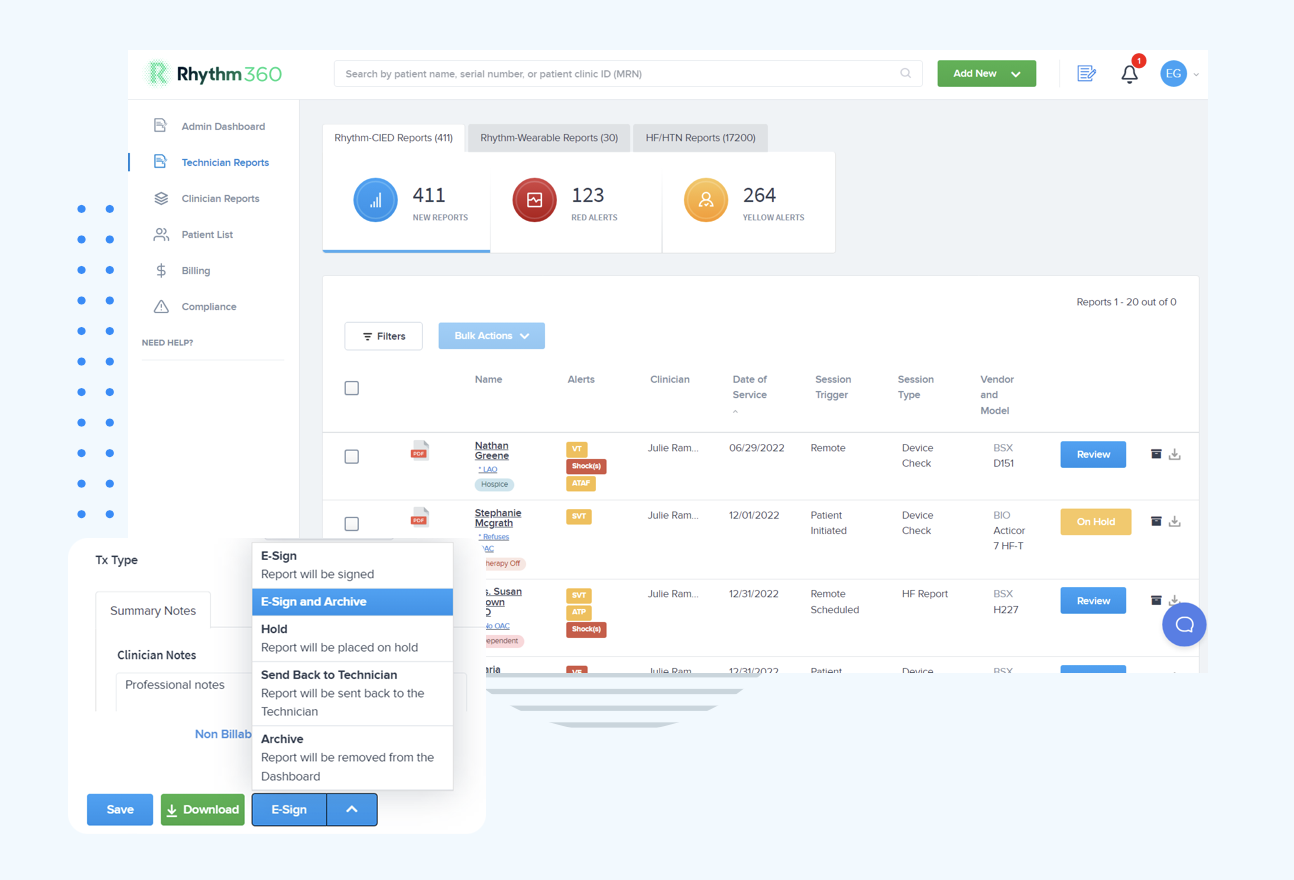
The table below maps practice type to the Rhythm360 capabilities most relevant to each buyer's core operational needs.
| Practice Type | Primary Need | Rhythm360 Capability | Key Outcome |
|---|---|---|---|
| Independent Cardiology Practice | Eliminate multiple OEM logins, reduce staff burden | Single vendor-neutral dashboard, API, HL7, XML, and PDF ingestion via computer vision | Unified view of entire device population, hours of administrative time recovered |
| Electrophysiology Clinic | Prioritize critical arrhythmia alerts, reduce alert fatigue | AI-powered alert triage, optional 24/7/365 CCT oversight | 80% faster critical alert response |
| Integrated Health System | Scale CIED and RPM monitoring across high patient volumes, ensure EHR continuity | Bi-directional EHR integration (Epic, Cerner, Athenahealth), >99.9% data transmissibility via redundant feeds | University of Chicago Medicine reviewed more than 73,000 reports annually through Rhythm360 in 2025 |
True vendor neutrality means the platform does not depend on a single OEM's data feed or proprietary format. Rhythm360 achieves this goal by ingesting data through multiple pathways, including direct APIs, HL7 messaging, XML feeds, and unstructured PDF parsing via computer vision and AI-powered data extrapolation. When one OEM's server experiences downtime, redundant data feeds act as a fail-safe and maintain continuity of the patient record.
AI-driven triage in unified platforms can maintain 99.9% data reliability, a threshold that matters when clinical decisions depend on transmission completeness. Rhythm360's architecture is built to that standard and cross-references incoming data for fidelity before surfacing it to clinicians.
For practices evaluating interoperability in 2026, a functional checklist should confirm support for HL7 v2 message types (ADT, ORU, ORM), FHIR R4 REST APIs for bi-directional EHR connectivity, and DICOM for imaging-adjacent workflows. The ONC Cures Act Final Rule required ONC-certified EHRs to support standardized FHIR APIs by December 31, 2022, which makes FHIR R4 support a baseline requirement rather than a differentiator. Rhythm360 meets all three standards.
Once data from multiple OEMs flows into a unified platform, the next operational challenge becomes managing the volume of alerts that data generates. That challenge is where AI-powered alert triage delivers the most visible impact for EP clinics.
EP clinics now manage thousands of devices and have experienced substantial growth in their device populations in recent years. At that scale, manual alert review no longer functions as a viable workflow. Rhythm360's AI-powered alert triage filters non-actionable transmissions and surfaces only clinically significant events, such as new-onset atrial fibrillation, ventricular tachycardia, lead malfunction, and ERI or RRT indicators, for immediate clinician review. The result is an 80% reduction in critical alert response time.
EP clinics that require an additional layer of clinical oversight can use an optional workflow supported by certified cardiac technicians (CCTs) supervised by physicians, available 24/7/365. This two-layer model, which combines AI triage with human review, ensures that borderline transmissions receive expert evaluation before escalation.
The clinical impact is direct. Andrew Beaser, MD, Associate Professor of Medicine at University of Chicago Medicine, noted that Rhythm360 enabled clinicians to review more transmissions daily and identify more abnormalities. As UCM's team observed, "We are able to address these issues earlier; rather than waiting for a 3-month visit, we can call patients in for evaluation."
Revenue leakage in CIED and RPM programs is largely a documentation problem. When billable events are not captured in real time and linked to compliant documentation, claims for CPT codes 93298, 93299, 99454, 99457, and 99458 are either missed or denied. This gap between clinical activity and billing documentation is where automation delivers the most direct financial impact.
Rhythm360 automates the documentation chain from transmission receipt through report generation so that every billable event produces an auditable record aligned with CPT compliance requirements. This automation helps practices improve billing performance and revenue outcomes.
Lehigh Valley Heart & Vascular Institute achieved 94% billing efficiency and 31% higher revenue capture across 8,000 device patients without expanding staff using an automated remote cardiac monitoring platform. Rhythm360 clients have reported up to 300% increases in revenue generation through optimized CPT code capture, improved staff efficiency, and the addition of RPM service lines for HF and HTN management.
University of Chicago Medicine confirmed: "We have improved billing and accountability for our patients after the integration." Rhythm360's administrative dashboard provides a real-time view of captured and potential revenue based on CPT code requirements. This visibility gives practice administrators the information needed to close billing gaps before the claim window closes.
Schedule a demo to see how Rhythm360's cardiovascular data integration improves CPT billing capture.
Critical cardiac events do not follow office hours, so clinicians need full access to data when they are on call. A new-onset AFib alert arriving on a Saturday morning requires the same clinical response as one arriving on a Tuesday afternoon. Rhythm360's secure, HIPAA-compliant mobile application allows clinicians to review transmissions, sign reports, and coordinate care from any location at any time.
The practical impact is significant. When Rhythm360 flags a critical arrhythmia on a Saturday morning, a clinician can review the transmission, initiate anticoagulation protocols, or arrange for device reprogramming before the patient would otherwise have been seen at a scheduled visit. Without mobile access, that event may not surface until Monday, which can create serious clinical risk.
Mobile access also reduces the dependency on a single on-site "super-user." When any credentialed clinician can access the full patient record from a smartphone, the practice maintains continuity of care regardless of staffing schedules or physical location.
A cardiovascular data integration platform that writes data into the EHR but cannot receive updates back creates a partial solution. Rhythm360 supports bi-directional integration with Epic, Cerner, Athenahealth, eClinicalWorks, Greenway Health, and other systems via HL7 and FHIR standards. Data flows in both directions, so device transmissions and clinical reports populate the EHR automatically, and patient demographic or scheduling updates in the EHR appear in Rhythm360 without manual re-entry.
FHIR-based data orchestration layers in cardiology EHR integrations can provide rapid data availability, a benchmark that reflects the current state of the art for real-time clinical data exchange. Rhythm360's integration architecture is designed to meet that standard.
Onboarding timelines for Rhythm360, including EHR integration setup, typically range from a few days to a few weeks. This speed contrasts with legacy implementations that can require months of IT coordination. UCM's implementation team noted: "That was a big piece for us, to have an integrated review of data from trained personnel."
The table below summarizes Rhythm360's specifications across the seven dimensions most relevant to cardiology practice administrators and EP leads evaluating cardiovascular data integration platforms in 2026.
| Evaluation Dimension | Rhythm360 Specification |
|---|---|
| Device Coverage | Vendor-neutral ingestion from all major OEMs, including Medtronic, Boston Scientific, Abbott, Biotronik, and others; covers pacemakers, ICDs, ILRs, CRT or CCM devices, and CardioMEMS PA monitors |
| Alert Triage | AI-powered triage that filters non-actionable transmissions, optional 24/7/365 CCT oversight supervised by physicians, and 80% faster critical alert response |
| Billing Automation | Automated CPT documentation for codes including 93298, 93299, 99454, 99457, and 99458; real-time dashboard of captured and potential revenue; revenue improvements reported by clients |
| Mobile Access | HIPAA-compliant mobile app that supports full transmission review, report signing, and care coordination from any device and any location |
| Onboarding Timeline | A few days to a few weeks, including EHR integration setup |
| Pricing Model | SaaS-based model that scales with clinic size and platform usage, without rigid high setup fees |
| Security & Compliance | HIPAA-compliant platform with a full audit trail on all communications and clinical actions, and >99.9% transmissibility via redundant feeds and AI-powered extrapolation |
Implementation timelines for Rhythm360 range from a few days to a few weeks, depending on the complexity of the practice's existing EHR environment and the number of device manufacturer connections required. The onboarding process includes EHR integration setup for systems such as Epic, Cerner, Athenahealth, eClinicalWorks, and Greenway Health. RhythmScience's implementation team manages the technical configuration and minimizes disruption to clinical workflows during the transition period.
Rhythm360 uses a SaaS-based pricing model that scales according to clinic size and platform usage. This structure avoids the high upfront setup fees common in legacy cardiac device management systems and allows smaller independent practices to access the same vendor-neutral ingestion, AI alert triage, and billing automation capabilities as large integrated health systems. Practices can also add service lines, such as HF and HTN remote physiological monitoring, incrementally as their patient population grows.
Rhythm360 is a HIPAA-compliant, cloud-based platform with a full audit trail covering all clinical actions, communications, and data access events. Patient messaging through the integrated Twilio framework is logged within the patient record, including phone call logs. The platform's redundant data feed architecture ensures that data is not lost due to OEM server downtime, and all mobile access is secured through the HIPAA-compliant mobile application. RhythmScience's infrastructure is designed to meet the security and compliance requirements of independent practices, EP clinics, and integrated health systems alike.
Rhythm360 automates documentation for the primary CPT codes used in CIED remote monitoring and remote physiological monitoring programs, including 93298, 93299, 99453, 99454, 99457, and 99458. The platform's administrative dashboard provides a real-time view of billable events, captured revenue, and potential revenue based on CPT compliance requirements. This visibility allows practice administrators to identify and close documentation gaps before claim submission deadlines, which reduces denial rates and recovers revenue that manual workflows typically miss.
Rhythm360 provides distinct but integrated service lines for Rhythm-CIED, which covers implantable devices including pacemakers, ICDs, ILRs, and CRT or CCM devices, and for HF or HTN remote physiological monitoring. Both service lines operate within the same centralized workspace, so clinical staff can manage rhythm disorders, heart failure, and hypertension patients without switching platforms. Turnkey onboarding checklists and automated billing support are included for each service line, which enables practices to launch new RPM programs with minimal logistical overhead.
Fragmented OEM portals, manual alert workflows, and undocumented CPT events are operational problems with measurable costs in staff time, patient safety, and practice revenue. The evaluation criteria covered in this article, including vendor-neutral ingestion, AI-powered alert triage, CPT billing automation, mobile access, and bi-directional EHR integration, provide a defensible framework for selecting a cardiovascular data integration platform that addresses all three dimensions simultaneously.
Rhythm360 is built specifically for cardiology practices, EP clinics, and integrated health systems that can no longer absorb the inefficiencies of fragmented device data management. With the reliability threshold established earlier, the alert response improvements mentioned earlier, and the revenue improvements detailed earlier, the platform delivers a single source of truth for CIED and RPM workflows.