

Last updated: July 13, 2026
Fragmented OEM portals increase operational cost and risk every year. When a practice implants devices from Medtronic, Boston Scientific, Abbott, and Biotronik, clinical staff must maintain separate logins, reconcile non-interoperable data exports, and manually transcribe findings into the EHR. This creates administrative overload, data silos, and a clinical environment where critical events can be missed.
The financial stakes match the operational burden. Many cardiology practices capture only a fraction of available RPM and CCM revenue, despite a potential of $2,580–$3,600 per complex cardiac patient per year for combined RPM and CCM revenue. Manual time logs cause lost billable 99457 and 99458 minutes. On the reimbursement side, CPT 93296 received a roughly 60% RVU increase on January 1, 2026. A 200-patient CIED monitoring program can gain additional revenue from that single code change alone when the 90-day billing window is tracked automatically. CMS also introduced new CPT code 99445 in 2026 for device supply and transmission of data 2–15 days per month, reimbursed at a national average of approximately $47 per patient per month, which adds documentation complexity for clinics without automated capture.
Given both the operational burden of fragmented portals and the financial complexity of maximizing reimbursement under the 2026 code changes, the five evaluation criteria below provide a structured framework for selecting the right EP workflow automation platform for cardiac device clinics of any size.
Schedule a demo to see how Rhythm360 addresses all five criteria in a single platform.
Vendor neutrality keeps clinics from running parallel workflows. A platform that supports only one or two OEMs forces staff to juggle multiple portals. True vendor neutrality means ingesting and normalizing data from Medtronic, Boston Scientific, Abbott, Biotronik, and others into a single dashboard. Small clinics remove the multi-portal login burden from a single device technician. Large health systems gain population-level reporting across thousands of patients regardless of implant brand.
Bi-directional EHR integration removes manual transcription instead of just reducing it. Read-only integrations still require staff to retype or copy findings. Bi-directional integrations push normalized device data into the EHR and pull patient context back into the monitoring platform. Bidirectional HL7 v2 plus FHIR integrations for high-volume messaging typically cost $60K–$150K+ and take 8–20 weeks or longer when built from scratch. Platforms with pre-built connectors to Epic, Cerner, Athenahealth, and eClinicalWorks compress that timeline significantly. Solo physicians with straightforward integrations can complete core EHR implementation in 2–4 weeks, while multi-provider clinics with complex device ecosystems should budget approximately 26 weeks for a realistic EHR integration project.
AI-powered alert triage protects clinicians from alert fatigue and protects patients from missed events. Alert fatigue is a patient safety issue, not just an annoyance. AI triage systems filter non-actionable transmissions and surface clinically significant events such as new-onset AFib, ventricular tachycardia, lead malfunction, and ERI or RRT indicators. A JMIR study evaluating an AI reasoning algorithm on real patient monitoring data found it reduced caregiver notifications substantially. Large clinics that manage thousands of transmissions each month depend on AI triage to keep workloads manageable and prevent systemic alert fatigue.
Automated CPT documentation turns complex code stacking into reliable revenue. Correct code stacking for a complex cardiac patient on an ICD and RPM cuff – codes 99454, 99457, 99458×2, 99490, and 93297 – can generate substantial revenue per month. Capturing that revenue requires meeting specific documentation thresholds, including the 16-day transmission rule for 99454, the 20-minute treatment management window for 99457, and accurate time tracking for each additional 99458 unit. Automated workflows enforce these thresholds upstream. They eliminate 99454 denials before claims are submitted and ensure that every qualifying 99457 interaction is documented and billed. On a 500-patient panel, this approach can add significant additional claims compared with manual tracking.
Secure mobile access keeps care moving when clinicians are away from their desks. Clinicians reviewing transmissions, signing reports, and coordinating care from a smartphone need a HIPAA-compliant mobile application with full audit trail functionality. This requirement affects electrophysiologists and NPs who cover weekends and evenings more than anyone else. Delayed access to a critical alert can mean the difference between early intervention and an adverse outcome.
The table below maps the five criteria to real workflow outcomes across three clinic-size segments. All figures come from cited industry benchmarks and Rhythm360 performance data.
| Clinic Size | Vendor Neutrality & EHR Integration Speed | AI Triage & Alert Response | CPT Capture & Revenue Impact |
|---|---|---|---|
| Small (1–5 providers, <500 CIED patients) | Single-dashboard access removes multi-portal logins, with EHR integration typically completable in 2–4 weeks for solo or small practices with straightforward device ecosystems | AI triage reduces alert volume to a manageable daily queue for a one- or two-person device team, and 80% faster critical alert response reduces reliance on a single “super-user” | Automated capture improves 99457 rates, eliminates 99454 denials, and creates a substantial revenue lift versus manual workflows |
| Medium (6–25 providers, 500–2,000 CIED patients) | Pre-built HL7 and FHIR connectors reduce integration burden, and multi-provider clinics should budget approximately 26 weeks for full EHR integration with complex device ecosystems | AI triage plus optional 24/7 CCT oversight manages growing transmission volume, and prioritized notifications enable weekend and on-call coverage without dedicated overnight staff | A 500-patient panel with automated capture can add substantial additional revenue, with new 2026 CPT 99445 captured automatically |
| Large (25+ providers, 2,000+ CIED patients) | Enterprise bi-directional EHR integration across Epic, Cerner, and others, where enterprise Epic integrations can take 4–8 months without pre-built connectors, while pre-certified integrations compress this timeline | Population-level AI triage scales to tens of thousands of annual reports, and University of Chicago Medicine has processed a high volume of reports through Rhythm360 with stable dismissal rates | A 200-patient CIED program can gain additional revenue from the 2026 CPT 93296 RVU increase alone when the 90-day billing window is tracked automatically, and this impact scales across larger panels |
Rhythm360 provides a cloud-based, vendor-neutral, HIPAA-compliant platform that consolidates CIED and RPM data from Medtronic, Boston Scientific, Abbott, Biotronik, and other manufacturers into a single dashboard. Data ingestion uses API, HL7, XML, and PDF parsing via computer vision and AI-powered extrapolation. This approach achieves greater than 99.9% data transmissibility through redundant data feeds that remain active even when an OEM server is offline.
Bi-directional EHR integrations come pre-built for Epic, Cerner, Athenahealth, eClinicalWorks, Greenway Health, and others via HL7. Implementation timelines range from a few days to a few weeks, depending on clinic size and existing infrastructure. AI-powered alert triage filters non-actionable transmissions and surfaces prioritized clinical events in near-real time. Automated CPT documentation supports codes including 93296, 93297, 93298, 93299, 99453, 99454, 99445, 99457, 99458, and 99490, with upstream enforcement of transmission-day thresholds to prevent denials. The HIPAA-compliant mobile application allows electrophysiologists, NPs, and RNs to review transmissions, sign reports, and coordinate care from any device, at any time.
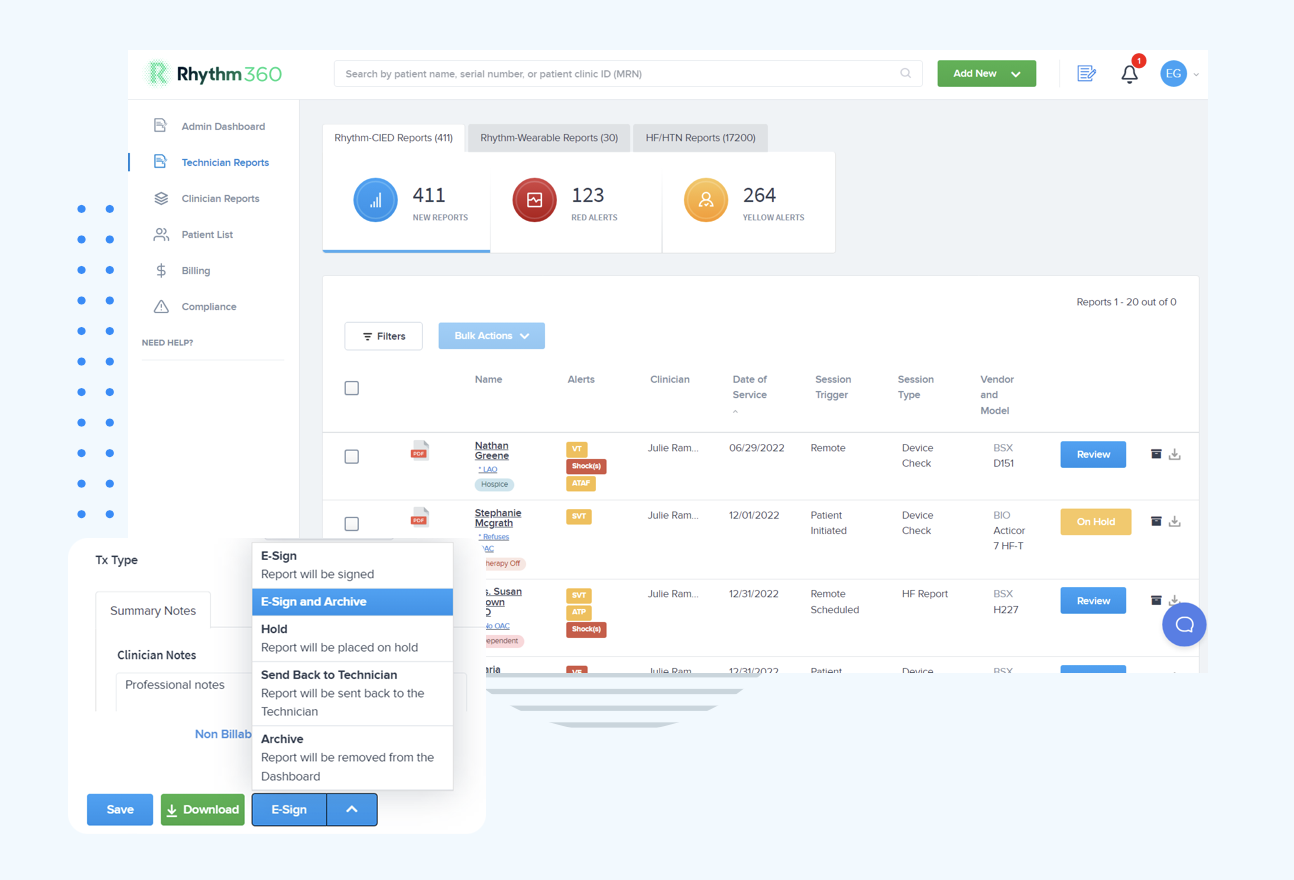
Optional 24/7/365 oversight by certified cardiac technicians (CCTs) supervised by physicians is available for practices that need continuous coverage without adding internal headcount.
Schedule a demo and see Rhythm360's unified dashboard in action.
Small electrophysiology practices with one or two device technicians feel the administrative burden of multiple OEM portals most acutely. A single clinician logging into separate Medtronic, Boston Scientific, and Abbott portals each morning before reviewing any clinical data loses hours per week to navigation alone. Rhythm360's single-dashboard model removes that overhead. The mobile application also lets the physician-owner sign off on transmissions during meetings because they can easily access them on their phone, according to an electrophysiologist at a high-volume academic center using the platform.
Medium-to-large health systems face a different challenge because of scale. While small practices struggle with administrative overhead per clinician, larger organizations must manage thousands of transmissions across multiple sites and provider teams. At this scale, the challenge shifts from eliminating portal logins to ensuring consistent triage, documentation, and billing compliance across the entire organization. University of Chicago Medicine has utilized Rhythm360 to review a high volume of reports. The platform enabled clinicians to review more transmissions daily and identify more abnormalities. The system also supports earlier intervention, since clinicians can call patients in for evaluation when a device transmission flags a developing issue instead of waiting for a 3-month visit. Billing and accountability for patients improved after the integration.
Rhythm360 also supports expansion into Heart Failure and Hypertension RPM service lines through its integrated Rhythm-HF/HTN module. Practices can add new revenue streams without new infrastructure or additional vendor contracts.
Total cost of ownership for EP workflow automation platforms includes more than licensing fees. Implementation timelines, training burden, ongoing maintenance, and the cost of not automating all factor into the true investment calculation.
Rhythm360's SaaS-based pricing scales with clinic size and platform usage, which avoids the large upfront capital expenditure associated with on-premise legacy systems. Implementation, including EHR integration, completes in days to weeks for most practices, which is significantly faster than the multi-month timelines typical of custom integrations. Pre-built OEM and EHR connectors eliminate the custom development costs mentioned earlier, including the $60K–$150K+ that custom integrations require.
Training burden stays low because of the platform's intuitive single-dashboard design, which removes the need for staff to maintain proficiency across multiple OEM portals. Business continuity improves because the platform does not depend on a single “super-user.” Any authorized clinician can access the full patient record from any device. Practices that add HF or HTN RPM service lines through Rhythm360 do so within the existing platform infrastructure, which avoids the cost and disruption of a separate vendor onboarding process.
The following matrix maps clinic size and primary operational priority to the Rhythm360 capabilities most relevant to each scenario.
| Clinic Size | Primary Priority | Rhythm360 Capability | Expected Outcome |
|---|---|---|---|
| Small (1–5 providers) | Eliminate multi-portal administrative burden | Vendor-neutral single dashboard and mobile app for on-call sign-off | Hours recovered per week and reduced burnout for device technicians |
| Small (1–5 providers) | Recover missed CPT revenue | Automated CPT documentation and 16-day transmission rule enforcement | Significant additional annual revenue on a 500-patient panel from improved 99457 capture |
| Medium (6–25 providers) | Scale alert management without adding headcount | AI triage plus optional 24/7 CCT oversight | 80% reduction in critical alert response times and a manageable daily queue |
| Large (25+ providers) | Unify CIED monitoring across a multi-site health system | Enterprise bi-directional EHR integration and population-level reporting | Scalable handling of a high volume of annual reports with stable dismissal rates |
| Any size | Add HF/HTN RPM without new vendor contracts | Integrated Rhythm-HF/HTN service line within the existing platform | New recurring revenue stream with no additional infrastructure cost |
Integration timelines vary significantly by clinic size and EHR system. Solo or small cardiology practices with straightforward device ecosystems and standard EHR systems like Athenahealth or eClinicalWorks can typically complete integration in 2–4 weeks. Multi-provider clinics with complex imaging and device ecosystems should budget approximately 26 weeks for a realistic EHR integration project. Large health systems using enterprise Epic or Cerner deployments face the longest timelines because of custom mapping requirements, App Orchard review processes, and phased rollouts across multiple sites. Rhythm360's pre-built connectors for Epic, Cerner, Athenahealth, eClinicalWorks, and Greenway Health compress these timelines substantially, with most practices completing implementation in days to weeks rather than months.
A comprehensive EP workflow automation platform should support the full range of CIED remote monitoring and RPM codes. For CIED monitoring, the relevant codes include 93296 (remote monitoring of implantable cardiovascular physiologic monitor, 90-day period), 93297 (remote monitoring of implantable cardiovascular physiologic monitor, each 30-day period), 93298, and 93299. For remote physiological monitoring, the 2026 code set includes 99453 (initial setup and patient education, one-time), 99445 (new in 2026: device supply and transmission 2–15 days per month, reimbursed at a national average of approximately $47 per patient per month), 99454 (device supply and transmission 16–30 days per month), 99457 (first 20 minutes of RPM treatment management), 99458 (each additional 20 minutes), and 99490 for chronic care management. Rhythm360 supports automated documentation and upstream compliance enforcement for all of these codes, including the 16-day transmission threshold required for 99454 and the new 99445 code introduced by CMS in 2026.
Clinicians can review and sign reports securely from a mobile device while on call with Rhythm360. The platform provides a HIPAA-compliant mobile application that allows electrophysiologists, NPs, PAs, and RNs to review transmissions, sign reports, and coordinate care from any smartphone or tablet. All actions are logged with a full audit trail within the patient record. This capability is particularly valuable for weekend and evening on-call coverage, where delayed access to a critical alert such as new-onset atrial fibrillation or a ventricular tachycardia episode can result in adverse patient outcomes. Clinicians at University of Chicago Medicine have noted that mobile access makes it practical to review and sign off on transmissions during meetings or outside of standard clinic hours, which increases the volume of transmissions reviewed daily without extending working hours.
Practices implementing Rhythm360 have reported revenue increases of up to 300% compared to manual workflows. This lift comes from several sources. Practices increase CPT 99457 capture rates versus typical manual workflows. They add a second unit of 99458 on complex patients. They eliminate 99454 denials through automated 16-day transmission rule enforcement and capture the 2026 CPT 93296 RVU increase of approximately 60%. On a 500-patient panel, automated 99457 capture can add substantial additional revenue annually, and automated capture of two units of 99458 on complex patients adds further revenue. A 200-patient CIED monitoring program gains additional revenue from the 2026 CPT 93296 RVU change when the 90-day billing window is tracked automatically. These figures compound when practices also add HF or HTN RPM service lines within the same platform.
The five evaluation criteria for EP workflow automation platforms in 2026 – vendor neutrality, bi-directional EHR integration speed, AI-powered alert triage, automated CPT documentation, and secure mobile access – work together as a single system. These interdependent capabilities determine whether a cardiac device clinic can deliver safe, efficient, and financially sustainable care at scale. Platforms that address only some of these criteria force clinics to maintain parallel workflows, accept revenue leakage, or compromise on patient safety.
Rhythm360 is built to satisfy all five criteria in a single, cloud-based, vendor-neutral platform. With greater than 99.9% data transmissibility, up to 80% faster critical alert response times, automated CPT capture supporting up to 300% revenue lift, and pre-built bi-directional EHR integrations that deploy in days to weeks, Rhythm360 gives cardiac device clinics of every size the infrastructure to operate without compromise.





