Last updated: July 14, 2026
Cardiology practices that implant devices from more than one original equipment manufacturer face a fragmented reality with separate logins, non-interoperable portals, and manual reconciliation of conflicting data formats. Variability in hardware, software formats, EHRs, and data labeling limits interoperability and degrades AI algorithm performance for ECG-based cardiac workflows, so a unified ingestion layer becomes a clinical necessity rather than a convenience.
Rhythm360 resolves this with a multi-modal ingestion architecture that normalizes data from all major manufacturers into a single source of truth. The platform uses API connections, HL7 feeds, XML parsing, and computer-vision OCR to extract and standardize data from unstructured PDFs, which remain the default format for many legacy OEM portals. Interoperability between AI outputs and existing EHRs can be achieved through HL7-FHIR, DICOM-SR, and SMART-on-FHIR interfaces, and Rhythm360 supports each of these pathways.
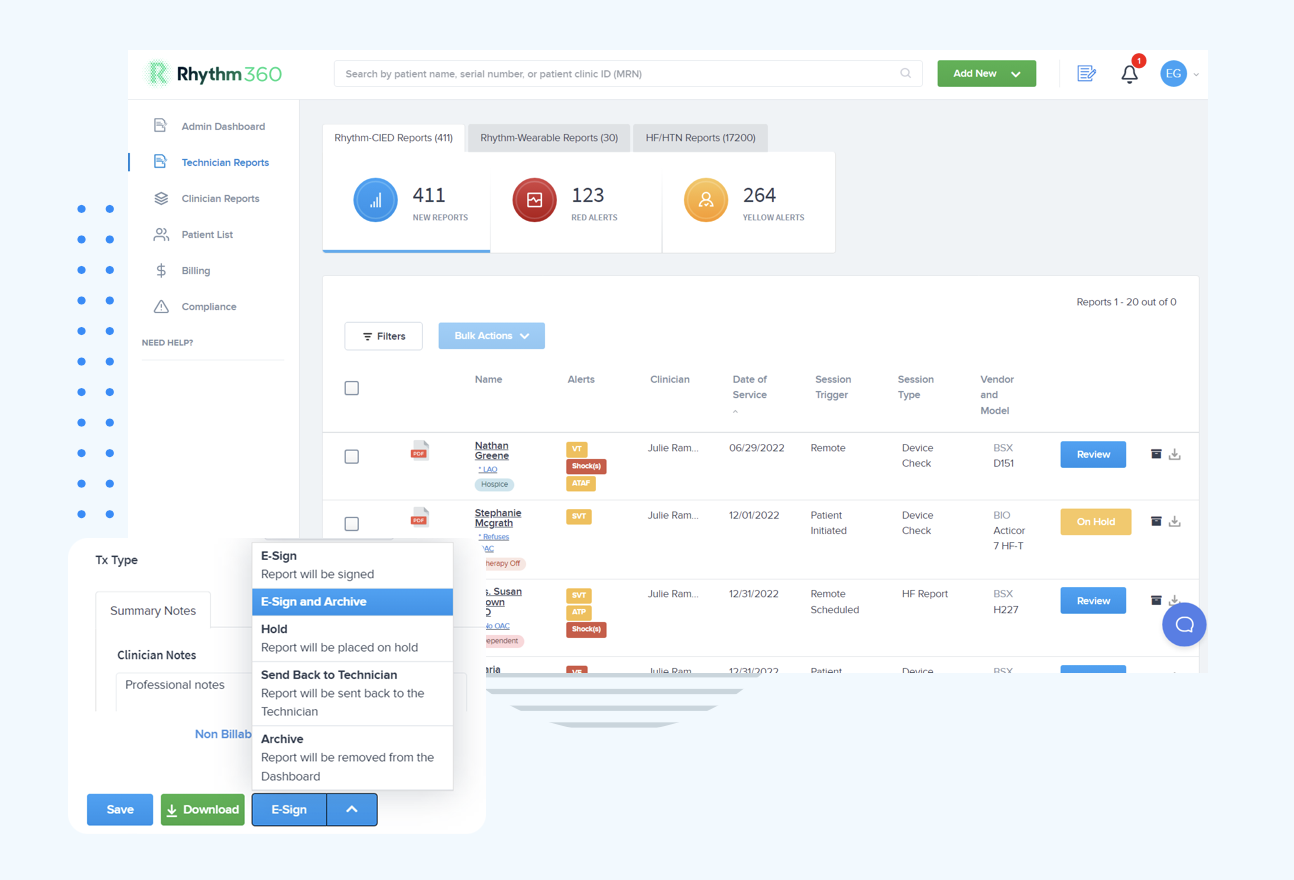
The practical result for device technicians and clinic administrators includes several concrete workflow gains.
Typical device clinics processing over 8,000 transmissions annually experience nearly 60% of alerts as clinically non-relevant, which establishes a measurable baseline for alert fatigue in standard CIED workflows. Device populations continue to grow, and some CIED clinics have experienced 250% growth in device population since 2018 and now manage nearly 9,000 devices, so manual triage quickly becomes operationally unsustainable.
Rhythm360 addresses this with an AI-powered alert triage engine that filters non-actionable noise and surfaces clinically significant events in priority order. AI-enhanced algorithms in cardiac monitoring filter nuisance alerts by as much as 85%, saving clinical staff hundreds of hours each year. Rhythm360’s implementation achieves up to an 80% reduction in alert fatigue while maintaining 99.9% data reliability. Practices that need additional coverage can add an optional 24/7/365 layer of certified cardiac technicians supervised by physicians, which provides human oversight on top of the AI layer.
Andrew Beaser, MD, Associate Professor of Medicine at University of Chicago Medicine, reported that Rhythm360’s implementation enabled clinicians to review more transmissions daily and identify more abnormalities. The 2026 HRS/AHA/APHRS/EHRA/IDSA/LAHRS/PACES/STS consensus statement reinforces this urgency. Mandatory remote monitoring for all CIED patients is now a guideline requirement, so alert volume will continue to increase.
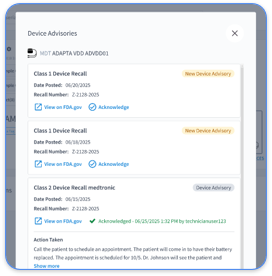
Several specific capabilities within Rhythm360 reduce alert fatigue in daily practice.
While reducing alert fatigue improves clinical efficiency, practices also need to ensure that every monitored transmission supports accurate, timely reimbursement, which requires robust billing documentation.
Incomplete CPT documentation remains one of the most consistent sources of revenue leakage in cardiology. The 2023 MGMA report found that 42% of cardiology denials are linked to missing documentation or modifier errors, and practices without automated claim scrubbing frequently run 45–60+ day A/R cycles, compared to the industry benchmark of under 30 days.
Rhythm360 automates the capture and documentation required for remote cardiac monitoring CPT codes, including 93298, 93299, 99454, 99457, 99458, and the new 2026 CMS codes 99445 and 99470. “We have improved billing and accountability for our patients after the integration,” noted a clinical leader at University of Chicago Medicine following Rhythm360 deployment. Practices using the platform have reported up to a 300% increase in captured revenue through improved CPT billing and the addition of new RPM service lines for heart failure and hypertension management.
The platform delivers three categories of billing automation outcomes: documentation compliance, revenue visibility, and claim acceptance. Automated time tracking per encounter satisfies CPT threshold requirements without manual logging. Audit-ready documentation is generated at the point of care rather than retrospectively, so records exist before the claim is submitted.
An administrative dashboard surfaces captured versus potential revenue by CPT code in real time, which allows practice managers to identify documentation gaps before the billing cycle closes. As a result, cardiology practices using EHR-integrated billing intelligence report first-pass acceptance rates above 95%, compared to 15–30% denial rates for manually coded claims. CMS finalized a 2.5% payment increase for the 2026 Medicare Physician Fee Schedule along with two new RPM CPT codes effective January 1, 2026, which expands billable opportunities for practices that maintain compliant documentation.
Electrophysiologists and device technicians managing multi-vendor populations need a workspace that removes the cognitive overhead of switching between OEM portals while preserving clinical granularity. The 2026 HRS consensus guidelines mandate remote monitoring for all CIED patients and emphasize lifelong lead management through a combination of remote monitoring and in-person clinic follow-up. That mandate means the platform a clinic selects must handle both routine scheduled transmissions and urgent unscheduled alerts reliably.
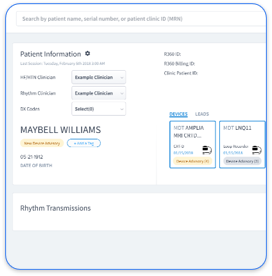
Rhythm360 provides distinct but integrated service lines for Rhythm-CIED and for HF/HTN remote physiological monitoring. Rhythm-CIED covers implantable devices including pacemakers, ICDs, implantable loop recorders, CRT/CCM devices, and CardioMEMS pulmonary artery monitors. Clinicians access both service lines from a single dashboard, with patient-level views that aggregate device data, vital signs, and communication logs in one record.
Several workflow features directly support multi-vendor device clinics.
Schedule a demo to walk through a live multi-vendor clinic workflow in Rhythm360.
Bi-directional EHR integration often represents the most complex variable in any cardiac monitoring implementation. Real-world EHR API integration projects consistently take 6–18 months and exceed budget projections, with Epic production API approval alone requiring 8–16 weeks. Rhythm360’s pre-built integration layer compresses that timeline significantly, and most practices complete full onboarding, including EHR integration, in days to a few weeks.
The platform supports bi-directional HL7 integration with Epic, Cerner, Athenahealth, eClinicalWorks, Greenway Health, and other major EHRs. Data flows in both directions. Device transmissions, alert documentation, time logs, and monthly summary reports push automatically into the patient’s EHR chart, while patient demographics and scheduling data pull from the EHR into Rhythm360. Automated workflows from EHR API integration deliver a 30–40% reduction in administrative tasks for healthcare organizations, which removes much of the manual transcription that drives technician burnout in fragmented environments.
Several integration specifics matter for cardiology practices.
Implementation speed matters for practices that cannot tolerate extended downtime or IT-intensive deployments. Rhythm360’s onboarding process minimizes disruption, and most practices reach full operational status, including EHR integration, within a few days to a few weeks. Large integrated health systems with complex Epic or Cerner environments may require additional configuration time, but the platform’s pre-built connectors remove the need for custom development on the practice side.
For context on industry norms, most cardiology RPM implementations follow a sequence covering platform configuration, EHR integration, staff training, and go-live within approximately two to three weeks. Rhythm360 follows the same phased sequence but shifts the technical burden away from the practice. RhythmScience manages platform configuration, integration credentials, and workflow setup, which allows clinical staff to focus on patient care rather than technical deployment. This division of labor enables a compressed timeline because practices are not waiting on internal IT resources to complete integration tasks.
Onboarding considerations vary by practice size.
Revenue performance improves when clinical workflows, documentation, and billing operate inside a single connected platform. Rhythm360 links AI triage, vendor-neutral data ingestion, and automated CPT tracking so that every clinically meaningful transmission has a clear path to compliant billing. This connection reduces missed billable events and shortens revenue cycles.
Practices using Rhythm360 have reported up to a 300% increase in captured revenue, as described earlier, driven by previously missed billable encounters and the addition of HF/HTN RPM service lines. First-pass acceptance rates above 95% reduce rework and staff time spent on appeals. Shorter A/R cycles improve cash flow, which supports investment in additional staff or expanded service lines.
These financial outcomes depend on accurate data capture and reliable alert handling. The same AI and integration capabilities that reduce alert fatigue and technician burnout also create the documentation trail that payers require. Clinical quality and financial performance move together when the monitoring platform connects these components.
Single-manufacturer portals surface data from one OEM’s devices only. A practice managing patients with Medtronic, Boston Scientific, Abbott, and Biotronik devices must maintain separate logins, learn separate interfaces, and manually reconcile data across all of them. Rhythm360 ingests data from all major manufacturers through a combination of API connections, HL7 feeds, XML parsing, and computer-vision OCR for PDF-based reports. The result is a single, normalized patient record regardless of device brand. The platform also maintains the greater than 99.9% data transmissibility mentioned earlier through redundant data feeds that remain active even when an OEM’s server is unavailable, a fail-safe that single-manufacturer portals cannot replicate by design.
Alert fatigue in CIED monitoring stems from high volumes of non-actionable notifications generated by legacy systems that apply minimal filtering logic. Rhythm360’s AI triage engine analyzes incoming transmissions and ranks alerts by clinical severity before they reach the clinician’s queue, filtering routine or non-actionable notifications while ensuring that events like new-onset AFib, ventricular tachycardia, lead malfunction, and ERI/RRT indicators are surfaced immediately. The platform achieves the up to 80% reduction in alert fatigue described earlier by combining AI triage with optional 24/7/365 oversight by certified cardiac technicians supervised by physicians, which provides a human safety net on top of the AI layer.
Rhythm360 supports automated documentation and time tracking for the primary remote cardiac monitoring CPT codes, including 93298 and 93299 for CIED remote interrogation, as well as 99453, 99454, 99457, 99458, and the new 2026 CMS codes 99445 and 99470 for remote physiological monitoring. The platform automatically tracks the time and data thresholds required for each code, generates audit-ready documentation at the point of care, and surfaces a real-time dashboard showing captured versus potential revenue by CPT code. This approach eliminates many manual documentation gaps that drive claim denials and delayed reimbursement. Practices have reported the up to 300% revenue increase mentioned earlier, driven by previously missed billable events, faster documentation cycles, and the addition of new HF/HTN RPM service lines.
Rhythm360’s onboarding process, including EHR integration, typically completes within a few days to a few weeks for most practices. The platform uses pre-built HL7 and FHIR connectors for Epic, Cerner, Athenahealth, eClinicalWorks, Greenway Health, and others, and RhythmScience manages the configuration and integration credentials on the practice’s behalf. Internal IT resources from the practice are not required. Once connected, data flows bi-directionally. Device transmissions, alert documentation, time logs, and CPT-coded summary reports push automatically into the EHR patient chart, while patient demographics pull from the EHR into Rhythm360. This structure removes the manual transcription step that accounts for a significant share of administrative time in device clinics.
Rhythm360 serves the full range of cardiology providers, from solo practitioners and small EP clinics to large integrated health systems managing thousands of CIED patients. The platform uses a SaaS-based pricing model that scales with clinic size and platform usage, so smaller practices do not pay for unused capacity. For small practices, the primary benefit is removal of the administrative overhead of managing multiple OEM portals with limited staff, which allows a single device technician to manage a significantly larger patient population from one dashboard. For large systems, scalability appears in deployments like University of Chicago Medicine, which processed more than 73,000 reports annually through Rhythm360 in 2025 with stable dismissal rates and consistent quarterly throughput.
Fragmented OEM portals, manual alert triage, and incomplete CPT documentation create avoidable clinical risk and revenue loss. Rhythm360 consolidates all CIED and RPM data into a single vendor-neutral workspace, applies AI triage to reduce alert fatigue by up to 80%, and automates the billing documentation that recovers lost revenue. The 2026 HRS guidelines mandate remote monitoring for all CIED patients, so practices now need platforms that can handle this volume reliably and efficiently.
Schedule a demo with the Rhythm360 team to see the platform in your workflow context.