

Last updated: July 14, 2026
Fragmented OEM portals slow down device clinics and increase risk. Cardiology device teams often work across multiple CIED databases and EMR systems, which makes sustained patient connectivity management difficult to maintain internally. When staff log into several non-interoperable portals to retrieve patient data, the administrative burden grows quickly.
The downstream consequences are measurable:
Gaurav A. Upadhyay, MD, FACC, FHRS, Professor of Medicine and Director of the Pacing & Defibrillation Device Clinic at the University of Chicago Medicine, summarized the impact clearly: "Staffing was always an issue for our center, because our device clinic, like many other medical centers, had struggled with technician turnover and timely weekend coverage."
Andrew Beaser, MD, Associate Professor of Medicine at UCM, described pre-implementation workflows as "a major challenge and incredibly difficult."
Fragmented portals compound the challenge by forcing staff to process high volumes of alerts across multiple systems. Alert fatigue is a structural problem, not a staffing one. Device clinics handle large numbers of transmissions every year, and nearly 60% of alerts are clinically non-relevant. Rapid growth in device populations compresses this problem further and stretches teams thin.
Marcus Pritchett, Cardiac Device Specialist at the Kansas City Heart Rhythm Institute, framed the stakes directly: "The last thing we want is to expose patients to bad patient care and expose our doctors and our APPs to maybe missing something that's very clinically relevant that could compromise patient care. And so having alert systems clear urgent versus non-urgent is the timeline difference."
Rhythm360 addresses this problem with AI-powered alert triage that filters non-actionable noise and surfaces only clinically significant events. Optional 24/7/365 oversight by certified cardiac technicians (CCTs) supervised by physicians adds another review layer, especially for weekend and after-hours transmissions. The result is an 80% reduction in alert fatigue while maintaining 99.9% data reliability.
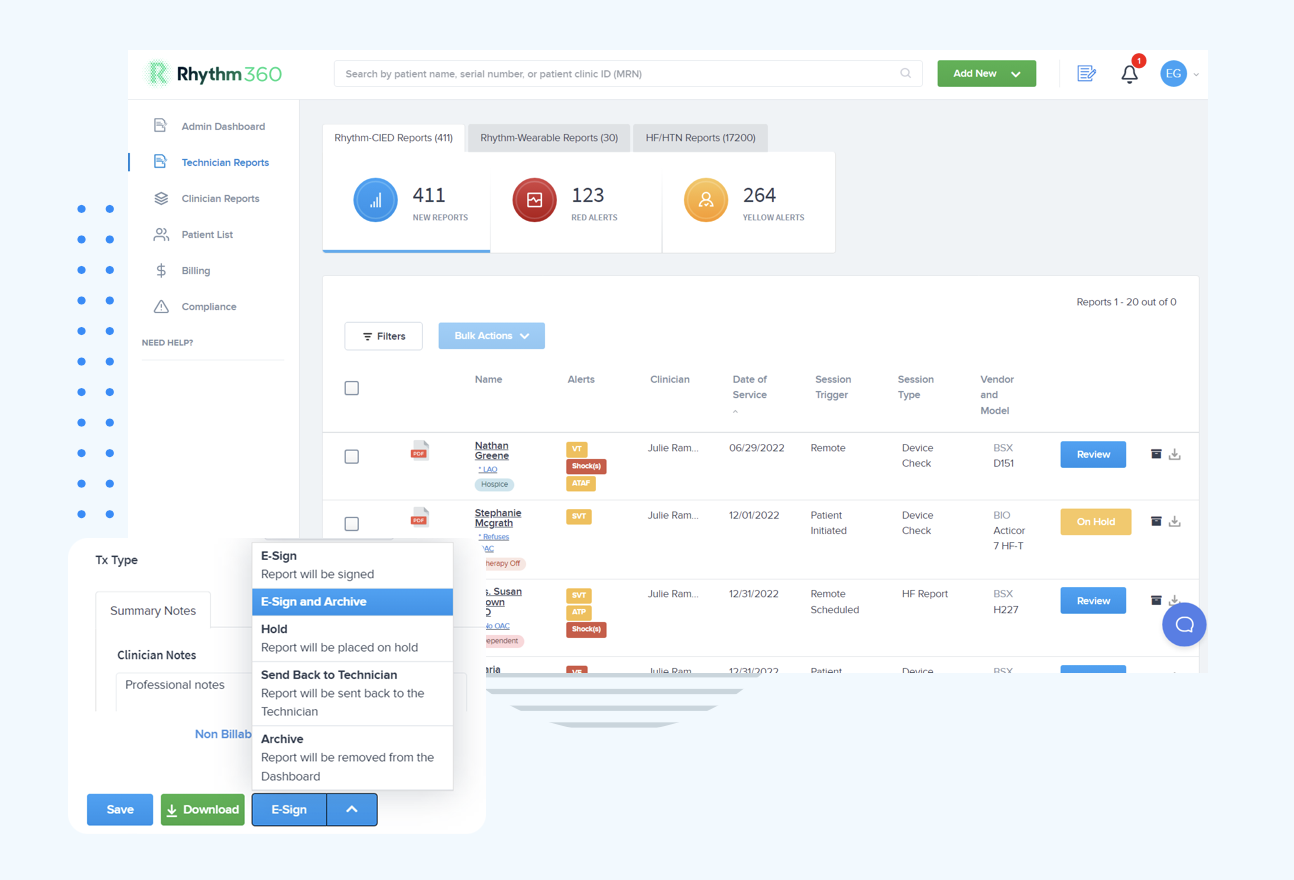
High data reliability protects patients from missed events. Data gaps in CIED monitoring are not merely inconvenient, they are clinically dangerous. A missed ventricular fibrillation alert or an undetected lead malfunction represents a fundamental failure in patient surveillance. Rhythm360 maintains greater than 99.9% transmissibility through redundant data feeds, computer vision (OCR), and AI-powered extrapolation that fills gaps when an OEM server experiences downtime.
The platform ingests data via API, HL7, XML, and unstructured PDF parsing, then normalizes these formats into a single source of truth. This architecture ensures clinicians make decisions on the most complete and cross-referenced data available, not just on what a single OEM portal happened to transmit.
At the University of Chicago Medicine, this approach enabled clinicians to review more transmissions daily and identify more abnormalities, with UCM managing more than 73,000 reports annually through Rhythm360 in calendar year 2025, averaging more than 18,000 reports per quarter.
Earlier intervention follows naturally from this level of visibility. As Dr. Beaser noted: "We are able to address these issues earlier; rather than waiting for a 3-month visit, we can call patients in for evaluation."
Direct EHR integration turns remote data into actionable information. Remote monitoring data that never reaches the treating clinician's chart cannot drive clinical decisions or support compliant billing. Without EHR integration, remote monitoring data collected outside the EHR blocks clinical action and causes revenue loss from unbilled CCM, RPM, and BHI services.
Rhythm360 supports deep, bidirectional integration with Epic, Cerner, Athenahealth, eClinicalWorks, Greenway Health, and other systems via HL7. Major EHR systems including Epic (via App Orchard marketplace and FHIR APIs) and Cerner (Oracle Health) support remote patient monitoring integration, which enables automatic transmission of device readings, bidirectional demographic synchronization, and clinical alert routing into patient charts.
The practical benefits of this connectivity include:
Schedule a demo to explore Rhythm360's Epic and Cerner integration capabilities.
Automated billing capture turns routine monitoring into reliable revenue. CIED remote monitoring is one of the fastest-growing and most consistently underbilled revenue categories in cardiology, billed via CPT codes 93296–93299 with 90-day transmission cycles that require specific documentation of transmission receipt and clinical review. The 2026 Medicare Physician Fee Schedule updates expanded billing eligibility, with reduced minimum monitoring periods that enable reimbursement on shorter 2–15 day windows, which is particularly useful for post-ablation and AF-burden monitoring.
Revenue loss in this category follows a predictable pattern. For cardiology practices with significant device populations, the gap between CMS-allowed billing hours and actual monitoring time can represent hundreds of thousands of dollars in annual uncollected revenue. Organizations that do not actively pull transmissions lose both clinical visibility and the ability to bill.
Rhythm360 automates CPT code capture and documentation for codes including 93298, 93299, and 99454, generating compliant billing records directly from the clinical workflow. The platform's administrative dashboard gives a real-time view of captured and potential revenue based on CPT code requirements, which removes the manual tracking that causes missed billing windows.
Dr. Upadhyay confirmed the outcome at UCM: "We have improved billing and accountability for our patients after the integration." Practices implementing Rhythm360 have reported up to a 300% increase in revenue generation through improved CPT code capture and higher staff efficiency.
Fast implementation and mobile access reduce disruption for busy clinics. Rhythm360's streamlined onboarding process, including EHR integration setup, often finishes more quickly than custom integrations with major EHR systems built from scratch.
For on-call coverage, Rhythm360's secure, HIPAA-compliant mobile application allows clinicians to review transmissions, sign reports, and coordinate care from their smartphones. A critical arrhythmia flagged on a Saturday morning can be addressed by Saturday afternoon, without requiring a clinician to sit at a workstation. This capability directly addresses the weekend coverage gap that UCM identified as a persistent staffing challenge prior to implementation.
The following table summarizes Rhythm360's core capabilities across data reliability, clinical workflow, revenue performance, and technical integration. Use it as a quick reference for the measurable outcomes practices can expect when consolidating their CIED monitoring infrastructure.
| Capability | Rhythm360 |
|---|---|
| Data Transmissibility | >99.9% via redundant data feeds, computer vision, and AI extrapolation |
| Critical Alert Response Reduction | Up to 80% faster response times (as noted earlier) through AI-powered triage and optional 24/7 CCT oversight |
| Revenue Lift | Up to 300% increase in revenue generation through automated CPT capture (93298, 93299, 99454) and stronger billing documentation |
| EHR Integration Depth | Bidirectional integration with Epic, Cerner, Athenahealth, eClinicalWorks, Greenway Health, and others via HL7 |
| Implementation Timeline | Efficient onboarding that includes EHR integration setup |
| Mobile Access | Secure, HIPAA-compliant mobile app for transmission review, report signing, and care coordination from any location |
| Annual Report Volume (UCM) | UCM's volume (detailed earlier) demonstrates scalability at the academic medical center level |
Structured criteria help leaders compare vendor-neutral platforms with confidence. Clinic administrators and EP leaders evaluating these platforms benefit from a clear checklist. Based on the operational challenges and clinical requirements discussed throughout this article, from data reliability to billing automation, the following six criteria capture the factors that determine long-term platform value:
Schedule a demo to walk through each of these criteria with the Rhythm360 team.
Onboarding with Rhythm360 moves quickly while protecting existing workflows. The implementation process, including EHR integration setup, can be completed efficiently based on the complexity of the clinic's current systems and the number of EHR integrations required. The Rhythm360 team provides hands-on support throughout setup, staff training, and go-live to keep disruption low.
Pricing scales with clinic size and usage. Rhythm360 uses a SaaS-based pricing model that adjusts based on clinic size and platform utilization. Solo practitioners, mid-sized electrophysiology clinics, and large integrated health systems all pay in proportion to their actual use rather than a fixed enterprise rate. This structure delivers a value-aligned investment across different device population sizes.
Weekend and after-hours coverage combines human oversight with mobile access. Rhythm360 offers optional 24/7/365 oversight by certified cardiac technicians (CCTs) supervised by physicians, which ensures that critical alerts such as new-onset atrial fibrillation, ventricular tachycardia, or device malfunction are triaged and addressed outside standard clinic hours. The platform's HIPAA-compliant mobile application also allows on-call clinicians to review transmissions, sign reports, and coordinate care directly from their smartphones, creating a safety net for time-sensitive events on evenings and weekends.
Rhythm360 integrates directly with major EHRs, including Epic and Cerner. The platform supports deep, bidirectional integration with Epic, Cerner, Athenahealth, eClinicalWorks, Greenway Health, and additional EHR systems via HL7. Bidirectional integration means data flows from the EHR into Rhythm360, such as patient demographics and scheduling, and from Rhythm360 back into the EHR, including transmission reports, alert documentation, and billing-ready CPT records. This approach removes manual data re-entry and ensures that device data appears directly in the treating clinician's chart.
Vendor-neutral consolidation solves the structural problems created by fragmented OEM portals. The operational and clinical costs of managing CIED data across multiple portals are well-documented: administrative overload, alert fatigue, missed critical events, and the revenue losses discussed earlier. These issues do not resolve with additional staffing alone, because they stem from the underlying system design.
Rhythm360 offers a single, vendor-neutral platform that consolidates data from all major device manufacturers, applies AI-powered triage to surface only actionable alerts, integrates bidirectionally with Epic and Cerner, and automates CPT billing documentation to recover revenue that would otherwise be permanently lost. The University of Chicago Medicine's experience, managing over 73,000 reports annually with improved billing outcomes and earlier clinical interventions, shows what this architecture can deliver at scale.
Clinics evaluating alternatives to their current multi-vendor workflow can use a clear framework: data reliability, alert intelligence, EHR integration depth, billing automation, implementation speed, and mobile access. Rhythm360 is built to meet each of these criteria without forcing practices to stitch together multiple point solutions.
Schedule a demo and see how Rhythm360 can unify your CIED monitoring program.





