Cardiology has one of the highest initial denial rates among tracked specialties, driven mainly by CARC 197 (prior authorization required) and CARC 50 (medical necessity). For a practice submitting $500,000 in monthly claims at a 7% denial rate, $35,000 is at risk each month.
CIED billing adds another layer of complexity. Each remote interrogation code, including 93294, 93295, 93297, and 93298, can only be reported once per its time window: 90 days for pacemakers and ICDs, 30 days for loop recorders. Claims submitted outside these windows trigger automatic CO-18 duplicate denials.
RPM billing has strict thresholds as well. Missing the 16-day data transmission threshold is the most common reason for CPT 99454 denials. The 2026 CMS Physician Fee Schedule added CPT 99445 for 2–15 days of monitoring at about $47 per month. Practices without automated adherence tracking rarely capture this revenue, because they do not identify patients who fall short of 16 days and route them to 99445.
Manual workflows also underperform on CPT 99457 and 99458 capture compared with automated systems that track time and thresholds in real time. The OIG announced a formal audit of Medicare Part B RPM billing (Project OAS-25-05-008) after Medicare RPM payments reached $536 million in 2024. Documentation gaps around the 16-day transmission rule and 20-minute time requirement now sit at the center of audit risk.
Cardiology practices that want to close revenue gaps and cut denial rates need platforms designed around cardiac device monitoring rules. The following capabilities matter most:
Rhythm360 by RhythmScience is a vendor-neutral, HIPAA-compliant, cloud platform built for CIED remote monitoring and RPM billing compliance. The University of Chicago Medicine implemented Rhythm360 and reviewed more than 73,000 reports annually through the platform in 2025, averaging over 18,000 reports per quarter. Their team reported, “We have improved billing and accountability for our patients after the integration.”
| Rhythm360 Capability | Documented Outcome |
|---|---|
| Vendor-neutral multi-OEM data ingestion (Medtronic, Boston Scientific, Abbott, Biotronik, and others) | Single triage queue removes redundant portal logins and data silos across device manufacturers |
| Data transmissibility via redundant feeds, computer vision, and AI-powered extrapolation | >99.9% transmissibility, so OEM downtime and connectivity gaps do not erase billable transmissions |
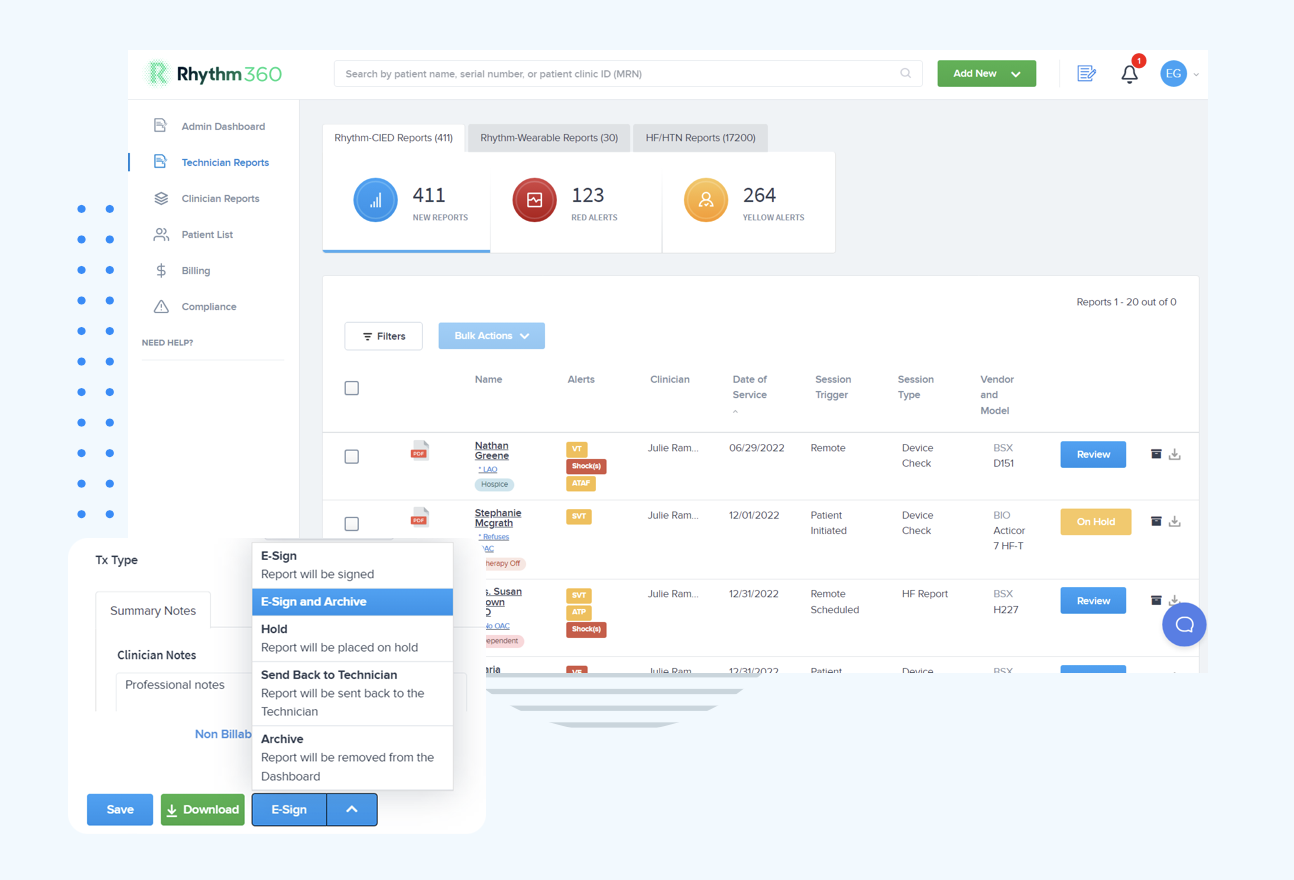
| AI-powered alert triage and optional 24/7/365 CCT oversight | Significant reduction in critical alert response time, allowing faster intervention on high-risk events |
| Automated CPT documentation and bi-directional EHR integration (Epic, Cerner, Athenahealth, eClinicalWorks, Greenway Health) | Large revenue increases through more complete CPT capture and support for new RPM service lines |
| HIPAA-compliant mobile application for remote transmission review and report signing | Continuous care coordination from any location, without workstation dependency |
| Integrated Twilio-powered communication hub with full audit trail | Documented patient interactions that meet OIG expectations for interactive communication |
Schedule a demo to see Rhythm360's vendor-neutral cardiology billing platform in action.
Practices that rely on OEM-specific portals carry a growing administrative burden as device populations expand. Each new manufacturer adds another login, alert queue, and documentation workflow. Fragmented RPM systems also prevent network leaders from seeing performance, outcomes, and revenue across the organization.
A vendor-neutral platform ingests data from all OEMs through one normalized interface. This setup removes the need for staff to reconcile conflicting portal data, lowers the risk of missed transmissions during OEM outages, and keeps every billable event within the correct CPT window, regardless of device brand. Fragmented programs also lose revenue from missed RPM and CCM stacking, inconsistent compliance, and higher cost per claim from duplicated work.
Decision makers should confirm that each platform supports all OEMs in their device mix, integrates bi-directionally with their EHR, and automates CPT threshold tracking instead of relying on manual review. Rhythm360 delivers these capabilities as a vendor-neutral solution built for CIED monitoring and RPM billing.
The right Rhythm360 configuration depends on practice size, device volume, and current EHR infrastructure.
Most costly cardiology billing errors follow predictable patterns and respond well to the right infrastructure.
A unified, automated cardiology billing platform creates a clear financial upside. Rhythm360 clients report large improvements in critical alert response times and revenue growth through more complete CPT capture and new RPM programs for heart failure and hypertension.
Industry data supports this opportunity. Automated workflows can raise CPT 99457 capture rates and generate more than $400,000 in incremental annual revenue on a 500-patient panel. Automated tracking of CIED technical components can add further annual revenue when programs consistently bill eligible monitoring work.
Top-performing cardiology practices often keep denial rates under 5%, well below specialty averages. That gap can represent hundreds of thousands of dollars per year for mid-size and large groups. As Andrew Beaser, MD, Associate Professor of Medicine at University of Chicago Medicine, explained after adopting Rhythm360, “Decision support, including AI-assisted decision support, will become increasingly important as data volumes grow.”
Schedule a demo to get Rhythm360's ROI benchmarks for your practice size and device population.
Rhythm360 onboarding, including EHR integration, usually takes from a few days to a few weeks. This timeline compares favorably with the three to six months often required for enterprise RPM deployments at large IDNs. Bi-directional integrations are available for Epic, Cerner, Athenahealth, eClinicalWorks, and Greenway Health via HL7, with added connectivity through API, XML, and PDF parsing with computer vision.
The HIPAA-compliant mobile app lets clinicians review transmissions, sign reports, and coordinate care from any device, which removes workstation dependency for on-call staff. All patient communications, including automated messages, phone call logs, and alert triage sessions, are timestamped and stored with a full audit trail in the patient record. This structure supports OIG documentation expectations for RPM interactive communication and CIED interpretation.
SaaS-based pricing scales with clinic size and usage, so solo practitioners and large health systems can adopt Rhythm360 without high upfront implementation fees.
Fragmented OEM portals and manual cardiology billing workflows create structural clinical risk and permanent revenue loss. In 2026, new CPT codes, rising OIG scrutiny, and high denial rates magnify the cost of staying with legacy processes.
A unified, vendor-neutral, AI-enabled platform improves clinical response times, reduces administrative effort, and captures CPT revenue that manual workflows often miss. Rhythm360 delivers these outcomes across solo EP clinics and academic medical centers that manage tens of thousands of annual reports, with the response-time and revenue improvements described earlier.
A vendor-neutral cardiology platform ingests and normalizes data from all major CIED manufacturers, including Medtronic, Boston Scientific, Abbott, and Biotronik, into a single interface, regardless of which devices a patient has. In 2026, this approach matters because practices must track separate 90-day interrogation cycles, 16-day RPM transmission windows, and 20-minute management time thresholds for every patient. A vendor-neutral platform automates this tracking across device types and keeps CPT codes 93294–93298, 99453, 99445, 99454, 99457, and 99458 within their correct billing windows without separate OEM logins. Practices see fewer denials, lower administrative burden, and more complete revenue capture.
For CIED remote monitoring, key codes include 93294 and 93295 for professional interpretation of remote pacemaker and ICD transmissions, 93296 for the technical component of remote monitoring infrastructure, 93297 for professional interpretation of implantable loop recorder transmissions, and 93298 for the loop recorder technical component. Each code has a defined billing window, with 90 days for pacemakers and ICDs and 30 days for loop recorders, and billing outside these windows triggers automatic duplicate denials.
For RPM, the 2026 code set includes 99453 for one-time initial device setup, 99445 for device supply with 2–15 days of monitoring at about $47 per month, 99454 for device supply with 16 or more days at about $47 per month, 99470 for 10–19 minutes of management time at about $26 per month, 99457 for the first 20 minutes of management time at about $52 per month, and 99458 as an add-on for each additional 20 minutes at about $41 per month. CPT 99470 and 99457 cannot appear together in the same calendar month.
Rhythm360 reduces denial risk at several points in the billing workflow. The platform tracks 90-day CIED interrogation cycles and 30-day RPM transmission windows for every enrolled patient, which prevents claims from going out outside valid billing periods. AI-powered alert triage creates timestamped documentation of each clinical review session and supports interactive communication and time documentation that OIG audits often examine.
Bi-directional EHR integration removes manual transcription errors that lead to coding denials. Automated CPT capture logic applies correct modifiers and code combinations based on documented clinical activity. Practices using Rhythm360 have reported large revenue increases, in part by recovering CPT revenue that manual workflows leave unbilled.
Rhythm360 supports solo electrophysiologists, small EP clinics, mid-size cardiology groups, and large integrated health systems that manage thousands of CIED and RPM patients. SaaS pricing scales with clinic size and usage, which keeps the platform accessible without large upfront costs. Implementation, including EHR integration with Epic, Cerner, Athenahealth, eClinicalWorks, and Greenway Health, usually takes from a few days to a few weeks. The HIPAA-compliant mobile app is available from day one, so staff can review transmissions and sign reports remotely during and after onboarding.
The OIG announced a formal audit of Medicare Part B RPM billing (Project OAS-25-05-008) in December 2024 after RPM payments reached $536 million that year. Common findings include CPT 99457 claims without documented 20 cumulative minutes of treatment management time, CPT 99458 billed without a corresponding 99457, CPT 99454 billed without 16 days of device transmissions in the prior 30-day window, missing required interactive communication with the patient or caregiver at least once per month, and double-counting RPM and CCM time in the same month. Rhythm360 addresses these risks with automated time tracking, transmission day-count monitoring, and a complete audit trail of patient communications and clinical review sessions stored in the patient record.