Last updated: August 24, 2026
Ambulatory mobile cardiac telemetry (MCT) is a wearable ECG diagnostic service used for a monitoring period of up to 30 days, with continuous or near-real-time rhythm recording and automatic arrhythmia detection. MCT devices are external diagnostic tools used to detect suspected arrhythmias in symptomatic patients. Once the monitoring episode ends, the service ends as well.
CIED remote monitoring follows a fundamentally different workflow. Modern CIEDs communicate automatically at scheduled intervals or after clinically important events such as ICD therapy or detection of significant arrhythmia, allowing clinicians to assess device function and arrhythmia episodes without routine in-person visits. This model supports a continuous, longitudinal service billed on 30- and 90-day windows under CPT codes 93294–93298, not a single diagnostic episode.
CIED remote-monitoring platforms consolidate transmissions from multiple manufacturer portals, perform alert triage, generate interrogation reports, and support 30- or 90-day interval billing, whereas ambulatory MCT services function as diagnostic studies ordered to answer a specific clinical question and end once completed.
The table below maps Rhythm360 capabilities to practice size and clinical need.
| Practice Size | Primary Challenge | Rhythm360 Solution | Measured Outcome |
|---|---|---|---|
| Solo / Small EP Clinic | Manual OEM portal logins, no dedicated device staff | Single vendor-neutral dashboard; optional 24/7 CCT oversight | 80% faster critical alert response |
| Mid-Size Cardiology Group | Alert fatigue, missed CPT billing windows | AI-powered alert triage; automated CPT capture for 93294–93298 | Up to 300% revenue lift |
| Large Multi-Site Practice | Data silos across sites and OEMs | Bi-directional EHR integration (Epic, Cerner, Athenahealth, eClinicalWorks) | >99.9% data transmissibility |
| Academic Medical Center | High transmission volume, compliance documentation | Scalable cloud infrastructure; auditable reporting | 73,000+ reports reviewed annually at University of Chicago Medicine |
| Integrated Health System | CIED + HF/HTN management across service lines | Unified Rhythm-CIED and HF/HTN RPM service lines on one platform | Consolidated population health dashboard |
Cardiology practices managing CIED patients across multiple device manufacturers must log into separate proprietary remote monitoring portals to retrieve and reconcile transmission data. This process is time-consuming, error-prone, and does not scale.
Three compounding problems drive operational failure in fragmented environments:
Kubica et al. (Cardiology Journal, 2026) identify workload, system integration, and clear workflow ownership as non-negotiable requirements to prevent operational failure in remote monitoring programs. Rhythm360 addresses each of these requirements through four core capabilities that directly resolve administrative overload, alert fatigue, and revenue leakage.
The table below outlines the capabilities Rhythm360 delivers and the measurable standard each meets.
| Capability | Rhythm360 Feature | Standard / Metric |
|---|---|---|
| Vendor-neutral data ingestion | API, HL7, XML, and PDF parsing via computer vision (OCR) for all major OEMs | Near-perfect transmissibility (see Key Takeaways) with redundant data feeds |
| AI-powered alert triage | Automated prioritization of clinically significant events; filters non-actionable noise | Response-time improvement referenced in the key takeaways |
| Automated CPT capture | Tracks 30- and 90-day billing windows; generates compliant documentation for 93294–93298 | Revenue lift described earlier in the key takeaways |
| Bi-directional EHR integration | Epic, Cerner, Athenahealth, eClinicalWorks, Greenway Health, and others via HL7/FHIR | Onboarding in days to weeks; FHIR compliance required under the 21st Century Cures Act |
See every Rhythm360 capability in a live environment built for your practice size
Rhythm360 consolidates all OEM data into a single administrative dashboard that displays patient compliance, critical alerts, and captured versus potential revenue in real time. This design removes the “super-user dependency” problem, where one staff member holds institutional knowledge of how to navigate multiple portals.
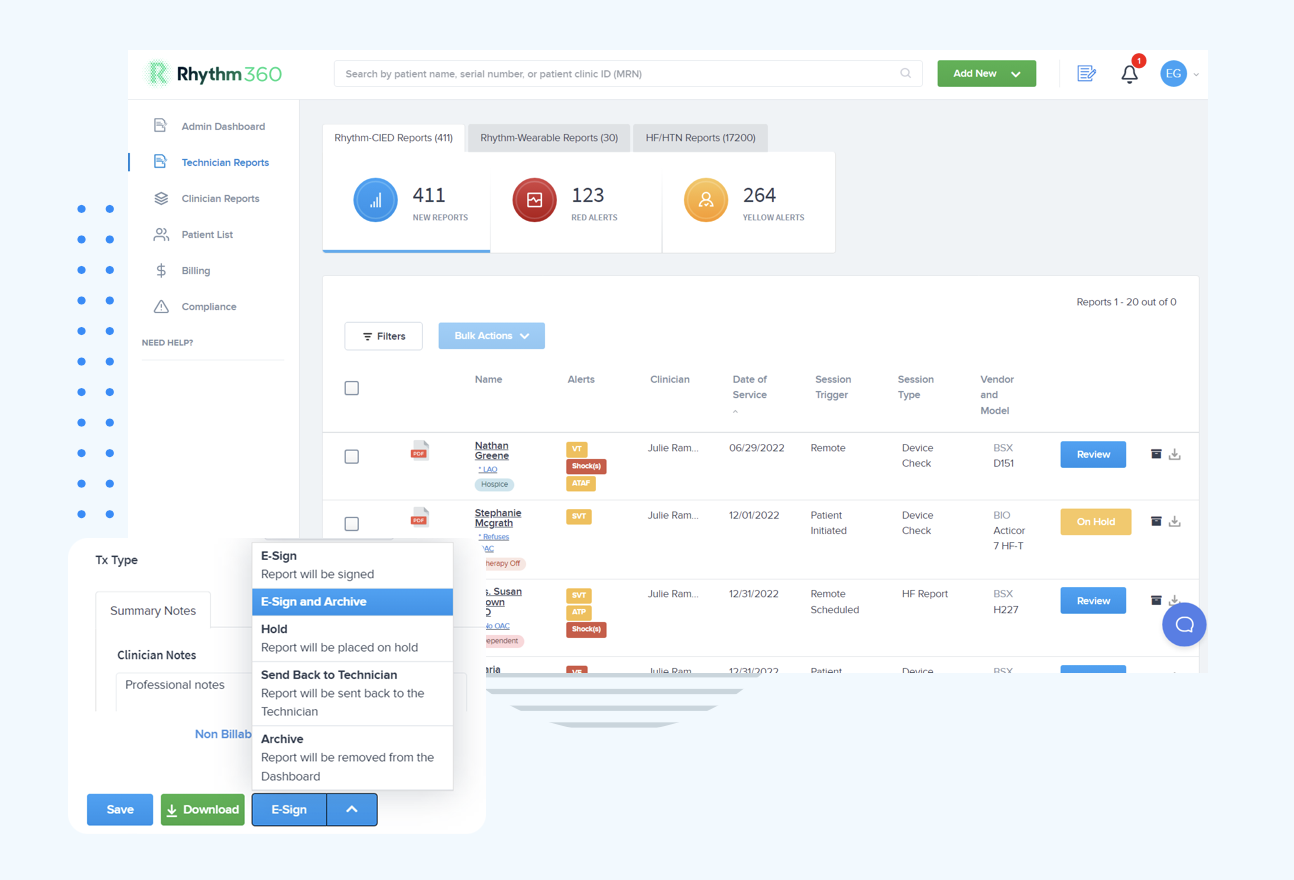
Key operational gains Rhythm360 delivers include:
Learn how Rhythm360 reduces administrative overhead for your device clinic staff
Rhythm360’s AI-powered alert triage filters non-actionable transmissions and surfaces clinically significant events, including ventricular arrhythmias, lead failures, ERI/RRT indicators, and new-onset atrial fibrillation, with enough context for immediate clinical action. This AI-powered triage delivers the 80% faster response mentioned earlier, compared to manual, portal-by-portal workflows.
The 2023 international consensus statement on remote device clinics reports that customized alert programming reduced alert frequency to roughly one per patient-year while increasing actionability of remaining alerts. Rhythm360’s AI triage layer applies this principle at scale.
Preventing a Catastrophe: What Faster Response Looks Like in Practice
- Rhythm360 flags a critical arrhythmia on a Saturday morning. By Saturday afternoon, the patient is on anticoagulants or has had their device reprogrammed, an intervention that might have waited until the next scheduled clinic visit without real-time alerting.
- A nurse receives a prioritized notification of new-onset AFib on a weekend and immediately initiates anticoagulation protocols, preventing a potential stroke.
- “We are able to address these issues earlier; rather than waiting for a 3-month visit, we can call patients in for evaluation.” — University of Chicago Medicine clinician
Discover how Rhythm360’s alert triage system protects patients and reduces clinician anxiety
2026 Medicare Reimbursement Snapshot for CIED and RPM
Cardiology practices often need clear numbers on remote monitoring costs and 2026 Medicare reimbursement. The table below summarizes current fee schedule data for key codes.
CPT Code Service Description Billing Window 2026 Medicare Rate 93294 Remote interrogation, pacemaker/ICD, professional component Minimum 30 days; no more than once per 90 days Varies by locality; billed under 2026 MPFS 93296 Remote monitoring platform, technical component Paired with 93294 or 93295 Billed by entity operating the monitoring service 93298 ILR/ICM technical component; 2026 updates reduced minimum monitoring period, easing qualification for shorter ILR windows 2–15 day monitoring period Billed per clinically indicated transmission period 99454 RPM device supply, 16+ days of readings in a 30-day period Per calendar month $52.11 national average Two new RPM codes took effect January 1, 2026: one covering 2 to 15 days of transmitted home physiologic data in a 30-day period and one covering 10 to 19 minutes of treatment management time in a calendar month. The 2026 Medicare conversion factor is $33.57 for qualifying alternative payment model participants and $33.40 for all other providers.
Rhythm360 automates the tracking of 30- and 90-day billing windows and generates compliant documentation for each billable event. This automation directly addresses the most common source of denied claims in device clinic billing.
EHR Integration and Billing Automation with Rhythm360
HL7 v2.x remains the dominant protocol for approximately 90% of US hospital interface traffic in 2026, while FHIR serves as the strategic modern layer for mobile, cloud, and app-based integrations. Production medical device projects typically support both. Rhythm360 is built on this dual-protocol foundation, supporting bi-directional integration with Epic, Cerner, Athenahealth, eClinicalWorks, Greenway Health, and others.
Modern FHIR-based API integration pulls real-time patient context, including medications, diagnoses, hospitalizations, labs, and cardiac function, from the EHR at the moment of alert review. Clinicians no longer need to switch systems. Rhythm360 applies this architecture so that when a clinician opens an alert, anticoagulation status, recent medication adjustments, and hospitalization history already appear in the same view.
Direct integration between clinical documentation and billing systems pre-populates CPT codes, ICD-10 diagnoses, place of service, and provider credentials from the clinical record. This approach eliminates the most common source of coding errors and claim denials. This automated CPT capture is the mechanism behind the revenue lift documented in the key takeaways. As one University of Chicago Medicine clinician confirmed after implementation: “We have improved billing and accountability for our patients after the integration.”
Implementation Timeline and Contract Planning
Rhythm360’s onboarding process, including EHR integration setup, typically takes from a few days to a few weeks. This timeline is significantly faster than the 3–9 month schedules associated with custom enterprise EHR integration projects. The platform uses a SaaS-based pricing model that scales with clinic size and platform usage, removing the high setup fees and rigid licensing structures common in legacy on-premise systems.
Practical implementation of remote monitoring in heart failure care requires integration with electronic health records and prescribing systems, plus training and role definition for nurses, pharmacists, and physicians. Rhythm360’s implementation team manages this process end to end, including role-based access configuration, staff training, and compliance documentation setup.
Key implementation considerations for cardiology practices follow a logical sequence. First, confirm EHR compatibility (Epic, Cerner, Athenahealth, eClinicalWorks, Greenway Health, or HL7-compatible systems) to establish the technical foundation. Next, identify which OEM device populations (Medtronic, Boston Scientific, Abbott, Biotronik) require data migration or portal decommissioning, since this step defines the scope of data consolidation. Once the data sources are mapped, establish role-based access for physicians, NPs, PAs, RNs, and device technicians so each team member sees only information relevant to their workflow. Then configure alert thresholds and escalation pathways aligned with practice protocols, building on the access structure you have defined. Finally, review HIPAA Business Associate Agreement requirements before go-live to ensure all compliance documentation is in place.
Get a practice-specific implementation timeline and pricing estimate
Evidence and Validation from High-Volume Programs
University of Chicago Medicine reviewed more than 73,000 reports annually through Rhythm360 in calendar year 2025, averaging more than 18,000 reports per quarter, a volume that demonstrates the platform’s capacity to support high-complexity academic cardiology programs without degrading alert quality or response times.
The clinical team at UCM specifically cited the value of consolidated, expert-reviewed data: “That was a big piece for us, to have an integrated review of data from trained personnel.”
These outcomes align with the broader evidence base. The 2023 Heart Rhythm Society consensus statement recommends remote monitoring as the primary mode of follow-up for pacemakers, ICDs, CRTs, and implantable loop recorders. The 2023 HRS/EHRA/APHRS/LAHRS international consensus statement recommends a minimum staffing ratio of 3.0 full-time equivalents per 1,000 patients on remote cardiac monitoring, a benchmark Rhythm360 automation helps practices meet without proportional headcount increases.
Frequently Asked Questions
Is Rhythm360 truly vendor-neutral, and which device manufacturers does it support?
Rhythm360 ingests and normalizes data from all major cardiac implantable electronic device manufacturers, including Medtronic, Boston Scientific, Abbott, and Biotronik, without requiring practices to favor any single OEM. The platform uses a combination of direct API connections, HL7 feeds, XML parsing, and AI-powered computer vision to extract data from unstructured PDFs, achieving the transmissibility rate outlined earlier. A redundant data feed system acts as a fail-safe if any manufacturer’s server experiences downtime, ensuring no transmission is lost due to a third-party technical failure.
How long does onboarding take, and will it disrupt our current clinical workflow?
Rhythm360 implementation, including EHR integration, typically takes from a few days to a few weeks depending on practice size and the number of EHR systems involved. The platform supports Epic, Cerner, Athenahealth, eClinicalWorks, Greenway Health, and other HL7-compatible systems. RhythmScience’s implementation team manages role configuration, staff training, and compliance documentation setup to minimize disruption. The SaaS-based pricing model removes large upfront infrastructure costs, and the platform scales as your monitored patient population grows.
How does Rhythm360 reduce alert fatigue without causing clinicians to miss critical events?
Rhythm360 uses an AI-powered alert triage system that filters non-actionable transmissions and prioritizes clinically significant events, such as new-onset atrial fibrillation, ventricular tachycardia, lead failures, and ERI/RRT indicators, before they reach the clinical team. Practices can also access optional 24/7/365 oversight by certified cardiac technicians (CCTs) supervised by physicians, adding a human clinical judgment layer to the automated triage. The combined effect achieves the response-time improvement outlined in the key takeaways. Customized alert programming, consistent with the 2023 HRS international consensus statement’s recommendation, further reduces alert frequency while increasing the actionability of remaining notifications.
How does Rhythm360 automate CPT code capture for CIED remote monitoring?
Rhythm360 automatically tracks the 30- and 90-day billing windows required for CPT codes 93294, 93295, 93296, 93297, and 93298. When a billable event occurs, the platform generates compliant documentation, including patient demographics, device type and manufacturer, monitoring period dates, and a structured clinician interpretation note, and pre-populates the relevant CPT and ICD-10 codes. This documentation flows directly into the billing workflow via bi-directional EHR integration, eliminating the manual tracking errors and missed windows that are the most common root cause of denied claims in device clinic billing. Practices using Rhythm360 have achieved the revenue improvements outlined earlier as a result of this automated approach.
Can clinicians access Rhythm360 on mobile devices when they are on call or away from the office?
Rhythm360 includes a secure, HIPAA-compliant mobile application that allows electrophysiologists, cardiologists, NPs, PAs, and RNs to review transmissions, sign reports, and coordinate care from their smartphones at any time. All communications initiated through the platform, including automated patient messages and manual phone calls logged via the integrated Twilio framework, are tracked with a full audit trail within the patient record. This mobile capability is particularly valuable for weekend and after-hours coverage, enabling same-day clinical intervention that prevents adverse outcomes such as stroke or device-related syncope.
Conclusion: What a Unified CIED Platform Delivers
Managing CIED data across multiple manufacturer portals creates administrative overload, alert fatigue, missed clinical events, and preventable revenue leakage. These problems do not represent inherent features of remote cardiac monitoring. They arise from fragmented infrastructure. Rhythm360 by RhythmScience resolves each of these problems through a single vendor-neutral, AI-powered platform that unifies all CIED and RPM data, automates CPT capture, improves critical alert response times, and integrates bi-directionally with the EHR systems cardiology practices already use. The University of Chicago Medicine’s experience, the high-volume deployment detailed earlier, provides a real-world benchmark for what consolidated, intelligent remote monitoring delivers at scale.
Read Next