Last updated: July 14, 2026
Fragmented OEM portals impose a compounding administrative burden on heart failure programs. Staff maintain separate logins, reconcile conflicting data formats, and manually transcribe readings into the EHR. This workflow creates data silos and delays intervention. The clinical cost is measurable: traditional monitoring methods such as symptom onset, weight gain, and blood pressure changes represent late-stage fluid markers with limited sensitivity and timeliness for detecting heart failure decompensation.
The case for combining pulmonary artery pressure with daily weight data is now well-supported. A 2025 USC Keck School of Medicine case series showed that integrating CardioMEMS pressure monitoring with Bodyport cardiac scale data improved remote titration of diuretics and guideline-directed medical therapy. Separately, research in Circulation found that weight gain begins at least one week before HF hospitalization, and any gain greater than 2 pounds increases hospitalization risk in a monotonic fashion.
Revenue leakage compounds the clinical risk. Without a centralized system tracking billable events, practices miss CPT codes, generate rejected claims, and leave recurring monthly revenue uncaptured. A January 2026 scientific statement from HFSA and AAHFN identifies interoperability as foundational, since seamless data flow between devices, EHRs, and clinicians forms the basis of integrated care and efficient triage.
The gaps described above call for a platform built specifically to close them. Rhythm360 by RhythmScience is a vendor-neutral platform that ingests data from Abbott CardioMEMS sensors alongside FDA-cleared Bluetooth weight scales, normalizing both streams into a single clinical workspace. It connects via API, HL7, XML, and PDF parsing through computer vision and AI-powered data mapping. Redundant data feeds achieve greater than 99.9% transmissibility, staying active even during OEM server downtime.
A device technician or NP logs into one dashboard to view pulmonary artery diastolic pressure trends alongside daily weight trajectories, without switching portals. Pairing invasive CardioMEMS data with noninvasive scale measurements gives a more complete picture of volume status, including cases where CardioMEMS readings show variability or discordance with symptoms. Rhythm360's unified view surfaces these discordances immediately rather than leaving them buried across disconnected portals.
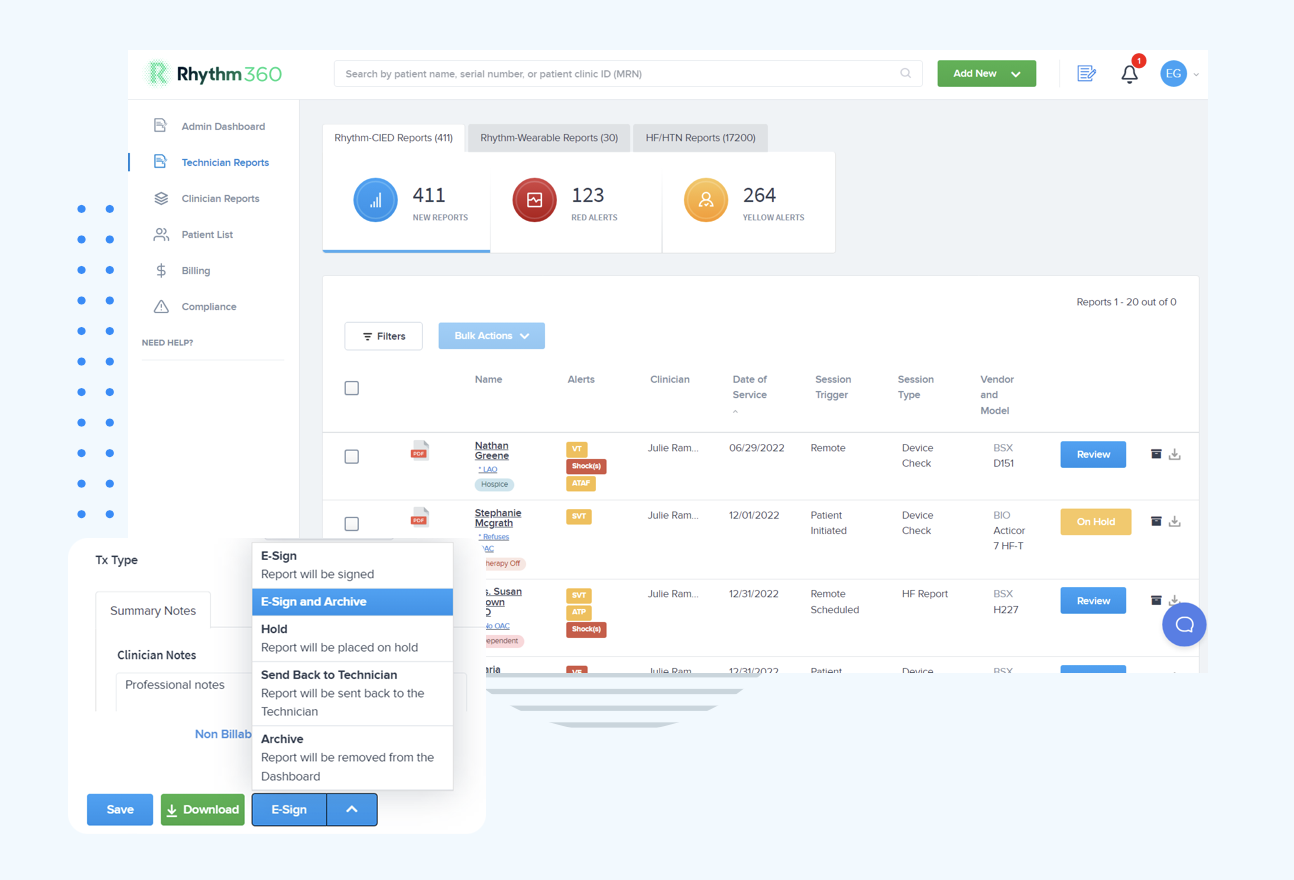
Bi-directional EHR integration with Epic, Cerner, Athenahealth, eClinicalWorks, Greenway Health, and others via HL7 writes normalized CardioMEMS and scale data back to the patient record automatically. Discrete data writing into Epic and Cerner normally requires custom interface work through vendor APIs, but Rhythm360 has already built that infrastructure. Onboarding takes a few days to a few weeks.
The 2026 Medicare Physician Fee Schedule introduced two new RPM codes and raised reimbursement across the existing set. This gives heart failure programs a more complete billing framework for managing multiple monitoring devices at once.
The complete 2026 RPM code set and national average non-facility reimbursement rates:
Digital weight scales and cardiac implantable devices qualify for CPT 99454 when they support automatic daily transmission, but only one device-supply code can be submitted per patient per 30-day period, even with multiple qualifying devices. When a patient uses multiple RPM devices, daily readings from all of them are totaled to determine whether 99445 or 99454 applies.
A cardiology practice with 100 Medicare RPM patients billing 99454 plus 99457 consistently can generate substantial recurring annual revenue, and adding 99458 on a portion of patients increases it further, but only if every billable event is captured accurately. Rhythm360 closes that gap by tracking transmission days, logging clinical staff time, and timestamping interactive communications automatically, preventing the revenue leakage described above without manual reconciliation.
Automated billing solves one half of the workflow problem. Alert fatigue is the other, and it's a documented clinical risk in heart failure programs managing high volumes of CardioMEMS transmissions alongside scale data. One physician summarized it this way: "We're burdened with information overload basically. So it helps process it in a way that's patient care-focused, and it gives us more tools to help optimize patients."
Rhythm360's AI-powered alert triage engine filters non-actionable transmissions and surfaces clinically significant events in a prioritized queue. It flags elevated pulmonary artery diastolic pressure, acute weight gain exceeding 2 lbs in 24 hours or 5 lbs in 7 days, new-onset arrhythmias, and device anomalies. The result is an 80% reduction in critical-alert response time compared with manual, portal-by-portal review.
In a nonrandomized study of heart failure patients, an AI-enabled virtual HF care platform handled most red alerts within 48 hours. Many were resolved at the first step by LVNs and RNs, with none requiring escalation to HF cardiologists. The January 2026 HFSA/AAHFN statement reinforces that remote monitoring works best when clinicians respond with timely, actionable feedback rather than just data uploads.
Rhythm360 also offers an optional 24/7/365 oversight layer staffed by certified cardiac technicians supervised by physicians. A critical pressure spike or weight gain event on a weekend gets the same triage response as one during business hours, a capability that directly prevents hospitalizations and adverse outcomes.
The table below shows how each core capability translates into a specific clinical or operational benefit for heart failure programs.
| Capability | Rhythm360 Feature | Clinical / Operational Benefit |
|---|---|---|
| Vendor-Neutral Connectivity | Ingests data from Abbott CardioMEMS, Medtronic, Boston Scientific, Biotronik, FDA-cleared Bluetooth scales, and others via API, HL7, XML, and computer-vision PDF parsing | Eliminates multiple OEM portal logins; single source of truth for all device data |
| Data Transmissibility | Greater than 99.9% transmissibility via redundant data feeds and AI-powered extrapolation | No critical events missed due to OEM server downtime or data gaps |
| Bi-Directional EHR Integration | Native integrations with Epic, Cerner, Athenahealth, eClinicalWorks, Greenway Health, and others via HL7; onboarding in days to weeks | Eliminates manual transcription; CardioMEMS and scale data write directly to the patient record |
| AI Alert Triage | AI engine prioritizes clinically significant events and filters non-actionable transmissions | Reduces alert fatigue and cuts critical-alert response time by 80% |
| Automated CPT Documentation | Tracks transmission days, logs clinical staff time, timestamps interactive communications; supports 99453, 99445, 99454, 99470, 99457, 99458 | Captures up to 300% more revenue; reduces rejected claims and billing errors |
| Mobile Access | HIPAA-compliant mobile app for iOS and Android; clinicians review transmissions, sign reports, and coordinate care from any location | Enables on-call response to critical alerts outside office hours |
| 24/7 CCT Oversight Option | Optional around-the-clock monitoring by certified cardiac technicians supervised by physicians | Ensures continuous triage coverage; prevents missed critical events on nights and weekends |
The clinical evidence supporting unified CardioMEMS and scale monitoring is substantial. The 2026 COAST registry of 304 NYHA class III heart failure patients across 37 centers in six countries found that CardioMEMS monitoring reduced annualized heart failure hospitalizations. The MONITOR-HF trial showed improved KCCQ quality-of-life scores at 12 months and reduced HF hospitalizations compared with standard care.
Practices deploying Rhythm360 translate this clinical evidence into measurable operational results. University of Chicago Medicine implemented Rhythm360 to overhaul cardiovascular remote monitoring across its CIED and heart failure populations. UCM reviewed more than 73,000 reports in 2025, averaging over 18,000 per quarter. Andrew Beaser, MD, Associate Professor of Medicine at UCM, noted that the implementation let clinicians review more transmissions daily and identify more abnormalities. UCM also reported: "We have improved billing and accountability for our patients after the integration."
Across Rhythm360 deployments, practices have paired this 80% drop in alert response time with up to a 300% increase in revenue, driven by optimized CPT code capture, improved staff efficiency, and new RPM service lines for heart failure and hypertension management.
Talk to our team about replicating UCM's results at your practice.
Evaluating a unified remote monitoring platform in 2026 means assessing capabilities across five dimensions. A platform that fails any one of them creates operational gaps that translate directly into missed clinical events and lost revenue.
Rhythm360 satisfies all five criteria with SaaS-based pricing that scales with clinic size and usage. Onboarding, including EHR integration, takes days to weeks rather than months.
Yes, but with an important constraint. In 2026, CMS permits only one device-supply code per patient per 30-day billing period, regardless of how many qualifying devices the patient uses. Daily readings from all devices are totaled to determine whether CPT 99445 or CPT 99454 applies for that month. The two codes are mutually exclusive. Treatment management codes 99470, 99457, and 99458 are billed separately based on cumulative clinical staff time and aren't affected by device count. Rhythm360 automates this tracking, aggregating transmission days across all connected devices and logging staff time so the correct code combination applies at the end of each billing period.
Rhythm360's onboarding, including EHR integration, typically takes a few days to a few weeks. The timeline depends on integration depth and the health system's internal project resources. Rhythm360 supports bi-directional integration with Epic, Cerner, Athenahealth, eClinicalWorks, Greenway Health, and others via HL7, FHIR R4, and XML. The platform has already completed vendor review and API registration for major EHR systems, eliminating the longest phase of most integration projects. Practices that assign a dedicated integration lead see the fastest go-live timelines. Greenfield integration projects can take 6 to 18 months; Rhythm360's pre-built connectors are designed to avoid that delay.
Rhythm360's AI triage engine works from a data set that's over 99.9% complete, thanks to redundant data feeds, computer vision, and AI-powered extrapolation. The system filters non-actionable transmissions and prioritizes clinically significant events, including elevated pulmonary artery diastolic pressure, acute weight gain, new-onset arrhythmias, and device anomalies. This is the same triage improvement described earlier, and it supports both faster clinical response and stronger compliance documentation. For added assurance, Rhythm360 offers an optional 24/7/365 oversight layer staffed by certified cardiac technicians supervised by physicians. Every alert disposition is logged with a full audit trail in the patient record.
The evidence base has strengthened considerably through 2025 and 2026. The COAST registry and the MONITOR-HF trial both link CardioMEMS monitoring to fewer hospitalizations and better quality-of-life scores. A 2025 USC Keck School of Medicine case series found that pairing CardioMEMS data with Bodyport scale readings gave clinicians a more complete picture of volume status, particularly when pressure readings showed variability or discordance with symptoms. Scale fluid index alarms in that study prompted timely outpatient medication adjustments that prevented rehospitalization. The January 2026 HFSA/AAHFN statement concludes that outcomes improve only when digital data pairs with defined workflows, clinician accountability, and rapid response, which is the operational model Rhythm360 is built to support.
Fragmented OEM portals create three compounding problems: administrative overload for staff, delayed interventions for patients, and steady revenue leakage for practices. The 2026 CPT landscape, with new codes and stricter documentation requirements, raises the stakes for programs still relying on manual billing processes.
Rhythm360 addresses each piece of that problem with one platform. Vendor-neutral connectivity brings CardioMEMS and Bluetooth scale data into a single dashboard. Bi-directional EHR integration removes manual transcription. Optional 24/7 CCT oversight means no critical event goes unaddressed regardless of time or day. These billing and triage efficiencies are what drove UCM's results, and they're available to any practice ready to move off fragmented portals.
Find out how much RPM revenue your program could be missing.