

Cardiology teams that implant devices from more than one manufacturer, such as Medtronic, Boston Scientific, Abbott, or Biotronik, must manage separate logins and interfaces for each portal. Staff then reconcile data that was never designed to work together. Over time, these disconnected steps create interlocking operational and clinical problems.
Alert volume becomes the first major pressure point. Between 40% and 90% of clinical alarms in hospital ICU settings are false or non-actionable, depending on alarm type. A 2014 observational study of arrhythmia alarms in PLOS ONE found that 88.8% of 12,671 annotated alarms were false positives. When clinicians cannot separate signal from noise, critical events such as new-onset atrial fibrillation, ventricular tachycardia, or device malfunction are more likely to be missed or delayed.
Downstream effects appear quickly. In a 2025 physician survey, 81% of respondents reported feeling overwhelmed by prescription alert volume, and 55% admitted to dismissing alerts without reading them. Device technicians burn out. Specialized staff leave. Without a centralized system that tracks billable transmission days or clinical time logs, CPT codes go uncaptured and claims are denied or never submitted.
These fragmented workflows require a different architecture that unifies data streams before they reach clinical staff and billing teams.
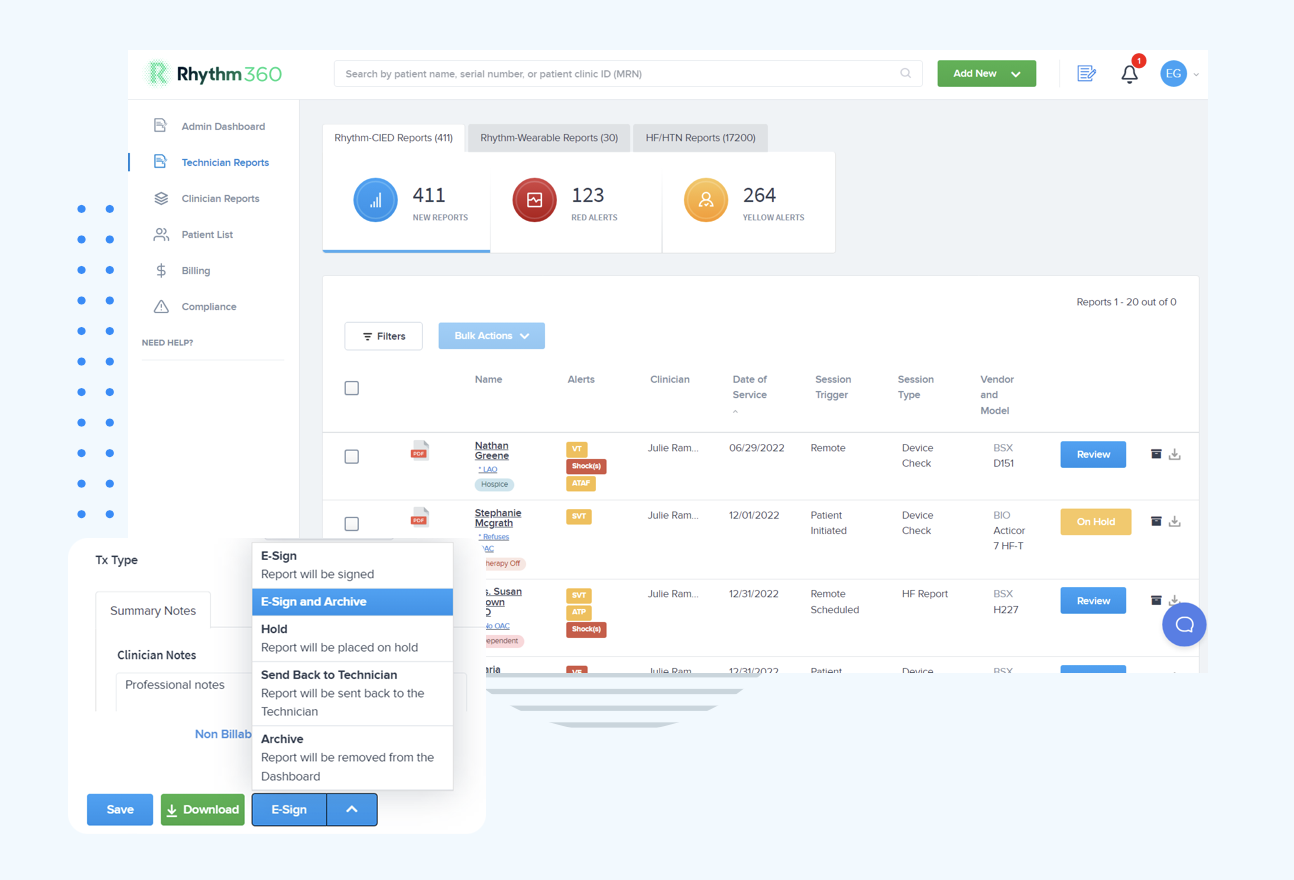
Workflow automation for RPM in cardiology uses a platform layer between device manufacturer infrastructure and the clinical EHR. This layer performs four core functions: data ingestion and normalization, AI-driven alert prioritization, bidirectional EHR integration, and automated CPT documentation. The architecture follows a consistent flow.
Rhythm360 is RhythmScience's cardiology-specific implementation of this architecture. It supports both CIED monitoring and chronic-condition RPM service lines within a single vendor-neutral platform.
Any workflow automation platform for cardiology RPM must meet specific technical and clinical requirements.
Centralizing multi-OEM CIED and RPM data into a single automated platform produces measurable operational and clinical gains across practice sizes.
Administrative burden drops quickly. Automation in RPM platforms can reduce clinician workload on repetitive tasks after implementation. Staff no longer maintain redundant portal logins or perform manual data transcription. Less repetitive administrative work supports device technician retention and reduces turnover risk.
Clinical response times improve as alert quality improves. When AI triage filters non-actionable transmissions and escalates only clinically significant events, on-call clinicians can respond to a Saturday morning arrhythmia alert and have a patient on anticoagulants or scheduled for device reprogramming by Saturday afternoon. Fragmented manual workflows often delay or miss that type of intervention.
The University of Chicago Medicine (UCM) experience with Rhythm360 shows these benefits at scale. UCM reviewed more than 73,000 reports annually through Rhythm360 in calendar year 2025, averaging more than 18,000 reports per quarter. Andrew Beaser, MD, Associate Professor of Medicine at UCM, noted, "We are able to address these issues earlier; rather than waiting for a 3-month visit, we can call patients in for evaluation." Gaurav A. Upadhyay, MD, at UCM, observed, "We have improved billing and accountability for our patients after the integration."
CMS introduced two new CPT codes effective January 1, 2026. These codes expand billable pathways for RPM programs and raise documentation expectations.
OIG issued an August 2025 data snapshot on Medicare RPM billing growth and oversight needs but did not flag RPM programs in its Fall 2025 Semiannual Report to Congress. CMS requires that every minute of clinical staff time for CPT 99457 and 99458 be documented with timestamps, staff identity, activity performed, and whether interactive patient communication occurred. Vague entries are increasingly flagged in audits. Treatment-management codes 99470, 99457, and 99458 require documented clinical time plus at least one interactive communication with the patient or caregiver each month.
Rhythm360 automates time logging, transmission-day counting, and interactive communication records. The platform generates a billing-ready audit trail for every patient encounter without manual chart reconstruction.
Bidirectional EHR integration turns an RPM platform from a data repository into a clinical workflow tool. Platforms must push RPM encounter notes, alert documentation, time logs, and monthly summary reports back to the patient chart automatically. This flow closes documentation gaps that often cause denied claims.
Rhythm360 supports bidirectional HL7 integration with Epic, Cerner, Athenahealth, eClinicalWorks, Greenway Health, and other systems. Onboarding timelines, including EHR integration setup, typically range from a few days to a few weeks. The platform's HIPAA-compliant mobile application extends access beyond the workstation. Clinicians can review transmissions, sign reports, and coordinate care from any location, which is especially valuable for weekend and overnight alerts.
| Dimension | Manual / Legacy Methods | Automated Workflows with Rhythm360 |
|---|---|---|
| Data Reliability | Dependent on OEM server availability and manual transcription, and transmission gaps often go undetected. | >99.9% transmissibility via redundant data feeds, computer vision, and AI-powered extrapolation (as demonstrated at UCM's scale) |
| Critical-Alert Response Time | Delayed by manual portal checks, alert overload, and off-hours staffing gaps. | Significantly faster response to critical alerts through AI-driven triage and prioritized escalation. |
| CPT Code Capture Rate | Manual tracking with incomplete transmission-day counts and time logs, which leads to missed or denied claims. | Automated tracking of transmission days and clinical time logs for CPT 93298, 93299, 99453, 99454, and 99457 with audit-ready documentation. |
| Mobile Access | Typically workstation-bound, and on-call review often requires physical presence or VPN access to OEM portals. | HIPAA-compliant mobile app that enables transmission review, report signing, and care coordination from any location. |
| Staff Hours per Week | Significant clinician time spent on RPM-related administrative tasks. | Reduced clinician time on repetitive tasks after automation implementation. |
| Revenue Capture | Significant leakage from uncaptured CPT codes, incomplete documentation, and rejected claims. | Up to 300% increase in captured revenue through structured CPT documentation and automated billing support. |
Operational priorities for workflow automation vary by practice size and structure.
Rhythm360's implementation process minimizes disruption to existing clinical operations. EHR integration setup typically completes within days to a few weeks, depending on the health system's IT environment and the EHR platform in use. The automation layer absorbs most data ingestion, normalization, and documentation tasks, so practices do not need to hire additional staff to manage the transition.
HIPAA compliance is maintained throughout via the security infrastructure detailed earlier, including encryption, access controls, audit logging, and SOC 2 Type II certification. All infrastructure vendors operate under Business Associate Agreements. The SaaS-based pricing model scales with clinic size and platform usage, which avoids the high upfront costs associated with on-premise legacy systems.
Workflow automation in cardiology RPM replaces manual, portal-by-portal data retrieval with a platform layer that ingests device transmissions from all major CIED manufacturers automatically. The platform normalizes the data into a standardized format, applies AI-driven triage to filter non-actionable alerts and escalate clinically significant events, and pushes encounter notes, time logs, and alert records bidirectionally into the EHR. Clinical staff then spend time acting on prioritized information rather than retrieving and transcribing it. Rhythm360 extends this approach by supporting both CIED monitoring and chronic-condition RPM service lines, including heart failure and hypertension, within a single platform.
The 2026 codes, 99445 and 99470, detailed earlier, expand billable pathways for partial-month monitoring and shorter engagement sessions. These codes require more precise documentation than previous codes. Practices must record exact transmission days to distinguish 99445 from 99454 and must document interactive communication time to the minute to distinguish 99470 from 99457. Vague entries such as "reviewed RPM data, 20 minutes" are increasingly flagged in audits. OIG issued an August 2025 data snapshot on Medicare RPM billing growth and oversight needs but did not flag RPM programs in its Fall 2025 Semiannual Report to Congress. Rhythm360 automates transmission-day counting, timestamps every clinical interaction, logs staff identity and activity, and records interactive communication events to create a billing-ready audit trail.
Rhythm360's onboarding process, including EHR integration setup, typically takes from a few days to a few weeks, depending on the EHR platform and the health system's IT environment. The platform supports bidirectional HL7 integration with Epic, Cerner, Athenahealth, eClinicalWorks, Greenway Health, and other systems. Inbound flows include patient demographics, active problem lists, insurance information, and ordering provider data. Outbound flows push RPM encounter notes, alert documentation, time logs, and monthly summary reports back to the patient chart automatically. The integration fits within existing clinical workflows rather than forcing staff to adopt a parallel documentation process.
Rhythm360 achieves greater than 99.9% transmissibility through redundant data feeds, computer vision for PDF-based device reports, and AI-powered extrapolation that fills gaps when an OEM server is temporarily unavailable. This reliability matters directly for billing because CPT 99454 requires automated device transmissions on at least 16 separate days within a 30-day period, and CPT 99445 requires documented transmission on 2–15 days. If a transmission is missed due to a technical failure and not recovered, the patient may fall below the billing threshold for that month. Rhythm360's architecture helps prevent those gaps so that transmission-day counts remain accurate and billing documentation reflects actual monitoring activity.
Fragmented OEM portals, manual data retrieval, alert overload, and incomplete CPT documentation reflect workflows that predate purpose-built automation. A vendor-neutral, AI-powered orchestration platform that ingests multi-OEM CIED data, normalizes it into a single source of truth, applies intelligent alert triage, integrates with major EHRs, and automates compliant CPT documentation can remove each of those failure points.
Rhythm360 by RhythmScience is built specifically for cardiology RPM. The platform scales from solo EP practices that need rapid onboarding and mobile access to large health systems that process tens of thousands of annual reports. The University of Chicago Medicine's experience, including more than 73,000 reports annually, earlier interventions, and improved billing accountability, shows how this approach performs in production.





