Last updated: July 13, 2026
Once a cardiology or EP clinic implants devices from more than one manufacturer, staff start a daily login marathon across non-interoperable OEM portals. The Heart Rhythm Society's white paper on CIED interoperability confirms that clinicians must pull together data from multiple settings and multiple vendors to manage large numbers of CIED patients. Each manufacturer uses proprietary nomenclature and communication protocols for identical device features. Surveys of healthcare leaders show that most organizations face at least one data integration challenge that affects their ability to provide timely, high-quality care.
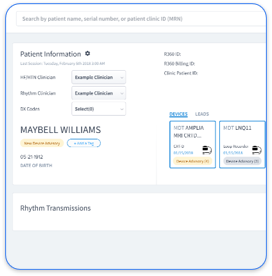
Rhythm360 ingests data via API, HL7, XML, and PDF parsing through computer vision, then normalizes every manufacturer's proprietary format into a single source of truth. Device technicians log in once and see every patient, every device, and every transmission in one place, with no tab switching.
Device clinics process thousands of transmissions every year, and many alerts are clinically non-relevant. That volume overwhelms even experienced staff. A cross-manufacturer analysis of 2,659 rhythm episodes from 1,710 patients found that even in AI-equipped implantable cardiac monitors, 32.9% of episodes were non-actionable and 30.6% were indeterminate. As Niraj Varma, MD, PhD, Professor of Medicine at the Cleveland Clinic, stated, false-positive alerts remain one of the biggest operational challenges in remote cardiac monitoring.
Rhythm360's AI-powered alert triage system filters non-actionable noise at the platform level and prioritizes clinically significant events such as new-onset AFib, ventricular tachycardia, lead malfunction, and ERI or RRT indicators. Clinical staff focus on alerts that demand attention. Clinics using this approach report up to an 80% reduction in critical alert response times.
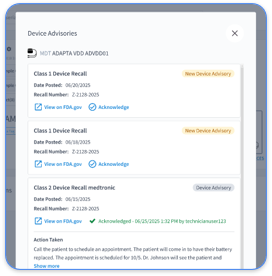
Many clinics now manage thousands of devices, and manual workflows cannot safely absorb that volume. Shannon Sorescu, Certified Cardiac Device Specialist at Emory University Hospital Midtown, reported that by using an automated platform, her team identified 7% more affected patients missing from manufacturer advisory lists and cleared their highest-risk patients within 24 hours.
Rhythm360 reaches greater than 99.9% transmissibility through redundant data feeds, computer vision, and AI-powered extrapolation. This fail-safe remains active even when an OEM server goes down. At the University of Chicago Medicine, implementing Rhythm360 enabled clinicians to review more transmissions each day and identify more abnormalities. As Andrew Beaser, MD, Associate Professor of Medicine at UCM, explained, the team can address issues earlier and bring patients in for evaluation instead of waiting for a three-month visit.
Without a centralized system tracking billable events, practices routinely miss CPT codes 93298, 93299, 99454, and 99457. These codes represent recurring monthly revenue. An international survey of 471 device clinic staff across 44 countries found that 45% of device clinics do not measure remote monitoring program performance in any structured way, and of those that do, only 29% track quality-related metrics. Undocumented monitoring periods, missing transmission logs, and incomplete consent records remain common denial triggers.
Rhythm360 automates CPT code capture and generates audit-ready documentation for every billable event. Gaurav A. Upadhyay, MD, at the University of Chicago Medicine, noted that billing and accountability improved after integration. Practices using Rhythm360 have captured up to 300% more revenue through stronger CPT documentation and new RPM service lines for heart failure and hypertension patients.
See how Rhythm360 automates CPT capture and closes billing gaps with a personalized walkthrough.
Beyond revenue capture, operational efficiency also depends on clinical accessibility. When critical events occur outside business hours, rapid response becomes a patient safety issue, so on-call mobility is the next challenge vendor-neutral platforms address.
Being tethered to a workstation creates risk for patients and stress for clinicians. When a critical arrhythmia fires on a Saturday morning, the clinician on call needs to review the transmission, sign the report, and start a care protocol from wherever they are. Legacy systems and OEM portals rarely support mobile-first clinical review.
Rhythm360's secure, HIPAA-compliant mobile application allows electrophysiologists, cardiologists, NPs, and PAs to review transmissions, sign reports, and coordinate care from their smartphones. A critical AFib alert flagged on Saturday morning can lead to anticoagulation by Saturday afternoon. Desktop-only workflows often miss that window.
An international survey of 471 device clinic staff across 44 countries found that 42% rated their staffing as somewhat or very insufficient, while only 43% rated it sufficient. The three tasks staff were most willing to outsource were managing disconnected patients, initial transmission review, and patient phone calls. These tasks consume the most time in fragmented, multi-portal environments.
As Marcus Pritchett, Cardiac Device Specialist at the Kansas City Heart Rhythm Institute, explained, unmanaged data growth creates bottlenecks and raises the risk of missed clinically relevant information. Rhythm360 addresses this by automating initial transmission review, report generation, and patient communication logging. Clinics reduce reliance on a single super-user and maintain business continuity even when specialized staff turn over.
A cardiac rhythm management (CRM) program is the clinical and operational infrastructure a cardiology or EP practice uses to monitor, document, and respond to data from CIEDs. These devices include pacemakers, ICDs, CRT devices, implantable loop recorders, and CardioMEMS pulmonary artery monitors. The HRS identifies primary clinical concerns for CIED management as evaluating battery status, programmed parameters, arrhythmias, and therapies delivered. All of these tasks require reliable, consolidated data access.
Rhythm360 serves as the operational backbone of a modern CRM program. The platform integrates connected service lines for CIED monitoring and RPM for heart failure and hypertension into a single workspace, so teams manage one workflow instead of several disconnected ones.
Device selection in EP clinics works best when clinicians choose hardware based on clinical needs, not software constraints. Pacemakers, ICDs, CRT devices, and implantable loop recorders from Medtronic, Boston Scientific, Abbott, and Biotronik all capture clinically valuable data. That data becomes actionable only when it reaches the clinical team reliably, in a normalized format, with intelligent triage applied. The HRS notes that the growing number of CIED patients has created an exponential quantity of data that must be sorted, interpreted, acted upon, and stored.
Rhythm360 supports all major CIED types and manufacturers. This support allows physicians to treat device choice as a clinical decision while the platform manages data flow and review.
The following table summarizes Rhythm360's key technical and clinical capabilities and the outcomes clinics report.
| Capability | Rhythm360 |
|---|---|
| Data Transmissibility | >99.9% via redundant feeds, computer vision, and AI extrapolation |
| Critical Alert Response Time Reduction | Up to 80% |
| Revenue Capture Improvement | Up to 300% through stronger CPT documentation and RPM service lines |
| Annual Report Volume (UCM, 2025) | 73,000+ reports annually (UCM, 2025) |
| OEM Compatibility | Medtronic, Boston Scientific, Abbott, Biotronik, and other manufacturers |
| EHR Integration | Bi-directional with Epic, Cerner, Athenahealth, eClinicalWorks, Greenway Health, and others via HL7 |
| Implementation Timeline | Days to weeks, including EHR integration setup |
Rhythm360 ingests data from every major CIED manufacturer through direct APIs, HL7 feeds, XML parsing, and AI-powered computer vision applied to unstructured PDFs. The platform normalizes every transmission into a consistent data model. A device technician reviewing a Medtronic pacemaker and a Boston Scientific ICD on the same patient sees both in one interface with the same field structure and no portal switching.
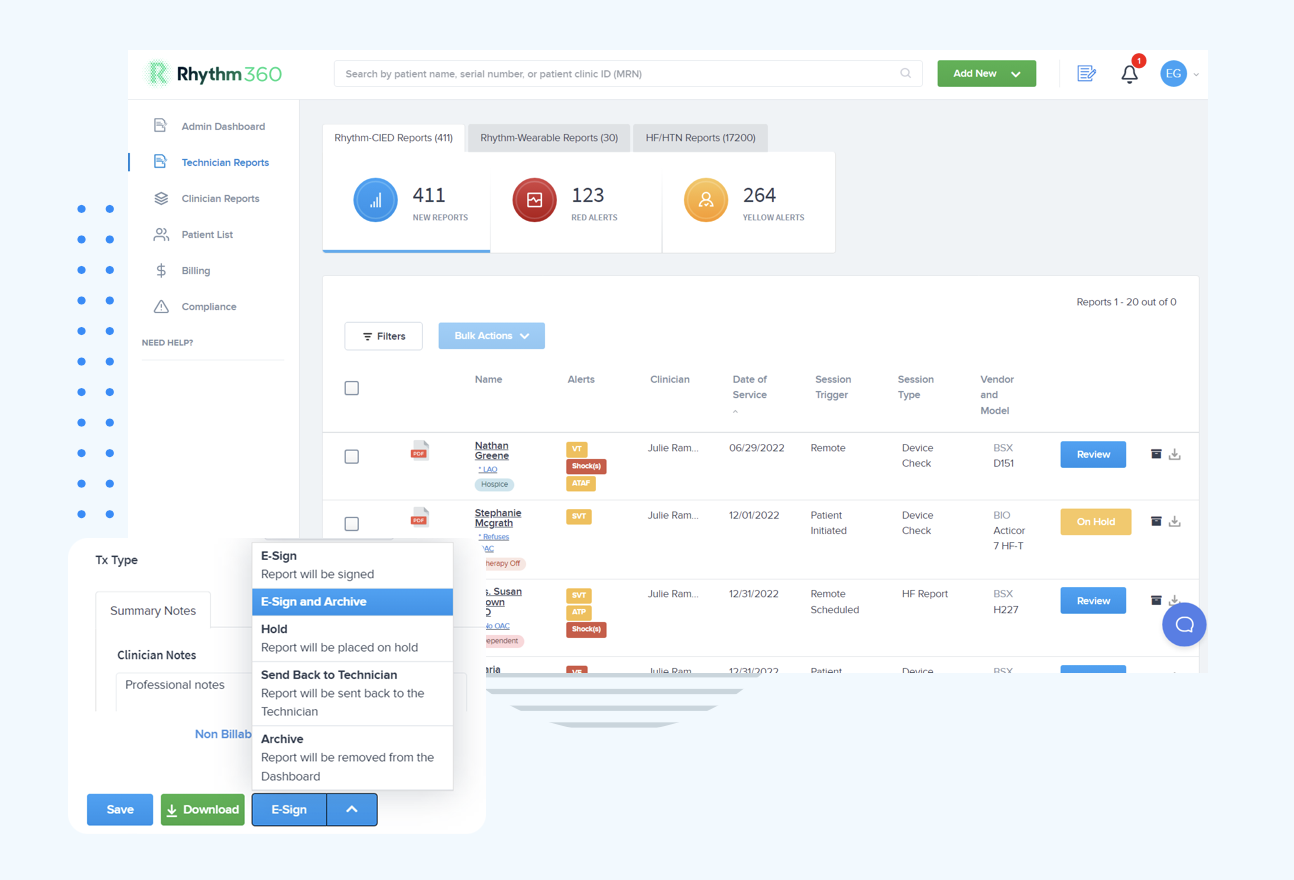
The administrative dashboard gives a real-time overview of patient compliance, critical alerts, and billable activity. Clinics replace fragmented, error-prone manual workflows with a single, consistent view.
In the LINK-HF2 trial, 95% of AI-generated heart failure alerts were reviewed by clinicians within 24 hours, and 26.7% led to clinical action such as therapy adjustment. These results show that AI-filtered alerts can drive meaningful clinical response rates. Real-world implementations of AI in cardiovascular medicine also report fewer diagnostic errors and faster emergency interventions. As Andrew Beaser, MD, at UCM noted, AI-assisted decision support will become increasingly important as data volumes grow.
Rhythm360's AI triage layer applies this principle at scale across manufacturers. The platform also offers optional 24/7/365 oversight by certified cardiac technicians (CCTs) supervised by physicians. Practices that want additional coverage gain a human-in-the-loop layer without adding permanent headcount.
Watch Rhythm360's AI alert triage filter real transmissions in a live demo.
Remote cardiac monitoring billing spans two CPT code families. CIED-specific monitoring uses codes such as 93298, which covers the technical component for ILR or ICM monitoring over a 2–15 day period, and 93299. Medicare's 2026 updates reduced the minimum monitoring period for CPT 93298.
For RPM service lines, the active 2026 code set includes:
Rhythm360 documents every qualifying event, including transmission logs, timestamps, interactive communication records, and consent confirmation. Billing staff submit complete, audit-ready claims instead of chasing missing documentation. A practice monitoring 200 RPM patients at the standard tier generates about $19,800 per month, or $237,600 per year, from RPM alone under 2026 national average rates.
Rhythm360's HIPAA-compliant mobile application extends the full clinical workflow to any smartphone. The on-call workflow follows these steps:
This workflow prevents critical events from sitting unreviewed until Monday morning because the on-call clinician lacked remote access.
Rhythm360's onboarding process, including EHR integration with Epic, Cerner, Athenahealth, eClinicalWorks, Greenway Health, and others via HL7, typically completes in days to weeks. Epic's App Orchard review process alone can take 2–6 months for new applications. Rhythm360's pre-built integration architecture and established EHR relationships shorten these timelines significantly.
The SaaS-based pricing model scales with clinic size and platform usage. Practices avoid rigid contracts that do not match their actual patient volume.
Rhythm360 delivers value in stages, and each stage enables the next.
AI alert triage applies machine learning models to incoming CIED transmissions and RPM data and classifies each alert as actionable, non-actionable, or indeterminate before it reaches a clinician's queue. In a manual workflow, every transmission requires human review, which delays attention to truly critical events. When AI filters out the large share of alerts that are non-actionable, clinical staff spend their time on events that require intervention, such as new-onset atrial fibrillation, ventricular tachycardia, lead malfunction, or significant weight gain in heart failure patients.
Rhythm360's AI triage layer, combined with optional 24/7/365 oversight by certified cardiac technicians, reduces critical alert response times by up to 80%. The platform also supports proactive care by flagging deteriorating trends before a patient reaches a crisis point.
Remote cardiac monitoring billing draws from two code families, depending on device type and service. For cardiac implantable electronic devices such as pacemakers, ICDs, CRT devices, and implantable loop recorders, relevant codes include 93294, 93295, 93296, 93297, 93298, and 93299. These codes cover professional interpretation and technical components of remote interrogation across device types and monitoring periods.
For remote physiological monitoring of chronic conditions such as heart failure and hypertension, the 2026 CMS code set includes 99453 for one-time setup, 99454 for device supply with 16 or more days of data, 99445 for device supply over 2–15 days, 99457 for the first 20 minutes of treatment management, 99470 for the first 10 minutes of treatment management, and 99458 for each additional 20 minutes. Rhythm360 automates documentation for all qualifying codes and generates transmission logs, time-stamped communication records, and consent confirmations that satisfy CMS audit requirements and reduce claim denials.
Transmissibility describes the percentage of scheduled device transmissions that are successfully received, processed, and made available for clinical review. When transmissibility drops, gaps appear in a patient's monitoring record and can conceal a critical arrhythmia, a device malfunction, or a worsening heart failure trajectory.
Rhythm360 reaches greater than 99.9% transmissibility through a redundant data feed architecture that maintains connectivity even when an OEM server experiences downtime. Computer vision and AI-powered extrapolation fill data gaps that would otherwise appear as missing transmissions in legacy systems. Clinicians make decisions based on a complete, cross-referenced view of device data instead of a partial record shaped by technical failures. At the University of Chicago Medicine, this infrastructure supported review of more than 73,000 reports annually with stable dismissal rates, showing that high transmissibility scales in high-volume environments.
Fragmented OEM portals, manual workflows, alert fatigue, missed critical events, billing documentation gaps, mobility constraints, and staffing strain all stem from monitoring infrastructure that has not kept pace with CIED volume growth. Rhythm360 addresses these challenges through a single, vendor-neutral, AI-powered platform that consolidates device data, automates CPT-compliant documentation, reduces critical response times by up to 80%, and supports up to 300% more revenue capture.
The University of Chicago Medicine's experience processing tens of thousands of reports annually on the platform shows that this model scales in demanding environments. Implementation typically takes days to weeks, and the value ladder starts with consolidation and extends to full RPM service line revenue capture.
Cardiology and EP clinics that continue managing multi-OEM environments through manual, portal-by-portal workflows absorb avoidable costs in staff time, missed events, and lost billing. A purpose-built platform replaces those costs with predictable, measurable outcomes.