Last updated: July 14, 2026
Automate device data flows and unlock up to 300% revenue lift with Rhythm360.
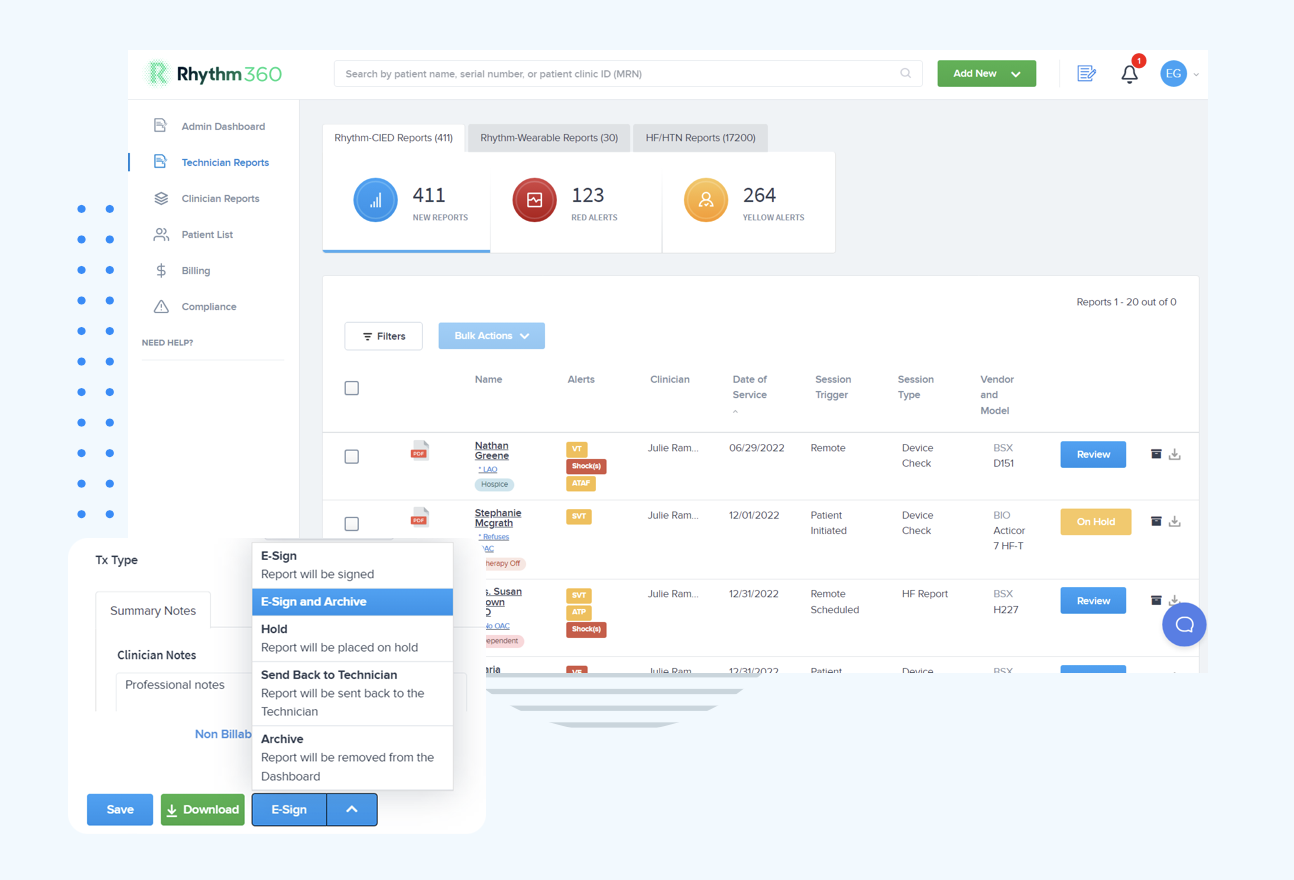
See the workflow in action and watch how Rhythm360 connects device data, documentation, and billing into one pipeline.
Cardiology billing is one of the most documentation-heavy corners of outpatient medicine. Denial rates run 15-20%, above the typical healthcare average. Complex procedures, modifier requirements, and payer-specific rules drive most of that gap. Prior authorization issues and incomplete documentation account for a large share of the rest.
The financial stakes are steep. A cardiology practice billing $2 million annually with a 12% denial rate loses $144,000 per year on denials that never get appealed. The average physician practice also loses 1-3% of net revenue annually from charge capture failures alone.
Remote monitoring makes the problem worse. Practices managing patients with Cardiac Implantable Electronic Devices (CIEDs) from multiple manufacturers must log into separate, non-interoperable OEM portals to retrieve transmission data. That creates data silos and missed billable events for CPT codes like 93298, 93299, and 99454. Each handoff between a monitoring portal and the EHR raises breach risk and can trigger denials for lack of medical necessity. Without one integration layer, revenue leaks at every step. The workflow below shows how to close those gaps one at a time.
Run automated eligibility checks at scheduling and again 48-72 hours before the appointment. Verifying eligibility before scheduling high-dollar procedures eliminates an entire denial category up front. Rhythm360's bi-directional EHR integration surfaces coverage data inside the scheduling workflow, removing manual portal lookups.
Pro Tip: Flag Medicare Advantage patients separately. Authorization requirements vary by payer, procedure, and plan type, even within the same payer. Build a procedure-level checklist into scheduling.
Submit authorization requests 5-7 business days before procedures. Staff spend an average of 14 hours per week managing prior authorizations, and cardiology ranks among the highest-burden specialties. Echocardiograms, stress tests, cardiac catheterization, and implantable devices face the heaviest scrutiny in 2026.
Rhythm360 surfaces alerts for pending, expiring, or mismatched authorizations directly in the EHR workflow. This cuts the manual tracking burden that drives avoidable denials.
Troubleshooting: Missing authorization on high-cost imaging is often non-appealable after the service happens. Assign authorization ownership to one department and log every request with expected response and expiry dates.
Enroll each CIED patient in Rhythm360 at implant or care transition. The platform ingests data from Medtronic, Boston Scientific, Abbott, Biotronik, and others through API, HL7, XML, and PDF parsing via computer vision. It normalizes these streams into one source of truth, ending the multi-portal login burden that creates silos.
Pro Tip: Redundant data feeds act as a fail-safe when an OEM server goes down. This maintains greater than 99.9% transmissibility, so no billable transmission gets lost to a technical outage.
Automated charge capture maps each completed transmission to its correct code. These codes work together to cover the full monitoring cycle, from professional interpretation to device supply days:
Troubleshooting: CPT 93294 and 93295 cannot be billed on the same date for the same patient. Rhythm360's charge logic enforces this rule before submission.
Bi-directional EHR integration means device data flows into the clinical note, and signed reports flow back to billing, without manual transcription. A cardiology EHR needs a dedicated module for device interrogation data reviewable inside the chart. Rhythm360 connects to Epic, Cerner, Athenahealth, eClinicalWorks, Greenway Health, and others via HL7.
True bidirectional integration, where care plans and medication changes inform monitoring logic in real time, requires architectural access most SaaS platforms don't expose beyond basic FHIR exports. Rhythm360 is built for that depth.
Rhythm360's alerting engine filters non-actionable transmissions and prioritizes clinically significant events: new-onset atrial fibrillation, ventricular tachycardia, lead malfunction, ERI/RRT indicators. This cuts critical-alert response time by up to 80%. University of Chicago Medicine's care team reported reviewing more transmissions daily and catching more abnormalities, noting: "We are able to address these issues earlier; rather than waiting for a 3-month visit, we can call patients in for evaluation."
Pro Tip: Optional 24/7/365 oversight by certified cardiac technicians, supervised by physicians, adds a triage layer for high-volume practices.
Reports on routine checks and urgent alerts generate in near-real-time. Clinicians review and sign them through Rhythm360's secure mobile app from any location, removing the workstation dependency that delays documentation. Required documentation includes device type, manufacturer, monitoring dates, and an interpretation note covering function, parameters, and findings. Rhythm360 structures every report to meet these requirements automatically.
Before submission, claims pass through automated edits checking for missing modifiers, authorization numbers, diagnosis-to-procedure alignment, and bundling conflicts. Practices using integrated EHR-RCM workflows reach clean claim rates of 90-98%, with first-pass acceptance at 95% or higher and denial rates below 5%. University of Chicago Medicine reported improved billing accountability after integrating Rhythm360 into its remote monitoring workflow.
Rhythm360 supports HF and HTN remote physiological monitoring alongside CIED monitoring codes. Maximum monthly RPM revenue per patient under 2026 codes reaches about $181, combining CPT 99454 ($47), 99457 ($52), and two units of 99458 ($82). The platform tracks transmission days, logs management time, and validates code selection to prevent overlap errors.
Pro Tip: CPT 99091 and 99457 cannot be billed together in the same month for the same patient. Rhythm360's code logic enforces this before submission.
Work denials within 48 hours of receipt. Categorizing denials by reason code, such as CO-4 for coding issues or CO-167 for medical necessity, reveals systemic problems instead of one-off errors. Rhythm360's dashboard shows captured and potential revenue by CPT code in real time, flagging denial patterns before they compound. Structured root-cause analysis paired with workflow changes can cut denials by 30-50% within six months when rates exceed 10%.
Talk to our team about applying this 10-step workflow to your practice.
This closed-loop architecture, built across Steps 3 through 6, is what makes the >99.9% transmissibility and 80% faster alert response possible in practice. When transmission data is incomplete or delayed, documentation gaps follow, and documentation gaps produce denials. Rhythm360 solves this at the infrastructure level rather than patching it downstream.
University of Chicago Medicine processed more than 73,000 reports in 2025, averaging over 18,000 per quarter, showing the platform holds up at high volume without losing data quality. Bi-directional sync means updates to a care plan in the EHR inform monitoring logic in Rhythm360, and signed reports write back automatically. That closed loop is what eliminates the transcription errors and documentation lags behind most clean-claim failures.
Building on the alert and documentation gaps above, most preventable denials trace back to one root cause: disconnection between clinical events and the billing system. These five patterns account for the majority of them.
The table below quantifies the gap between fragmented, portal-dependent workflows and Rhythm360's integrated pipeline, showing why closing that gap translates directly into faster alert response and higher captured revenue.
| Metric | RhythmScience Baseline (Pre-Integration) | Rhythm360 Outcome | Source |
|---|---|---|---|
| Data Transmissibility | Variable; OEM portal-dependent | >99.9% via redundant feeds and AI extrapolation | RhythmScience platform specifications |
| Critical Alert Response Time | Baseline manual workflow | Up to 80% reduction | RhythmScience client outcomes |
| Revenue Generation | Baseline CPT capture with fragmented workflows | Up to 300% increase through optimized CPT capture and RPM service lines | RhythmScience client outcomes |
| Annual Report Volume (UCM) | Pre-implementation fragmented monitoring | >73,000 reports annually; >18,000 per quarter | HMP Global / University of Chicago Medicine, 2025 |
Compare your practice's KPIs against these benchmarks.
Closing the RCM-EHR gap only pays off if onboarding is fast enough to matter. Rhythm360 setup, including EHR integration, takes a few days to a few weeks depending on practice size and EHR system. SaaS-based pricing scales with clinic size, avoiding the setup fees tied to legacy on-premise systems.
Most practices see measurable financial improvement within 60 to 90 days, with first-pass acceptance rates improving in the first billing cycle and AR days improving by month two or three.
The same mobile app used for report sign-off in Step 7 also gives on-call clinicians full access to transmission reviews and care coordination from any smartphone, day or night. This removes workstation dependency during evenings and weekends, the exact windows when delayed response carries the highest clinical risk. A critical arrhythmia flagged Saturday morning can lead to anticoagulation or device reprogramming by Saturday afternoon instead of waiting for Monday's clinic schedule. The app logs every action, including patient communications through the integrated Twilio messaging framework, keeping the audit trail complete no matter where the clinician works.
Three compounding improvements. Automated CPT capture recovers billable events that used to sit unused in OEM portals. New RPM service lines for heart failure and hypertension patients add recurring monthly revenue many practices aren't currently billing. Pre-submission scrubbing reduces denials, so more submitted claims get paid on the first pass. Together they recover lost revenue, add new revenue, and cut the cost of rework.
It's the same mechanism applied at scale. Legacy workflows depending on manual OEM portal retrieval are vulnerable to server outages and staff availability gaps, any of which can mean a missed transmission or a missed billing window. The redundant feeds, OCR, and AI extrapolation described earlier keep that failure rate under 0.1% across the entire patient population, not just isolated cases.
It applies specifically to clinically significant events like ventricular fibrillation, new-onset atrial fibrillation, lead malfunction, and ERI/RRT indicators, the same categories filtered by the AI triage engine in Step 6. Non-actionable transmissions get filtered out first, so clinicians see a prioritized queue instead of a raw feed. The mobile app then lets on-call clinicians act immediately rather than waiting for the next business day.
The gap comes from fixing the same structural failures covered in Step 8: missed billable events, incomplete point-of-care documentation, and claims that skip pre-submission checks for authorization numbers and modifier requirements. Closing those gaps is what pushes first-pass acceptance to 95% or higher and keeps denials under 5%, compared to the 15-20% industry baseline described earlier.
Fragmented OEM portals, manual charge capture, and disconnected EHR-billing workflows aren't minor inconveniences. They cost measurable revenue and add clinical risk. Practices that integrate RCM with their cardiology EHR get a closed-loop system instead, where device data, authorization, documentation, and denial management run as one automated pipeline.
Rhythm360 builds that pipeline with vendor-neutral CIED ingestion, bi-directional EHR integration, AI-powered alert triage, and automated CPT capture across CIED and RPM service lines. The result: faster alert response, the revenue lift described earlier, and clean claim rates that consistently beat the cardiology industry average.