Last updated: July 14, 2026
Cardiology and electrophysiology practices can evaluate RPM alternatives using five criteria that tie directly to clinical and operational outcomes.
The table below demonstrates how Rhythm360’s unified architecture delivers clinical, operational, and financial benefits across three functional domains, showing that device connectivity, alert triage, and billing outcomes operate as integrated capabilities rather than isolated features. Every data point is drawn from RhythmScience’s platform specifications and verified client outcomes.
| Capability | CIED Remote Monitoring | HF/HTN RPM | Revenue-Cycle Outcomes |
|---|---|---|---|
| Device connectivity | Vendor-neutral ingestion from Medtronic, Boston Scientific, Abbott, Biotronik via API, HL7, XML, and PDF computer vision | Turnkey onboarding for connected blood pressure, weight, and pulse oximetry devices | Eliminates redundant OEM portal logins that cause documentation gaps and missed billable events |
| Data transmissibility | >99.9% via redundant data feeds and AI-powered extrapolation | Automated patient engagement via Twilio-powered messaging to maintain 16-day transmission thresholds required for CPT 99454 | High transmissibility supports improved billing capture of eligible CPT codes per month |
| Alert triage | AI-powered prioritization of ventricular fibrillation, new-onset AFib, lead malfunction, and ERI/RRT alerts, with optional 24/7/365 CCT oversight | Tiered alerts for significant weight gain, blood pressure spikes, and pulse oximetry drops | Faster triage reduces staff hours per alert, which lowers cost per billable interaction |
| EHR integration | Bi-directional with Epic, Cerner, Athenahealth, eClinicalWorks, Greenway Health, and others via HL7 | Bi-directional, with automated report push that eliminates manual transcription for HF/HTN encounters | Integrated documentation supports compliant billing for 93298, 99454, 99457, 99445, and 99470 |
| Mobile access | HIPAA-compliant app for transmission review, report signing, and care coordination from any location | Mobile dashboard for HF/HTN alert review and patient messaging | On-call response capability prevents missed billable interventions on evenings and weekends |
| Scalability | University of Chicago Medicine processed more than 73,000 CIED reports annually through Rhythm360 in 2025 | Scales from solo practices to large integrated health systems | SaaS pricing adjusts to clinic size and platform usage |
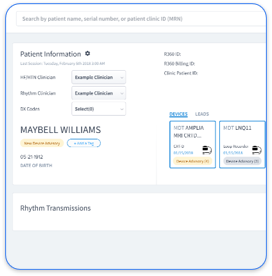
Clinicians managing CIED patients must integrate data pulled from multiple settings and multiple device manufacturers because traditional EHRs are not well suited to managing CIED data. As soon as a practice implants devices from more than one OEM, staff must log into separate, non-interoperable portals, which creates data silos and an unsustainable administrative burden.
Rhythm360 resolves this with vendor-neutral ingestion of data from Medtronic, Boston Scientific, Abbott, and Biotronik into a single dashboard. The platform uses API connections, HL7 feeds, XML parsing, and computer vision OCR on unstructured PDFs to normalize disparate data formats into a unified patient record. A redundant data feed system acts as a fail-safe when an OEM server is unavailable and maintains the platform’s >99.9% transmissibility rate.
One representative scenario shows how this works in practice. On a Saturday morning, a Rhythm360 alert flags new-onset atrial fibrillation in a patient with a Boston Scientific ICD. The on-call electrophysiologist receives a prioritized mobile notification, reviews the transmission, and initiates anticoagulation protocols before the patient’s next scheduled office visit. As Andrew Beaser, MD, Associate Professor of Medicine at the University of Chicago Medicine, noted: "We are able to address these issues earlier; rather than waiting for a 3-month visit, we can call patients in for evaluation."
UCM’s implementation of Rhythm360 enabled clinicians to review more transmissions daily and identify more abnormalities. That improvement came directly from consolidating multi-OEM data into one actionable workspace.
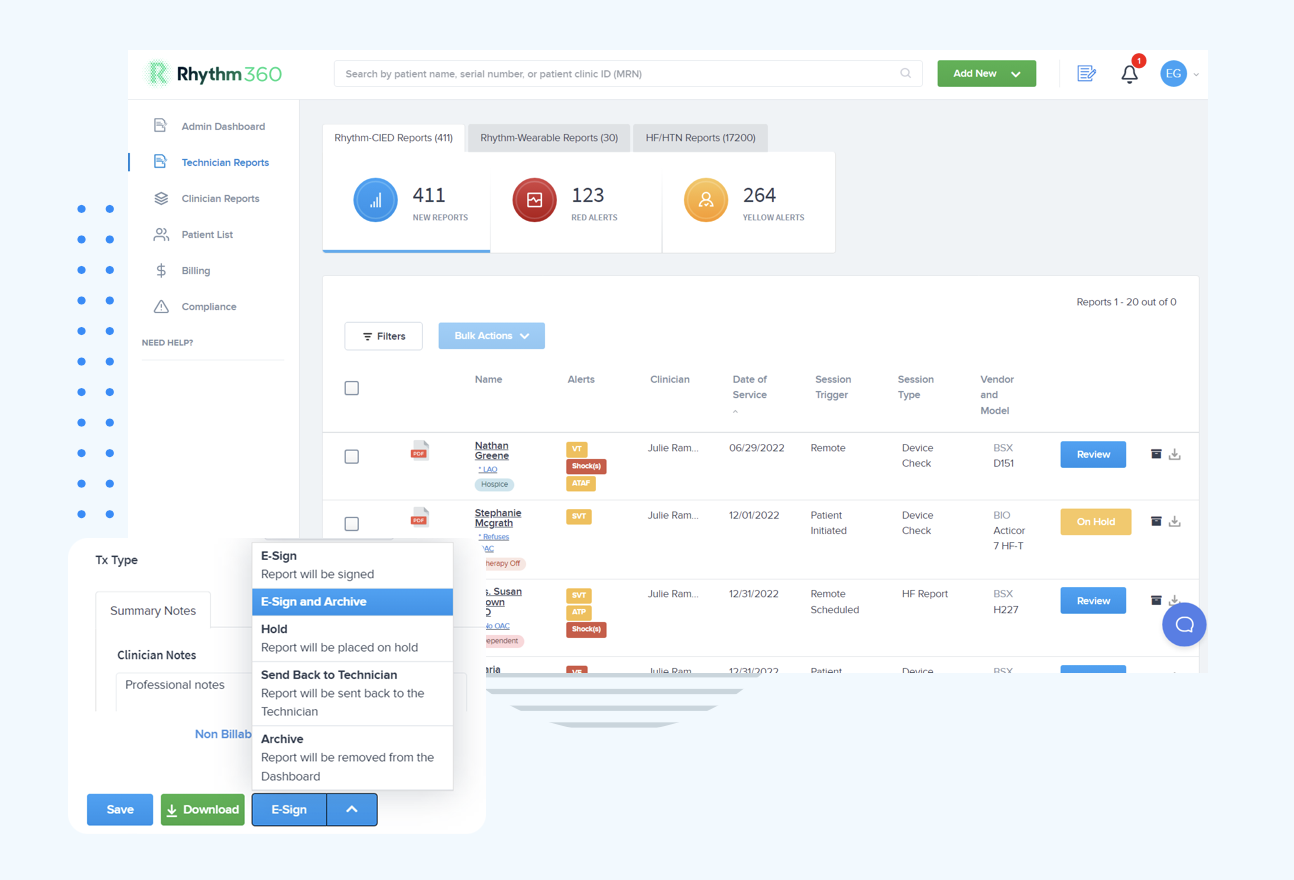
Alert fatigue is a documented clinical risk in CIED monitoring. Legacy systems generate high volumes of non-actionable notifications that desensitize care teams to genuine emergencies. Rhythm360’s AI triage layer filters this noise by prioritizing clinically significant events such as ventricular fibrillation, ventricular tachycardia, lead malfunction, ERI/RRT indicators, and new-onset AFib, while suppressing routine transmissions that require no immediate action.
The platform delivers the response-time improvements described in the key takeaways through intelligent filtering and prioritization. For practices that lack in-house capacity, optional 24/7/365 oversight by certified cardiac technicians (CCTs) supervised by physicians provides an additional triage layer. Andrew Beaser, MD, at UCM observed that "decision support, including AI-assisted decision support, will become increasingly important as data volumes grow."
Automated CPT capture runs in parallel with alert triage. When a clinician reviews and acts on a transmission, Rhythm360 logs the interaction with a timestamped audit trail that supports billing for CPT 93298 (remote interrogation of implantable cardioverter-defibrillator) and CPT 99454 (device supply with 16+ days of readings). Automated reimbursement tracking can improve billing capture of eligible CPT codes per month, which Rhythm360’s documentation engine is designed to support.
Schedule a demo to see Rhythm360’s AI alert triage and automated CPT documentation in action.
The clinical capabilities described above, including vendor-neutral data ingestion, AI triage, and automated billing, directly influence total cost of ownership by reducing manual workload and capturing revenue that fragmented systems miss. Rhythm360 operates on a SaaS pricing model that scales with clinic size and platform usage and avoids the high fixed costs associated with on-premise legacy systems. Implementation, including EHR integration setup, typically takes a few days to a few weeks and remains significantly faster than enterprise software deployments that can exceed $500,000 per system for integration projects.
The platform reduces staff burden by eliminating redundant OEM portal logins, automating report generation, and providing a centralized administrative dashboard that tracks patient compliance, critical alerts, and captured versus potential revenue by CPT code. This structure reduces reliance on a single “super-user” and supports business continuity when key staff are unavailable.
As Gaurav A. Upadhyay, MD, at UCM, observed: "We have improved billing and accountability for our patients after the integration." Practices implementing Rhythm360 have reported up to a 300% increase in revenue capture through stronger CPT billing and the addition of new HF/HTN RPM service lines that generate recurring monthly revenue.
Remote CIED monitoring can also generate savings for payers and hospitals by reducing cardiovascular hospitalizations compared with standard in-office monitoring.
The right RPM platform depends on practice size, device mix, and existing infrastructure. The following framework highlights where Rhythm360 delivers the clearest fit.
If your practice matches any of the scenarios above, such as a multi-OEM device mix, enterprise scale, new RPM service lines, or billing leakage, the decision framework points to a unified platform architecture. Other platforms in the CIED monitoring and cardiology RPM space exist, but Rhythm360 is the platform to evaluate when the requirement is a single, unified workspace that spans CIED monitoring, chronic-condition RPM, AI triage, and automated billing documentation within one vendor-neutral architecture.
Each major CIED manufacturer, including Medtronic, Boston Scientific, Abbott, and Biotronik, uses proprietary data formats, nomenclature, and communication protocols to describe comparable device features. Traditional EHRs are not designed to ingest or display this data natively, and standalone CIED management tools often struggle to unlock information from these proprietary formats. Staff must log into multiple separate portals to retrieve patient data, reconcile conflicting terminology, and manually transcribe findings into the EHR. This workflow creates data silos, increases the risk of transcription errors, and consumes significant clinical and administrative time. A vendor-neutral platform that ingests data via API, HL7, XML, and PDF parsing and normalizes it into a single patient record removes these silos and provides a complete, consistent view of each patient’s device status regardless of manufacturer.
Cardiology practices billing for remote monitoring services in 2026 work with two overlapping code sets. For CIED-specific remote interrogation, the relevant codes include 93298 (remote interrogation of implantable cardioverter-defibrillator with physician analysis and report) and related device-analysis codes. For broader RPM services covering chronic conditions such as heart failure and hypertension, the 2026 Medicare Physician Fee Schedule includes CPT 99453 (device setup and patient education, $21.71 one-time), 99454 (device supply with 16 or more days of readings in a 30-day period, $52.11 per month), 99457 (first 20 minutes of treatment management by clinical staff, $51.77 per month), and 99458 (each additional 20 minutes, $41.42 per month).
Two new codes took effect in 2026. Code 99445 covers device supply for patients transmitting on 2 to 15 days per month at $52.11, and 99470 covers 10 to 19 minutes of treatment management at $26.05, which lowers the prior 20-minute threshold that previously left partial-month engagement unbillable. CPT 99091, which covers physician or qualified healthcare professional interpretation of remotely transmitted physiologic data (minimum 30 minutes), reimburses at approximately $58 per 30-day period and cannot be billed in the same month as 99457 or 99458 for the same patient. Practices must also note that RPM codes cannot be billed concurrently with Chronic Care Management, Transitional Care Management, or several other care management codes for the same patient in the same period.
Billing leakage in cardiology RPM most often occurs when documentation is incomplete, transmission thresholds are not met, or staff lack a centralized system to track which patients have satisfied the requirements for each CPT code in a given month. A unified platform addresses all three failure points. Automated patient engagement tools, such as Twilio-powered messaging, prompt patients who have not transmitted recently and help practices maintain the 16-day threshold required for CPT 99454.
Automated time-tracking logs clinician and staff interactions with timestamped audit trails and generates the documentation required for 99457, 99458, and 99091 without manual entry. A real-time administrative dashboard shows which patients have met billing thresholds and which have not, so staff can intervene before the billing period closes. Practices that implement this level of automation can achieve high billing capture rates of eligible CPT codes per month. Rhythm360’s billing documentation engine is designed to support this outcome across both CIED monitoring codes and chronic-condition RPM codes within a single workflow.
Without intelligent filtering, CIED monitoring programs generate large volumes of alerts, many of which are routine transmissions or non-actionable notifications that do not require immediate clinical intervention. When care teams must manually review every alert, critical events such as new-onset atrial fibrillation, ventricular tachycardia, or lead malfunction can be delayed or missed entirely, particularly on evenings and weekends. AI-powered triage addresses this by classifying incoming alerts by clinical urgency, surfacing only the events that require immediate action, and routing routine transmissions to standard review queues.
Rhythm360’s AI triage layer, combined with optional 24/7/365 oversight by certified cardiac technicians, delivers the 80% response-time reduction mentioned earlier. In practical terms, a clinician receiving a prioritized mobile notification for a Saturday morning AFib event can initiate anticoagulation protocols within hours rather than waiting until the next scheduled office visit. That difference can prevent stroke or other adverse outcomes. University of Chicago Medicine’s implementation of Rhythm360 demonstrated this at scale, with clinicians able to review more transmissions daily and identify more abnormalities across a population generating the volume described in UCM’s case study.
Prevounce’s general-purpose RPM architecture leaves cardiology practices managing CIED data fragmentation, alert fatigue, incomplete billing documentation, and disconnected chronic-condition workflows. These gaps translate directly into missed critical events, staff burnout, and preventable revenue loss.
Rhythm360 is the vendor-neutral, AI-powered platform that consolidates CIED monitoring across all major OEMs and chronic-condition RPM for HF and HTN into a single source of truth. Bi-directional EHR integration, mobile access, automated CPT documentation, and AI-driven alert triage combine to deliver measurable improvements, including the faster response times, billing capture above 95% of eligible codes, and up to 300% revenue growth for practices that add new RPM service lines. At the University of Chicago Medicine, Rhythm360 supported the enterprise-scale volume described above while enabling earlier clinical interventions and improved billing accountability.
For cardiology practices, electrophysiology clinics, and integrated health systems evaluating alternatives to Prevounce RPM, Rhythm360 provides purpose-built infrastructure that general-purpose platforms cannot match.
Schedule a demo with RhythmScience and see how Rhythm360 unifies your cardiology RPM workflows.