Last updated: July 13, 2026
The table below shows why Rhythm360 is the only platform that delivers real-time eligibility verification, native cardiology device integration, and threshold tracking in one system. Use this comparison to decide whether your current vendor can support 2026 compliance and prevent the 41% denial rate tied to missed 16-day thresholds.
| Platform | Real-Time CPT Eligibility Verification | Cardiology Device Integration (Medtronic, Abbott, Boston Scientific, Biotronik) | Threshold Tracking + EHR Connectivity |
|---|---|---|---|
| Rhythm360 by RhythmScience | Automated pre-submission eligibility check with payer-specific rule enforcement, including UnitedHealthcare planned to restrict RPM coverage to heart failure and hypertensive disorders of pregnancy beginning January 1, 2026, but later postponed implementation | Vendor-neutral ingestion via API, HL7, XML, and AI-powered PDF parsing with redundant feeds and >99.9% transmissibility | Rolling 30-day device-day counter, real-time 99457/99470 minute accumulation, and bi-directional integration with Epic, Cerner, and Athenahealth |
Rhythm360 delivers these capabilities as a unified, vendor-neutral platform built specifically for cardiology billing compliance.
CPT 99453 is a one-time setup code covering patient education and device onboarding. CPT 99454 covers device supply with daily recordings and requires transmission of physiologic data on at least 16 distinct days, not 16 readings, within any 30-day period. Under Medicare fee-for-service, both CPT 99453 and CPT 99454 may be used for a newly enrolled patient in the same month when requirements are met.
The compliance checklist for same-month billing follows the order in which each requirement must be confirmed to avoid denials:
Once you confirm same-month eligibility for 99453 and 99454, the next decision involves device supply and management codes for patients who miss the 16-day or 20-minute marks. CPT 99453 remains the one-time device setup and patient education code, reimbursing approximately $22 under Medicare. For ongoing device supply, CMS finalized CPT 99445 effective January 1, 2026, for device supply when 2–15 days of data are captured in a 30-day period, creating a compliant billing pathway for complex cardiac patients who do not consistently meet the 16-day threshold every month. CPT 99454 remains the standard code for 16–30 days of data.
Short-period management time follows a similar pattern. CPT 99470 covers the first 10–19 minutes of RPM treatment management time in a calendar month and requires at least one real-time interactive communication. CPT 99457 covers 20 or more minutes. These codes function as either-or choices. A platform must route each patient to the correct code based on actual day counts and documented minutes before any claim is generated.
Every compliant RPM claim starts with complete, timely device data from all manufacturers. Rhythm360 ingests live transmission data from Medtronic CareLink, Abbott Merlin.net, Boston Scientific Latitude, and Biotronik Home Monitoring through API connections, HL7 feeds, XML parsing, and AI-powered computer vision for unstructured PDFs. Redundant data feeds maintain continuity when an OEM server is unavailable, sustaining >99.9% transmissibility across the patient population. All data flows into a single queue, so staff no longer log into separate portals.
Accurate day and minute counts determine whether a patient qualifies for short-period or standard RPM codes. Rhythm360 maintains a rolling 30-day transmission counter per patient and automatically routes each patient to the 99454 pathway for 16 or more days or to the 2026 short-period 99445 pathway for 2–15 days. At the same time, every staff action, including alert review, data trending, and documented phone or video calls, is logged against the monthly clinical time counter.
The platform surfaces patients approaching the 20-minute threshold for 99457 or the 10-minute threshold for 99470 before the billing period closes. Dedicated RPM platforms enforce the 16-day rule upstream by flagging patients on day 21 with only 12 transmissions to trigger outreach before claims are generated.
Real-time eligibility checks at the patient level prevent denials that appear only during month-end reconciliation. Before any claim is staged, Rhythm360 runs payer-specific rule checks against each patient’s active coverage. The only compliant way to manage complex RPM rules, including 2–15 vs 16–30 day device supply thresholds, 10–19 vs 20+ minute management time thresholds, exclusivity checks, and payer-specific eligibility, is a Compliance-as-Code engine that automates verification before claims submission. Rhythm360 enforces this gate for each patient in real time, which avoids end-of-month clean-up and associated revenue loss.
Clean documentation in the EHR supports both payment and audit defense. Once thresholds are confirmed, Rhythm360 assembles the complete documentation package required for each CPT code and pushes it directly into the patient’s EHR chart through bi-directional integration with Epic, Cerner, and Athenahealth. The package includes:
As one physician at the University of Chicago Medicine confirmed after implementing Rhythm360, “We have improved billing and accountability for our patients after the integration.”
Schedule a demo to see Rhythm360’s claim-ready documentation workflow in action.
Practices losing a significant share of RPM revenue cannot wait months for a new platform to go live. Rhythm360’s onboarding process, including EHR integration with Epic, Cerner, Athenahealth, eClinicalWorks, and Greenway Health, typically takes from a few days to a few weeks. Device manufacturer connections to Medtronic, Abbott, Boston Scientific, and Biotronik are established during the same onboarding window. This timeline allows practices to begin capturing compliant RPM revenue in the current billing cycle instead of deferring implementation to a later quarter.
Automated pre-bill transmission scrubs deliver measurable financial and clinical gains. Practices implementing a pre-bill transmission scrub that verified the 16-day threshold before submission have achieved high first-pass RPM claim acceptance and increased monthly RPM revenue.
Rhythm360 clients have reported an 80% reduction in response times for critical patient alerts and up to 300% improvement in revenue generation through more accurate CPT code capture and the addition of new RPM service lines. The 2026 introduction of 99445 and 99470 creates additional billable pathways for patients who previously generated no RPM revenue because they fell short of the 16-day or 20-minute thresholds.
Rhythm360 ingests transmission data from all major cardiac device manufacturers, including Medtronic, Abbott, Boston Scientific, and Biotronik, through a combination of direct API connections, HL7 feeds, XML parsing, and AI-powered computer vision for PDF-based reports. Each transmission is timestamped and logged against a rolling 30-day counter per patient. The platform displays each patient’s current day count on a real-time compliance dashboard and triggers automated alerts when a patient is at risk of falling below the 16-day threshold before the billing period closes. Clinical staff can then intervene with patient outreach or device troubleshooting while there is still time to meet the threshold, rather than discovering the shortfall at month-end.
Rhythm360 enforces payer-specific eligibility rules as a hard gate in the pre-submission workflow. For UnitedHealthcare members, the platform references that UnitedHealthcare planned to restrict RPM coverage to heart failure and hypertensive disorders of pregnancy beginning January 1, 2026, but later postponed implementation of the new policy. The system also runs benefit verification at billing time, not only at device enrollment, to account for patients who change insurance mid-month. This approach prevents denials and potential recoupments that arise when payer policy changes are not reflected in the billing workflow.
Rhythm360 maintains separate time logs for RPM management codes 99457, 99458, and the 2026 code 99470, and for Chronic Care Management codes 99490 and 99491. Every staff action is classified at the point of logging. Device-driven treatment management is tagged as RPM, while broader care coordination is tagged as CCM. CMS prohibits counting the same clinical minutes toward both programs, and the OIG’s 2024 audit announcement identified double-counting as a primary audit trigger. Rhythm360’s time-log architecture prevents this conflict from occurring rather than flagging it after the fact.
Rhythm360 automatically routes patients to the appropriate 2026 code pathway based on actual transmission day counts and documented clinical minutes. Patients with 2–15 days of device data are routed to CPT 99445 for device supply, and patients with 10–19 documented management minutes are routed to CPT 99470. Patients meeting the standard thresholds of 16 or more days and 20 or more minutes are routed to 99454 and 99457 respectively. This routing occurs automatically before claim generation, so practices capture revenue from patients who previously generated no RPM billing because they fell short of the prior all-or-nothing 16-day rule.
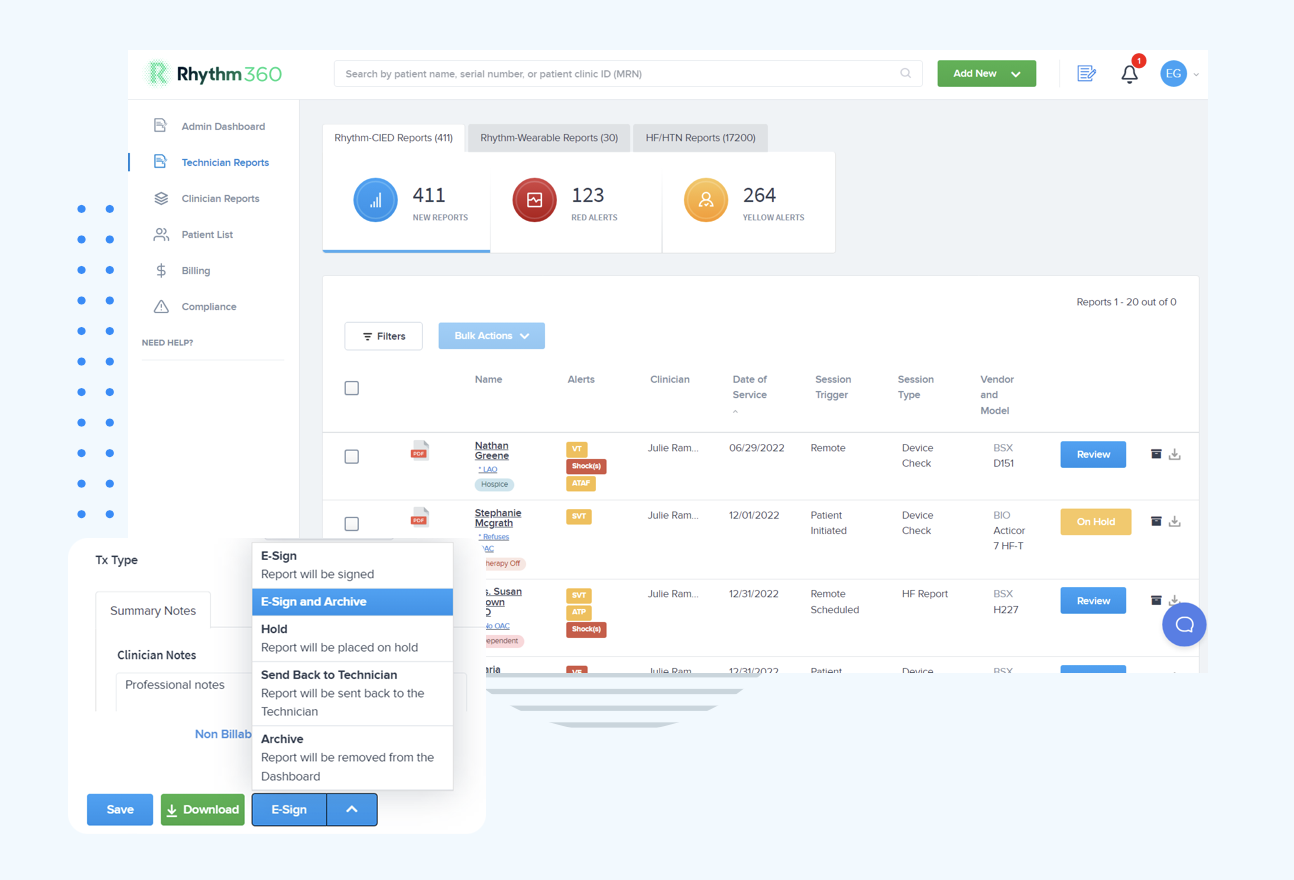
Rhythm360 includes a secure, HIPAA-compliant mobile application that allows clinicians to review device transmissions, sign reports, respond to critical alerts, and coordinate care from any location. This capability is particularly relevant for cardiology practices managing patients with implantable devices, where a critical arrhythmia alert on a weekend requires immediate clinical response. All actions taken through the mobile app are logged with timestamps and staff identity, contributing to the audit-ready documentation record required for CPT 99457 and 99470 billing.
Fragmented OEM portals and manual threshold tracking are the primary drivers of this revenue leakage, the same 30–40% gap identified in the opening, because they prevent practices from identifying threshold shortfalls before claims are submitted. Rhythm360 addresses this by combining live multi-manufacturer data ingestion, automated CPT eligibility verification, and bi-directional EHR integration into a single vendor-neutral platform, so claims are verified before submission, not corrected after denial.
Request a live walkthrough of Rhythm360’s multi-manufacturer data ingestion and threshold tracking to see how it eliminates billing gaps across your entire cardiology RPM program.