Last updated: August 24, 2026
Three converging pressures are pushing cardiology and EP clinic administrators to reassess their technology stack this year. Most practices implant devices from more than one manufacturer, so staff must authenticate into separate, non-interoperable OEM portals such as Medtronic, Boston Scientific, Abbott, and Biotronik. That fragmentation creates heavy administrative burden and data silos.
The volume of device transmissions also drives alert fatigue. University of Chicago Medicine reviewed a large number of reports annually, with most OEM-generated alerts being nonactionable across that entire volume. High dismissal rates reflect safety-first monitoring design rather than a specific platform failure.
Manual CPT documentation creates measurable billing leakage. Cardiology practices can capture significant annual recurring revenue from properly billed remote monitoring. That revenue disappears when documentation workflows stay manual and error-prone.
The eight capabilities below directly address these three pressures: multi-OEM fragmentation, alert fatigue, and billing leakage. Together they define the minimum standard for any CIED workflow platform evaluation in 2026.
Schedule a demo to see how Rhythm360 meets every criterion in a single platform.
Clinics that implant devices from multiple OEMs cannot rely on a platform tied to one manufacturer's ecosystem. A vendor-neutral solution must ingest data through APIs, HL7, XML, and unstructured PDF parsing so every transmission stays within reach.
Rhythm360 aggregates CIED data from Medtronic, Abbott, Boston Scientific, and Biotronik into a single vendor-neutral dashboard, using advanced APIs, HL7, XML feeds, and computer-vision PDF parsing. Clinicians no longer need to log into multiple OEM portals to see a complete patient picture.
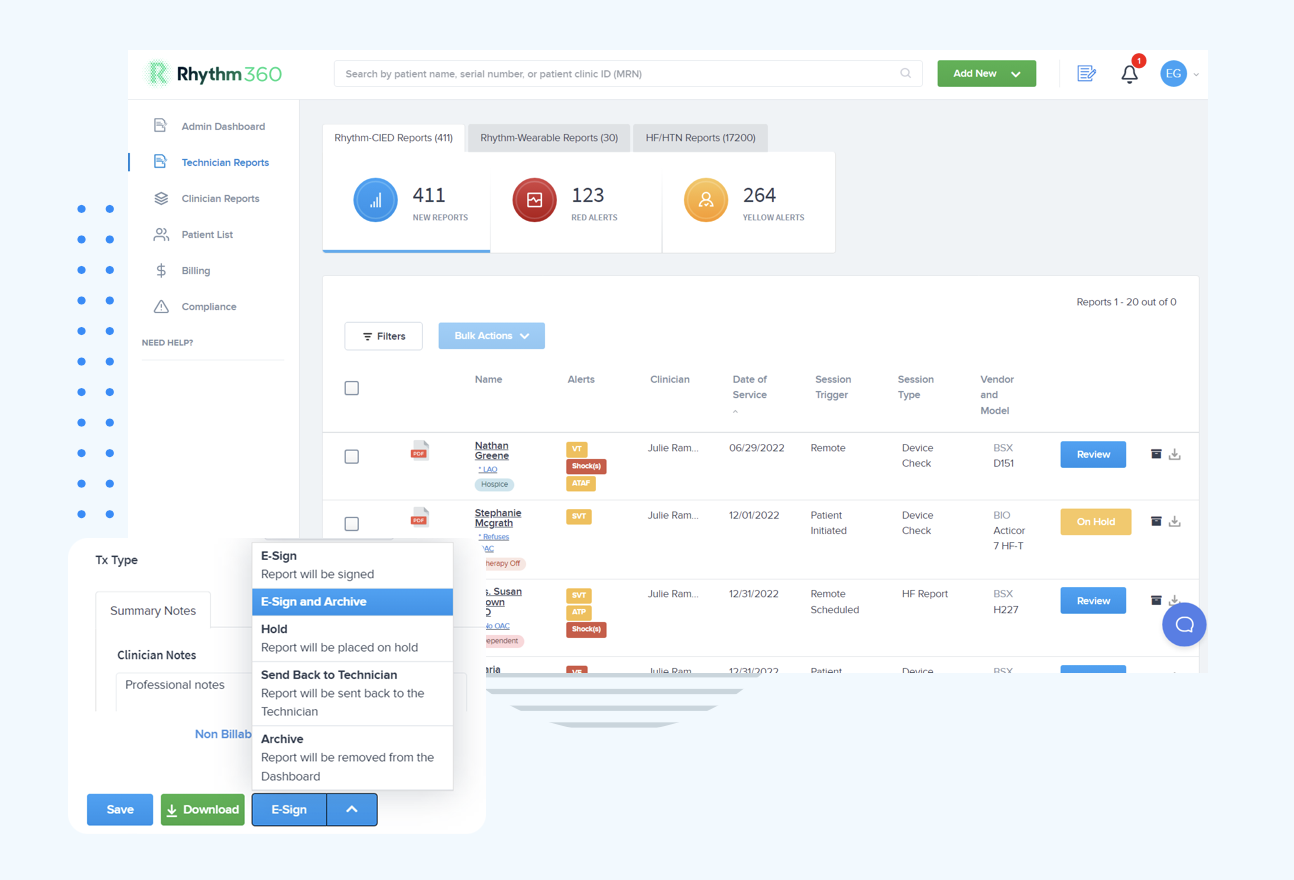
Alert fatigue creates a direct patient-safety risk, not just an inconvenience. When every transmission carries the same priority, clinicians desensitize to alerts and responses to critical events slow down.
Rhythm360's AI-driven alert triage delivers the 80% response-time improvement noted earlier, for example from four hours to 45 minutes, and cuts non-actionable alerts by about 80%. Optional 24/7/365 oversight by certified cardiac technicians (CCTs) supervised by physicians adds human clinical judgment on top of the algorithmic filter.
As noted at University of Chicago Medicine, “decision support, including AI-assisted decision support, will become increasingly important as data volumes grow.”
One-way data pushes create reconciliation work and documentation gaps. A modern platform must write structured data back into the EHR, not just read from it, so device findings appear in the longitudinal patient record without manual transcription.
Rhythm360 provides bi-directional HL7 integration with Epic, Cerner, Athenahealth, eClinicalWorks, Greenway Health, and others. Healthcare data integration commonly breaks down because of inconsistent data formats, poor patient identity matching, and variable data quality. Standards-based HL7 and FHIR exchange directly address these issues.
CIED remote monitoring uses the CPT code series 93294–93299. CPT 93294 covers professional interpretation of remote transmissions from single- or dual-chamber pacemakers and requires a minimum 30-day monitoring period. CPT 93295 covers ICDs and CRT-D devices under the same requirements, and CPT 93296 is the technical component billed alongside 93294 or 93295.
Recent Medicare updates have introduced shorter monitoring windows for some remote monitoring codes, which makes reimbursement easier for shorter windows such as post-ablation or AF burden assessment. Rhythm360 automates documentation for CPT codes 93298, 93299, 99454, 99453, and 99457, with automated CPT documentation reported to increase remote-monitoring revenue by up to 300% by reducing documentation gaps.
Staff at University of Chicago Medicine confirmed this impact: “We have improved billing and accountability for our patients after the integration.”
A missed transmission equals a missed clinical event. That risk is highest when platforms rely on a single OEM data feed, because they inherit that feed's downtime and have no fallback when the upstream server fails.
Rhythm360 achieves greater than 99.9% transmissibility through redundant data feeds, computer vision OCR for PDF-based reports, and AI-powered gap-filling that extrapolates missing values when upstream servers are temporarily unavailable. This architecture helps a Saturday-morning arrhythmia alert reach the on-call clinician regardless of OEM server status.
Clinicians need full access to device data while on call, not just at a workstation. A HIPAA-compliant mobile application must support transmission review, report signing, and care coordination from any location.
Rhythm360's secure mobile app provides this capability. A critical arrhythmia flagged on a Saturday morning can lead to anticoagulation or device reprogramming by Saturday afternoon. Manual, desktop-only workflows rarely support that level of responsiveness.
Independent and community cardiology practices run the same device-heavy remote CIED monitoring programs as large health systems but with a fraction of the IT staff and no enterprise integration budget, which turns un-integrated transmissions into manual work for device specialists. A platform's onboarding process must be fast and require minimal IT overhead for any clinic size.
Rhythm360's implementation timeline, from contract to go-live, typically spans days to weeks. The process includes EHR integration setup without requiring a dedicated integration analyst on the clinic's side.
The 2023 HRS/EHRA/APHRS/LAHRS international consensus statement on remote device clinic management provides guidance on staffing for monitored patients. Automation directly reduces that staffing burden and supports sustainable growth.
Rhythm360 clients document the response-time gains described above and up to a 300% increase in revenue generation through improved CPT code capture and the addition of RPM service lines for heart failure and hypertension management.
| Capability | Rhythm360 |
|---|---|
| Vendor-neutral data ingestion (Medtronic, Abbott, BSc, Biotronik) | ✓ API, HL7, XML, computer-vision PDF parsing |
| AI-powered alert triage with optional CCT oversight | ✓ 80% reduction in critical-alert response time |
| Bi-directional EHR integration | ✓ Epic, Cerner, Athenahealth, eClinicalWorks, Greenway, GE Centricity |
| Automated CPT documentation (93294–93299, 99453, 99454, 99457) | ✓ Up to 300% revenue lift |
| Data transmissibility | ✓ >99.9% via redundant feeds and AI gap-filling |
| HIPAA-compliant mobile access | ✓ iOS/Android app for transmission review and report signing |
| Scalable onboarding | ✓ Days to weeks, no dedicated IT analyst required |
| Measurable ROI | ✓ Faster critical response and up to 300% revenue increase |
A solo electrophysiologist implanting devices from two or three OEMs faces a specific operational trap. Every new device patient adds linear workload to a team already at capacity.
Without automation, the device technician becomes the integration layer, logging into separate portals, reconciling conflicting data, and manually entering findings into the EHR. Rhythm360 removes that loop. The single dashboard consolidates all OEM transmissions, AI triage surfaces only actionable alerts, and automated CPT documentation captures the 93295 and 93296 codes that staff would otherwise miss.
CPT 93295 carries an average Medicare reimbursement of approximately $36–37 per claim (2026 non-facility national average). That revenue accumulates quickly across even a modest patient panel when documentation runs automatically.
A mid-size health-system device clinic managing hundreds or thousands of CIED patients faces scale-specific challenges. Alert volume overwhelms manual triage, EHR integration spans multiple departments, and inconsistent CPT documentation across a larger staff creates compliance risk.
University of Chicago Medicine has managed high volumes of reports, with clinicians able to review more transmissions daily and identify more abnormalities. Rhythm360's redundant data architecture and CCT oversight layer help clinics manage that volume without proportional staffing increases.
Rhythm360's onboarding process minimizes disruption to active clinical operations. The typical sequence moves through four phases:
Rhythm360 uses a SaaS-based pricing model that scales with clinic size and platform usage. This approach avoids the large upfront capital expenditure associated with on-premise legacy systems.
Training is included in onboarding and supported by ongoing resources. Maintenance and platform updates arrive continuously, without scheduled downtime windows. The measurable financial return, including faster critical-alert response and up to a 300% increase in billing capture, typically offsets platform costs within the first billing cycle for practices that previously managed CPT documentation manually.
Schedule a demo to receive a tailored ROI estimate for your patient panel size.
Clinic administrators and EP lab managers should score each candidate platform against the eight criteria above before requesting demos. A platform that satisfies fewer than all eight leaves residual manual workflows that erode the value of partial automation.
Rhythm360 satisfies all eight criteria with documented clinical outcomes from high-volume academic medical center deployments.
A complete CIED workflow automation platform must support the full 93294–93299 code family. CPT 93294 covers professional interpretation for single- and dual-chamber pacemakers on a 90-day monitoring cycle. CPT 93295 covers ICDs and CRT-D devices on the same cycle, and CPT 93296 is the technical component billed alongside 93294 or 93295.
CPT 93297 covers implantable loop recorder professional interpretation without a minimum monitoring period requirement. CPT 93298 is the technical component for ILRs, and recent Medicare updates have reduced minimum monitoring periods for some codes, which makes it easier to bill for shorter windows such as post-ablation monitoring. CPT 93299 is the professional component for ILR monitoring.
Practices adding RPM service lines for heart failure or hypertension also need support for 99453, 99454, and 99457. Rhythm360 automates documentation across all of these code families, which reduces the manual burden that causes missed claims and rejected submissions.
AI alert triage classifies incoming device transmissions against clinical rule sets and machine-learning models trained on large CIED datasets. Non-actionable transmissions, such as routine checks, minor parameter variations, and known benign arrhythmia patterns, are filtered or deprioritized before they reach clinical staff.
Transmissions that meet critical thresholds, including new-onset atrial fibrillation, ventricular tachycardia, lead malfunction, or ERI/RRT indicators, are escalated immediately with structured clinical context. Rhythm360's AI triage layer, combined with optional CCT oversight, reduces critical-alert response times by up to 80%. In practice, that shift can move a Saturday-morning arrhythmia response from four hours to about 45 minutes, with direct implications for stroke risk and device-related syncope.
Vendor-neutral integration means a platform can ingest, normalize, and display transmission data from any device manufacturer, including Medtronic, Boston Scientific, Abbott, and Biotronik, without requiring the clinic to use manufacturer-specific portals or software. This capability matters because most EP clinics implant devices from multiple OEMs, and each OEM portal uses different data formats, authentication systems, and alert structures.
Without a vendor-neutral layer, staff must log into separate systems, reconcile conflicting data formats, and manually transfer findings into the EHR. Rhythm360 achieves vendor-neutral integration through direct APIs, HL7 feeds, XML data streams, and computer-vision PDF parsing for manufacturers that do not offer structured data exports. The result is a single dashboard that presents a unified patient population view regardless of device brand.
Rhythm360's implementation timeline runs from a few days to about 30 days, depending on the number of OEM integrations and the complexity of the clinic's EHR environment. The process covers OEM portal credentialing, API and HL7 feed activation, bi-directional EHR integration testing, role-based staff training, and alert threshold configuration.
Unlike enterprise deployments that require a dedicated IT analyst on the clinic's side, Rhythm360's onboarding fits practices with lean administrative teams. Solo EP practices and mid-size health-system device clinics follow the same implementation path, with configuration scaled to patient panel size and device mix. The first billing cycle review is included in the go-live phase to confirm that CPT documentation captures all eligible transmissions from day one.
The eight capabilities in this guide, including vendor-neutral data ingestion, AI-powered alert triage, bi-directional EHR integration, automated CPT documentation, greater than 99.9% transmissibility, mobile clinician access, scalable onboarding, and measurable ROI, define the minimum standard for CIED workflow automation software in 2026. Fragmented OEM portals, alert fatigue, and billing leakage reflect outdated tools, not unavoidable realities of device clinic management.
Rhythm360 addresses all eight criteria in a single AI-first, vendor-neutral platform, with documented outcomes from high-volume academic medical center deployments such as University of Chicago Medicine and client-verified gains in response time and revenue.