Last updated: July 13, 2026
Fragmented OEM portals create daily friction for cardiac device clinics. Device technicians spend hours navigating separate websites before they understand a single patient's status. Manual transcription of device data into the EHR introduces errors and delays. Billable events go undocumented because no centralized system tracks CPT code eligibility across the patient population. When alert volumes spike, clinically significant events such as new-onset atrial fibrillation, ventricular tachycardia, lead malfunction, or device battery depletion can hide beneath non-actionable notifications.
Andrew Beaser, MD, Associate Professor of Medicine at the University of Chicago Medicine (UCM), described pre-implementation workflows as “a major challenge and incredibly difficult.” Gaurav A. Upadhyay, MD, FACC, FHRS, Professor of Medicine and Director of the Pacing & Defibrillation Device Clinic at UCM, noted that “staffing was always an issue for our center, because our device clinic, like many other medical centers, had struggled with technician turnover and timely weekend coverage.”
These operational challenges carry clear financial consequences. Practices without a centralized system for tracking billable events and generating compliant documentation miss revenue and face rejected claims, particularly for complex remote monitoring CPT codes. When practices adopt a unified platform, they have achieved up to an 80% reduction in critical-alert response times and up to a 300% increase in revenue capture through accurate CPT code billing.
A vendor-neutral, cloud-based cardiac telemetry monitoring platform ingests and normalizes data from all major OEMs through APIs, HL7 feeds, XML parsing, and AI-powered document processing. The platform then presents this information in a single, consistent view for the care team.
These capabilities eliminate redundant logins, reduce manual transcription, and support proactive patient management instead of reactive triage. The operational impact of these technical features becomes clear when you look at how they change daily work for each stakeholder group.
Clinic administrators and physician-owners see measurable operational improvements with a unified platform. A single login replaces multiple portal credentials. Compliance tracking moves into one system, which lowers audit risk. Real-time dashboards display population health metrics, device compliance rates, and captured versus potential revenue based on CPT code requirements.
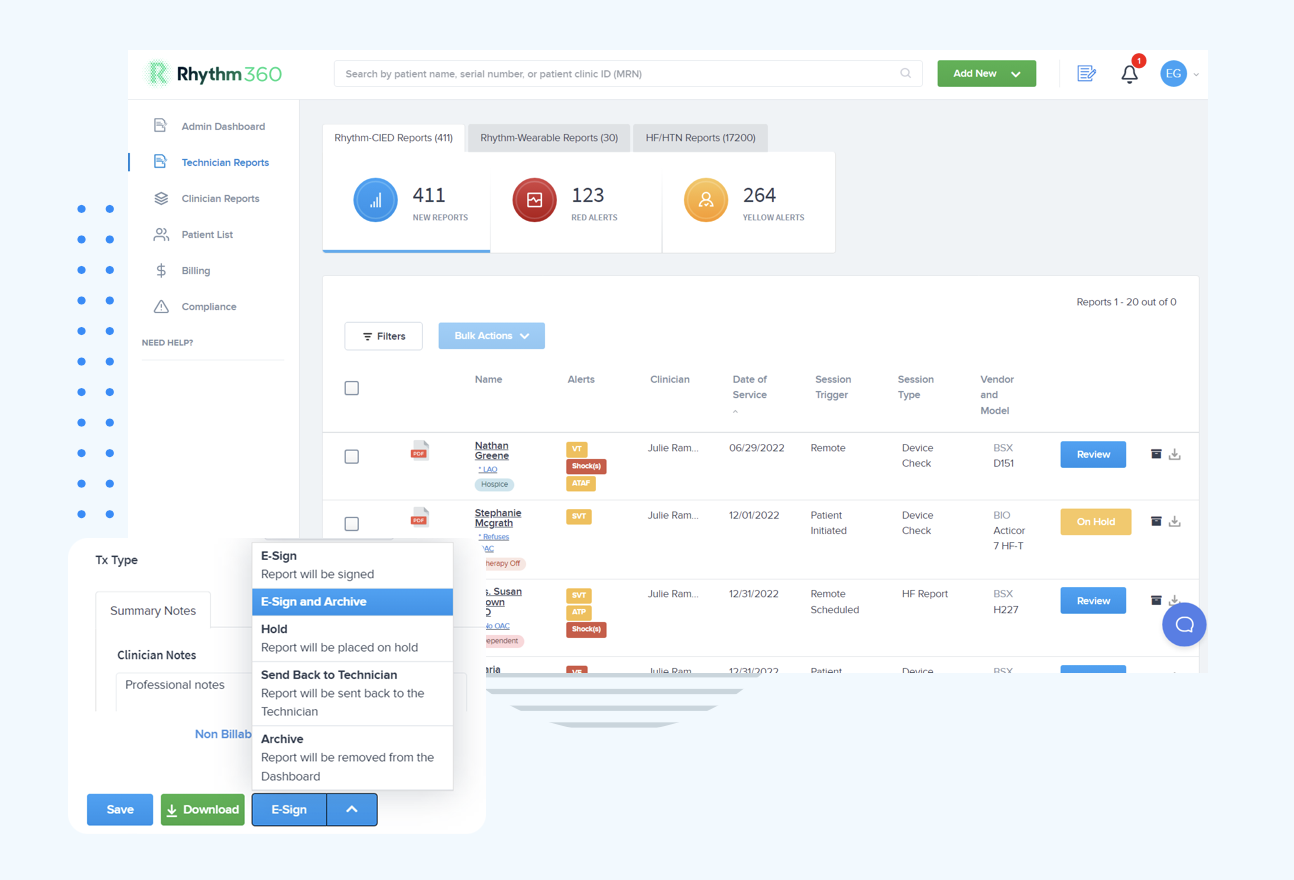
Gaurav A. Upadhyay, MD, at UCM stated, “We have improved billing and accountability for our patients after the integration.” UCM processed more than 73,000 reports annually through Rhythm360 in calendar year 2025, averaging more than 18,000 reports per quarter. This volume shows that a cloud-based platform can scale in high-volume cardiology settings.
Staff retention also improves when device technicians are not buried in administrative overload and alert fatigue. Reducing reliance on a single “super-user” who understands every portal creates business continuity and lowers operational risk.
Schedule a demo to see Rhythm360's administrative dashboard in action.
Electrophysiologists, cardiologists, nurse practitioners, and device technicians gain faster response to actionable events with a unified platform. AI-powered alert triage cuts the volume of non-actionable notifications that drive fatigue and surfaces only events that need clinical attention. Rhythm360 supports this workflow with greater than 99.9% data transmissibility through redundant data feeds and AI-powered gap-filling.
Andrew Beaser, MD, at UCM explained, “We are able to address these issues earlier; rather than waiting for a 3-month visit, we can call patients in for evaluation.” Continuous, centralized monitoring enables this shift from reactive to proactive care, which periodic manual review of individual OEM portals cannot match.
Secure mobile access lets clinicians review transmissions, sign reports, and coordinate care from a smartphone. A critical arrhythmia flagged on a Saturday morning can lead to anticoagulation or device reprogramming by Saturday afternoon. Fragmented, manual workflows rarely support that level of responsiveness.
The 2026 CMS Physician Fee Schedule introduced two new RPM CPT codes and increased reimbursement across existing codes. Practices need precise documentation to capture these codes and avoid denials.
Applicable 2026 CPT codes for cardiac remote monitoring include:
Maximum monthly RPM reimbursement per patient using 99454 + 99457 + 99458 totals $145.30 under 2026 rates. Documentation must specify the exact number of days readings were received for 99445 and the precise time range of 10–19 minutes for 99470. Vague documentation remains the leading cause of RPM denials and audit findings.
For EHR integration, Rhythm360 supports bi-directional connectivity with Epic, Cerner, Athenahealth, eClinicalWorks, Greenway Health, and others. Epic exposes three connectivity surfaces for device data: Epic Bridges for high-volume HL7 v2 feeds, the Cupid cardiology imaging stack, and FHIR R4 APIs with SMART on FHIR for app-based and patient-generated data. Oracle Health (Cerner) routes device data through the CareAware iBus, which normalizes vendor protocols and delivers observations into Cerner Millennium as HL7 v2 or FHIR R4 resources. Rhythm360's onboarding process, including EHR integration setup, typically takes from a few days to a few weeks.
Feature needs, total cost of ownership, and ROI timelines vary by practice size. The framework below outlines key considerations across three segments.
Solo and small practices (1–5 providers) gain the most from removing per-portal login overhead and automating CPT documentation, because administrative staff are limited. Cloud-based solutions for small practices incur modest implementation costs, with deployment typically completed in several weeks to a few months. Rhythm360's SaaS pricing scales with clinic size and usage, so small practices avoid large upfront capital commitments.
Mid-size groups (5–20 providers) need centralized compliance tracking, multi-user role management, and real-time population dashboards. These capabilities historically required expensive on-premise infrastructure and dedicated IT support. However, five-year TCO for a mid-size practice using cloud solutions is usually lower than for on-premise deployments when you include IT labor, hardware refreshes, and maintenance. Vendor-neutral platforms like Rhythm360 reduce costs further by removing per-portal licensing fees and the manual transcription labor that fragmented workflows create.
Large health systems managing thousands of CIED patients require enterprise-grade scalability, 24/7 alert coverage, and deep EHR integration. UCM's experience with Rhythm360, processing over 73,000 reports annually, shows that a cloud-based platform can sustain high-volume monitoring with stable dismissal rates.
The table below compares key platform capabilities between a unified, vendor-neutral cloud platform and legacy multi-portal or manual workflows.
| Capability | Unified Cloud Platform (Rhythm360) | Legacy Multi-Portal / Manual Workflow |
|---|---|---|
| OEM data consolidation | Single dashboard, all major OEMs via API, HL7, XML, and AI-powered PDF parsing | Separate login per OEM portal, no cross-vendor view |
| Alert triage | AI-powered prioritization, up to 80% reduction in critical-alert response times | Manual review of all alerts across multiple portals, high fatigue risk |
| CPT documentation | Automated capture and documentation for 2026 codes (93298, 93299, 99454, 99445, 99457, 99458, 99470, 99453) | Manual transcription, incomplete documentation that drives claim denials and revenue leakage |
| EHR integration | Bi-directional with Epic, Cerner, Athenahealth, and others via HL7 v2 and FHIR R4, onboarding in days to weeks | Manual export and re-entry, no structured bi-directional data flow |
A vendor-neutral cardiac telemetry monitoring platform is a software system that ingests, normalizes, and displays cardiac device data from multiple OEMs such as Medtronic, Boston Scientific, Abbott, and Biotronik without separate logins for each portal. The platform standardizes data formats from APIs, HL7 feeds, XML, and unstructured PDFs into a single, unified dashboard. This approach removes data silos, reduces administrative work, and gives a complete view of a patient's cardiac status regardless of device manufacturer. Rhythm360 is a vendor-neutral platform that also includes AI-powered alert triage, automated CPT-compliant reporting, and bi-directional EHR integration.
Medicare covers remote cardiac monitoring services through the CMS Physician Fee Schedule, which was updated for 2026 with higher reimbursement rates and two new CPT codes. Established codes such as 99453 (device setup), 99454 (device supply with 16+ days of readings), 99457 (first 20 minutes of management), and 99458 (additional 20-minute increments) all received rate increases effective January 1, 2026. Two new codes, 99445 for device supply with 2–15 days of readings and 99470 for 10–19 minutes of management requiring live interactive communication, extend coverage to patients with lower transmission adherence and shorter monthly management encounters. CIED-specific interrogation codes 93298 and 93299 remain applicable for remote device evaluations. Practices must document the exact number of transmission days for 99445 and the specific time range for 99470, because vague documentation drives many RPM claim denials.
Implementation timelines depend on practice size and EHR integration complexity. As noted in the compliance section, small practices with straightforward workflows can complete onboarding in days to weeks. Mid-size groups that need bi-directional Epic or Cerner integration may require additional configuration time, and Epic integration for new provider sites using SMART on FHIR generally requires 2–4 months per production site. Large health systems with complex data environments may take longer, although Rhythm360's streamlined implementation approach limits disruption to clinical operations. The SaaS delivery model removes hardware procurement and on-premise installation, which often extend timelines in legacy deployments.
Data transmission reliability directly affects timely detection of life-threatening arrhythmias or device malfunctions. As mentioned in the clinical benefits section, Rhythm360's redundant data feed architecture maintains a greater than 99.9% transmissibility rate even when an OEM's server is unavailable. This design acts as a fail-safe so clinicians do not lose visibility into patient status during vendor-side outages. The platform also uses computer vision (OCR) and AI-powered extrapolation to ingest unstructured PDF reports and fill data gaps that would otherwise create incomplete patient records.
Practices usually see fewer hours spent by device technicians and clinical staff on portal navigation, manual data entry, and billing documentation. This reduction in administrative work addresses a major driver of technician burnout and turnover in device clinics. By centralizing workflows into a single platform with automated reporting and AI-powered alert triage, Rhythm360 reduces reliance on a single “super-user” who holds institutional knowledge of multiple OEM portals. Staff can redirect time from data retrieval to direct patient care and proactive outreach. Practices using Rhythm360 have also reported up to an 80% reduction in critical-alert response times, reflecting both improved data reliability and more efficient staff workflows.
Choosing a cloud-based cardiac telemetry monitoring platform requires balancing clinical, operational, and financial criteria. Clinically, the platform must deliver reliable data transmission, AI-powered alert prioritization, and mobile access for on-call workflows. Operationally, it must remove redundant logins, support bi-directional EHR integration with Epic, Cerner, and Athenahealth, and scale across practice sizes without dedicated IT infrastructure. Financially, it must automate CPT-compliant documentation for 2026 codes and provide real-time visibility into captured and potential revenue.
Vendor neutrality remains a non-negotiable requirement. A platform that supports only some OEMs recreates the fragmentation problem it aims to solve. Rhythm360 consolidates data from all major device manufacturers into a single source of truth, with the AI infrastructure, EHR integrations, and CPT automation that cardiology practices need to run efficiently and capture the revenue they have earned.
Gaurav A. Upadhyay, MD, at UCM summarized the value of integrated, centralized data review: “That was a big piece for us, to have an integrated review of data from trained personnel.” That level of integration separates a modern, vendor-neutral platform from the fragmented workflows that continue to burden practices that have not yet adopted one.