

Last updated: July 14, 2026
A vendor-neutral platform must ingest and normalize data from pacemakers, ICDs, implantable loop recorders (ILRs), CRT devices, CCM devices, and specialized sensors such as CardioMEMS pulmonary artery monitors, regardless of manufacturer. OEMs use different data formats and transmission protocols, so Rhythm360 combines direct API connections, HL7 and XML feeds, and computer vision-based PDF parsing to extract structured data from unstructured OEM reports. A redundant data feed architecture acts as a fail-safe when an OEM server experiences downtime, which supports a platform-wide data transmissibility rate greater than 99.9%.
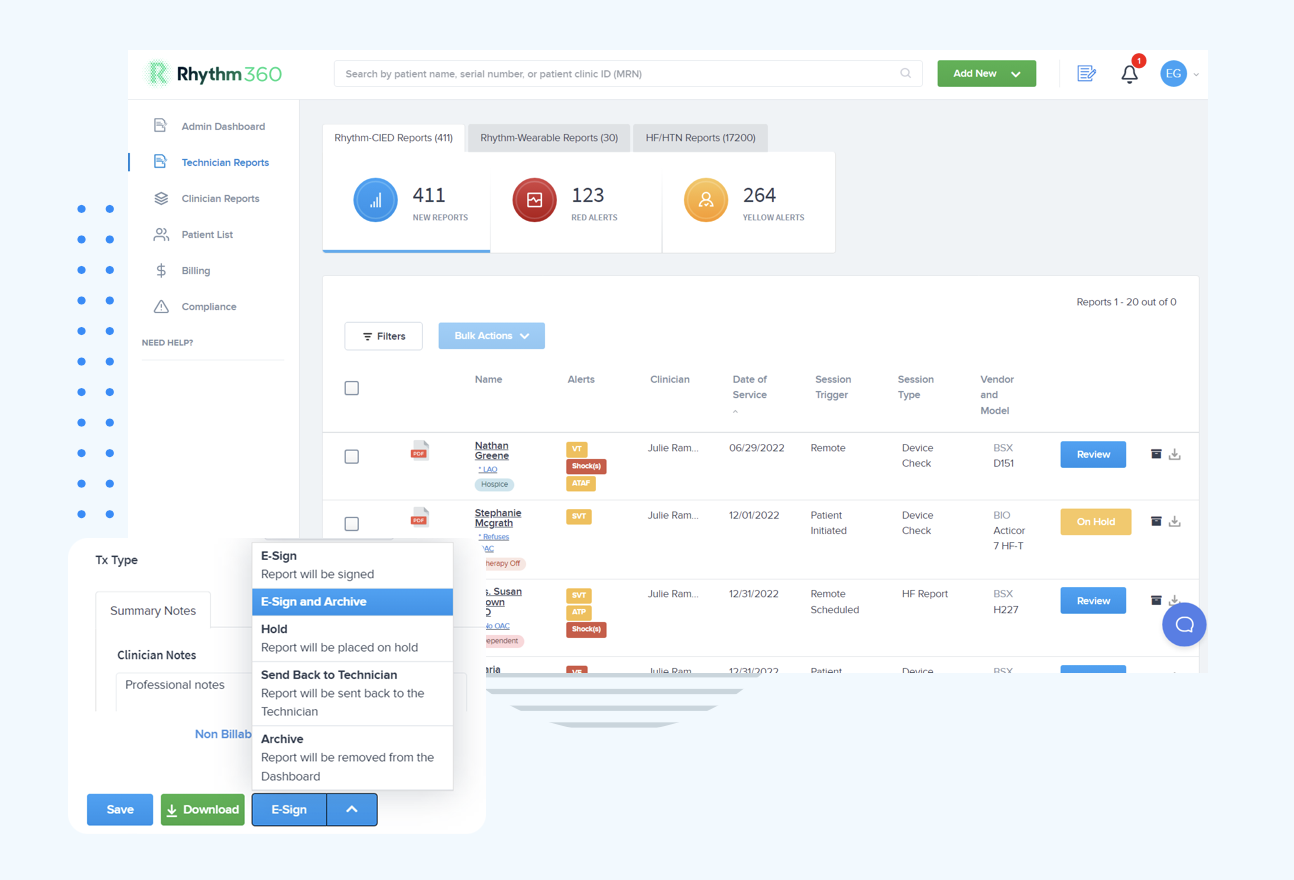
The clinical impact of that reliability appears clearly at scale. University of Chicago Medicine (UCM) reviewed more than 73,000 reports annually through Rhythm360 in calendar year 2025, averaging more than 18,000 reports per quarter. UCM’s experience shows vendor-neutral aggregation in a high-volume academic environment, with a single dashboard replacing multiple OEM logins and stable dismissal rates maintained across a growing patient population.
While UCM’s results demonstrate Rhythm360’s capabilities at scale, practices evaluating any cloud-based monitoring platform can apply the six criteria in this guide. These criteria create a consistent framework for matching platform capabilities to the specific needs of each practice.
Alert fatigue drives many clinical staff members out of device monitoring roles. Legacy systems generate high volumes of non-actionable notifications, and without intelligent filtering, clinicians spend time triaging noise instead of responding to genuine emergencies. Rhythm360’s AI-powered alert triage layer filters non-actionable transmissions and surfaces clinically significant events in priority order, which reduces critical alert response times by up to 80%.
Consider a Saturday morning when a patient’s ILR transmits a new-onset atrial fibrillation episode. Without an AI triage layer, that transmission sits in a queue alongside dozens of routine checks until Monday. With Rhythm360, the alert is flagged, prioritized, and routed to the on-call clinician’s mobile device within minutes. By Saturday afternoon, the care team has reviewed the data, initiated anticoagulation, and documented the intervention, which directly reduces stroke risk.
This type of rapid response already occurs in real-world deployments. UCM’s implementation of Rhythm360 enabled clinicians to review more transmissions daily and identify more abnormalities. The platform also supports optional 24/7/365 oversight by certified cardiac technicians (CCTs) supervised by physicians, which adds another triage layer for practices that want service-supported monitoring. As noted in UCM’s implementation review, “that was a big piece for us, to have an integrated review of data from trained personnel.”
See how Rhythm360’s AI alert triage handles your practice’s alert volume in a live demo.
Bi-directional EHR integration determines whether a monitoring platform reduces documentation burden or simply adds another data silo. Rhythm360 supports deep bi-directional integration with Epic, Cerner, Athenahealth, eClinicalWorks, Greenway Health, and additional systems via HL7. Data flows in both directions, so device transmissions populate the EHR automatically, and patient demographic or clinical updates in the EHR appear in Rhythm360 without manual re-entry.
Implementation timelines range from a few days to a few weeks, including EHR integration setup. That speed matters for practices that cannot tolerate prolonged operational disruption, and rapid deployment only delivers value when staff can use the platform without extensive training. Minimal training requirements reduce reliance on a single “super-user,” a staffing vulnerability that creates business continuity risk when that individual is unavailable.
Clinic administrators gain a single dashboard that displays patient compliance status, pending transmissions, critical alerts, and billable activity in real time. “We have improved billing and accountability for our patients after the integration,” noted a UCM clinical leader following Rhythm360 deployment. That accountability extends to CPT documentation, because automated report generation creates the auditable record required for compliant billing without additional staff hours.
Security requirements for EHR-integrated remote monitoring platforms include HIPAA compliance and executed Business Associate Agreements. Rhythm360 is HIPAA-compliant with executed Business Associate Agreements across its cloud infrastructure, mobile application, and integration layer.
| Criterion | Rhythm360 Performance |
|---|---|
| Vendor-Neutral Aggregation | Supports Medtronic, Boston Scientific, Abbott, Biotronik, and others via API, HL7, XML, and computer vision PDF parsing; demonstrated at UCM’s 2025 volume |
| AI Alert Triage | AI-powered filtering prioritizes clinically significant events; 80% faster critical alert response; optional 24/7/365 CCT oversight |
| Bi-Directional EHR Integration | Deep bi-directional integration with Epic, Cerner, Athenahealth, eClinicalWorks, Greenway Health, and others via HL7; HIPAA-compliant with executed Business Associate Agreements |
| Automated CPT Documentation | Automated capture and documentation for CPT 93298, 93299, and RPM codes 99453, 99454, 99457; up to 300% increase in captured revenue |
| Implementation Timeline | Days to weeks including EHR integration; minimal training; reduced super-user dependency |
| Mobile Access | Secure, HIPAA-compliant mobile app for transmission review, report signing, and care coordination from any location |
| Total Value of Ownership | SaaS pricing scaled to clinic size and usage; practices can capture significant annual recurring revenue in remote monitoring with complete CPT documentation |
Rhythm360 uses a SaaS pricing model with fees scaled to clinic size and platform usage rather than fixed enterprise licensing. This structure allows solo EP practices to access the same core capabilities as large health systems without disproportionate upfront costs.
The revenue impact of automated CPT documentation can be substantial. Billing CPT 93294, 93295, 93297, or 93298 inside the applicable lookback window is one of the five highest-frequency EP denial categories identified in billing audits. To prevent these denials, Rhythm360’s automated documentation tracks each device’s monitoring window, generates compliant reports at the correct intervals, and creates the audit trail required to defend claims. By eliminating the manual tracking errors that cause lookback violations, practices implementing Rhythm360 have achieved triple the previously captured revenue by recovering missed CPT events across CIED monitoring and RPM service lines including CPT 99454 for heart failure and hypertension patients.
Emerging 2026 research continues to examine the clinical and operational outcomes of unified remote monitoring platforms, which supports the case for platforms that combine data reliability with automated billing support. As AI-assisted decision support becomes increasingly important as data volumes grow, platforms that embed that intelligence into billing workflows, not just clinical alerts, will deliver compounding financial returns.
Rhythm360 is designed to scale across practice types. The table below maps common organizational profiles to the platform capabilities most relevant to each.
| Practice Type | Primary Challenge | Rhythm360 Capabilities That Address It |
|---|---|---|
| Small EP Group (1–3 physicians) | Limited staff bandwidth; reliance on a single super-user; incomplete CPT capture | Rapid implementation (days to weeks); automated CPT documentation; mobile app for on-call coverage; SaaS pricing scaled to volume |
| Mid-Sized EP Clinic (4–15 physicians) | Multi-vendor device population; alert fatigue; EHR documentation burden | Vendor-neutral aggregation across all major OEMs; AI alert triage with 80% response-time reduction; bi-directional Epic/Cerner integration; optional CCT oversight |
| Large Health System | High transmission volume; compliance tracking at scale; revenue visibility across sites | Demonstrated scalability at UCM’s 2025 volume; centralized compliance and revenue dashboard; integrated HF/HTN RPM service lines; enterprise EHR integration |
Rhythm360 onboarding, including EHR integration setup, typically takes from several days to several weeks depending on the complexity of the practice’s existing infrastructure and the availability of IT resources. The implementation process minimizes workflow disruption, because configuration, training, and integration support follow a structured path to reach go-live readiness quickly. Since the platform reduces reliance on a single super-user, staff can become proficient without extended training programs, and the practice avoids a prolonged period of parallel workflows.
Rhythm360 is a HIPAA-compliant platform that executes Business Associate Agreements with all covered entities, specifying permitted data uses, breach notification timelines, and subcontractor oversight requirements. These standards apply uniformly across the cloud infrastructure, the mobile application, and all OEM data feed integrations.
The most frequently automated codes in unified CIED monitoring platforms cover the full remote interrogation series. CPT 93294 covers pacemaker remote interrogation over a 90-day period. CPT 93295 covers ICD remote interrogation over a 90-day period. CPT 93296 is the technical component for remote rhythm monitoring of pacemakers or ICDs. CPT 93297 covers remote interrogation of an implantable cardiovascular monitor over 30 days. CPT 93298 covers remote interrogation of a subcutaneous cardiac rhythm monitor (ILR) over 30 days. CPT 93299 covers the professional interpretation component for ILR monitoring.
For heart failure and hypertension RPM programs, CPT 99453, 99454, and 99457 are also automated. Each code carries specific reporting window requirements, such as 93295 being billable only once per 90-day period per patient, and billing inside the applicable lookback window remains one of the most common sources of claim denials in electrophysiology practices. Rhythm360 provides automated capture and documentation for codes such as 93298, 93299, 99453, 99454, and 99457 to reduce that denial risk.
Rhythm360 provides distinct but integrated service lines for CIED monitoring (Rhythm-CIED) and remote physiological monitoring for heart failure and hypertension (HF/HTN RPM). Both service lines operate within the same dashboard, so clinical staff do not need to switch between systems to manage patients with overlapping conditions. The HF/HTN service line includes patient onboarding checklists, automated weight and blood pressure data ingestion from connected devices, and billing support for RPM CPT codes.
Practices can launch the RPM service line incrementally without disrupting existing CIED workflows, and the SaaS pricing model scales to reflect the additional patient volume rather than requiring a separate platform purchase.
The decision framework for selecting a cloud-based cardiac implant monitoring platform in 2026 centers on six measurable criteria: vendor-neutral aggregation, AI alert triage, EHR integration depth, automated CPT documentation, implementation speed, and total cost of ownership. Practices that evaluate platforms against these criteria with quantified benchmarks, rather than feature checklists alone, position themselves to select a solution that delivers durable clinical and financial returns.
Rhythm360 addresses each criterion with documented outcomes: greater than 99.9% data transmissibility across all major OEMs, up to 80% reduction in critical alert response times, bi-directional integration with Epic and Cerner deployable in days to weeks, automated CPT capture supporting up to a 300% increase in recovered revenue, and a HIPAA-compliant mobile application that extends clinical reach beyond the office. At the scale of a major academic medical center, Rhythm360 supported more than 73,000 annual report reviews at UCM in 2025 while maintaining stable dismissal rates, which shows that the platform scales without degrading clinical oversight quality.
Solo EP groups, mid-sized clinics, and large health systems can all build a strong operational and financial case for a unified, vendor-neutral platform. The key decision focuses on which platform delivers the most complete fit for a given practice’s patient population, staffing model, and growth trajectory.





