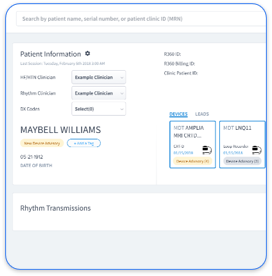
Cardiology clinics evaluating CIED platforms focus first on vendor compatibility, EHR connectivity, and alert handling. The next table highlights how Rhythm360’s multi-vendor support and AI triage create a unified workflow advantage for clinics managing devices from several manufacturers.

Platform | Multi-Vendor Compatibility | EHR Integration | AI Alert Triage |
Murj | Limited OEM support | Basic integration | Standard filtering |
Rhythm360 | All major OEMs | Bi-directional Epic/Cerner | 80% faster response times |
PaceMate | Select manufacturers | HL7 compatible | Basic AI features |
Paceart | Medtronic-focused | Multiple EMR integrations | Auto-triage capabilities |
Implicity | Multi-vendor support | Standard HL7 | Algorithm-based filtering |
Financial performance, data reliability, and mobile access then determine whether a platform can support long-term growth. The next table shows how Rhythm360’s SaaS model, revenue impact, and mobile tools support scalable remote monitoring programs.
Platform | Revenue Impact | Data Reliability | Mobile Access |
Murj | Standard billing | 95% transmissibility | Web-based only |
Rhythm360 | 300% revenue increase | >99.9% reliability | HIPAA-compliant app |
PaceMate | Moderate improvement | Standard reliability | Limited mobile |
Paceart | Advanced capture | On-premise dependent | No mobile access |
Implicity | Billing optimization | High reliability | Mobile dashboard |
Rhythm360’s strength across compatibility, automation, and reliability positions it as a practical choice for clinics that want both operational efficiency and stronger financial performance. Experience these unified capabilities in your own clinic environment.
Multi-OEM clinics need a single system that handles every device vendor without extra logins or manual workarounds. Murj’s workflow-focused approach can work in single-vendor environments but falls short when practices implant devices from several manufacturers.
Clinics that use Medtronic, Abbott, Boston Scientific, and Biotronik devices need seamless data consolidation across all manufacturers. Rhythm360’s vendor-neutral architecture ingests data from every major OEM through APIs, HL7 feeds, and computer vision-powered PDF parsing.
Consider an electrophysiologist on call over a weekend. One alert flags new-onset atrial fibrillation in a patient with an Abbott device. Another alert appears for a Medtronic ICD patient with ventricular tachycardia.
Murj’s limited compatibility forces that physician to move between multiple OEM portals. Each switch adds time and increases the chance of missed information. Rhythm360’s unified dashboard presents both cases together with AI-prioritized alerts, which supports rapid clinical decisions and timely intervention.
While Murj struggles with multi-vendor compatibility, Paceart faces different constraints that also slow clinic growth. Paceart’s on-premise architecture and Medtronic-centric design limit scalability for expanding practices that want flexibility and remote access.
Modern cardiology clinics now favor cloud-based platforms that support rapid expansion and broad chronic disease management. Rhythm360’s SaaS model scales from small practices to large health systems without new servers or hardware.
Rhythm360 also extends beyond CIED monitoring to support heart failure and hypertension remote physiological monitoring. This combined approach creates a single environment for chronic disease management instead of separate tools for each program.
Clinics can launch profitable RPM service lines for HF and HTN patients while keeping workflows unified across conditions. Paceart’s legacy design cannot support this multi-modality strategy, which limits both care models and revenue diversification.
Alert fatigue has become a major patient safety risk in CIED monitoring programs. Traditional platforms such as Murj and PaceMate generate many non-actionable notifications that overwhelm staff and bury true emergencies.
Rhythm360’s AI-powered alert triage system analyzes transmission patterns, patient history, and clinical context. The system then ranks events so that clinically urgent issues appear first.
This intelligent filtering delivers the 80% response time improvement mentioned earlier by replacing manual triage with automated prioritization. Certified cardiac technicians can provide optional 24/7/365 oversight under physician supervision, which supports immediate escalation of life-threatening arrhythmias or device malfunctions.
The machine learning models behind Rhythm360’s triage engine continue to refine accuracy over time. They adapt to each clinic’s protocols and patient mix, which further reduces noise while preserving critical signals.
Bi-directional EHR integration removes manual data entry and supports complete documentation for CPT codes 93298, 93299, and 99454. Rhythm360 connects deeply with Epic, Cerner, and other major EHR systems so that transmission data, interpretations, and billing details flow directly into the chart.
This automation helps practices recover revenue that previously went unbilled. Many clinics report remote monitoring profitability gains of up to 300% after consistent CPT capture and accurate documentation.
Clinic administrators also see fewer hours spent on data transcription and billing follow-up. Rhythm360’s automated CPT code capture supports compliance with evolving reimbursement rules while protecting revenue that might otherwise leak out of the process.
A 10-provider electrophysiology clinic managing 2,000 patients with mixed Medtronic and Abbott devices illustrates Rhythm360’s impact in daily practice. Before implementation, device technicians spent hours each day inside separate OEM portals, which delayed responses and left billing inconsistent.
After adopting Rhythm360, the clinic gained unified data access and much faster alert handling. The team also realized the dramatic alert response improvements discussed above and the revenue gains tied to automated billing capture.
Rhythm360’s redundant data feeds and computer vision capabilities support >99.9% data transmissibility for this clinic. When an OEM server experiences downtime, Rhythm360’s backup pathways maintain continuous monitoring and protect continuity of care.
This level of reliability gives clinicians confidence in their data during critical decisions. It also reduces the risk of serious events going unnoticed during gaps in OEM availability.
Real-world results like these show how Rhythm360 can reshape operations while supporting better outcomes. Discover how your clinic can achieve similar revenue and efficiency gains.
Implementation speed and cost-effectiveness set Rhythm360 apart from platforms that require long setup periods and high upfront fees. This advantage stems from its cloud-based architecture, which supports deployment within days to weeks, including full EHR integration and staff training.
Because clinics can go live so quickly, they reduce disruption and see value sooner. Staff adapt to the new workflows in a shorter window, and leadership can measure early improvements in throughput and documentation quality.
The flexible SaaS pricing model then scales with practice size and usage. Clinics avoid large capital purchases and instead align costs with patient volume.
HIPAA-compliant infrastructure and security controls support regulatory compliance without extra security projects for internal IT teams. Over time, clinics benefit from more proactive care, stronger patient retention, and a reputation for reliable, technology-enabled cardiology services.
Clinics that need multi-vendor compatibility, AI-driven efficiency, and strong financial performance should place Rhythm360 at the top of their shortlist. The platform’s feature set addresses the core evaluation criteria that matter most to cardiology leaders and administrators.
Vendor-neutral data ingestion, AI triage, and deep EHR connectivity work together to support both clinical and business goals. Decision-makers can select Rhythm360 with confidence when they want a single platform that supports growth, quality, and predictable revenue.
Rhythm360 represents a strong Paceart alternative for clinics that want cloud-based scalability, multi-vendor compatibility, and AI-powered alert triage. Unlike Paceart’s on-premise deployment and Medtronic focus, Rhythm360 supports all major device manufacturers and also extends into chronic disease management for heart failure and hypertension patients.
Murj and PaceMate both offer cloud-based monitoring, yet Rhythm360 goes further with broader vendor neutrality, more advanced AI capabilities, and proven revenue gains. Bi-directional EHR integration and mobile access give Rhythm360 a more complete footprint across clinical, operational, and financial needs.
Rhythm360 leads this category with deep bi-directional integration for Epic, Cerner, and other major EHR systems. This connection removes manual data entry and supports complete documentation for both billing compliance and clinical decision-making.
Rhythm360’s AI-powered alert system cuts response times by 80% through intelligent triage that pushes clinically significant events to the top of the queue. As noted earlier, this approach reduces alert fatigue while ensuring that staff focus quickly on high-risk arrhythmias and device issues.
Rhythm360’s automated CPT code capture and documentation workflows help practices increase remote monitoring revenue by up to 300%. The platform supports compliance with codes 93298, 93299, and 99454 while removing manual billing steps that often cause missed claims.
Rhythm360’s strengths in vendor neutrality, AI-driven efficiency, and revenue performance make it a compelling choice for cardiology clinics that want to modernize CIED monitoring. Schedule a personalized demo to see Rhythm360 in action.