

Last updated: August 24, 2026
Cardiology groups that implant devices from more than one manufacturer quickly see that OEM portals do not work together. Operational and clinical problems grow over time. Five recurring pain points push practices to look for alternatives in 2026:
Each of these pain points maps directly to specific platform capabilities that practices need from a vendor-neutral solution. The following nine criteria reflect the operational, clinical, and financial realities of running a multi-OEM CIED program in 2026.
Rhythm360 addresses all nine criteria within a single platform. Schedule a demo to see how Rhythm360 maps to your specific implant mix and EHR environment.
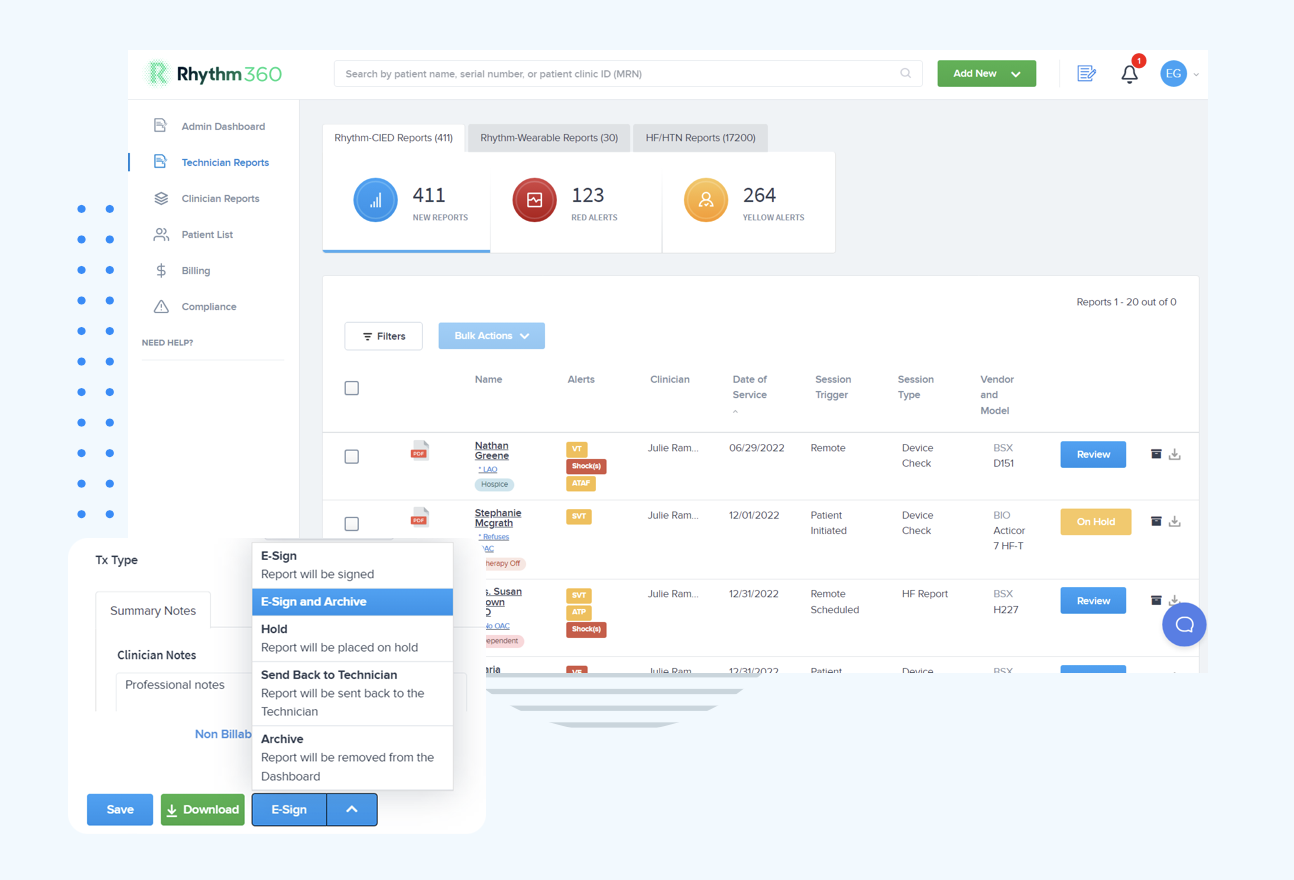
Rhythm360 uses SaaS pricing that scales with clinic size and platform usage, and its EHR integration timelines shorten significantly for sites where reusable templates already exist. The table below summarizes Rhythm360-specific integration notes by practice profile.
| Practice Profile | EHR | Rhythm360 Integration Approach | Typical Timeline |
|---|---|---|---|
| Solo EP / small group (<500 patients) | Athenahealth, eClinicalWorks | HL7 v2 messaging, lightweight onboarding with pre-built templates | Days to 2 weeks |
| Mid-size cardiology group (500–2,000 patients) | Epic, Cerner | Bi-directional FHIR R4 / HL7, reusable endpoint templates that reduce build time | 2–4 weeks |
| Large health system / academic center (>2,000 patients) | Epic, Cerner, Greenway Health | Full bi-directional integration with security review, BAA, and clinical validation; UCM processed 73,000+ reports annually at this scale | 4–6 weeks |
University of Chicago Medicine reviewed more than 73,000 reports annually through Rhythm360 in 2025, averaging more than 18,000 reports per quarter. At that volume, manual triage without AI assistance does not remain operationally viable.
Rhythm360’s AI layer filters non-actionable transmissions and surfaces clinically significant events such as new-onset AFib, ventricular tachycardia, lead malfunction, and ERI/RRT indicators for prioritized human review. The result is an 80% reduction in critical alert response times. UCM clinicians reported the ability to address issues earlier, calling patients in for evaluation rather than waiting for a scheduled 3-month visit.
For practices that cannot staff overnight triage, Rhythm360’s optional 24/7/365 CCT oversight layer adds physician-supervised human review on top of AI filtering. This hybrid model, which combines AI triage with certified human review, helps ensure that a critical arrhythmia flagged on a Saturday morning results in clinical action by Saturday afternoon, not Monday.
Medicare covers remote physiologic monitoring for chronic and acute conditions using a general set of procedure codes, paying separately for education and setup, device supply, and treatment and management. For CIED programs, the relevant code families span implanted device follow-up codes 93294, 93295, and 93296 for pacemakers, ICDs, and CRT devices, plus subcutaneous rhythm monitor codes 93298 and 93299, and home physiologic monitoring codes 99453, 99454, 99457, and 99458.
Two new CPT codes effective January 1, 2026 cover short post-discharge and post-procedure cardiac monitoring episodes, which creates additional billable opportunities that most practices are not yet capturing systematically. The 2026 Medicare conversion factor is $33.57 for qualifying alternative payment model participants and $33.40 for non-participants, so accurate code capture directly affects practice revenue.
Rhythm360 automates CPT documentation generation and flags the billing rule conflicts described in the decision criteria before claims are submitted. Practices implementing Rhythm360 have captured up to 300% more revenue through improved code capture and better staff efficiency. UCM physicians noted improved billing and accountability for patients after integration.
The right service model depends on internal staffing capacity, patient volume, and tolerance for overnight coverage gaps. Software-only deployments give practices full control over triage workflows and fit groups with dedicated device technicians and sufficient FTE coverage. The HRS/EHRA/APHRS/LAHRS international consensus statement provides staffing guidance for remote monitoring, a requirement that many mid-size practices cannot sustain.
Rhythm360 offers both models without requiring a long-term commitment to either. Practices can begin with software-only access and add optional 24/7 CCT oversight as patient volume grows or staffing constraints emerge. The platform’s architecture remains identical across both tiers, so clinical workflows, EHR integrations, and billing automation stay consistent regardless of which oversight model a practice selects.
EHR integration timelines often represent the longest variable in a platform switch. First-time integrations to a new EHR partner involve security review, BAA execution, network firewall changes, analyst coordination, and clinical validation, which extends work beyond engineering alone. Rhythm360’s reusable integration templates for Epic, Cerner, Athenahealth, eClinicalWorks, and Greenway Health compress these timelines to days to a few weeks for most practice profiles.
Total cost of ownership extends beyond licensing fees. Staff hours spent on manual data retrieval, alert triage, and billing documentation create a significant hidden cost in fragmented-portal environments. Rhythm360’s SaaS pricing scales with clinic size and usage, and the platform’s automation of reporting and billing documentation reduces the per-patient administrative burden that drives technician burnout and turnover.
On-call clinicians managing CIED patients cannot remain tethered to a workstation. Rhythm360’s HIPAA-compliant mobile application allows EP physicians, NPs, and PAs to review transmissions, sign reports, and coordinate care from their smartphones. Clinicians at UCM reported signing off on reports during meetings because mobile access made it practical.
The mobile app surfaces the same prioritized alert queue as the desktop dashboard. A critical notification such as ventricular fibrillation, lead malfunction, or significant weight gain in an HF patient reaches the on-call clinician immediately, regardless of location or time of day.
Before scheduling a final evaluation, ask every platform vendor these five questions and compare the specificity of their answers.
A genuinely vendor-neutral platform ingests data from every major device manufacturer, including Medtronic, Boston Scientific, Abbott, Biotronik, and others, through multiple integration methods such as APIs, HL7 messaging, XML feeds, and PDF parsing via computer vision. It normalizes all incoming data into a single schema so clinicians see a consistent, unified patient record regardless of which OEM manufactured the implanted device. Platforms that support only two or three manufacturers, or that require manual data entry for certain brands, do not function as fully vendor-neutral solutions in practice.
Rhythm360 uses a redundant data feed architecture that operates independently of any single OEM’s server infrastructure. If an OEM server experiences downtime, the platform’s AI-powered extrapolation and computer vision OCR layer continues to process available data and flags connectivity issues for clinical review. This redundancy enables Rhythm360 to sustain greater than 99.9% transmissibility across a diverse device population.
Rhythm360 automates documentation for the full family of relevant 2026 CPT codes, including the CIED monitoring codes, subcutaneous rhythm monitor codes, home physiologic monitoring codes, and the two new 2026 codes covering short post-discharge cardiac monitoring episodes described earlier in this guide. The platform also flags the AMA CPT parenthetical restriction that blocks concurrent billing of 99453 or 99454 alongside 93296 for the same patient and period, which reduces claim rejections before submission.
The software-only tier gives practices full access to Rhythm360’s data consolidation, AI alert triage, EHR integration, mobile app, and billing automation tools, while the practice’s own clinical staff perform transmission review and triage. The managed-service tier adds optional 24/7/365 oversight by certified cardiac technicians supervised by physicians, who review and triage transmissions on behalf of the practice. Both tiers run on the same platform architecture, so practices can transition between models with 30 days’ notice without re-implementing integrations or retraining staff on a new system.
Rhythm360 includes distinct but integrated service lines for Rhythm-CIED monitoring and for heart failure and hypertension remote physiological monitoring. The HF/HTN service line supports wearable and connected device data, including CardioMEMS pulmonary artery monitors, and automates patient onboarding checklists and billing documentation for the RPM code family. Practices can manage rhythm disorders, heart failure, and hypertension within a single clinical workspace, which enables a more complete view of each patient’s cardiovascular status without adding a separate platform or portal.
Fragmented OEM portals do not resolve themselves over time. As implant volumes grow and device manufacturers continue to operate separate, non-interoperable systems, the administrative burden, clinical risk, and revenue leakage all increase. A vendor-neutral platform that consolidates all CIED data, automates CPT-compliant documentation, and delivers AI-prioritized alerts to clinicians on any device, desktop or mobile, now serves as core operational infrastructure for modern cardiology programs.
Rhythm360 delivers that infrastructure with the high transmissibility rates described earlier, the alert response improvements already documented, the revenue gains outlined in the key takeaways, and EHR integration timelines measured in days to weeks rather than months. The University of Chicago Medicine case study shows that the architecture scales from solo EP clinics to large academic medical centers without degrading performance or alert accuracy.
The decision criteria, billing requirements, and service model considerations outlined in this guide provide a structured framework for evaluating any vendor-neutral CIED platform. Rhythm360 is built to meet every criterion on that list.
Schedule a demo to see Rhythm360’s unified dashboard, AI triage workflow, and EHR integration in a live environment tailored to your practice’s implant mix and patient volume.
If your practice feels ready to move from evaluation to implementation, the Rhythm360 team can walk through onboarding timelines, integration requirements, and service tier options specific to your clinic size and EHR. Schedule a demo today and quantify what consolidated cardiac data management is worth to your program.





