Last updated: July 14, 2026
A systematic audit of every threshold configured across all OEM portals is the first step toward reducing alert fatigue. Default manufacturer thresholds are designed for broad safety coverage, not clinical precision. A 2026 cross-manufacturer EHRA analysis of 2,659 episodes from 1,710 patients found that even AI-equipped implantable cardiac monitors still generate non-actionable episodes in 32.9% of reviewed rhythm events.
Here's a practical test for any threshold. If a new-onset AFib alert fires at 2 a.m. on a Saturday, would the on-call clinician act before Monday morning? If the honest answer is no, the threshold generates noise instead of signal.
Run through this checklist before finalizing any threshold change.
Pro tip: Vendors report reductions of 60–80% in false alerts when patient-specific baselines replace fixed thresholds. Rhythm360 supports individualized threshold configuration across all connected OEM devices from one interface, eliminating the need to replicate changes across separate portals.
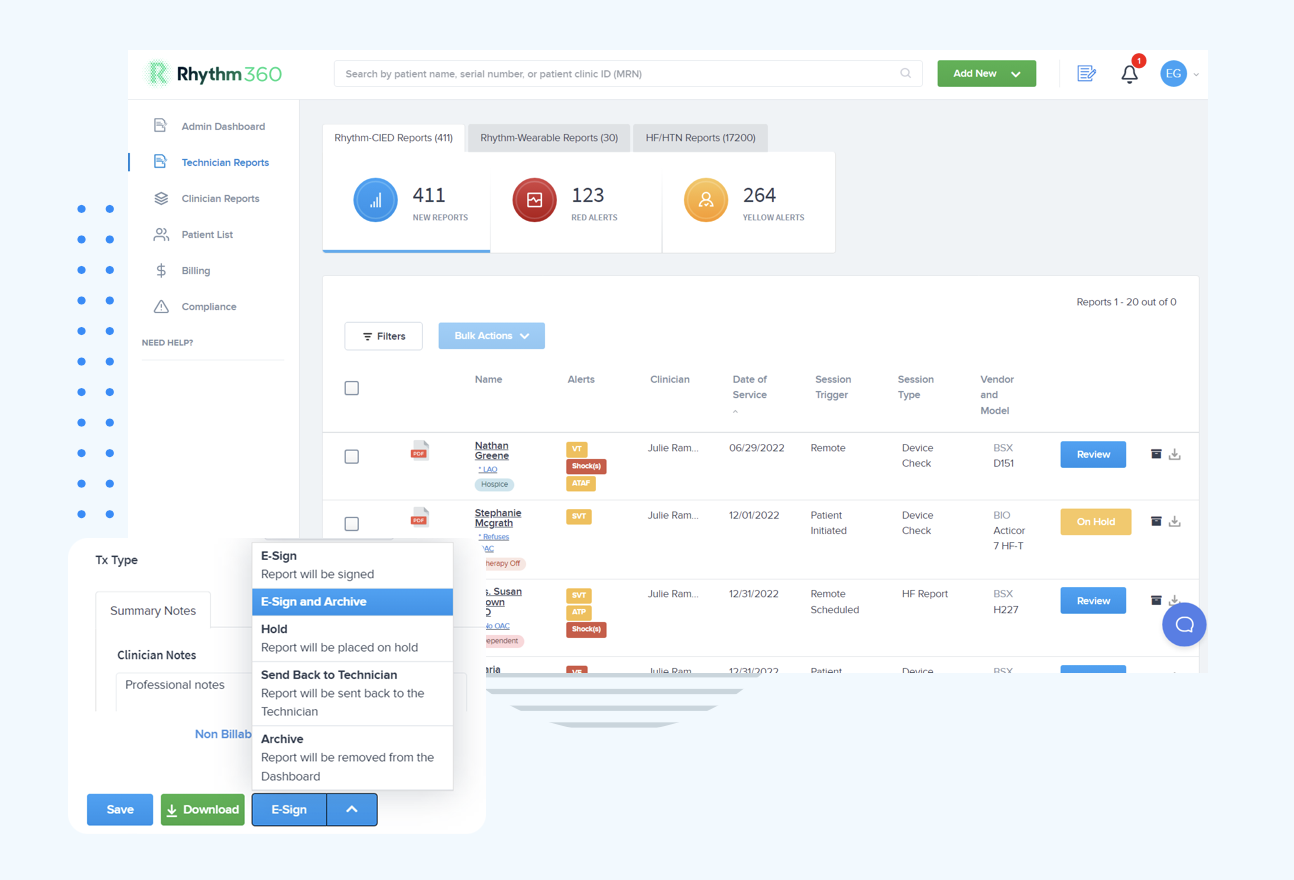
Tuned thresholds reduce noise at the source, but a well-tuned alert still needs to reach the right person through the right channel. That's where severity tiering comes in.
Not every alert warrants a phone call. Mapping severity tiers to the appropriate notification channel, whether that's a push notification, secure message, phone page, or escalation protocol, is one of the most effective structural interventions available. University of Maryland Medical Center stratifies cardiac monitor alarms into patient crisis, patient advisory, patient warning, and system warning categories, a model directly applicable to outpatient CIED programs. CardiQ's Alert Triage Workflow formalizes this with a color-coded RED/YELLOW/GREEN algorithm.
Consider a practical example. A ventricular fibrillation detection or ICD shock delivery is RED and triggers an immediate on-call page. A battery approaching ERI status is YELLOW and routes to the next business-day worklist. A routine scheduled transmission with no findings is GREEN and gets auto-filed.
Use this checklist when building your tier structure.
Pro tip: Regulatory frameworks for active implantable medical devices flag the high risk of devices like pacing-dependent pacemakers and ICDs, giving practices a basis for treating their alerts as highest priority. Rhythm360's severity tier engine routes alerts to the correct channel automatically.
An alert without clinical context forces the receiving clinician to open a separate portal, locate the patient record, retrieve prior transmissions, and then decide on a course of action. A 2026 qualitative study on alert fatigue found that this cognitive effort leads to interruptions, frustration, lost time, and clinician burnout.
Every alert delivered through Rhythm360 includes the patient's device type, implant date, prior transmission history, current medications on file, and the specific waveform or parameter that triggered the notification. A clinician receiving a Saturday morning AFib alert can immediately see burden percentage, ventricular rate, and whether anticoagulation is already on the medication list, without logging into a separate system.
Checklist for actionable alert design:
Pro tip: Guideline-based smartphrase templates for specific alert types, including atrial and ventricular arrhythmias, ICD therapies, lead issues, and battery status, standardize the clinical context delivered with each notification. Rhythm360 generates near-real-time reports with this context embedded, cutting the time between alert receipt and clinical decision.
Rich context helps a single clinician act faster on one alert. The next challenge is preventing the same event from generating multiple alerts across different vendor systems in the first place.
Practices managing devices from Medtronic, Boston Scientific, Abbott, Biotronik, and other manufacturers receive overlapping notifications for the same patient event from multiple portals. Fragmented systems using different protocols generate alerts independently with no shared communication layer, flooding staff with notifications across multiple interfaces.
Deduplication means identifying and suppressing redundant alerts that represent the same underlying clinical event. It's a prerequisite for any sustainable alert management program. Correlation goes further, linking related events, such as a lead impedance change followed by an inappropriate shock, into a single clinical narrative rather than two separate notifications.
Deduplication checklist:
Pro tip: University of Chicago Medicine reviewed more than 73,000 reports annually through Rhythm360 in 2025, averaging more than 18,000 reports per quarter, with stable dismissal rates, a result the health system attributes partly to centralized data aggregation. Rhythm360 achieves this aggregation by ingesting data via API, HL7, XML, and PDF parsing through computer vision, normalizing transmissions from all major OEMs into a single deduplicated record, the mechanism behind the stability seen at UChicago Medicine.
AI-powered triage applies machine learning to the incoming alert stream to distinguish clinically significant events from noise before a human clinician sees the notification. A 2026 study published in the Journal of Cardiovascular Electrophysiology showed that a deep learning 1D-CNN model could detect over three-quarters of true ventricular tachycardia events while reducing false positives.
AI triage works best paired with human oversight for high-acuity events. Andrew Beaser, MD, Associate Professor of Medicine at University of Chicago Medicine, stated: "Decision support, including AI-assisted decision support, will become increasingly important as data volumes grow." Rhythm360 combines AI triage with optional 24/7/365 oversight by certified cardiac technicians (CCTs) supervised by physicians, so the AI layer is backed by clinical judgment when it's needed.
Implementation checklist for AI triage:
See the triage engine in action, request a walkthrough of how Rhythm360's AI and optional CCT oversight layer work together in a live cardiology workflow.
Alert thresholds, severity tiers, and triage rules drift over time as patient populations change, new device models get implanted, and OEM firmware updates alter default alert behaviors. Missed alerts and unclear escalation pathways are common preventable system failures that delay clinical response in cardiac device programs. A monthly governance review prevents that drift from becoming a patient safety event.
A governance review meeting should include at minimum one electrophysiologist, one device technician, and the clinic administrator. The agenda covers dismissal rate trends, missed critical events from the prior month, threshold change requests, and staffing coverage gaps.
Monthly governance checklist:
Pro tip: Gaurav A. Upadhyay, MD, FACC, FHRS, Director of the Pacing & Defibrillation Device Clinic at University of Chicago Medicine, noted: "Staffing was always an issue for our center, because our device clinic, like many other medical centers, had struggled with technician turnover and timely weekend coverage." Rhythm360's administrative dashboard gives governance teams real-time visibility into alert volume, dismissal rates, and coverage gaps to inform monthly decisions.
Governance reviews often surface the same finding: staff spend too much time on routine, predictable tasks that don't require clinical judgment. Automation solves that specific problem.
Automation reduces the manual burden on clinical staff for tasks that follow a predictable, rules-based pathway. When a heart failure patient's connected scale shows three consecutive days of missed readings, an automated reminder message works faster than a staff-initiated phone call and creates a documented audit trail. Cincinnati Children's Hospital Medical Center reduced the median number of daily cardiac alarms from 180 to 40, an 80% reduction, by implementing a standardized, team-based care process that included reliable monitor discontinuation methods and individualized daily parameter assessments.
Automation doesn't replace clinical judgment. It ensures routine, low-complexity tasks get completed consistently so clinical staff can focus on events that require human decision-making.
Automation checklist:
Pro tip: Rhythm360's integrated communication hub, powered by Twilio, automates patient messaging and logs all outreach, including phone call records, within the patient record. When a staff member reviews a case, the full communication history is visible, eliminating redundant outreach and supporting compliant documentation for CPT codes including 93298, 93299, and 99454.
The table below maps each of the seven strategies above to the specific Rhythm360 capability that implements it, along with the documented outcome.
| Rhythm360 Capability | How It Works | Documented Outcome |
|---|---|---|
| Vendor-neutral data ingestion | Ingests API, HL7, XML, and PDF data from all major OEMs (Medtronic, Boston Scientific, Abbott, Biotronik, and others) via computer vision and AI normalization | See University of Chicago Medicine result cited above under Strategy 4. |
| AI-powered alert triage with optional 24/7 CCT oversight | Machine learning filters non-actionable alerts; certified cardiac technicians supervised by physicians provide optional around-the-clock review for high-acuity events | Up to 80% reduction in critical alert response times (RhythmScience platform data) |
| Risk-based severity tiering | Configurable RED/YELLOW/GREEN tier engine maps each alert type to the appropriate notification channel and escalation pathway | Supports the response-time gains shown in the row above; industry-wide AI triage was separately cited at HRS 2026 as reducing alert fatigue by 80% |
| Automated CPT code documentation | Billable remote monitoring events trigger automated documentation workflows aligned to CPT codes 93298, 93299, 99453, 99454, and 99457 | Up to 300% increase in revenue through optimized CPT code capture and improved staff efficiency (RhythmScience platform data) |
| Redundant data feeds with >99.9% transmissibility | Fail-safe data ingestion activates when an OEM server is unavailable; computer vision and AI extrapolation fill data gaps | Uninterrupted monitoring continuity across all connected device manufacturers (RhythmScience platform data) |
| HIPAA-compliant mobile application | Clinicians review transmissions, sign reports, and coordinate care from any location via a secure mobile app | Eliminates tether to workstation for on-call coverage; supports weekend and after-hours critical event response (RhythmScience platform data) |
| Bi-directional EHR integration | Connects to Epic, Cerner, Athenahealth, eClinicalWorks, Greenway Health, and others via HL7; onboarding takes days to weeks | Eliminates manual data transcription and reduces administrative overhead across the device clinic (RhythmScience platform data) |
Reducing alert fatigue takes a combination of threshold tuning, risk-based severity tiering, actionable alert design, deduplication across vendor portals, AI-powered triage, regular governance reviews, and workflow automation. No single intervention works alone. The most durable reductions come from consolidating device data into one platform where thresholds, tiers, and triage rules can be managed centrally and reviewed on a consistent schedule.
Risk-based severity tiering mapped to specific notification channels stands out as the single most effective strategy. When every alert type gets assigned a tier, critical, warning, or advisory, and each tier routes to the appropriate channel, clinicians receive notifications proportional to the urgency of the underlying event. This prevents the flattening effect where all alerts feel equally urgent and equally easy to ignore.
Alert fatigue prevention is an ongoing operational discipline, not a one-time configuration task. It requires monthly governance reviews to catch threshold drift, a feedback loop between clinical staff and the platform so override patterns inform future triage rules, and automation of routine tasks so clinical attention stays available for events that genuinely need it. Fragmented monitoring across multiple OEM portals is itself a structural cause of alert overload, which is why vendor-neutral platforms matter here.
Critical alert fatigue in CIED and RPM programs is not an inevitable feature of high-volume cardiac monitoring. It is a solvable operational problem with measurable solutions: tuned thresholds, risk-based severity tiers, actionable clinical context, cross-vendor deduplication, AI-powered triage, monthly governance, and targeted automation. Each strategy addresses a specific failure mode in the alert pipeline.
Together, these seven strategies shift a cardiology practice from reactive, fragmented monitoring to proactive, unified oversight. Rhythm360 supports every layer of that framework, from ingesting and normalizing data across all major device manufacturers to delivering risk-tiered, context-rich alerts through a HIPAA-compliant mobile app. The platform gives electrophysiologists, device technicians, NPs, and clinic administrators the tools to stop missing critical events and start recapturing the clinical and financial value that fragmented workflows leave behind.
Schedule a demo and see how Rhythm360 can help your practice achieve the response-time and revenue gains outlined above.