

Last updated: July 13, 2026
Remote monitoring platforms transmit device data on daily or weekly schedules, so clinicians can detect arrhythmias, lead anomalies, and battery depletion between scheduled visits. In-person interrogation, by contrast, creates data gaps that can span weeks or months. Andrew Beaser, MD, Associate Professor of Medicine at the University of Chicago Medicine, described the clinical advantage directly: “We are able to address these issues earlier; rather than waiting for a 3-month visit, we can call patients in for evaluation.”
Alert volume remains a persistent problem with legacy remote systems. AI-enhanced algorithms in insertable cardiac monitors filter nuisance alerts by more than 91%, saving clinical staff more than 400 hours annually. Rhythm360 applies AI-powered triage to prioritize clinically significant events and suppress non-actionable noise, reducing critical alert response times by up to 80%. The platform achieves greater than 99.9% transmissibility through redundant data feeds, computer vision, and AI-powered extrapolation, a reliability threshold that manual in-person workflows and single-feed OEM portals cannot match.
Remote CIED monitoring relies on bedside transmitters or smartphone-connected readers that transfer device diagnostic data nightly. Implantable cardiac devices increasingly include wireless telemetry; patients use a bedside monitor or smartphone-connected reader to transmit device diagnostic data nightly, allowing clinicians to identify battery depletion, lead issues, or arrhythmic burden without a clinic visit. In-person interrogation requires a physical programming wand and a dedicated clinic appointment, which creates scheduling overhead and limits data frequency to visit intervals.
Cellular-connected remote monitoring devices transmit directly without smartphone or Wi-Fi dependency, resulting in consistently higher adherence rates than Bluetooth-paired devices, especially in older Medicare populations. Rhythm360 ingests both remote transmissions and in-clinic interrogation data into one unified dashboard, so device technicians never need to reconcile data from two separate systems. The critical distinction in remote CIED workflows is whether device data is captured in structured form and connected to the EHR, enabling a visible patient journey that includes implant history, prior interventions, arrhythmias, and clinical events rather than isolated technical reports.
In-person visits still play a key role for findings that require physical examination, such as new murmurs, peripheral edema assessed by palpation, or jugular venous distension. Rhythm360 is designed to complement those evaluations rather than replace them.
Practices implanting devices from more than one manufacturer face an immediate operational burden: separate, non-interoperable portals for Medtronic CareLink, Abbott Merlin.net, Boston Scientific Latitude, and Biotronik Home Monitoring. Managing patients across multiple CIED vendors requires structured data capture and EHR integration of transmissions; without it, clinicians must manually assemble information from disconnected manufacturer portals, limiting scalability after the post-COVID surge in remote monitoring volumes.
Andrew Beaser, MD, described pre-Rhythm360 workflows at UCM as “a major challenge and incredibly difficult,” and Gaurav A. Upadhyay, MD, FACC, FHRS, noted that “staffing was always an issue for our center, because our device clinic, like many other medical centers, had struggled with technician turnover and timely weekend coverage.”
Rhythm360 normalizes data from Medtronic, Boston Scientific, Abbott, and Biotronik using API, HL7, XML, and PDF parsing via computer vision, then presents every manufacturer’s data in a single, consistent format. Other platforms exist in the market, yet Rhythm360’s architecture focuses specifically on full consolidation of multi-vendor CIED data alongside HF and HTN remote physiological monitoring in one workspace.
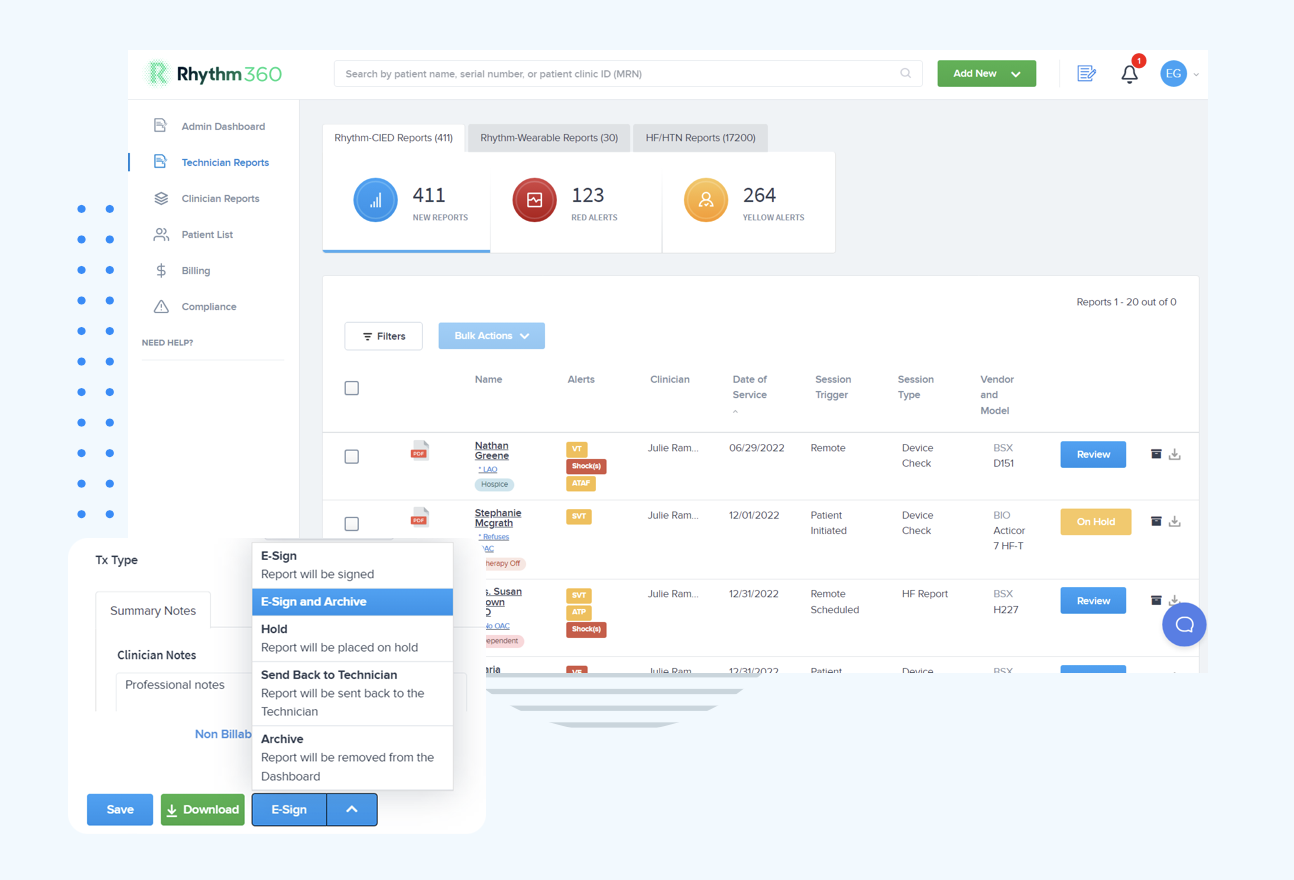
See how Rhythm360 consolidates every OEM portal into one dashboard, and request your walkthrough.
Effective multi-vendor CIED management depends on EHR integration that delivers current patient context at the moment a clinician opens an alert. Modern API-driven EHR integration built on the FHIR standard requests current patient context, including medications, diagnoses, hospitalizations, labs, and cardiac function, from the EHR at the exact moment a device report is opened, rather than relying on prior cached data. Rhythm360 provides bi-directional integration with Epic, Cerner, Athenahealth, eClinicalWorks, Greenway Health, and others via HL7, which removes the manual retrieval steps that slow alert response in fragmented environments.
Billing automation carries equal weight for program sustainability. The 2026 Physician Fee Schedule includes updated reimbursement values for remote cardiac monitoring services, which can generate additional revenue for CIED monitoring programs when billing windows are tracked automatically. The 2026 CPT updates also add code 99445 for remote physiologic monitoring device supply covering 2–15 days and code 99470 for 10–19 minutes of treatment management services, expanding reimbursement pathways for patients who do not meet traditional 16-day thresholds.
Rhythm360 automates CPT code identification, documentation generation, and billing preparation across these codes, helping practices capture up to 300% more revenue than manual workflows allow. Gaurav A. Upadhyay, MD, confirmed: “We have improved billing and accountability for our patients after the integration.”
Mobile access changes how quickly clinicians can act on critical data. Consider a concrete scenario: an on-call electrophysiologist receives a Rhythm360 alert on Saturday morning indicating new-onset atrial fibrillation in a patient with a recently implanted ICD. Using the platform’s HIPAA-compliant mobile application, the physician reviews the transmission, signs the report, and initiates anticoagulation protocols before noon. Without a mobile-accessible platform, that alert might wait until Monday’s clinic opening, which creates a stroke risk window of more than 48 hours.
Beyond urgent alert response, Rhythm360’s mobile and workflow capabilities support new revenue opportunities. Consider a second scenario involving a cardiology practice that launches an HF/HTN RPM service line. Rhythm360’s turnkey onboarding checklists and automated billing support for CPT codes 99453, 99454, and 99457 allow the practice to generate new recurring revenue without hiring additional staff. RPM programs have demonstrated high levels of billing capture for eligible CPT codes following implementation.
Smartphone-based cardiac apps have reduced reperfusion times compared with conventional methods, according to a 2025 meta-analysis, which illustrates the broader clinical impact of mobile-first cardiac workflows. Rhythm360’s mobile application extends that principle to CIED monitoring, so clinicians can act on critical data from any location.
Explore Rhythm360’s mobile access and RPM service line capabilities, and connect with our team.
The 2026 HRS/AHA/APHRS/EHRA/IDSA/LAHRS/PACES/STS expert consensus statement update on cardiovascular implantable electronic device lead management and extraction mandates remote monitoring as a standard of care for CIEDs, with Yong-Mei Cha, M.D., of Mayo Clinic stating: “Remote monitoring and close clinical follow-up are crucial.” Rhythm360’s architecture satisfies these requirements across all major device manufacturers without separate compliance workflows for each OEM.
The OIG announced a formal audit of Medicare Part B RPM billing on December 16, 2024, with Medicare RPM payments totaling $536 million in 2024. Rhythm360’s automated documentation and audit trail capabilities address these compliance risks directly.
Implementation typically takes days to weeks, not months. The SaaS pricing model scales with clinic size and platform usage, which removes large upfront capital commitments. Minimal training is required because the platform consolidates previously fragmented tasks into a single intuitive interface, reducing dependence on specialized “super-users” and supporting staff retention.
| Feature / Metric | Rhythm360 Capability |
|---|---|
| Data Consolidation | Single vendor-neutral dashboard ingesting Medtronic, Boston Scientific, Abbott, and Biotronik data via API, HL7, XML, and computer vision PDF parsing |
| Transmissibility | >99.9% (see Data Frequency and Alerts section for details) |
| Critical Alert Response Time | Up to 80% faster than manual, fragmented workflows (see Data Frequency and Alerts section) |
| EHR Integrations | Bi-directional: Epic, Cerner, Athenahealth, eClinicalWorks, Greenway Health, and others via HL7 |
| Billing Automation | Automated CPT code capture and documentation for 93296–93299, 99453, 99454, 99457, 99458, 99445, 99470, with up to 300% revenue improvement (see EHR Integration and Billing Automation section) |
| Mobile Access | HIPAA-compliant mobile app for transmission review, report signing, and care coordination from any location |
| Annual Report Volume (UCM) | 73,000+ reports annually at University of Chicago Medicine in 2025 (see Data Frequency and Alerts section) |
| Chronic Disease Service Lines | Integrated Rhythm-CIED and HF/HTN RPM modules in one workspace |
| Implementation Timeline | Days to weeks, including EHR integration setup |
| Pricing Model | Scalable SaaS pricing based on clinic size and platform usage |
Use the following checklist to assess your current environment. Practices that answer “yes” to three or more items are strong candidates for a unified platform evaluation.
If your practice matches this profile, a unified, vendor-neutral platform with automated billing and mobile access represents a high-impact operational investment in 2026.
Modern remote CIED monitoring platforms transmit device data daily or on a scheduled basis using bedside transmitters or smartphone-connected readers, which provides far more frequent data points than quarterly or semi-annual in-person interrogations. Transmission reliability varies significantly by platform architecture. Rhythm360 achieves greater than 99.9% transmissibility through a redundant data feed system, computer vision, and AI-powered extrapolation that fills gaps when an OEM server experiences downtime. In-person interrogations remain the standard for findings that require physical examination, but for arrhythmia detection, battery monitoring, and lead surveillance, continuous remote transmission with high reliability is clinically superior to visit-interval data collection alone.
Alert fatigue in CIED monitoring stems from two sources: high volumes of non-actionable transmissions and the cognitive burden of switching between multiple OEM portals with inconsistent alert formats. A vendor-neutral platform addresses both. By normalizing data from all manufacturers into a single queue and applying AI-powered triage to filter non-actionable events, Rhythm360 reduces the number of alerts requiring human review while ensuring that clinically significant events, such as new-onset atrial fibrillation, ventricular tachycardia, lead malfunction, and battery depletion, surface promptly. The result is the alert response improvement detailed earlier and a shift from reactive to proactive patient management. Optional 24/7/365 oversight by certified cardiac technicians supervised by physicians provides an additional triage layer for high-volume programs.
Remote monitoring generates billable events under multiple CPT codes, including 93296, 93297, 93298, 99453, 99454, 99457, and the new 2026 codes 99445 and 99470, yet capturing that revenue consistently requires automated tracking of monitoring periods, documentation standards, and billing cycle windows. Manual workflows frequently miss billable events or generate documentation that fails audit review. Rhythm360 automates CPT code identification, documentation generation, and billing preparation across all applicable codes, which helps practices recover previously lost revenue. The 2026 increase in the technical component RVU for CPT 93296 from 0.60 to 0.95 makes accurate automated tracking even more financially significant for high-volume CIED programs. Practices implementing Rhythm360 have achieved up to 300% improvement in revenue generation through optimized CPT code capture and improved staff efficiency.
Rhythm360 is designed for rapid deployment. The full implementation process, including EHR integration with Epic, Cerner, Athenahealth, or other supported systems, typically takes days to a few weeks depending on the complexity of the existing environment. The platform’s intuitive interface minimizes training time and reduces dependence on specialized super-users, which is particularly helpful for clinics that have experienced technician turnover. The SaaS pricing model removes large upfront capital requirements, and the platform scales as the practice grows, whether adding new device manufacturers, expanding to HF/HTN RPM service lines, or onboarding additional clinic locations.
Remote and in-person cardiac device workflows each carry distinct trade-offs across data frequency, equipment requirements, alert reliability, EHR connectivity, billing capture, and clinician mobility. In-person interrogation remains irreplaceable for physical examination findings. Remote monitoring delivers continuous data and earlier intervention capability, but only when the underlying platform achieves high transmissibility, intelligent alert triage, and structured EHR integration. Fragmented OEM portals undermine all three.
Rhythm360 consolidates multi-vendor CIED data, HF monitoring, and HTN RPM into one AI-powered, vendor-neutral platform that aligns with 2026 HRS guidelines, automates CPT documentation, and gives clinicians mobile access to act on critical alerts from anywhere. The University of Chicago Medicine’s experience, described earlier as a high-volume program with earlier clinical interventions and improved billing accountability, shows what a unified platform can deliver at scale.





