
Top Unified Multi-Vendor Pacemaker Monitoring Platforms
Rhythm360 unifies all CIED vendors in one AI-powered dashboard—cut alert response times 80% & maximize CPT billing. See why cardiology teams choose us

Last updated: June 27, 2026
Key Takeaways for Cardiology Practices in 2026
- A unified multi-vendor pacemaker monitoring platform pulls CIED data from Medtronic, Boston Scientific, Abbott, and Biotronik into one vendor-neutral workspace, which eliminates fragmented OEM portals.
- Practices using these platforms see up to 80% faster critical alert response times and as much as 300% revenue lift through automated CPT billing and fewer claim denials.
- Core 2026 requirements include AI-powered alert triage, bi-directional EHR integration, HIPAA-compliant mobile access, and real-time CPT documentation for codes such as 93298 and 99454.
- Implementation timelines typically range from days to weeks, with data transmissibility above 99.9% and support for major EHR systems including Epic and Cerner.
- Cardiology practices ready to consolidate their CIED population and improve billing outcomes can schedule a demo with Rhythm360.
Executive Overview: Why CIED Monitoring Workflows Are Breaking
Cardiology practices in 2026 face a compounding operational crisis. CIED implant volumes continue to rise while device manufacturers maintain proprietary, non-interoperable portals. Clinical and administrative staff must manage parallel logins, reconcile conflicting data, and manually track billable events across disconnected systems.
These fragmented workflows create measurable downstream effects. Teams experience alert fatigue, miss critical events, submit claims that lack supporting documentation, and struggle with staff burnout. A true unified multi-vendor CIED monitoring platform resolves these problems at the infrastructure level.
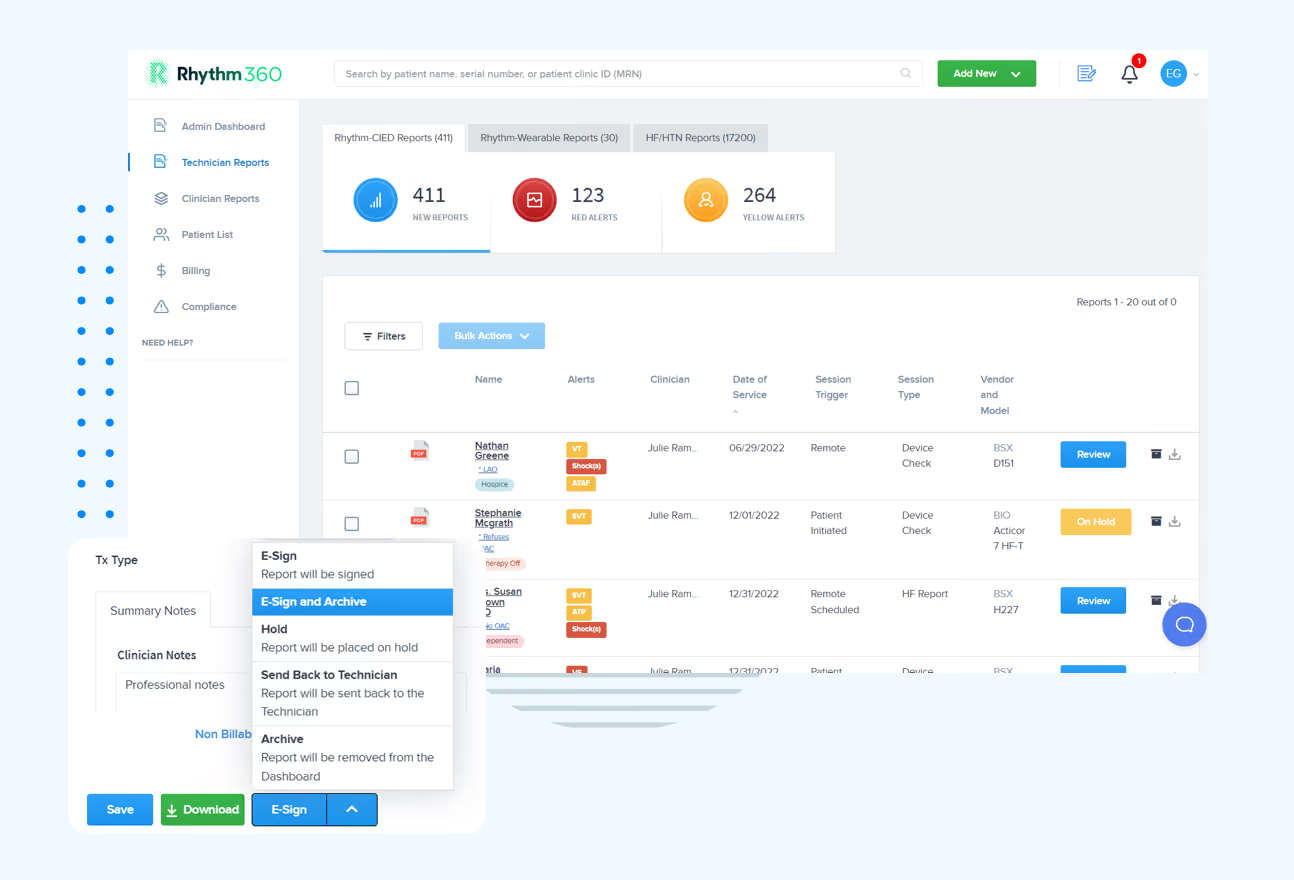
The platform replaces legacy OEM portals with a single source of truth. It supports AI-powered alert triage, automated CPT code documentation, and bi-directional EHR integration. This guide explains what that platform must deliver in 2026, how Medicare billing applies, and how leading solutions compare on quantified outcomes.
See how Rhythm360 consolidates your entire CIED population into one platform, and schedule a demo.
Why Multi-Vendor CIED Monitoring Consolidation Matters in 2026
To understand the operational impact of consolidation, consider the daily reality in an electrophysiology clinic. The average clinic manages devices from three or more OEMs at the same time. Each manufacturer, including Medtronic, Boston Scientific, Abbott, and Biotronik, operates a separate web portal with distinct login credentials, report formats, alert thresholds, and data export protocols.
Device technicians and nurses must switch between these environments dozens of times per day. This constant context switching introduces transcription errors and creates data silos that no single clinician can fully reconcile. The clinical stakes are direct and immediate.
A critical arrhythmia event such as new-onset atrial fibrillation, ventricular tachycardia, or a lead integrity alert may surface in one OEM portal. That event can sit unreviewed for hours or days if the portal is not in the active queue. Manual processes and unreliable data transmission increase this risk.
Billing suffers as well. Without a centralized billing tracker, billable remote monitoring events go undocumented. CPT claims for codes such as 93298, 93299, and 99454 are missed or submitted without adequate supporting documentation, which results in denials.
University of Chicago Medicine processed more than 73,000 CIED and heart failure reports annually through a unified platform in calendar year 2025, averaging more than 18,000 reports per quarter. That volume would be operationally unmanageable across fragmented OEM portals without significant additional staffing.
Core Capabilities Your Unified CIED Platform Must Deliver
Not every vendor-neutral cardiac remote monitoring solution delivers the same level of functionality. A production-grade platform in 2026 must provide a connected set of capabilities that work together, not just a list of isolated features.
Data normalization across all OEMs. Normalized data forms the foundation for every other workflow. The platform must ingest data via API, HL7, XML, and unstructured PDF formats. It should use computer vision and AI-based extrapolation to convert disparate data structures into a consistent schema. Redundant data feeds maintain continuity when an OEM server experiences downtime and support data transmissibility above 99.9%.
AI-powered alert triage. Once the platform normalizes data, it can apply AI-powered alert triage across the entire device population. Intelligent filtering separates clinically significant events such as ventricular fibrillation, ERI or RRT battery indicators, and significant weight gain in heart failure patients from non-actionable noise. This prioritization reduces alert fatigue and enables faster, focused response.
Automated CPT billing documentation. The same unified data stream supports billing automation. The platform tracks billable remote monitoring events in real time, generates compliant documentation, and maps activities to the correct CPT codes. This approach reduces claim denials and captures revenue that manual workflows often miss.
Bi-directional EHR integration. Bi-directional integration connects clinical and billing workflows to the EHR. Seamless two-way data flow with Epic, Cerner, Athenahealth, eClinicalWorks, and other systems via HL7 eliminates manual transcription. The EHR reflects current device status without duplicate data entry, which improves both clinical accuracy and staff efficiency.
HIPAA-compliant mobile access. On-call clinicians need secure access from anywhere. A production-grade platform allows clinicians to review transmissions, sign reports, and coordinate care from a smartphone. This access ensures that critical events receive timely attention regardless of physical location.
Medicare Coverage and CPT Billing Requirements for CIED Monitoring
Medicare covers remote monitoring of CIEDs under a defined set of CPT codes. Practices must understand the distinction between interrogation-only codes and those that include programming or analysis. They also need to meet documentation requirements that support each code.
Key CPT codes applicable to CIED remote monitoring include:
- 93294 — Remote interrogation of an implantable cardioverter-defibrillator (ICD) with physician analysis, review, and report; up to 90 days.
- 93295 — Remote interrogation of an ICD with physician analysis, review, and report; each 90 days.
- 93296 — Remote technical support for ICD interrogation; per 90-day period.
- 93297 — Remote interrogation of an implantable cardiovascular physiologic monitor (e.g., CardioMEMS) with physician analysis; up to 30 days.
- 93298 — Remote interrogation of a pacemaker or implantable loop recorder with physician analysis; up to 90 days.
- 93299 — Remote technical support for pacemaker or loop recorder interrogation; per 90-day period.
- 99453 — Remote physiologic monitoring setup and patient education (RPM, one-time).
- 99454 — Remote physiologic monitoring device supply with daily recording; per 30 days.
- 99457 — Remote physiologic monitoring treatment management; first 20 minutes per calendar month.
- 99458 — Remote physiologic monitoring treatment management; each additional 20 minutes per calendar month.
Medicare requires that the treating physician order remote monitoring services. The monitoring period and transmission frequency must meet code-specific thresholds, and documentation must support medical necessity. Automated CPT tracking within a unified platform maintains a real-time audit trail of every billable event. This capability reduces the risk of undercoding, overcoding, and claim denial.
How AI-Powered Alert Triage Cuts Response Time by 80%
Legacy OEM portals generate alerts at high volume without clinical prioritization. Device technicians and nurses receive notifications for routine transmissions, minor parameter deviations, and critical arrhythmias in the same queue. This pattern creates alert fatigue and delays response to genuinely urgent events.
AI-powered alert triage applies clinical logic to incoming transmissions in near real time. The system classifies alerts by severity, filters non-actionable notifications, and surfaces only those that require immediate clinical attention. Optional 24/7/365 oversight by certified cardiac technicians supervised by physicians adds a human layer of review for high-acuity events.
The operational result is the 80% reduction in critical alert response times mentioned earlier. A clinician who previously spent the first hour of a shift reconciling overnight alerts across four OEM portals can instead review a single prioritized worklist. Clinicians at University of Chicago Medicine reported the ability to review more transmissions daily and identify more abnormalities, which enabled earlier intervention rather than waiting for scheduled in-person visits.
EHR Integration Timelines and Daily Workflow Example
EHR integration often becomes the longest lead-time item in platform implementations. A production-grade unified platform completes bi-directional EHR integration in days to weeks, not months. It uses HL7 messaging standards that work with Epic, Cerner, Athenahealth, eClinicalWorks, and Greenway Health.
Consider a representative workflow after integration. A device technician receives a prioritized alert for new-onset atrial fibrillation in the unified dashboard. The platform has already generated a draft report with the relevant transmission data. The technician reviews the report, and the supervising electrophysiologist signs electronically via mobile app. The finalized report then moves directly into the patient’s EHR record.
This entire sequence occurs within a single session without manual transcription or portal switching. At the same time, the platform logs the billable event against the applicable CPT code for the current monitoring period.
Side-by-Side Vendor Comparison for 2026 Platforms
The table below compares four platforms on five operational dimensions using figures drawn from company-disclosed outcomes and publicly available implementation data. All figures reflect 2026 reported or projected performance. Rhythm360 outcomes are sourced from RhythmScience-published results. Competitor figures reflect publicly available disclosures and should be independently verified with each vendor.
Platform Critical Alert Response Reduction Revenue Lift (CPT Optimization) EHR Integration Timeline Mobile Access CPT Billing Automation Rhythm360 (RhythmScience) Up to 80% Up to 300% Days to weeks Yes, HIPAA-compliant mobile app Yes, automated tracking and documentation PaceMate Not publicly disclosed Not publicly disclosed Not publicly disclosed Yes Partial, workflow automation reported Murj Not publicly disclosed Not publicly disclosed Not publicly disclosed Yes Partial, workflow automation reported Implicity Not publicly disclosed Not publicly disclosed Not publicly disclosed Yes Not publicly disclosed
Practices evaluating any platform should request vendor-specific outcome data for their patient volume and device mix before making a final selection.
Implementation Timeline and ROI Checklist for Cardiology Teams
A structured implementation evaluation shortens time-to-value and helps the platform deliver measurable returns within the first billing cycle. Use the following checklist when assessing a unified multi-vendor pacemaker monitoring platform for cardiology:
- Confirm vendor-neutral OEM coverage for all device manufacturers currently in the patient population.
- Verify the data transmissibility service-level agreement. Target above 99.9% with redundant feed architecture.
- Confirm bi-directional EHR integration compatibility and timeline with the practice’s current EHR system.
- Review CPT code automation scope and confirm coverage for all applicable CIED and RPM codes.
- Assess AI alert triage logic and request documentation of classification criteria and false-negative rates.
- Confirm HIPAA-compliant mobile access for on-call clinicians.
- Request a reference from a comparable-volume practice or health system.
- Calculate projected revenue lift based on current missed or undercoded CPT events per quarter.
- Confirm the implementation support model, including dedicated onboarding team, training timeline, and go-live support.
- Evaluate SaaS pricing scalability relative to current and projected patient panel size.
Ready to calculate your practice’s revenue recovery potential? Schedule a demo with Rhythm360.
FAQ
What is a vendor-neutral cardiac remote monitoring platform, and how does it differ from OEM portals?
A vendor-neutral cardiac remote monitoring platform aggregates data from all cardiac implantable electronic device manufacturers, including Medtronic, Boston Scientific, Abbott, Biotronik, and others, into a single clinical workspace. OEM portals are proprietary systems that display data only for that manufacturer’s devices. Practices that manage patients with devices from multiple manufacturers must log into each portal separately, reconcile data manually, and maintain parallel workflows.
A vendor-neutral platform removes this fragmentation by normalizing all incoming data into a unified schema, regardless of the originating device or manufacturer. Clinicians then work from one consistent view of the patient’s device data.
Which CPT codes apply to remote pacemaker and CIED monitoring, and how does a unified platform support billing compliance?
The primary CPT codes for remote CIED monitoring include 93294 through 93299 for interrogation and technical support services. Codes 99453, 99454, 99457, and 99458 apply to remote physiologic monitoring of chronic conditions such as heart failure and hypertension. Each code carries specific documentation requirements, including monitoring period thresholds, transmission frequency minimums, and physician review attestation.
A unified platform with automated CPT tracking logs every billable event in real time. It generates compliant supporting documentation and maps activities to the correct code. This approach reduces claim denials and captures revenue that manual workflows routinely miss.
How does AI-powered alert triage reduce alert fatigue without increasing the risk of missed critical events?
AI-powered alert triage applies clinical classification logic to incoming transmissions. It separates routine or non-actionable notifications from events that require immediate clinical attention. The system does not suppress alerts arbitrarily. Instead, it prioritizes them based on clinical severity criteria.
The platform flags ventricular fibrillation, lead integrity failures, ERI or RRT battery indicators, and significant physiologic changes at the top of the worklist. It routes lower-acuity transmissions to a secondary review queue. Optional 24/7/365 oversight by certified cardiac technicians adds a human review layer for high-acuity events and further reduces the risk of a critical event going unaddressed.
The net effect is an 80% reduction in critical alert response times, along with a reduction in the total volume of notifications that require immediate clinician attention.
How long does EHR integration take, and which systems are supported?
EHR integration for a production-grade unified CIED monitoring platform typically takes from a few days to a few weeks. Timelines depend on the EHR system and the complexity of the practice’s existing data environment. Rhythm360 supports bi-directional integration with Epic, Cerner, Athenahealth, eClinicalWorks, Greenway Health, and other systems via HL7 messaging standards.
Bi-directional integration means that data flows both from the monitoring platform into the EHR and from the EHR into the platform. This structure eliminates manual transcription in both directions and ensures that the patient record reflects current device status without duplicate data entry.
What financial return can a cardiology practice expect from switching to a unified monitoring platform?
Financial returns vary based on current patient panel size, device mix, and the degree of CPT billing leakage in existing workflows. Practices that have implemented Rhythm360 have reported revenue increases of up to 300%. These gains come from three primary mechanisms.
First, the platform captures previously missed or undercoded CPT billing events through automation. Second, it reduces staff hours spent on manual data retrieval and transcription. Third, it supports new recurring revenue streams through RPM service lines for heart failure and hypertension patients.
Practices with significant CPT leakage, particularly those not currently billing for 93298, 93299, or the RPM code series, typically see the largest near-term revenue recovery. A structured ROI assessment that uses current billing data and patient volume provides the most accurate projection for a specific practice.
.avif)