Last updated: July 13, 2026
A cardiac VNA must handle a broader range of data formats than a standard radiology PACS. VNAs ingest non-standard formats including PDF, XML, and SCP files, applying automatic DICOMization through a built-in DICOM gateway or middleware layer to convert them into DICOM-compliant objects while preserving native metadata. The table below maps the primary data types in a cardiology practice to their relevant standards.
| Data Category | Common Format / Standard | Archiving Mechanism | 2026 Interoperability Standard |
|---|---|---|---|
| Cardiac imaging (echo, cardiac CT, MRI, nuclear) | DICOM | DICOM C-STORE / DICOMweb WADO-RS | USCDI V7 Diagnostic Imaging Reference via FHIR ImagingStudy R4/R5 |
| CIED transmissions (pacemakers, ICDs, ILRs) | OEM XML, PDF, HL7 aECG | API ingestion, computer vision OCR, HL7 messaging | HL7 ORU + FHIR DiagnosticReport |
| Remote physiological monitoring (HF, HTN) | XML, JSON, FHIR Observation | FHIR R4 API, HL7 ADT/ORM feeds | 2026 ISA FHIR-based exchange |
| Structured reports and clinical documents | DICOM SR, CDA, PDF | IHE XDS/XDS-I registration and retrieval | FHIR DocumentReference |
Draft USCDI v7 adds a Diagnostic Imaging Reference data element describing information (such as endpoint weblinks or unique identifiers) that can be used to access diagnostic imaging studies. Rhythm360 achieves greater than 99.9% data transmissibility through redundant OEM data feeds, computer vision, and AI-powered normalization, which prevents a downed OEM server from creating a gap in the longitudinal patient record.
Vendor-neutral data handling becomes especially valuable when practices work with multiple device manufacturers. A practice that implants devices from Medtronic, Boston Scientific, Abbott, and Biotronik must maintain separate logins, learn separate portal interfaces, and reconcile data presented in incompatible formats. This fragmentation creates administrative overload, raises the probability of missed critical events, and makes population-level reporting nearly impossible without manual aggregation.
Rhythm360 addresses this directly. The platform ingests data from all major CIED manufacturers through a multi-path approach that includes direct API connections, HL7 messaging, XML parsing, and computer vision OCR applied to unstructured PDF transmissions. The result is a normalized, unified dataset that clinicians and administrators access through a single dashboard, while existing OEM hardware and contracts remain in place.
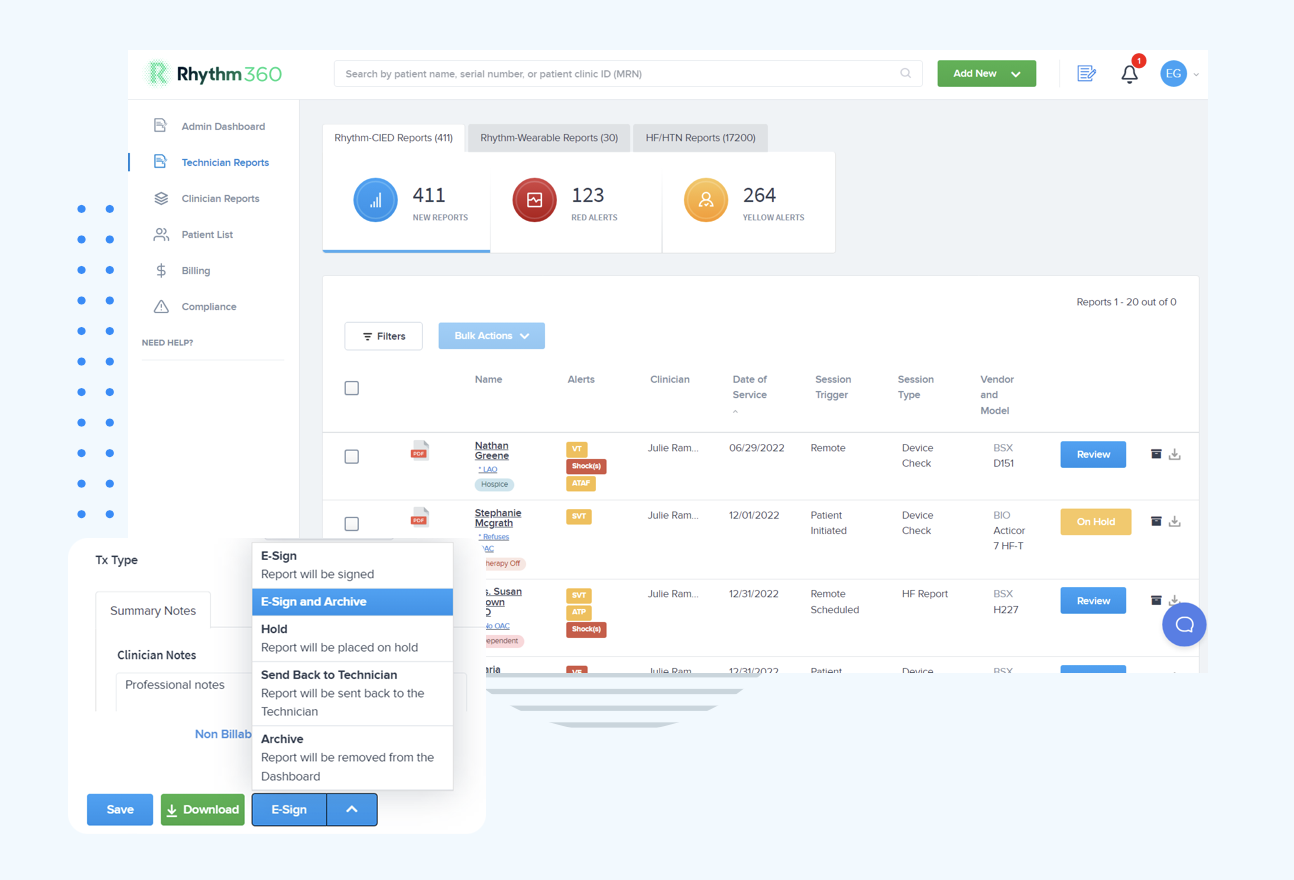
This consolidation delivers four interconnected operational improvements. It eliminates redundant logins and manual data transcription across OEM portals, which reduces context switching for staff. That reduction in friction supports up to an 80% decrease in critical alert response times, because teams no longer move between systems to find actionable data. Redundant data feeds maintain continuity of monitoring when an OEM server experiences downtime. All interactions flow into a single audit trail for CIED transmissions, which simplifies HIPAA documentation and reduces the need to reconstruct activity from multiple sources.
Eliminate your multi-portal workflow and see how Rhythm360 unifies data from Medtronic, Boston Scientific, Abbott, and Biotronik in a single login.
A cardiology PACS is optimized for DICOM imaging workflows, including echocardiograms, cardiac CT, nuclear studies, and cath lab angiography. It provides diagnostic-grade viewing, hanging protocols, and structured reporting for image-centric specialties. A VNA, by contrast, functions as a storage and interoperability layer that centralizes both DICOM and non-DICOM content, applies information lifecycle management tiering, and enables cross-enterprise sharing via IHE profiles. A PACS alone does not provide these capabilities.
For electrophysiology and device clinics, non-DICOM CIED transmission handling creates the most critical distinction. OEM-generated device reports arrive as XML files, proprietary PDFs, or HL7 aECG messages, which a standard PACS cannot ingest without middleware conversion. A cardiac-specific VNA like Rhythm360 normalizes these formats natively and places device transmissions alongside imaging studies in the same longitudinal patient record.
Several workflow advantages emerge when a cardiac VNA sits alongside or in front of a standalone PACS.
The operational impact of a unified cardiac VNA becomes most visible in high-volume environments. University of Chicago Medicine reviewed more than 73,000 reports annually through Rhythm360 in calendar year 2025, averaging more than 18,000 reports per quarter. At that scale, manual triage across fragmented OEM portals no longer works.
UCM’s implementation enabled clinicians to review more transmissions daily and identify more abnormalities, as noted by Andrew Beaser, MD, Associate Professor of Medicine at UCM. The platform also produced a direct billing improvement: “We have improved billing and accountability for our patients after the integration.”
These results reflect five connected workflow components that together form a complete monitoring process for any practice size.
As UCM’s experience confirms, “decision support, including AI-assisted decision support, will become increasingly important as data volumes grow.”
Fragmented documentation workflows are a primary driver of lost revenue in CIED monitoring programs. CPT codes 93298 (remote interrogation of implantable cardiovascular monitor) and 99454 (remote physiological monitoring device supply and daily recording) require compliant, time-stamped documentation tied to specific transmission events. When staff generate that documentation manually across multiple OEM portals, billable events are routinely missed or submitted with insufficient supporting records.
Rhythm360’s automated documentation engine captures billable events at the point of transmission review, generates compliant reports, and links them to the appropriate CPT codes. Practices implementing the platform have achieved up to a 300% increase in revenue generation through improved CPT code capture and better staff efficiency. The platform also supports CPT codes 93299, 99453, and 99457 for broader remote monitoring programs covering heart failure and hypertension patients.
The X-ray modality segment accounted for the largest share (42.8%) of the global VNA and PACS market in 2025, driven by the volume and complexity of cardiovascular data. This trend reinforces the financial case for investing in purpose-built cardiac data infrastructure rather than adapting generic enterprise VNA tools.
Ready to eliminate vendor lock-in and recover lost CPT revenue? Request a personalized assessment of your current CIED monitoring workflow and see how much time and revenue your practice could reclaim with unified data management.
A general enterprise VNA is designed primarily for DICOM imaging data across radiology, pathology, and other imaging-heavy specialties. A cardiac-specific VNA extends that foundation to handle non-DICOM CIED transmission formats, including OEM XML files, proprietary PDFs, and HL7 aECG messages, which standard enterprise VNAs cannot normalize without significant custom middleware. Rhythm360 is built specifically for cardiology, with native ingestion pipelines for all major CIED manufacturers and AI-powered normalization that achieves greater than 99.9% data transmissibility without custom integration work from the practice.
Alert fatigue in CIED monitoring stems from the high volume of non-actionable transmissions generated by OEM systems, including routine scheduled checks, minor parameter fluctuations, and connectivity confirmations that do not require clinical intervention. When these alerts arrive across multiple separate portals without prioritization, clinical staff spend significant time triaging noise rather than responding to genuine events. As described in the clinical workflows section, Rhythm360’s AI triage prioritizes genuine clinical events over routine noise and reduces the time staff spend on non-actionable transmissions by up to 80%.
A cardiac VNA supports documentation workflows for the primary remote CIED monitoring CPT codes, including 93298 for remote interrogation of implantable cardiovascular monitors, 93299 for remote interrogation of implantable loop recorders, 99453 for initial patient setup and education for remote physiological monitoring, 99454 for device supply and daily recording, and 99457 for remote physiological monitoring treatment management. Automated documentation improves capture rates by generating compliant, time-stamped reports at the point of transmission review rather than relying on staff to compile documentation after the fact. This approach narrows the gap between billable events that occur and billable events that are successfully submitted and reimbursed.
Rhythm360’s implementation process, including EHR integration setup, typically takes from a few days to a few weeks, depending on the complexity of the existing IT environment and the number of OEM data feeds being connected. The platform supports bi-directional integration with Epic, Cerner, Athenahealth, eClinicalWorks, Greenway Health, and other systems via HL7. Because Rhythm360 is a cloud-based SaaS platform, practices avoid on-premise hardware procurement and infrastructure refresh cycles, and the pricing model scales with clinic size and platform usage rather than requiring large upfront capital expenditure.
Cardiology practices that manage patients with CIEDs from multiple OEM vendors face a structural data problem that generic enterprise VNAs and standalone PACS systems do not solve. Fragmented portals, non-DICOM transmission formats, manual documentation workflows, and the growing volume of remote monitoring data create administrative overload, clinical risk, and measurable revenue leakage.
Rhythm360 addresses each of these gaps through a purpose-built, vendor-neutral, AI-powered platform that consolidates cardiac imaging and CIED data into a single HIPAA-compliant archive. The platform’s redundant data feeds, computer vision normalization, intelligent alert triage, and automated CPT documentation deliver the operational and financial outcomes that cardiology practices require, as demonstrated at scale by University of Chicago Medicine’s management of more than 73,000 reports annually.
With the VNA and PACS market projected to reach USD 8.57 billion by 2031 at an 8.9% CAGR and cardiology representing the largest specialty segment, the shift toward unified cardiac data infrastructure is accelerating. Practices that implement a cardiac-specific VNA now position themselves ahead of 2026 interoperability mandates and the continued growth in CIED patient populations.
Find out if your practice is ready for the shift to unified cardiac data infrastructure and connect with Rhythm360’s team to discuss your current monitoring volume, OEM mix, and revenue capture goals.