Last updated: July 14, 2026
Fragmented workflows force device clinic staff to manually re-enter transmission data into the EHR after retrieving it from each OEM portal. Without proper EHR integration, clinical staff add 45–90 minutes of administrative burden per provider per day, and the lack of automated documentation causes revenue to leak from unbilled RPM and chronic care management services. The 21st Century Cures Act has driven the adoption of FHIR-based APIs for certified EHR systems, so bidirectional HL7 sync now provides a practical way to eliminate both problems.
Rhythm360 establishes bidirectional EHR integration with Epic, Cerner, Athenahealth, eClinicalWorks, Greenway Health, and others via HL7. Encounter notes, alert documentation, time logs, and monthly summary reports flow automatically back into the patient chart. Gaurav A. Upadhyay, MD, FACC, FHRS, Professor of Medicine and Director of the Pacing & Defibrillation Device Clinic at University of Chicago Medicine (UCM), stated: "We have improved billing and accountability for our patients after the integration." That improvement follows directly from removing manual transcription and replacing it with structured, automated data flow.
See Rhythm360’s EHR integration in a live demo.
While EHR integration solves the documentation problem, it does not address the upstream challenge of device fragmentation. Each third-party monitoring input, including Holter monitors, MCTs, loop recorders, pacemakers, ICDs, and FDA-approved wearables, requires its own login and workflow, which exacerbates system fragmentation across cardiovascular service lines. Each CIED manufacturer has developed its own proprietary nomenclature, technical standards, and communication protocols, so clinicians must aggregate data from multiple care settings and vendors because traditional EHRs do not manage this data natively.
Rhythm360 normalizes data streams from Medtronic, Boston Scientific, Abbott, Biotronik, and other manufacturers into a single dashboard. The platform achieves greater than 99.9% transmissibility through redundant data feeds, computer vision, and AI-powered extrapolation. UCM reviewed more than 73,000 reports annually through Rhythm360 in calendar year 2025, averaging more than 18,000 reports per quarter, which demonstrates the platform’s capacity to handle high-density, multi-OEM CIED monitoring at scale. Andrew Beaser, MD, Associate Professor of Medicine at UCM, described pre-implementation workflows as "a major challenge and incredibly difficult."
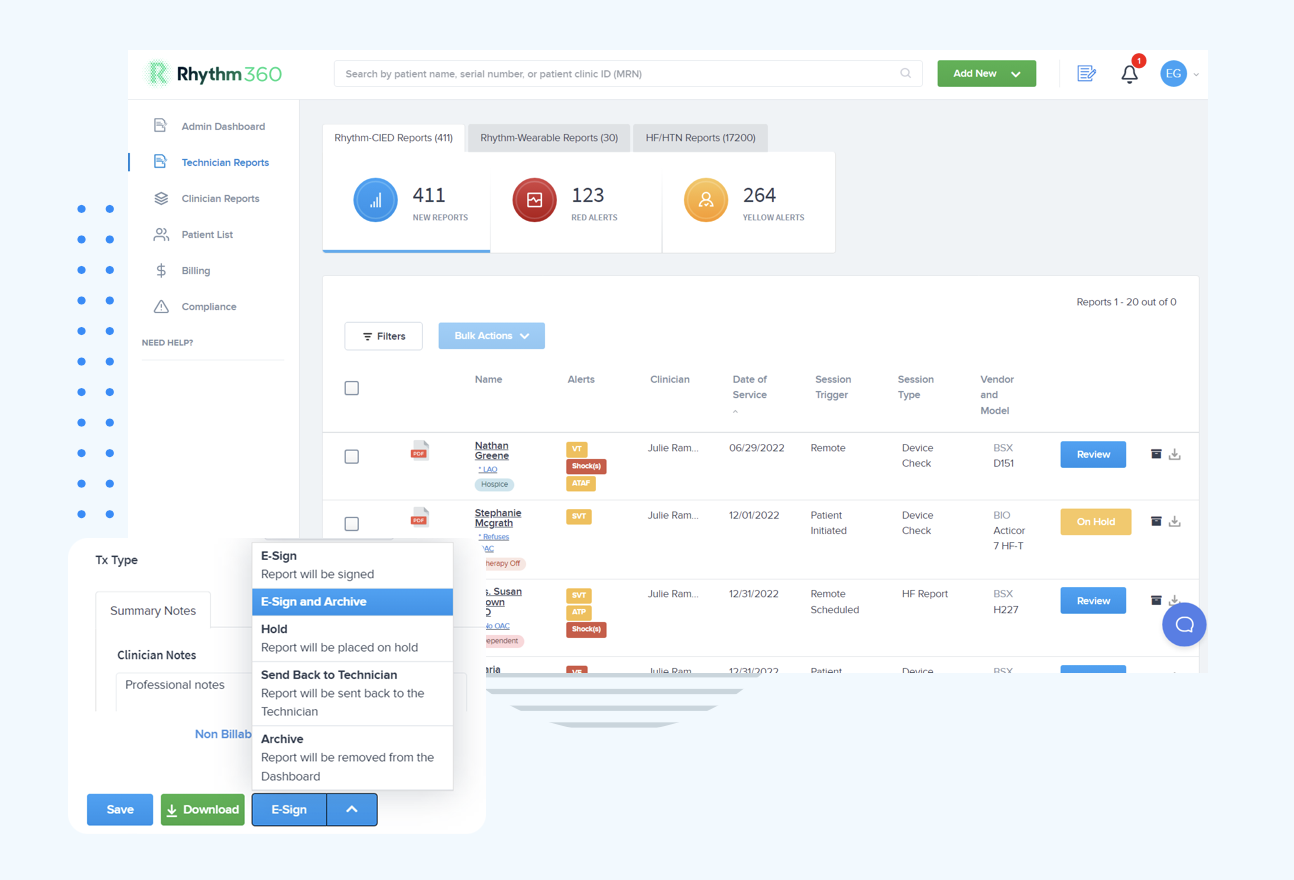
Failure to actively pull patient transmissions results in lost clinical visibility and the inability to bill for remote monitoring services. Manual CPT tracking across codes 93298, 93299, 99453, 99454, and 99457 introduces documentation gaps, which in turn trigger claim rejections and ultimately cause revenue leakage that compounds as patient volumes grow. 2026 CMS code updates expand billing eligibility for patients transmitting data between two and 15 days per month, and these changes make accurate documentation even more urgent because practices need upstream connectivity and standardized protocols to capture the new eligibility.
Rhythm360 automates report generation and produces claim-ready documentation for CPT codes 93298, 93299, 99453, 99454, and 99457. The administrative dashboard tracks billable activities in real time and surfaces captured and potential revenue based on CPT requirements. Practices implementing Rhythm360 have achieved up to 300% revenue lift through precise CPT code capture and improved staff efficiency. Dr. Upadhyay’s observation about improved billing and accountability after EHR integration also reflects the impact of this automated CPT documentation workflow.
Device clinics often process thousands of transmissions annually, with nearly 60% of alerts clinically non-relevant, which contributes to alert fatigue that burdens staff and increases the risk of missing genuinely critical events. Even in AI-equipped implantable cardiac monitors, 32.9% of episodes remained non-actionable and another 30.6% were deemed indeterminate due to guideline-based interpretation gaps and signal-detection issues, according to EHRA 2026 research, which confirms that manufacturer-level filtering alone does not resolve the problem.
Rhythm360’s AI-powered alert triage layer filters non-actionable noise and prioritizes clinically significant events, including new-onset atrial fibrillation, ventricular tachycardia, lead malfunction, and ERI or RRT indicators. This approach reduces critical-alert response times by up to 80%. RhythmScience 2026 platform data confirms AI-driven triage can reduce alert fatigue by 80% while maintaining 99.9% data reliability in cardiac device monitoring workflows. The platform also offers optional 24/7/365 oversight by certified cardiac technicians supervised by physicians, so weekend and after-hours events receive timely triage. Dr. Beaser noted: "We are able to address these issues earlier; rather than waiting for a 3-month visit, we can call patients in for evaluation."
The HRS Scientific Statement on Artificial Intelligence Integration Framework into Clinical Electrophysiology Workflows, released April 20, 2026, identifies data interoperability across devices, platforms, and EHRs as a core requirement for successful AI adoption in EP workflows. Rhythm360’s architecture aligns with that standard.
A competent RPM vendor can move an ambulatory practice from contract signature to first billable encounter within 30–60 days. Rhythm360 supports that timeline with streamlined implementation that includes EHR integration setup. The onboarding sequence moves from practice configuration and EHR integration through patient identification, device fulfillment, monitoring launch, staff training, and first billing cycle while preserving existing clinical operations.
The HIPAA-compliant Rhythm360 mobile application allows clinicians to review transmissions, sign reports, and coordinate care from any smartphone. Dr. Upadhyay identified staffing continuity as a persistent challenge: "Staffing was always an issue for our center, because our device clinic, like many other medical centers, had struggled with technician turnover and timely weekend coverage." Mobile access directly addresses that gap by untethering clinicians from a fixed workstation and supporting coverage during staffing fluctuations.
The following table summarizes how Rhythm360’s unified platform transforms four critical daily workflows compared to the fragmented OEM portal approach.
| Workflow Task | Fragmented OEM Portal Approach | Rhythm360 Unified Platform | Time Impact |
|---|---|---|---|
| Daily transmission review | Log into 3–4 separate OEM portals, then manually reconcile data | Single dashboard aggregates all CIED and RPM data | Eliminates up to 90 min/provider/day of manual re-entry |
| Critical alert identification | Manual review of high-volume, mixed-priority alert queues, with the majority of alerts non-actionable as noted earlier | AI triage surfaces only clinically significant events | Up to 80% faster critical-alert response |
| CPT billing documentation | Manual tracking of 93298, 93299, 99453–99457 across disconnected systems | Automated report generation and claim-ready documentation | Up to 300% revenue lift from precise CPT capture |
| EHR data entry | Manual transcription from OEM portal PDFs into EHR | Bidirectional HL7 sync pushes data automatically | Eliminates the manual re-entry burden described earlier |
| Metric / Feature | Rhythm360 Specification | Source |
|---|---|---|
| Data transmissibility | >99.9% via redundant feeds, computer vision, and AI extrapolation | RhythmScience 2026 Platform Data |
| Critical-alert response time reduction | Up to 80% | RhythmScience 2026 Platform Data |
| Revenue lift from CPT optimization | Up to 300% | RhythmScience client outcomes |
| Annual report volume (UCM, 2025) | UCM’s annual volume, detailed earlier | UCM / HMP Global Learning Network, 2025 |
| EHR compatibility | Epic, Cerner, Athenahealth, eClinicalWorks, Greenway Health, and others via HL7 | RhythmScience integration documentation |
| Implementation timeline | Streamlined implementation with EHR integration | RPM implementation best practices, 2025 |
| Practice Profile | Primary Pain Point | Rhythm360 Outcome | Key Feature |
|---|---|---|---|
| Solo EP or small cardiology practice (1–3 physicians) | Staff managing 2–4 OEM portals manually and missing billable events | Up to 300% revenue lift and single-dashboard efficiency | Automated CPT documentation (93298, 93299, 99453–99457) |
| Mid-size cardiology group (4–15 physicians) | Alert fatigue, technician burnout, and weekend coverage gaps | Up to 80% faster critical-alert response and optional 24/7 CCT oversight | AI-powered alert triage plus HIPAA-compliant mobile app |
| Large EP clinic or academic medical center | High-volume CIED population, EHR data silos, and scalability limits | >73,000 reports per year managed with >99.9% transmissibility at scale | Bidirectional EHR integration and redundant multi-OEM data feeds |
| Integrated health system with HF or HTN program | Separate CIED and chronic-condition workflows and fragmented billing | Unified Rhythm-CIED and HF or HTN service lines with consolidated revenue capture | Multi-modality chronic disease management with RPM CPT automation |
Map your practice profile to a Rhythm360 configuration in a personalized demo.
A virtual cardiac remote patient monitoring platform for cardiology practices supports the full range of CIED and RPM billing codes, including 93298 and 93299 for remote interrogation of implantable cardiac devices, and 99453, 99454, and 99457 for remote physiological monitoring of chronic conditions such as heart failure and hypertension. Manual CPT tracking across these codes is error-prone and time-consuming, particularly when data lives in separate OEM portals with no connection to the EHR. Rhythm360 automates report generation and produces claim-ready documentation for each applicable code based on transmission data already captured in the platform. The administrative dashboard tracks billable activities in real time, so practice managers can see captured versus potential revenue without manual reconciliation. Practices using Rhythm360 have achieved up to 300% revenue lift through this automated documentation approach.
Alert fatigue occurs when clinical staff receive a high volume of notifications, a significant proportion of which are non-actionable, which makes it difficult to identify genuinely critical events quickly. In device clinics, nearly 60% of alerts can be clinically non-relevant. Rhythm360’s AI triage layer analyzes incoming transmissions from all connected OEM devices and filters non-actionable signals before they reach the clinical queue, surfacing only events that require a clinical decision, such as new-onset atrial fibrillation, ventricular tachycardia, lead malfunction, or ERI or RRT indicators. This approach reduces critical-alert response times by up to 80%. The platform also supports optional 24/7/365 oversight by certified cardiac technicians supervised by physicians, which provides an additional human triage layer for after-hours and weekend events that might otherwise be delayed until the next business day.
Implementation timelines vary by practice size and internal resources. Rhythm360’s process includes practice configuration, EHR integration setup, patient identification, OEM data feed activation, and staff training. The bidirectional HL7 connection with the practice’s EHR, supporting Epic, Cerner, Athenahealth, eClinicalWorks, Greenway Health, and others, is established during this period, and data mapping for demographics, problem list, insurance, and ordering provider is completed before monitoring launch.
A genuinely vendor-neutral platform ingests and normalizes data from all major CIED manufacturers, including Medtronic, Boston Scientific, Abbott, and Biotronik, without requiring staff to log into separate OEM portals or manually reconcile conflicting data formats. True vendor neutrality also means the platform does not favor one manufacturer’s alert thresholds, nomenclature, or transmission cadence over another’s. Rhythm360 achieves this through a combination of API connections, HL7 and XML parsing, and computer vision-based PDF extraction, with redundant data feeds that maintain connectivity even when an OEM’s server is temporarily unavailable. The result is greater than 99.9% transmissibility across the entire device population, regardless of manufacturer, which eliminates the data silos and blind handoffs that occur when each OEM’s data remains isolated in its own proprietary system.
Cardiology practices and electrophysiology clinics evaluating a virtual cardiac remote patient monitoring platform for cardiology practices face five recurring decision criteria: bidirectional EHR integration, multi-vendor CIED support, automated billing documentation, AI-powered alert triage, and rapid implementation with mobile access. Fragmented OEM portal workflows fail on all five. Rhythm360 addresses each criterion through a single, vendor-neutral, HIPAA-compliant platform that normalizes data from Medtronic, Boston Scientific, Abbott, Biotronik, and other manufacturers, syncs bidirectionally with major EHR systems via HL7, automates CPT documentation for codes 93298, 93299, 99453, 99454, and 99457, reduces critical-alert response times by up to 80%, and deploys rapidly without disrupting existing clinical operations.
The University of Chicago Medicine’s experience, managing more than 73,000 reports annually through Rhythm360 with documented improvements in transmission review volume, earlier clinical interventions, and billing accountability, shows what a unified platform delivers at scale in a real cardiology environment.
See how Rhythm360 can unify your CIED and RPM workflows in a tailored demo.