Revenue cycle automation closes the biggest financial gap in many cardiology practices: preventable claim denials and coding errors. St. Luke’s Health System implemented generative AI and reported an increase in reimbursement of about $13,000 per clinician through revenue cycle coding improvements. Automated coding systems often reach 95% clean claim rates, compared with 70% to 80% using manual processes.
Implementation relies on three connected components that work together to eliminate revenue leakage. Automated CPT code capture supports device interrogations, real-time eligibility verification prevents avoidable claim rejections, and AI-powered documentation review strengthens compliance. Rhythm360’s automated billing documentation delivers all three capabilities, ensuring compliant capture of complex RPM codes while reducing administrative overhead. The platform also generates audit-ready reports that support accurate reimbursement for cardiac device monitoring services.
| Metric | Manual Process | Automated Process | Improvement |
|---|---|---|---|
| Claim Denial Rate | 20-30% | 5-10% | 50-75% reduction |
| Coding Accuracy | 75-80% | 95-98% | 20-25% increase |
| Revenue per Clinician | Baseline | +$13,000 | Significant boost |
Stronger billing performance only pays off when the underlying device data flows smoothly into your system. That connection leads directly into the next strategy.
Vendor-neutral platform consolidation removes the drag of juggling separate portals for Medtronic, Abbott, Boston Scientific, and Biotronik devices. Device technicians often spend 15 to 20 minutes per patient moving between systems, while unified platforms cut this to 2 to 3 minutes per patient. That shift delivers 60% to 80% time savings across daily workflows.
Automated data normalization converts different device outputs into standardized reports, so clinicians can make consistent decisions regardless of manufacturer. Critical alerts such as atrial fibrillation episodes that once required more than two hours of manual data compilation now generate actionable reports within minutes.
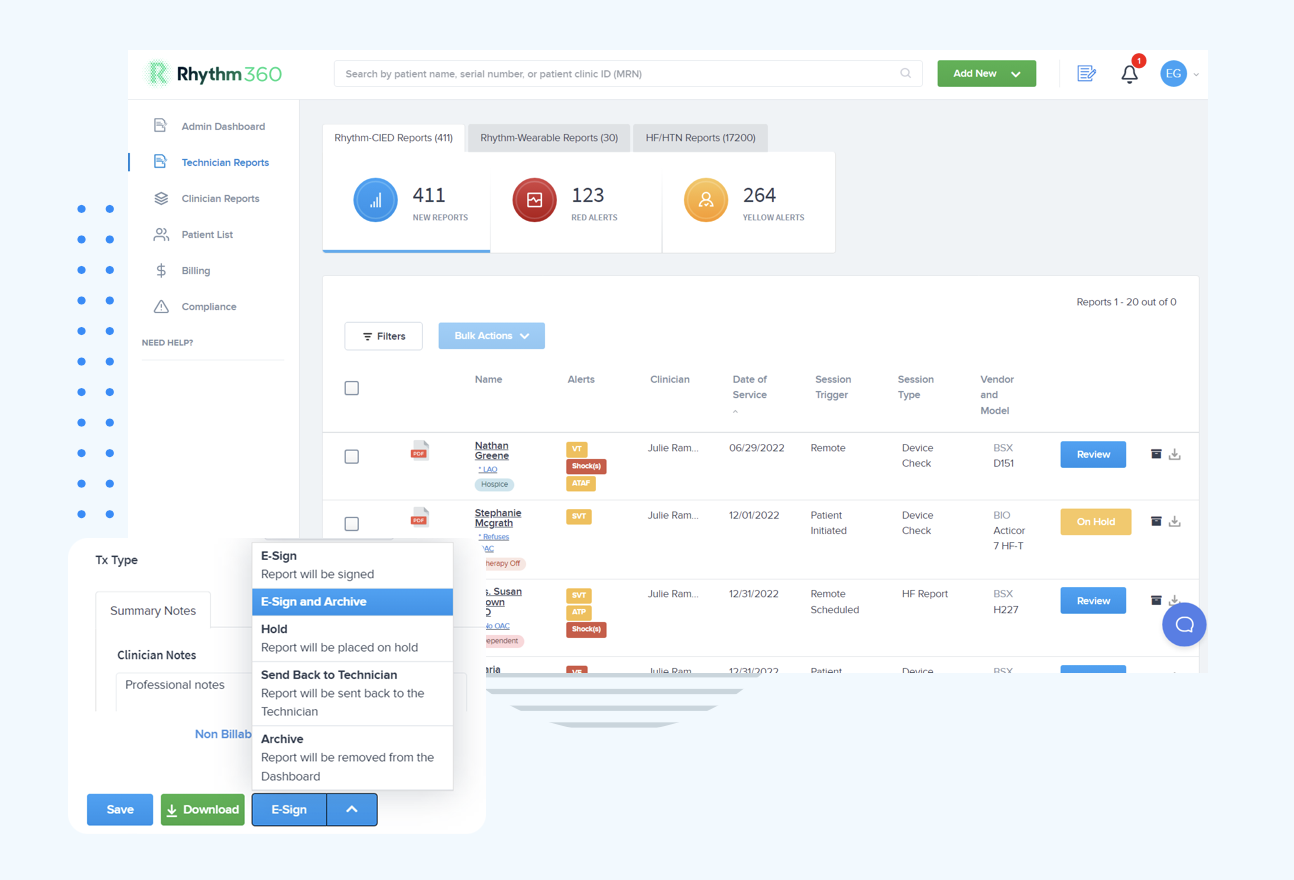
Rhythm360 Spotlight: As a leading vendor-neutral platform, Rhythm360 unifies all major OEM data streams with >99.9% reliability through redundant feeds and AI-powered data extrapolation. The platform’s Epic and Cerner integrations, combined with Twilio-powered communications, help practices capture up to 300% more revenue through streamlined workflows and comprehensive patient monitoring capabilities.
Once device data flows reliably into a single system, practices can expand remote programs with confidence. That expansion sets up the next strategy around RPM and TAVR productivity.
Remote patient monitoring automation turns chronic disease management into a scalable, profitable service line. Automated platforms such as TAVI-PREP and 4TAVR extract over 22 essential measurements from pre-TAVR CTA scans in about 2 minutes with high correlation to manual measurements. At the same time, comprehensive RPM programs capture billing opportunities that many practices previously missed for heart failure and hypertension management.
Automated report generation for CPT codes 99454, 99457, and 99458 supports compliant documentation while easing staff workload. Practices that adopt comprehensive RPM automation often see roughly 80% growth in billable monitoring events through better patient compliance and systematic data capture. TAVR workflow automation layers on top of this foundation and further improves procedural efficiency and billing accuracy.
Expanded monitoring programs generate more data and more alerts, which can overwhelm teams without the right controls. The next strategy focuses on managing that volume with AI triage.
AI-powered alert triage delivers one of the largest operational gains for cardiology practices. Clinicians using ambient technology to create pre-visit histories, transcribe notes, and review treatment plans saved about 20% of their documentation time. Advanced cardiology platforms extend this impact by reducing non-actionable alerts by about 80%, which lets clinical staff focus on truly critical events.
Intelligent filtering algorithms separate routine device checks from urgent clinical situations, which prevents alert fatigue and supports rapid responses to life-threatening arrhythmias. This targeted approach lowers staff burnout and improves patient safety through more efficient resource allocation.
The time savings from eliminating manual portal access also compound across major device manufacturers:
| OEM Portal | Manual Login Time (Min/Day) | Automated Access | Time Savings |
|---|---|---|---|
| Medtronic CareLink | 45-60 | 0 | 100% |
| Abbott Merlin.net | 30-45 | 0 | 100% |
| Boston Scientific LATITUDE | 30-40 | 0 | 100% |
| Biotronik Home Monitoring | 20-30 | 0 | 100% |
With alerts under control and staff capacity freed up, practices can focus on long-term relationships and value-based performance. That shift anchors the next strategy.
Value-based care integration that uses automated patient engagement improves both retention and outcomes metrics. AI integration in VBC improves cost structure by reducing nurse-to-patient ratios from 1:50-75 to 1:200-300 as AI handles routine engagement and monitoring. Proactive monitoring flags deteriorating patients before acute episodes, which reduces readmissions and supports stronger quality scores.
Mobile applications that include automated medication reminders, symptom tracking, and educational content raise patient compliance rates by 40% to 60%. Higher engagement leads to better clinical outcomes and stronger reimbursement under value-based contracts. Practices then see meaningful profitability gains through fewer emergency interventions and improved population health metrics.
To capture these gains, practices need a clear rollout plan that limits disruption. The final strategy focuses on a practical implementation roadmap.
Successful automation programs follow a structured rollout that protects clinical operations while delivering quick wins. The process starts with a comprehensive workflow assessment to identify high-impact automation opportunities. Those findings guide EHR integration setup so the build focuses on the most valuable workflows first.
After technical integration, focused staff training helps teams use new capabilities confidently. A gradual feature rollout then builds momentum through early wins, such as immediate time savings from portal consolidation and faster alert response times. Leading platforms complete this entire sequence within days to weeks rather than months, and most practices reach maximum ROI within about 90 days.
Ready to transform your cardiology practice profitability? Connect with our implementation team to map out your specific automation roadmap and timeline.
Cardiology practices that implement comprehensive RPM automation typically see large revenue gains through several channels. Optimized CPT code capture for remote monitoring services, reduced staff overhead from workflow consolidation, and expanded chronic disease programs all contribute. The combination of better billing accuracy, higher patient volume capacity, and lower operational costs creates substantial profitability improvements. Rhythm360 clients report these outcomes through unified device management, automated documentation, and AI-powered clinical workflows that capture revenue that previously went unbilled.
Rhythm360 leads the vendor-neutral CIED platform market through redundant data feeds and computer vision technology that support comprehensive device monitoring across major manufacturers including Medtronic, Abbott, Boston Scientific, and Biotronik. The platform’s bi-directional EHR integration with Epic and Cerner, intelligent triage that cuts alert volume, mobile access for on-call clinicians, and automated billing documentation all work together to support compliant revenue capture.
AI-powered alert triage systems review incoming device transmissions and patient data to separate routine notifications from clinically significant events. Advanced algorithms filter non-actionable alerts while prioritizing emergencies such as new-onset atrial fibrillation, ventricular arrhythmias, or device malfunctions. This intelligent filtering sharply reduces alert volume while preserving rapid responses to critical events. Practices see lower staff burnout, stronger clinical focus, and better patient outcomes through more efficient resource use and faster interventions.
Modern cardiology automation platforms like Rhythm360 usually complete implementation within days to weeks. The streamlined process includes EHR integration setup, device manufacturer API connections, staff training, and phased feature rollout. Early efforts focus on high-impact areas such as device data consolidation and critical alert routing to deliver immediate value. Full platform use with billing automation, patient engagement tools, and advanced analytics often reaches peak ROI within about 90 days of initial deployment.
Remote patient monitoring CPT codes 93298, 93299, 99454, 99457, and 99458 benefit strongly from automation because they require detailed documentation and often face high rejection rates when handled manually. Automated platforms support compliant capture of device interrogation data, patient symptom tracking, and clinical response documentation. This systematic approach to billing documentation reduces claim denials and captures revenue that might otherwise be missed. Practices report large increases in successful reimbursement for these codes through automated workflow management and audit-ready documentation.
These six strategies for revenue cycle performance, device integration, RPM productivity, AI alert management, value-based care alignment, and structured implementation create a connected roadmap for cardiology profitability. Workflow automation addresses core operational bottlenecks that limit growth while opening new revenue streams through greater efficiency and expanded services.
Rhythm360 delivers all six strategies through a unified, vendor-neutral platform that consolidates device management, automates billing processes, and uses AI to streamline clinical workflows. Start your profitability transformation with a personalized assessment of your practice’s automation opportunities.