Last updated: August 24, 2026
Revenue cycle management compliance for cardiology and electrophysiology in 2025 requires auditable documentation, accurate CPT capture, and prior-authorization workflows that satisfy CMS remote-monitoring expansions and OIG audit criteria without adding administrative headcount. The seven steps below form the backbone of this guide and provide a practical roadmap.
See how Rhythm360 automates each of these seven steps inside a single, vendor-neutral platform.
The first step in any compliance strategy is understanding exactly which codes you can bill and under what conditions. CMS guidance restated core RPM requirements, including a documented condition and data and duration that satisfy the CPT descriptor. Effective January 1, 2026, several codes carry restructured or new descriptors that affect device clinic billing.
| CPT Code | 2026 Descriptor Summary | Key Billing Threshold | Rhythm360 Automation |
|---|---|---|---|
| 99454 | CPT 99454 retains the descriptor for remote monitoring device supply with 16–30 days of data transmission, and CMS proposed 2026 rates are not stated as $47.06 in available sources. | 16 days minimum per month | Automated day-count tracking with threshold alerts |
| 99445 | New device supply code for 2–15 days of data transmission per 30-day period | 2 days minimum per month | Captures previously non-billable short-duration data automatically |
| 99470 | First 10 minutes of treatment management requiring real-time interactive communication | Interactive communication documented | Communication logs with full audit trail via integrated Twilio framework |
CMS guidance also addresses interactions between RPM and other care management services such as Remote Therapeutic Monitoring, chronic care management, transitional care management, and principal care management. EP ablation billing under CPT 93653 can carry denial risk when modifier 26 is required for remote reading, and Modifier 59 or XU on cath-lab bundles (CPT 93454–93461 with PCI) is denied on audit unless the operative note explicitly documents one of three exceptions: no prior adequate study, inadequate prior study, or significant clinical change.
CIED remote monitoring billed under CPT 93296–93298 operates on 90-day transmission cycles. Transmissions received but not billed within the cycle create permanent revenue loss. Device-type code mismatches, such as billing CPT 93297 for pacemakers or ICDs instead of implantable loop recorders, are a documented denial trigger under CMS Billing Article A56602.
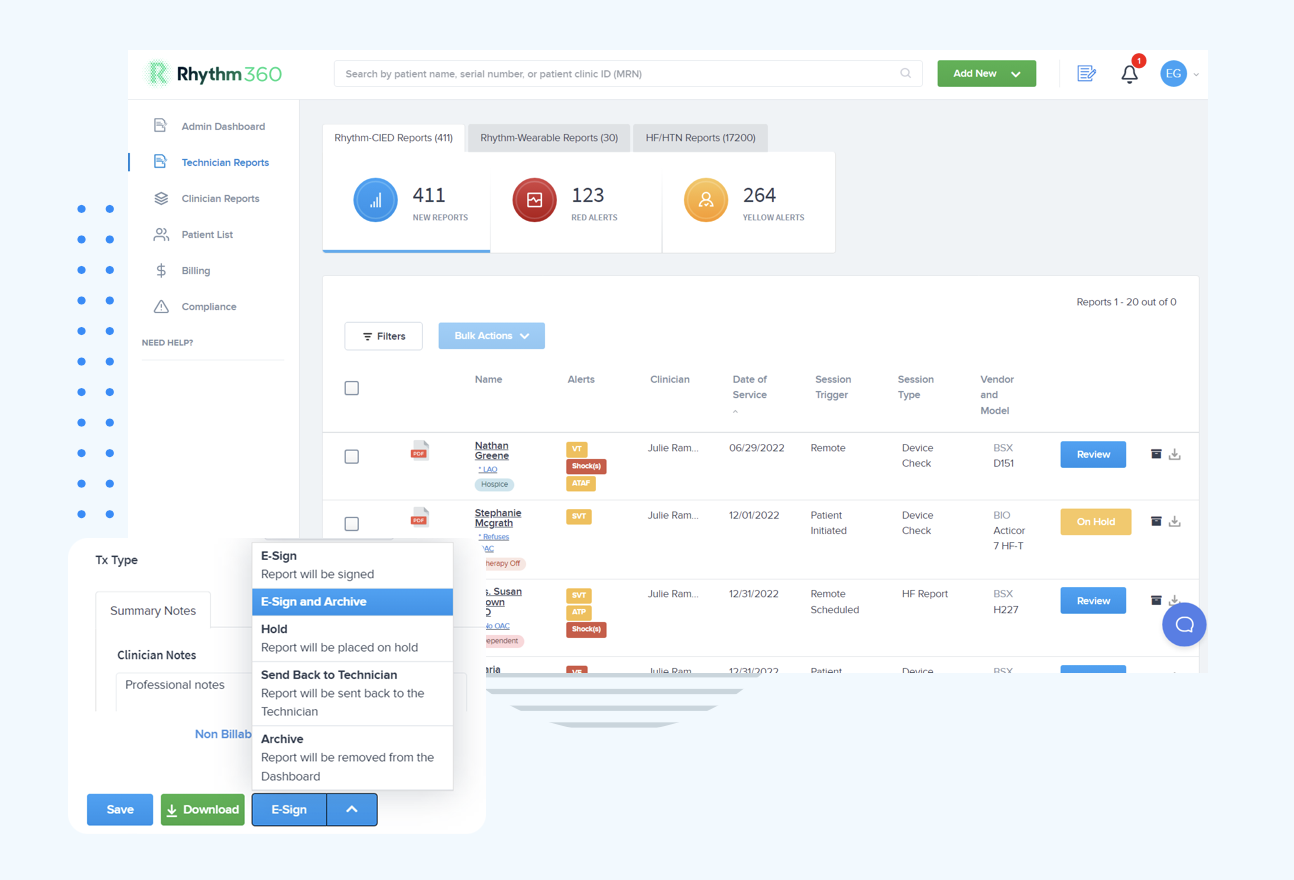
Rhythm360's administrative dashboard gives practices a real-time view of patient compliance, critical alerts, and captured versus potential revenue based on CPT code requirements. The five denial categories below represent the highest-risk exposure points for device clinics and EP practices.
| Denial Category | Estimated Share of Cardiology Denials | Root Cause | Rhythm360 Mitigation |
|---|---|---|---|
| Prior authorization failure | Leading category | Missing or invalid auth on stress tests, imaging, elective cath, ICDs | Automated prior-auth status tracking integrated with EHR workflow |
| Incorrect or missing modifiers | Common category | Modifier 26/TC errors on device monitoring and EP codes | CPT/modifier validation layer flags mismatches before claim submission |
| Medical necessity documentation gaps | Common category | Vague diagnosis codes and insufficient clinical-change documentation | Structured report templates enforce ICD-10 specificity and clinical rationale fields |
| Bundling errors on cath and imaging codes | Common category | RPM time double-counted with CCM or TCM and operative note exceptions undocumented | Bundling rules engine cross-checks concurrent service codes at claim generation |
| Device monitoring frequency violations | Billing before 30-day minimum or exceeding 90-day frequency limit per CMS A56602 | Transmission billed outside payer-allowed window | Automated cycle-window enforcement prevents premature or expired claim submission |
Cardiology practices face denial rates of 10–15%, roughly two to three times the cross-specialty average of approximately 5%, with some practices losing more than $200,000 annually to preventable claim rejections. Practices that audit denials frequently recover more net revenue than those that audit less often.
University of Chicago Medicine implemented Rhythm360 to address these fragmentation risks across OEM portals and manual workflows. After integration, UCM reported: "We have improved billing and accountability for our patients after the integration." In calendar year 2025, UCM reviewed more than 73,000 reports annually through Rhythm360, averaging more than 18,000 reports per quarter, a volume that manual, portal-by-portal workflows cannot sustain without significant denial exposure.
A structured quarterly audit calendar reduces OIG audit exposure and supports the clean-claim rate target of 95% or higher recommended by documented prevention strategies. The schedule below maps documentation reconciliation, prior-authorization workflows, and price-transparency reporting across four quarters.
| Quarter | Audit Focus | Key Actions | Rhythm360 Support |
|---|---|---|---|
| Q1 (Jan–Mar) | CPT code and modifier reconciliation | Validate 99454/99445/99470 descriptor compliance and audit modifier 26/TC assignments on 93228, 93229, 93653 | Automated CPT capture report and modifier validation alerts |
| Q2 (Apr–Jun) | Prior-authorization workflow review | Confirm routing to correct payer entities, such as EviCore for Cigna effective January 1, 2026, and verify seven-calendar-day standard decision compliance | Prior-auth status dashboard and EHR-integrated workflow tracking |
| Q3 (Jul–Sep) | CIED transmission cycle audit | Reconcile 90-day billing windows for CPT 93294–93298, identify expired unbilled transmissions, and review 30-day RPM data thresholds | Cycle-window enforcement engine and expiration alert notifications |
| Q4 (Oct–Dec) | Documentation and price-transparency reporting | Confirm ICD-10 specificity on all remote monitoring claims, validate bundling controls, and prepare OIG audit readiness file | Structured report templates and full audit trail with communication logs |
Implementation readiness for this schedule depends on three parallel workstreams. EHR integration, supported by Rhythm360's bi-directional connections with Epic, Cerner, Athenahealth, eClinicalWorks, and Greenway Health via HL7, typically completes within days to a few weeks. Staff training focuses on alert triage protocols and structured documentation templates rather than OEM portal navigation. A 90-day ROI assessment after go-live benchmarks billing accuracy improvement, denial rate reduction, and recovered transmission revenue against the pre-implementation baseline.
Practices deciding between internal compliance infrastructure and a purpose-built platform face a clear trade-off. Internal builds require dedicated compliance staff, ongoing CPT update maintenance, and custom EHR integration work. A platform approach transfers that maintenance burden and delivers immediate audit-trail functionality. The OIG has recommended that CMS scrutinize RPM claims using vague or non-specific diagnosis codes and consider requiring ordering provider information displayed on claims, which manual workflows struggle to enforce consistently at scale.
Three pitfalls account for the majority of compliance failures in device clinics. These issues compound each other and magnify OIG scrutiny when left unaddressed.
Rhythm360 offers a vendor-neutral architecture, AI-powered alert triage, and an integrated CPT documentation layer that operate within a single cloud-based environment.
CMS guidance indicates that remote patient monitoring services must include a documented condition requiring monitoring and data collection that meets the CPT descriptor thresholds for the specific code billed. Medicare pays separately for each of the service components, including patient education and device setup, device supply, and treatment management, using distinct CPT codes. Effective January 1, 2026, the device supply code 99454 requires 16–30 days of data transmission per 30-day period, while the new code 99445 covers 2–15 days of data, and 99470 covers the first 10 minutes of treatment management with real-time interactive communication. CMS guidance also addresses counting of RPM interpretation time with other services such as chronic care management, transitional care management, and principal care management in the same period. The OIG has flagged RPM programs that omit patient education and setup documentation or treatment management codes as potential indicators of incomplete services subject to audit.
EP ablation under CPT 93653 can carry denial risk when modifier 26 is required for remote reading. For catheterization lab procedures billed under CPT 93454–93461 alongside percutaneous coronary intervention, Modifier 59 or XU is denied on audit unless the operative note explicitly documents one of three exceptions: no prior adequate study was available, a prior study was inadequate, or a significant clinical change occurred since the prior study. Device-type code mismatches represent another frequent source of EP denials. Billing CPT 93297 for pacemakers or ICDs instead of implantable loop recorders, or using CPT 93298 for non-CardioMEMS devices, generates automatic rejections. CIED remote monitoring claims billed before the 30-day minimum monitoring window closes or after the 90-day frequency limit passes are denied for frequency violations. Practices prevent most of these errors through a CPT/modifier validation layer that cross-checks code combinations and cycle windows before claim submission.
Prior authorization denials represent a significant portion of all cardiology claim denials and form the single most costly denial category by average claim value at risk. Industry analyses show cardiology prior-authorization denial rates ranging from 18% to 25%, with high-cost interventions experiencing steeper rejection rates. Cardiac catheterization, PCI, ICDs, TAVR, cardiac MRI, and CT angiography typically require prior authorization, often routed through radiology benefit managers. A 2026 denial management analysis covering 240 specialty practices found that prior authorization denials made up 34% of all first-pass claim denials, up from 22% in 2023. Under the CMS Interoperability and Prior Authorization Final Rule effective January 1, 2026, insurers must issue standard determinations within seven calendar days and expedited decisions within 72 hours. When denials are appealed, Medicare Advantage plans overturn the 75% of denials mentioned earlier, which reinforces why timely and complete initial documentation is the most effective prevention strategy. Practices reduce prior-authorization denial rates by implementing front-end eligibility checks, confirming correct payer routing before submission, and maintaining structured documentation that explicitly addresses medical necessity criteria for each procedure type.
For a cardiology practice, properly billed CIED remote monitoring using the appropriate CPT codes can generate substantial annual recurring revenue. For a cardiac monitoring program, the gap between CMS-allowed billing time and actual monitoring time for CIED remote monitoring and RPM services can represent significant uncollected revenue on patients the practice already serves. Common leakage points include CIED transmissions received but not billed within the 90-day cycle, RPM data collected but not meeting the prior 16-day minimum threshold under the legacy 99454 descriptor, and monthly RPM management time that is documented but never tallied against the 20-minute billing threshold. The new CPT 99445 code, effective January 1, 2026, makes previously non-billable short-duration data, defined as 2–15 days per month, eligible for reimbursement, a category most practices have not yet updated their billing logic to capture. Practices using Rhythm360 have reported up to a 300% increase in revenue generation through improved CPT code capture and greater staff efficiency.
Rhythm360 offers bi-directional EHR integration with Epic, Cerner, Athenahealth, eClinicalWorks, Greenway Health, and additional systems via HL7. The onboarding process, including integration setup, typically takes from a few days to a few weeks depending on practice size and EHR configuration. The platform consolidates data from all major device manufacturers, including Medtronic, Boston Scientific, Abbott, Biotronik, and others, into a single dashboard, which eliminates the need for separate OEM portal logins. Because Rhythm360 is cloud-based and HIPAA-compliant, practices avoid on-premise infrastructure installation. Staff training focuses on the centralized dashboard and alert triage workflows rather than multiple legacy systems, which reduces the learning curve and accelerates time to operational benefit.
The compliance requirements covered in this guide, including CPT descriptor mapping, denial monitoring, quarterly audits, and EHR integration, form a complete defense against the 2025 regulatory changes. Fragmented OEM portals and manual billing workflows cannot reliably satisfy these requirements at scale. As UCM's experience demonstrates, a unified platform changes the operational equation: "We are able to address these issues earlier; rather than waiting for a 3-month visit, we can call patients in for evaluation."
Rhythm360 delivers vendor-neutral, cloud-based infrastructure that automates CPT documentation, enforces billing cycle windows, normalizes multi-OEM data into a single audit-ready record, and reduces critical alert response times by up to 80% without additional administrative headcount. Practices implementing Rhythm360 have recovered up to 300% more revenue through improved CPT code capture and better billing accuracy.