The table below organizes 2026 cardiology codes by denial risk patterns such as same-day bundling conflicts, NCCI edit violations, and documentation thresholds. Use it to spot code families that require modifier justification or minimum time and day thresholds before billing.
| Category | CPT Code(s) | Description | Key 2026 Note |
|---|---|---|---|
| Evaluation & Management | 99202–99215 | Office/outpatient E/M visits | Modifier -25 required when billed same day as a procedure |
| Diagnostic Cath | 93454–93461 | Coronary angiography; left/right heart cath combinations | Fluoroscopy and cardiac output (93598) bundled, not separately reportable |
| PCI | 92920–92944 | Balloon angioplasty, stent, atherectomy by vessel | One base code per major coronary artery, with new codes for bifurcation and CTO lesions |
| Echocardiography | 93306, 93320, 93351 | Complete TTE, Doppler, stress echo | 93320 bundled into 93306, and 93306 bundled into 93351 |
| Stress Testing | 93015–93018 | Cardiovascular stress test components | Component codes not separately reportable when the global code is billed |
| CIED Remote Monitoring | 93298 | Interrogation device evaluation, remote, pacemaker/ICD | Minimum 91-day period, with physician review and report required |
| RPM Setup | 99453 | Remote monitoring device education and setup | No significant changes, bill once per episode |
| RPM Supply | 99454 | Device supply with daily recordings and transmissions | Requires at least 16 days of data per 30-day period |
| RPM Treatment Mgmt | 99457 / +99458 | Treatment management, first 20 minutes and each additional 20 minutes | Requires a minimum of 20 minutes per calendar month |
| RPM (New 2026) | 99445, 99470 | New remote physiologic monitoring codes for shorter durations | Introduced in 2026 to address gaps in reporting for monitoring periods of 2-15 days or management time under 20 minutes |
CMS NCCI policy bundles E/M services performed on the same date as a procedure into the procedure code unless the E/M service is significant, separately identifiable, and documented with an appropriate modifier. To unbundle an E/M or procedure from this default edit, you must append one of two modifiers that signal clinical distinction: -25 for separately identifiable E/M services or -59 for distinct procedural services.
Modifier -25 Decision Checklist (E/M + Procedure, Same Day)
Modifier -59 Decision Checklist (Distinct Procedural Service)
Cardiology practices typically experience denial rates between 8% and 15%, and coding errors drive a large share of those denials. The MGMA benchmark for clean claim rate is 95% or higher, yet most cardiology practices achieve clean claim rates between 85% and 95%, with industry targets of 95% or higher. The checklist below highlights NCCI bundling edits that cause many of these denials, and removing these errors closes much of the 5% to 10% clean-claim gap.
Do Not Unbundle: 2026 NCCI Checklist
The 2026 CPT update reshapes remote physiologic monitoring by adding shorter-duration codes while keeping existing thresholds for longer monitoring. New codes 99445 and 99470 were added for 2026 to cover 2–15 days of monitoring and 10 minutes of management, while existing codes 99453, 99454, 99457, and +99458 retain the original 16-day and 20-minute thresholds. These additions give practices a way to bill episodic or lower-intensity monitoring that previously fell below billable thresholds.
Key 2026 RPM Billing Requirements
Meeting these documentation thresholds, such as 16 days of data for 99454, 20 minutes for 99457, and 91 days for 93298, requires a complete, auditable record of every device transmission. Practices managing patients across Medtronic, Boston Scientific, Abbott, and Biotronik devices face a structural compliance problem because each OEM operates a separate, non-interoperable portal. Staff must log into multiple systems to retrieve transmission data, reconcile records, and generate the documentation required to support billing. This fragmentation produces missed billable events, incomplete audit trails, and claim denials on codes that were legitimately earned.
Rhythm360 consolidates all CIED and RPM data into a single vendor-neutral platform and automates the documentation required for compliant billing of 99453–99457, 93298, and the new 2026 codes. Schedule a demo to see how Rhythm360 closes the compliance gaps created by fragmented OEM portals.
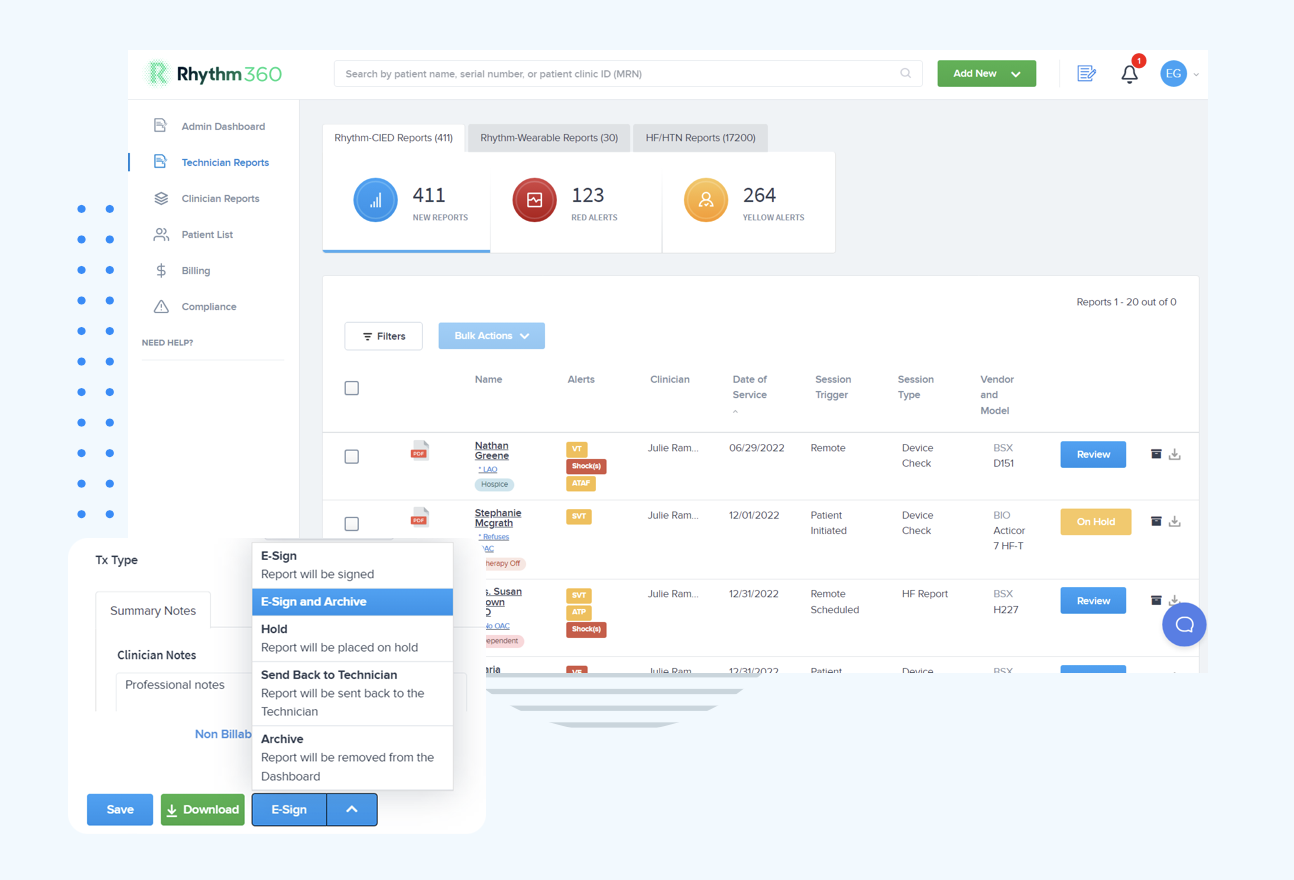
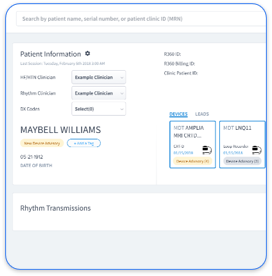
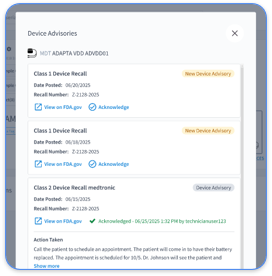
Automated, vendor-neutral platforms reduce cardiology billing leakage by creating a unified, auditable record of billable events across device manufacturers and monitoring modalities. Rhythm360 ingests data from Medtronic, Boston Scientific, Abbott, and Biotronik devices via API, HL7, XML, and PDF parsing that uses computer vision and AI, and it achieves greater than 99.9% data transmissibility through redundant data feeds. When an OEM server experiences downtime, the platform’s fail-safe architecture prevents data gaps that would otherwise create missing-documentation denials.
Key compliance-support capabilities include:
Practices implementing Rhythm360 have reported up to a 300% increase in revenue generation through more complete CPT code capture and the addition of RPM service lines for heart failure and hypertension management.
The 2026 CPT code set introduces clearer definitions for major coronary arteries, branches, segments, and lesions in PCI reporting. A single lesion may span multiple segments without qualifying as multiple reportable lesions, and only one base PCI code may be reported per major coronary artery. New codes were added for bifurcation lesions and chronic total occlusion PCI, including cases requiring both antegrade and retrograde approaches. For remote monitoring, the 2026 update added 99445 for 2–15 days of monitoring and 99470 for 10 minutes of management, while the original RPM codes kept their existing thresholds.
For code 99457, the minimum threshold is 20 minutes of treatment management time per calendar month, with at least one real-time interactive communication with the patient or caregiver during that period. Add-on code +99458 is billed for each additional 20 minutes beyond the initial 20. The new 2026 code 99470 covers management time of 10–19 minutes and addresses the gap below the 99457 threshold. For code 93298, which covers remote interrogation of a pacemaker or implantable cardioverter-defibrillator, the minimum monitoring period is 91 days. A physician must review the transmitted data, interpret the findings, and generate a signed report to support billing. Practices using fragmented OEM portals frequently miss the 91-day documentation window because transmission records are siloed across manufacturer systems and not tracked centrally.
Appeals for modifier 25 denials require submission of the complete medical record documentation that shows the E/M service was significant and separately identifiable from the procedure performed on the same date. The documentation must show that the E/M addressed a distinct clinical problem or required additional medical decision-making beyond routine pre- and post-procedure assessment. For modifier 59 denials, the appeal must include operative or procedure notes that clearly establish the clinical distinction between the two billed services, specifically that they occurred at different anatomic sites or during separate encounters. Reporting different diagnoses alone does not meet NCCI requirements. Practices with automated documentation platforms have an advantage in appeals because every billable event is captured with a timestamped, auditable record that staff can retrieve and submit without manual reconstruction.
The 2026 CPT updates to PCI, echocardiography, and remote physiologic monitoring codes require cardiology practices to tighten documentation standards, apply modifiers with precision, and track billable thresholds across a more complex code set. Practices that rely on manual workflows and fragmented OEM portals face compounding risk from missed billable events, modifier misuse, and NCCI bundling errors that push clean-claim rates below the 95% benchmark.
Rhythm360 reduces these risks by consolidating Medtronic, Boston Scientific, Abbott, and Biotronik device data into a single vendor-neutral platform with automated CPT documentation, AI-powered alert triage, and bi-directional EHR integration. This approach creates a compliant, auditable record of every billable event and captures it automatically without adding administrative burden to clinical staff.
Schedule a demo to see how Rhythm360 protects every billable event in your 2026 cardiology revenue cycle.