Last updated: August 24, 2026
The CY 2026 Medicare Physician Fee Schedule Final Rule policies generally take effect on January 1, 2026, unless otherwise noted and introduce two codes that close a longstanding gap in cardiology billing. Previously, a post-discharge heart failure patient who transmitted data on only 10 days in a month generated zero device-supply revenue because the 16-day threshold for 99454 was not met. The new CPT 99445 closes that gap by covering 2–15 days of transmitted data at the same ~$52 rate as 99454. CPT 99470 similarly captures 10–19 minutes of management time that previously went uncompensated when staff engagement fell short of the 20-minute threshold for 99457.
At the same time, the 2026 update reduced the minimum monitoring period for CPT 93298, which makes ILR reimbursement accessible for shorter post-ablation and AF burden assessment windows. These changes require cardiology practices to maintain separate, parallel billing tracks for CIED interrogation and physiologic RPM, with distinct documentation standards for each track.
A practice with 200 RPM-enrolled patients that previously billed only 140 patients meeting the 16-day and 20-minute thresholds can now bill the remaining 60 patients under 99445 and 99470, generating approximately $4,400 in additional monthly revenue. Capturing that revenue at scale requires automated day-count and time-tracking infrastructure because manual workflows rarely sustain accurate tracking across hundreds of patients.
Before practices implement any 2026 billing strategy, teams need a clear view of how CIED and physiologic RPM codes differ operationally, because billing them incorrectly or in overlapping periods triggers immediate denials. The table below highlights those differences and maps each to the Rhythm360 workflow that supports compliant billing.
| Dimension | CIED Codes (93294–93298) | Physiologic RPM Codes (99445/99453/99454/99457/99458/99470) | Rhythm360 Workflow |
|---|---|---|---|
| Billing interval | Up to 90 days (93294–93296), up to 30 days (93297–93298) | 30-day period for device supply, calendar month for management time | Automated interval tracking with separate clocks per code family |
| Data threshold | 30-day minimum monitoring period for 93294 and 93295, no minimum for 93297 | 2–15 days for 99445 or 16+ days for 99454, 10–19 minutes for 99470 or 20+ minutes for 99457 | AI-powered day-count aggregation across all connected devices with automated code selection |
| Mutual exclusivity | Codes 93294 and 93295 cannot be billed together for the same patient on the same date | Codes 99445 and 99454 are mutually exclusive, and 99470 and 99457 are mutually exclusive | Rules engine flags conflicting code pairs before claim submission |
| Cross-family exclusivity | Codes 93296, 93297, and 93298 exclude 99453 and 99454 in overlapping periods per AMA CPT parenthetical | Codes 99453 and 99454 cannot be reported alongside 93296 or 94760 | Enrollment segmentation separates CIED and physiologic RPM service lines per patient |
| Required documentation | Device type and manufacturer, monitoring period dates, and a clinician interpretation note covering device function, programmed parameters, and actionable findings | Treating practitioner order, patient consent, per-period transmission log, dated time entries, and evidence of live interactive communication | Automated report generation with bi-directional EHR integration and a full audit trail |
University of Chicago Medicine reviewed more than 73,000 reports annually through Rhythm360 in calendar year 2025, averaging more than 18,000 reports per quarter, which illustrates why automated, compliant documentation infrastructure has become essential for high-throughput cardiology programs.
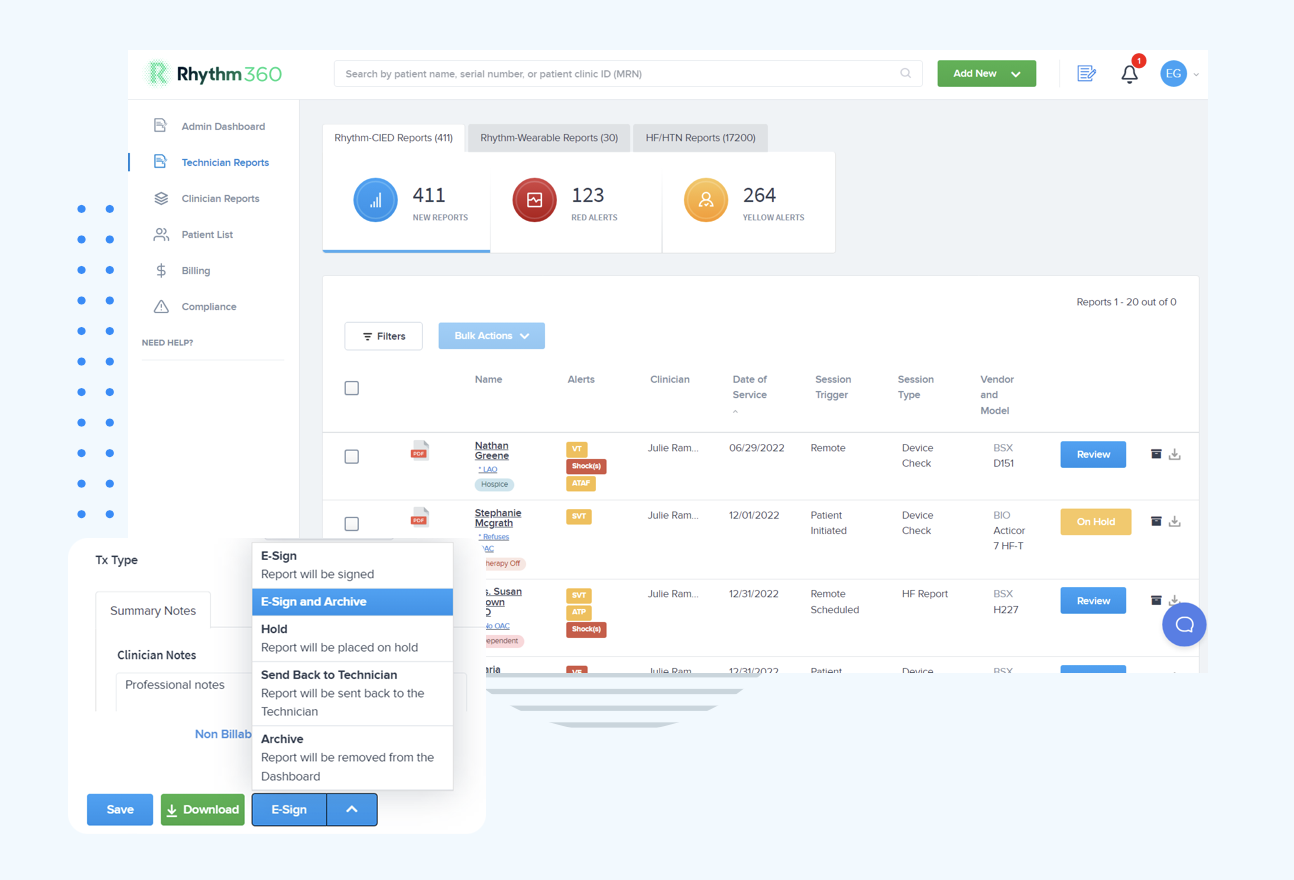
A heart failure patient with an implanted CRT-D and a connected weight scale sits on two billing tracks at the same time. The workflow below shows how Rhythm360 manages both tracks without overlap.
Commercial payer policies for cardiology RPM diverge from CMS rules in ways that directly affect claim outcomes. Aetna updated its RPM policy effective March 1, 2026, limiting coverage to heart failure, hypertension, and diabetes while explicitly excluding the new 2026 codes 99445 and 99470 as well as all RTM codes for both commercial and Medicare Advantage members.
UnitedHealthcare announced plans in late 2025 to restrict RPM coverage to heart failure and hypertensive disorders of pregnancy but delayed implementation indefinitely after provider objections over Medicare Advantage compliance. Practices billing UHC for cardiology RPM should verify current policy status before each billing cycle because the delayed restriction may be reinstated.
Key payer compliance actions for cardiology practices include the following.
See how Rhythm360 handles payer-specific billing rules so your team can bill Aetna, UHC, and Medicare Advantage plans confidently without manual policy lookups for every claim.
The following decision logic supports consistent code selection before any remote monitoring claim submission for a cardiology patient.
CIED codes (93294–93298) cover the interrogation and professional interpretation of implanted cardiac devices such as pacemakers, ICDs, CRT devices, and implantable loop recorders. Physiologic RPM codes (99453, 99445, 99454, 99457, 99458, 99470) cover patient-transmitted home data from connected devices like weight scales, blood pressure cuffs, and pulse oximeters. The two families run on different billing intervals, with CIED codes using 30- to 90-day device-specific cycles and RPM codes using 30-day device-supply periods and calendar-month management periods. Certain codes from the two families cannot be billed together in overlapping periods for the same patient because the AMA CPT parenthetical under 99453 and 99454 explicitly excludes reporting those codes alongside more specific cardiac monitoring codes such as 93296, 93297, and 93298. A patient with a CRT-D who is also enrolled in a heart failure weight-monitoring program therefore requires separate, non-overlapping billing tracks managed by code family.
For CPT 99445, documentation must include a treating practitioner order, documented patient consent, confirmation that the device is FDA-cleared and capable of automatic data transmission, and a per-period log showing the exact number of days physiologic readings were received, specifically 2 to 15 days within the 30-day billing period. For CPT 99470, documentation must include dated time entries specifying the activities performed, a total time record showing 10 to 19 minutes of clinical staff engagement, and evidence of at least one live, synchronous interactive communication with the patient during the calendar month. Asynchronous messages, texts, and voicemails do not satisfy the interactive communication requirement. Both codes require that the same minutes not be counted toward any other billable service, such as CCM, in the same period.
Rhythm360 is a vendor-neutral platform that maintains separate billing clocks for each code family within a single dashboard. Its rules engine evaluates each patient’s enrollment status across CIED and physiologic RPM service lines and flags conflicting code pairs, such as 93296 and 99454 in the same period, before a claim is submitted. The platform’s AI-powered day-count aggregation automatically determines whether 99445 or 99454 applies based on actual documented transmission days, which removes the manual counting errors that commonly trigger denials. Bi-directional EHR integration ensures that finalized documentation flows directly into the practice’s existing system of record, which supports clean claim creation without manual transcription. University of Chicago Medicine reported improved billing and accountability after integrating Rhythm360 into their cardiovascular remote monitoring program.
Coverage varies by payer and plan type. Aetna updated its RPM policy effective March 1, 2026, explicitly excluding CPT 99445 and 99470 for both commercial and Medicare Advantage members while limiting covered conditions to heart failure, hypertension, and diabetes. UnitedHealthcare announced plans to restrict RPM coverage but delayed implementation indefinitely following provider objections. Practices should verify current policy status for each payer before enrolling patients under the new codes because Medicare Advantage plans are legally required to provide coverage equivalent to traditional Medicare, and Aetna’s exclusion of CMS-approved codes may conflict with that requirement. Maintaining payer-specific billing rules within a centralized platform reduces the risk of submitting non-covered codes to plans that have not yet adopted the 2026 additions.
The most frequent errors include billing both codes from a mutually exclusive pair in the same period, such as 99445 and 99454 together or 99470 and 99457 together, attaching the 99458 add-on to 99470 rather than to 99457, rounding up transmission day counts or management minutes above what documentation supports, double-counting staff time between RPM and CCM in the same month, and billing RPM and RTM management codes for the same patient in the same period.