CPT code 99291 applies when a practitioner delivers direct critical care services to a critically ill or injured patient for 30 to 74 minutes on a single calendar date. The service must meet both a clinical definition and a time standard before it can be reported.
2026 CMS criteria for 99291 (per CMS MLN006764, May 2026):
When multiple providers are involved, an additional Medicare rule applies. 2026 Medicare note: CMS MLN006764 confirms that when multiple providers from the same specialty and same group furnish critical care to the same patient on the same date, their time is combined. Only one provider may report critical care services for the combined time.
See how Rhythm360 unifies critical care and RPM documentation in a single platform.
Accurate critical care billing depends on tracking cumulative time across the full calendar date, selecting the correct code combination, and documenting each time increment. CMS MLN006764 permits aggregation of non-continuous critical care time on the same date.
Step-by-step workflow:
| Total Critical Care Time | Codes to Report | Notes |
|---|---|---|
| Fewer than 30 minutes | Appropriate E/M code | 99291 not reportable |
| 30–74 minutes | 99291 × 1 | 99291 reported once; 99292 not yet billable |
| 75–103 minutes | 99291 × 1 only (Medicare) | CPT midpoint rule would allow 99292 at 75 minutes, but Medicare requires a full 30-minute increment; 99292 not billable until 104 minutes |
| 104–133 minutes | 99291 × 1 + 99292 × 1 | First unit of 99292 reportable at 104 total minutes |
| 134+ minutes | 99291 × 1 + 99292 × additional units | Each additional complete 30-minute increment equals one additional 99292 unit |
Practices may bill 99291 and 99292 together only when total critical care time reaches 104 minutes or more under Medicare rules. UTHealth Houston's E/M time guidance clarifies that the CPT midpoint rule would permit the first unit of 99292 at 75 total minutes, but CMS MLN006764 requires the full 30-minute increment beyond the initial 74 minutes, which makes 104 minutes the Medicare threshold for the first 99292 unit. At 90 minutes of total critical care time, Medicare allows only 99291.
Cardiology examples:
Providence Health Plan's 2026 coding policy confirms that 99292 may not be billed for any increment of less than 30 minutes beyond the initial 74-minute threshold.
Certain services are included in the global payment for 99291 and 99292 and cannot be billed separately. First Coast Service Options (FCSO) Medicare guidance (April 9, 2026) and CMS MLN006764 identify the following as bundled:
Certain invasive procedures remain separately billable when documentation clearly identifies the procedure and its distinct medical necessity. Separately billable examples include intubation (CPT 31500), CPR (CPT 92950), central venous line placement (CPT 36555), and arterial line insertion (CPT 36620). Time spent performing these procedures must be excluded from the critical care time total.
| CPT Code | Service Type | Time / Frequency Basis |
|---|---|---|
| 99291 | Critical care, initial | 30–74 minutes per date of service |
| 99292 | Critical care, add-on | Each additional 30 minutes beyond 74 minutes, with a 104-minute minimum for the first unit under Medicare |
| 99453 | RPM, device setup and patient education | One time per episode of care |
| 99454 | RPM, device supply with daily recording | Per 30-day period, 16 or more days of data required |
| 99457 | RPM, treatment management, first 20 minutes | Per calendar month, interactive communication required |
| 99458 | RPM, treatment management, add-on 20 minutes | Per calendar month, each additional 20 minutes |
| 93294 | CIED remote interrogation, single lead | Up to every 90 days |
| 93296 | CIED remote interrogation, technical component | Per interrogation period |
| 93298 | CIED remote interrogation, subcutaneous | Up to every 30 days |
Split or shared critical care applies when a physician and a non-physician practitioner (NPP) in the same group both provide critical care to the same patient on the same calendar date. CMS MLN006764 and FCSO guidance govern this scenario. The substantive portion, defined as more than 50% of combined total time, determines the billing provider.
Split/shared critical care checklist:
The substantive portion is determined by proportion of total time, not by whether the time involves direct patient contact. Medical decision-making is not used to select critical care levels in split/shared scenarios.
Insufficient documentation is the primary driver of medical necessity denials and audit findings for critical care claims. To address this risk, CMS MLN006764 and FCSO Medicare policy specify required elements that auditors will verify in the medical record.
Critical care coding guidance notes that family discussions count toward critical care time only when they occur at the bedside or on the patient's unit, directly concern medical decision-making or treatment limitations, and the patient participates or the chart explains why the patient cannot participate.
Learn how Rhythm360 automates audit-ready documentation for critical care and remote monitoring claims.
The documentation requirements outlined above become even more critical when practices manage multiple service lines simultaneously. Cardiology practices managing patients with cardiac implantable electronic devices (CIEDs), heart failure, or hypertension frequently bill both critical care codes (99291/99292) and remote physiologic monitoring codes (99453–99458, 93294–93298) for the same patient population. When these workflows operate in disconnected systems, practices face duplicated administrative effort, incomplete audit trails, and missed billing opportunities.
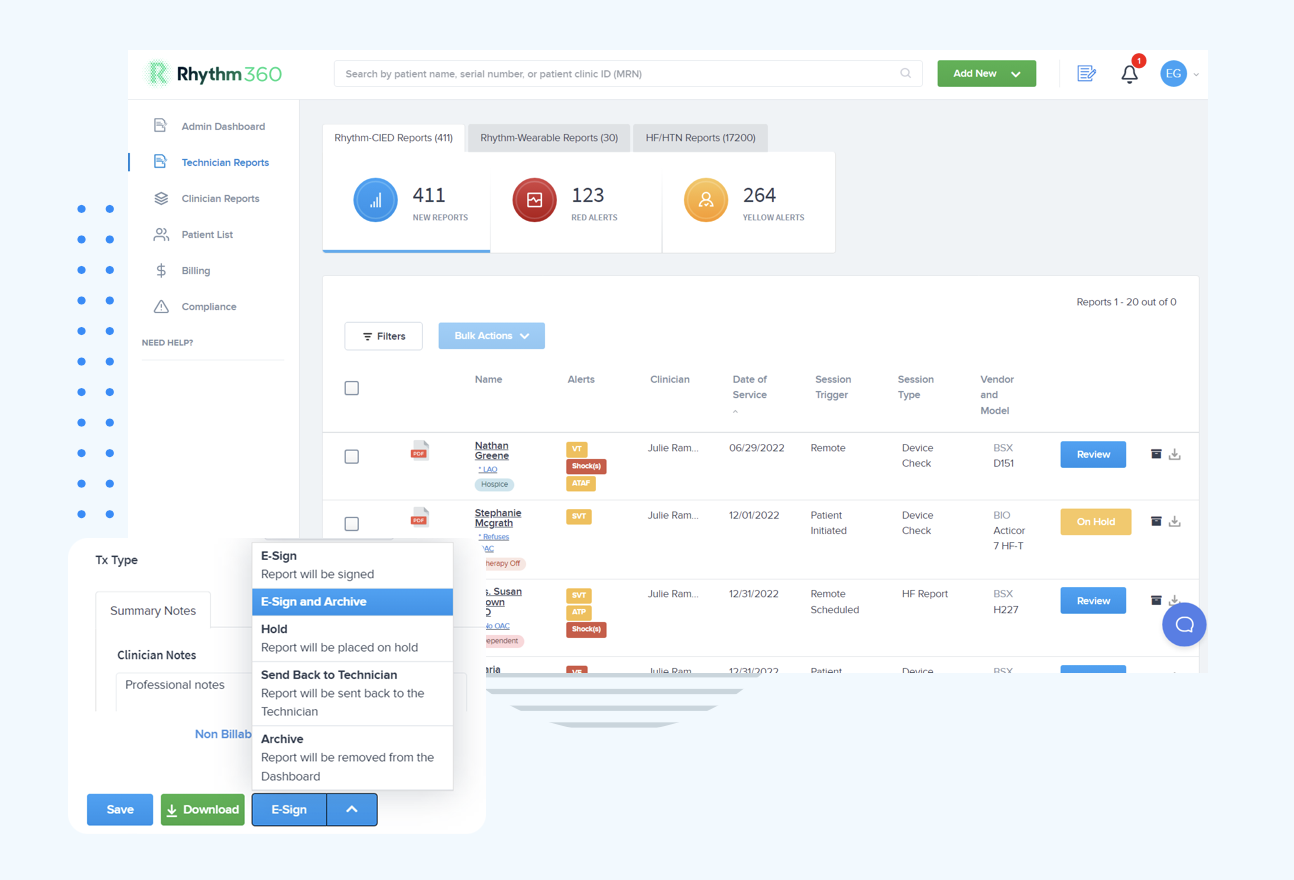
A unified documentation platform directly addresses these gaps. When critical care time, clinical decision-making notes, and RPM transmission data are captured in a single system with a shared patient record, billers can verify that critical care documentation does not overlap with RPM service periods, that bundled services are correctly excluded from critical care time, and that each CPT code is supported by a distinct, complete documentation entry. This structure reduces the risk of CO-50 medical necessity denials and supports concurrent audit review across both service lines without requiring staff to reconcile records from multiple portals.
Practices that track critical care and RPM billing in separate systems also risk missing the 16-day data threshold for 99454 or the interactive communication requirement for 99457 when clinical attention is concentrated on acute critical care episodes. A centralized workflow surfaces these requirements at the same time as acute care needs, which protects revenue across both service lines.
Compliant critical care billing in 2026 depends on precise adherence to Medicare's time-based thresholds, correct application of bundling rules, and complete documentation that supports medical necessity. Practices that embed these requirements into a unified workflow, rather than treating critical care and RPM as separate administrative silos, reduce denial risk and protect revenue across both service lines.
Integrated documentation also simplifies audit response, since critical care notes, procedure details, and RPM data live in a single record that clearly supports each billed code.
Request a demo of Rhythm360's compliant billing platform for critical care and remote physiologic monitoring.
A practitioner must provide at least 30 minutes of critical care services to a critically ill or injured patient on a single calendar date to report CPT code 99291. Critical care time totaling fewer than 30 minutes on a given date is not reported with 99291; instead, the appropriate evaluation and management code for the site of service applies. The 30-minute minimum applies to the aggregate of all medically necessary critical care time provided on that calendar date, so non-continuous episodes may be combined. The patient must meet the critical illness definition, which is acute impairment of one or more vital organ systems with a high probability of imminent or life-threatening deterioration, at the time of each episode.
Medicare requires the full 30-minute increment to be completed before 99292 is reportable, unlike the CPT midpoint rule. This means practices cannot bill the first unit of 99292 until 104 total minutes, even though CPT guidance would allow it at 75 minutes. See the section "When 99291 and 99292 Are Billed Together" for the complete explanation and cardiology examples.
Practitioners from different specialties may each report 99291 and 99292 on the same date for the same patient, provided each provider's services are medically necessary, meet the definition of critical care, and are not duplicative of the other's care. Each provider's documentation must demonstrate that their critical care addresses a distinct condition or a separate element of the plan of care. For example, a cardiologist managing cardiogenic shock and an electrophysiologist managing a concurrent sustained ventricular arrhythmia may each report critical care independently if their documentation clearly delineates the separate clinical roles. Same-specialty providers within the same group must aggregate their time and follow the rules for concurrent same-specialty critical care billing, with only one provider reporting 99291.
Critical care CPT codes 99291 and 99292 and remote physiologic monitoring codes such as 99453, 99454, 99457, and 99458 serve distinct clinical purposes and operate under separate billing rules. Critical care codes apply to acute, time-limited episodes where a patient's vital organ systems are acutely impaired. RPM codes apply to ongoing, chronic condition management, such as heart failure or hypertension, using connected monitoring devices over 30-day periods. The two service lines can coexist for the same patient, but practices must ensure that documentation for each is distinct, that bundled services are not double-counted, and that critical care time does not overlap with RPM service periods. Practices that manage both service lines in disconnected systems face elevated risk of documentation gaps, missed billing thresholds, and audit exposure. A unified platform that tracks both service lines in a single record reduces this risk and supports compliant billing across the full scope of cardiology revenue-cycle activity.
Rhythm360 is a cloud-based, vendor-neutral remote patient monitoring platform built for cardiology practices managing patients with cardiac implantable electronic devices and chronic conditions including heart failure and hypertension. The platform consolidates data from all major device manufacturers into a single record, automates CPT code documentation for remote monitoring service lines, and provides bi-directional EHR integration with systems including Epic, Cerner, and Athenahealth. For practices billing both critical care and RPM codes, Rhythm360's centralized documentation infrastructure supports audit-ready records across both service lines, reduces the administrative burden of reconciling data from multiple portals, and helps practices capture previously missed revenue. Practices using Rhythm360 have reported up to a 300% increase in revenue generation through improved CPT code capture and an 80% reduction in response times for critical patient alerts.