Last updated: September 22, 2026
See Rhythm360 In Action — Schedule A Demo
Two CPT codes govern payment when a practice submits a 90-day pacemaker monitoring claim: CPT 93294 and CPT 93296. CPT 93294 is the professional component, covering interim analysis, review, and report by a physician or other qualified health care professional for a single, dual, multiple-lead, or leadless pacemaker system over a period of up to 90 days. CPT 93296 is the technical component, covering remote data acquisition, receipt of transmissions, technician review, technical support, and distribution of results for pacemaker systems and implantable defibrillator systems.
CPT 93296’s total RVU increased from 0.60 in prior years to 0.95 in 2026. CMS updated the code’s direct practice expense inputs, including a cardiovascular technician labor classification and an updated equipment code. These changes produced a 59% increase in office-based practice expense RVUs, per the Boston Scientific CY 2026 Medicare payment rules summary. CPT 93294 carries 0.88 total RVUs at $29 in both non-facility and facility settings. In the hospital outpatient setting, CPT 93296 is assigned to APC 5741 (Level 1 electronic analysis of devices) with a national unadjusted rate of $38, while CPT 93294 carries status indicator M and is not separately payable in that setting. The table below summarizes how the two codes differ by component, device type, and 2026 payment context.
| CPT Code | Component | Device Type | 2026 Payment Context (Non-Facility) |
|---|---|---|---|
| 93294 | Professional | Single, dual, multiple-lead, or leadless pacemaker | 0.88 RVUs / ~$29; once per 90 days; 30-day minimum |
| 93296 | Technical | Pacemaker (any lead configuration, including leadless) or ICD | 0.95 RVUs / ~$32; once per 90 days; 30-day minimum |
Both CPT 93294 and CPT 93296 may be reported when the practice performs both the professional and technical components for the same pacemaker monitoring period. This pairing rule applies in addition to the standard frequency limits. The codes describe distinct services, with physician interpretation reported under 93294 and technical data acquisition reported under 93296. Each is separately payable when the corresponding work is performed and documented by the billing entity, per CMS guidance on cardiac device evaluation.
In hospital facility settings, a physician who performs only the professional component of remote pacemaker interrogation while the facility provides the technical component bills CPT 93294 with modifier -26. In most other cases, the code does not require modifiers and can be used on its own. CPT 93296 is inherently a technical-component-only service, so appending a -TC modifier is generally inappropriate and can trigger claim denials. The same logic applies in reverse: appending -26 to a code with no professional or technical split, or applying -TC where the practice performs both components, produces a rejection rather than a payment reduction. In every case, modifier selection must follow the actual division of work.
The frequency rules for CPT 93294 and 93296 translate into a predictable operational calendar. Each step below aligns with a denial scenario billing managers encounter regularly, per CMS Billing Article A56602 as cited in Muni Health’s 2026 cardiology denial analysis.
An audit of 61,400 claims found that 9% of device interrogation and remote monitoring claims were denied for frequency, with an average denied charge of $94 per claim. Most of those denials trace to billing before the 30-day minimum closes or submitting a second claim inside an open 90-day window. Frequency errors are one denial source. A second comes from mixing CIED codes with general remote physiologic monitoring codes, which the next section explains.
For the same patient and the same monitoring period, general remote physiologic monitoring (RPM) codes 99453, 99454, and 99457 and CPT 99091 are not billed alongside CIED codes 93294 and 93296. The exclusion is grounded in the AMA CPT parenthetical under 99453 and 99454, which explicitly names 93296 as a more-specific code that displaces the general RPM supply codes when an implanted cardiac device is being monitored.
The code families serve different clinical purposes. CPT 93294 and 93296 apply to implanted pacemaker and ICD data such as device battery status, lead integrity, arrhythmia episodes, and programming parameters transmitted from the implanted device. RPM codes 99453, 99454, and 99457 apply to physiologic monitoring data such as blood pressure, weight, and glucose collected by a patient-operated connected device and transmitted to the provider. CPT 99091 covers physician or qualified health care professional collection and interpretation of physiologic data over 30 minutes per 30-day period and is mutually exclusive with RPM management codes 99457 and 99458 in the same period, per the CMS CY 2026 Medicare Physician Fee Schedule.
A patient with an implanted pacemaker monitored under 93294 and 93296 does not generate RPM device supply claims for that same monitoring period. The two frameworks operate on different billing clocks, with a 90-day CIED cycle and a 30-day RPM calendar month. The CPT parenthetical prevents stacking them for the same monitoring activity.
Talk To Our Team About CIED Billing Compliance
Rhythm360 is a vendor-neutral, HIPAA-compliant, cloud-based platform built for practices that manage pacemaker and CIED remote monitoring programs. It consolidates data from all major CIED manufacturers, including Medtronic, Boston Scientific, Abbott, and Biotronik, into a single dashboard and removes the need to log into separate OEM portals for each device family.
The platform automatically tracks device-specific CPT pairings, including the 90-day pacemaker and ICD cycle (93294, 93295, 93296) and the 30-day cycle for implantable cardiovascular physiologic monitors (93297) and subcutaneous cardiac rhythm monitors and loop recorders (93298). It enforces the 30-day minimum monitoring window and the once-per-90-days frequency rule before a claim is generated. This approach prevents the frequency denials and device-type mismatch errors that account for many CIED billing losses. Auditable documentation is generated automatically, so the professional component record contains the monitoring period dates, device type, transmitted data reviewed, interpretation, and physician signature required to survive payer review.
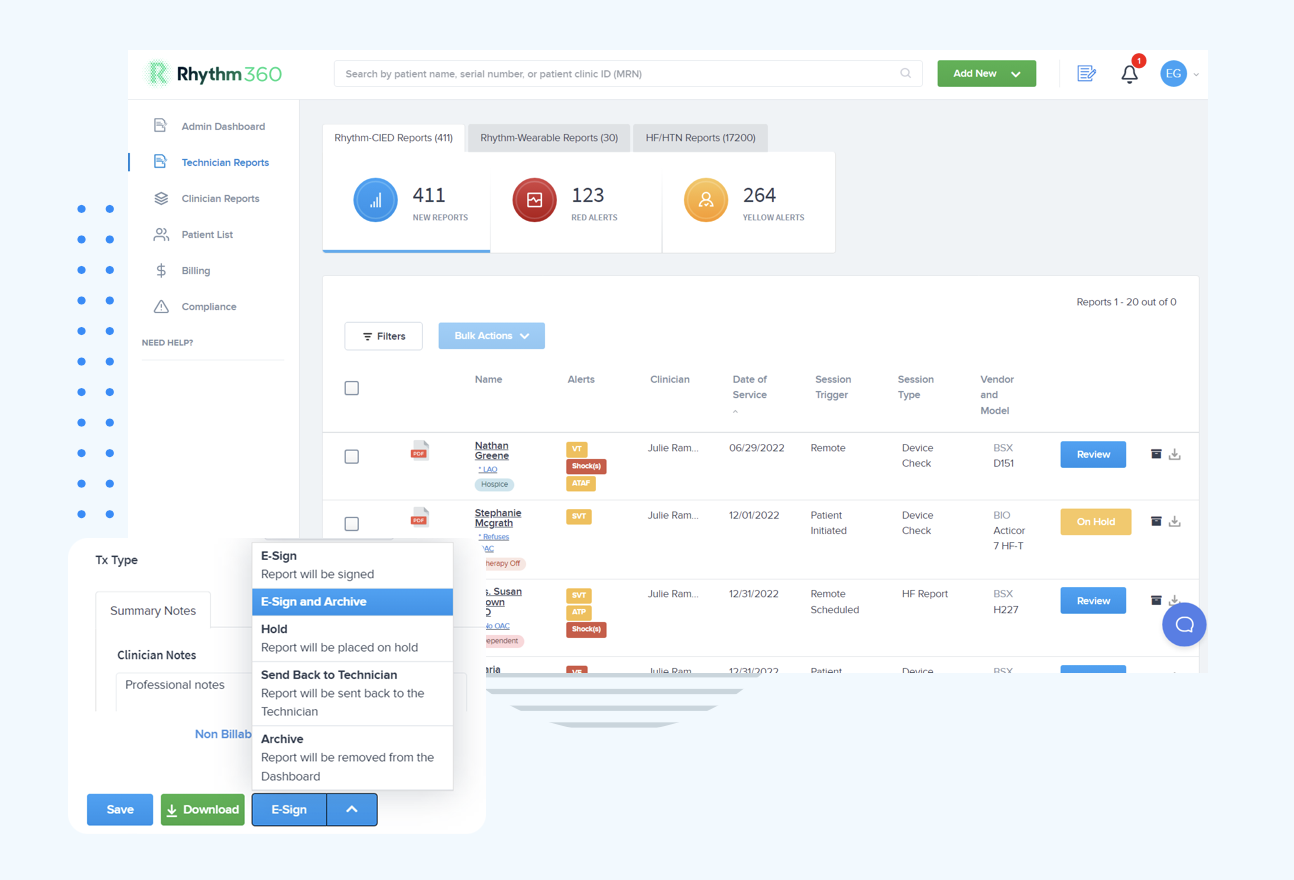
Rhythm360 offers bi-directional EHR integration with Epic, Cerner, Athenahealth, eClinicalWorks, and Greenway Health, so billing eligibility surfaces in the workflow before a claim goes out rather than after it is denied. AI-powered alert triage filters non-actionable transmissions and prioritizes clinically significant events. A secure HIPAA-compliant mobile app allows clinicians to review transmissions, sign reports, and coordinate care from anywhere. Practices using Rhythm360 have achieved up to an 80% reduction in critical alert response times and up to a 300% increase in revenue capture.
CPT 93295 is the professional component for ICD remote monitoring and covers interim analysis, review, and report by a physician or other qualified health care professional for an implantable defibrillator system over a period of up to 90 days. CPT 93296 is the technical component for both pacemaker and ICD remote monitoring. The pairing logic for 93295 and 93296 mirrors that of 93294 and 93296. Both may be reported when the practice performs both the professional and technical components for the same ICD monitoring period, subject to the same 30-day minimum and once-per-90-days frequency limit.
Device type drives the choice of professional code. CPT 93294 is the professional code for pacemakers, and CPT 93295 is the professional code for ICDs. Billing 93294 for an ICD patient or 93295 for a pacemaker patient creates a wrong-device-family coding error that payers deny on claim review, per 2026 billing guidance on CPT 93294. CPT 93296 serves both device families as the shared technical component, so the technical claim does not change based on whether the patient has a pacemaker or an ICD. The professional code must match the implanted device precisely.
CPT 93297 covers remote monitoring of an implantable cardiovascular physiologic monitor such as a hemodynamic sensor, and CPT 93298 covers remote monitoring of a subcutaneous cardiac rhythm monitor or implantable loop recorder. Each is billable once per 30 days and each can be billed globally or split into -26 and -TC components. Neither 93297 nor 93298 forms a professional and technical pair with the other, because they describe different device categories and different monitoring data types.
Leadless pacemakers fall under the same remote monitoring CPT codes as transvenous pacemakers. The CPT descriptors for 93294 and 93296 explicitly include “leadless pacemaker system” alongside single, dual, and multiple-lead pacemaker systems, per the Medtronic CY 2026 Micra reimbursement guide. A practice that monitors a Micra VR or Micra AV patient remotely bills 93294 for the professional component and 93296 for the technical component on the same 90-day cycle used for any other pacemaker.
CPT 93288 applies when the patient presents in person for a pacemaker interrogation. Its descriptor also explicitly includes leadless pacemaker systems, so the in-person code family covers the same device types as the remote codes. CPT 93288 is reported per encounter and covers connection, recording, disconnection, analysis, review, and report. It carries 1.66 total RVUs at a $55 national non-facility payment rate globally, with the professional component (modifier -26) at $20 and the technical component (modifier -TC) at $35, per the Medtronic CY 2026 Micra reimbursement guide.
The selection between 93288 and 93294 or 93296 turns on whether the interrogation occurred in person or remotely. In-person and remote monitoring of the same device cannot overlap in the same billing period, so a clinic that performs both must select one code for that window, per AMA CPT 2026 guidance. An in-person interrogation performed during an open remote monitoring period is included in the remote service and should not be billed separately for that period, per National Government Services guidance.
The professional component of CPT 93294 must be supported by a monitoring report that contains specific elements to survive payer review, per CMS Billing and Coding Article A56602.
Pacemaker remote monitoring billing fails most often at three points: incorrect code pairing between the professional and technical components, claims submitted outside the 30-day minimum or 90-day maximum frequency window, and device-type mismatches that route the wrong professional code to the wrong patient. The exclusion of general RPM codes from CIED monitoring periods adds a fourth failure point for practices that run both program types. Each of these errors produces a denial that is preventable before the claim goes out, as long as monitoring period dates, device type, and code pairing are verified at the documentation stage.
Rhythm360 automates CPT code capture, documentation, and billing compliance for pacemaker remote monitoring. The platform enforces the 90-day cycle, the 30-day minimum window, and device-specific code pairings automatically while generating auditable reports that contain every element required for the professional component to survive review. The 80% and 300% outcomes cited earlier follow directly from eliminating the manual tracking gaps where CIED billing revenue is lost.
Schedule A Demo And See How Rhythm360 Supports Pacemaker Remote Monitoring Billing Compliance