Last updated: October 1, 2026
See How The Six-Stage Architecture Runs On Rhythm360
The rest of this guide follows a ten-step implementation sequence, from defining the clinical question through quarterly reassessment. Each step appears in more detail in the sections below.
Guideline recommendations consistently tie monitoring intensity to symptom frequency and clinical risk. The 2024 ESC AF guideline and the 2023 ACC/AHA/ACCP/HRS AF guideline both require physician-interpreted ECG confirmation before initiating therapy when AF is detected by a wearable or mobile screening tool. PPG-only alerts from smartwatches do not provide a definitive AF diagnosis. The 2024 ESC AF guideline specifies that AF diagnosis requires either a 12-lead ECG showing AF for 10 seconds or more than 30 seconds of AF on a single-lead or continuous ECG tracing.
Clinical goals drive the choice of modality more than any single device feature. Patch monitors and MCT extend continuous capture beyond 48 hours. ILRs provide long-term surveillance and play a central role in cryptogenic stroke workups, where CMS LCD L40257 cites a meta-analysis finding that prolonged monitoring of 7 days or more increased AF detection after cryptogenic stroke or TIA compared with shorter monitoring (13.8% vs. 2.5%; OR 6.4). For patients with CIEDs or ILRs already implanted, see the Remote Monitoring Of Implanted Cardiac Devices: 2026 Guide for device-specific protocols. The table below maps each modality to typical duration, transmission mode, and best-fit scenario so teams can match the device to the clinical question.
| Modality | Typical Monitoring Duration | Transmission Mode | Best-Fit Clinical Scenario |
|---|---|---|---|
| Holter Monitor | Up to 48 hours (CPT 93224–93227) | Continuous passive recording, reviewed after the fact | Frequent symptoms, baseline arrhythmia characterization |
| Patch Monitor | 48 hours to 30 days, coded as CPT 93241-93244 (greater than 48 hours up to 7 days), 93245-93248 (greater than 7 days up to 15 days), and 0937T-0940T (more than 15 days up to 30 days) | Continuous recording with batch upload or periodic transmission | Infrequent symptoms, post-ablation surveillance, AF burden quantification |
| Mobile Cardiac Telemetry (MCT) | Up to 30 days (CPT 93228–93229) | Real-time transmission to an attended surveillance center, 24-hour staffed receiving station required per CMS LCD L40257 | Syncope of unknown cause, palpitations with hemodynamic compromise, suspected paroxysmal AF after shorter monitoring is inconclusive |
| ILR / ICM | Up to 3 years, with battery longevity varying by device model and real-world use | Automatic wireless transmission with alert-based and scheduled reports | Cryptogenic stroke, unexplained syncope, long-term AF surveillance, a single RCT found ILR detected significantly more AF than 30-day ELR (15.3% vs. 4.7%) |
| CIED (Pacemaker / ICD / CRT) | Device lifetime | Automatic daily or scheduled wireless transmission through manufacturer portals | Known arrhythmia, device therapy management, heart failure monitoring, see CIED-specific protocols |
The six stages below define the operational spine of a remote arrhythmia monitoring program. Each stage includes explicit role assignments so work does not drift.
Assigning accountability for each stage to a named role turns a monitoring description into an operating program.
Talk To Us About Your Monitoring Program
Alert governance starts with clear triage tiers. Operational recommendations suggest the following response windows: urgent alerts receive immediate response, actionable alerts receive same-day response, and routine transmissions receive next-business-day review. Teams should document these windows in a written protocol and assign them to named roles.
The 2023 HRS/EHRA/APHRS/LAHRS Expert Consensus Statement points toward alert-based monitoring, in which clinics respond to meaningful events rather than processing every scheduled transmission equally. The operational reality is that research consistently shows 57–80% of CIED remote monitoring transmissions are ultimately non-actionable, and in some programs only 7% of alerts were judged clinically meaningful.
Triage tiers by device type:
Reducing alert fatigue requires four structural interventions. Deduplicate retransmitted readings so the same event is not reviewed twice. Configure thresholds per patient instead of applying uniform defaults. Separate clinical alerts from technical alerts and give each category its own owner and escalation path. Assign clear named ownership to every alert tier. AI should support human decision-making rather than autonomously suppress or resolve alerts. Human review, source traceability, and auditability remain necessary.
Staffing a remote arrhythmia monitoring program to patient count alone produces chronic understaffing as device mix and transmission volume grow. The relevant variables include projected alert volume, device types in the panel, coverage hours, and the ratio of urgent to routine transmissions. A tiered staffing approach with CCTs handling first reads and triage, nurses or NPs managing escalation, and EPs providing interpretive oversight distributes workload more sustainably than a flat coordinator model.
For practices operating mobile cardiac telemetry, CMS LCD L40257 requires the receiving station to be staffed on a 24-hour basis with a minimum of an EKG technician or other non-physician staff, with immediate 24-hour access to a physician, and explicitly states that an answering service does not fulfill this requirement.
Staffing shortfalls appear frequently in real-world programs. Gaurav A. Upadhyay, MD, FACC, FHRS, at University of Chicago Medicine, stated: "Staffing was always an issue for our center, because our device clinic — like many other medical centers — had struggled with technician turnover and timely weekend coverage." Research published in Heart Rhythm O² identified low supply of knowledgeable clinicians and staff as a major barrier, with burnout and lengthy training timelines cited as the biggest obstacles.
High-volume monitoring becomes manageable when architecture and staffing align. University of Chicago Medicine reviewed more than 73,000 reports annually through Rhythm360 in calendar year 2025, averaging more than 18,000 reports per quarter. This experience shows that volume alone does not prevent operational stability when workflows are structured and technology supports them.
Patient education and adherence workflows keep monitoring programs clinically effective and billable. The 2026 JHRS Expert Consensus Statement recommends individualized, continuously reinforced education covering system functions, transmitter setup, enrollment, transmission schedules, and device operation, with written instructions and informed consent documented. Patients must hear that remote monitoring does not function as an emergency response system, that they must keep contact information current, and that they should notify the clinic about travel or hospitalization.
Practical adherence tracking steps include:
Patient acceptance of remote monitoring remains high when programs follow these structures. In the TRUST study, 98% of patients chose to continue remote monitoring at the end of the study, and no patients crossed over to conventional follow-up.
Remote arrhythmia monitoring generates billable events across two primary code families, each with device-specific rules.
For pacemakers and ICDs on a 90-day cycle:
For physiologic monitors and loop recorders on a 30-day cycle:
Codes 93297 and 93298 function as device-specific codes rather than a professional and technical pair. Each maps to a distinct device category and must not be applied interchangeably. CMS's cardiac rhythm device evaluation billing article states that 93294 and 93296 describe services furnished over a monitoring period rather than payment per transmission, so scheduled and alert transmissions should not be reported separately.
For heart failure and hypertension remote physiological monitoring, RPM codes 99453 (education and setup), 99454 (device supply), and 99457 (treatment management) apply. CMS requires at least 2 readings every 30 days for the device supply component (99454).
Rhythm360 automates CPT code capture and documentation so practices recover billable events that would otherwise be missed. Gaurav A. Upadhyay, MD, at University of Chicago Medicine, noted: "We have improved billing and accountability for our patients after the integration."
Health equity: Access to monitoring devices and reliable connectivity varies significantly across patient populations. The 2024 ESC AF guideline recommends routine heart rhythm assessment for people aged 65 and older and supports opportunistic screening in older adults. These recommendations carry direct access implications for underserved populations who may lack broadband connectivity or device literacy.
Cybersecurity: HIPAA-compliant data transmission and storage function as baseline program requirements. Every vendor contract, data-sharing agreement, and transmission pathway should be evaluated for compliance before program launch.
EHR interoperability: Bi-directional integration with Epic, Cerner, Athenahealth, eClinicalWorks, Greenway Health, and others via HL7 removes manual data entry and supports auditable documentation. A 2026 JMIR systematic review found interoperable connectivity reported in 30 of 43 early warning systems, using standards including HL7 and FHIR. Rhythm360 provides these bi-directional EHR integration capabilities.
Rhythm360 is a vendor-neutral, HIPAA-compliant, cloud-based platform that unifies all CIED and RPM data into a single dashboard. The platform supports each stage of the six-stage monitoring architecture described in this guide.
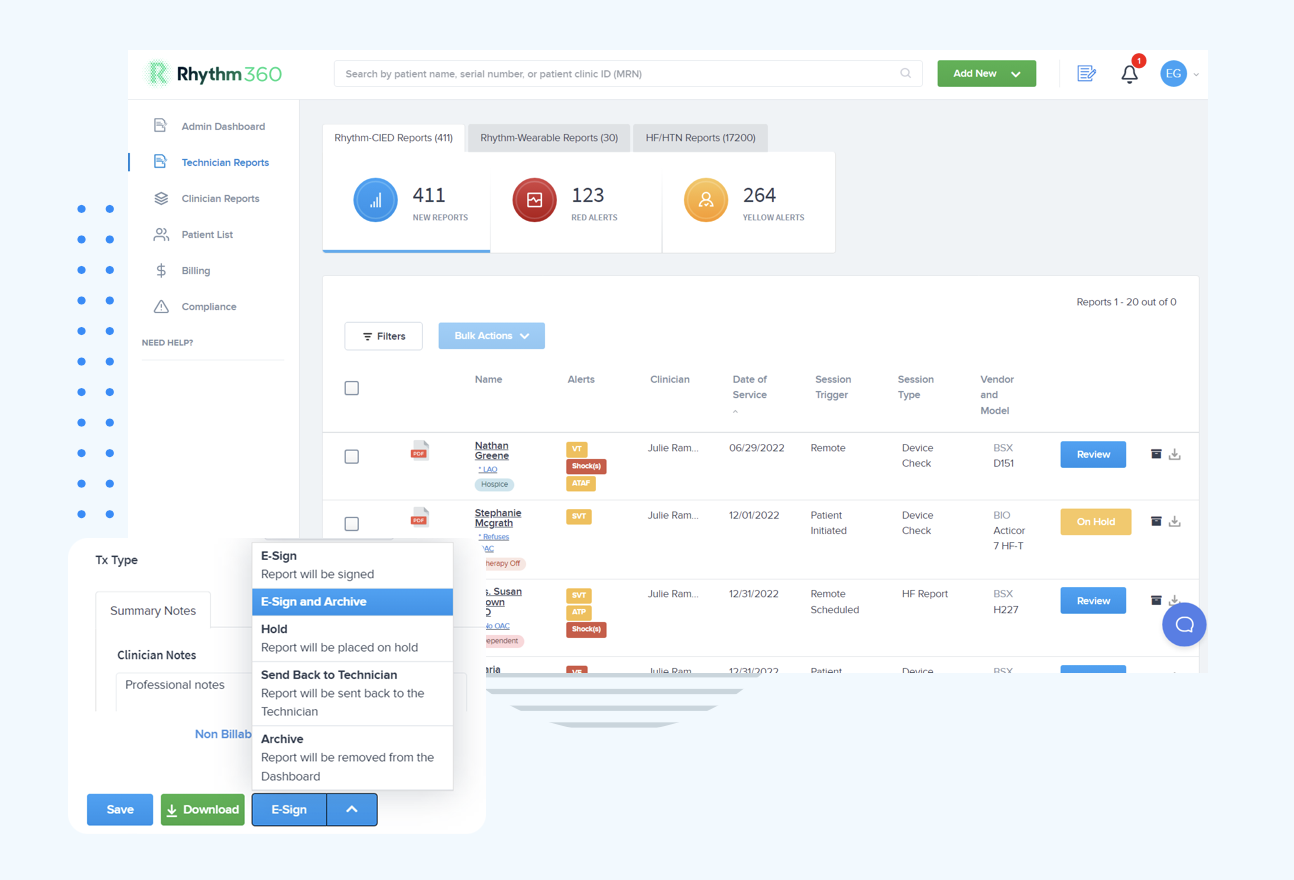
Rhythm360 delivers up to 80% reduction in critical alert response times and up to 300% increase in revenue capture and profitability. Andrew Beaser, MD, at University of Chicago Medicine, noted: "Decision support, including AI-assisted decision support, will become increasingly important as data volumes grow."
Talk To Us About Your Monitoring Program
Programs that have operated for several years still face structural risks. The most common missteps include:
CMS organizes remote patient monitoring around three separately reimbursed components: education and setup, device supply, and treatment and management. To qualify for Medicare coverage, a patient must have a chronic or acute condition requiring monitoring and must use an internet-connected device that meets the FDA's definition of a medical device, digitally uploads data, and collects and transmits health data at least 2 days every 30 days. CMS pays the same rate regardless of device type or data collected. Providers should deliver all three components to prevent fraud and reduce the risk that patients receive devices without education or setup support.
The core requirements are straightforward. The patient must have a qualifying chronic or acute condition. The device must meet the FDA's definition of a medical device and transmit data digitally. The device supply component requires collection and transmission of at least 2 readings every 30 days. Delivering all three components, including education/setup, device supply, and treatment/management, supports compliance and reduces claim denials. Documentation should support medical necessity and identify the interpreting clinician.
Alert fatigue reduction requires a structural approach rather than individual workarounds. Implement tiered triage with four categories, including critical, actionable, routine, and archive, and route transmissions accordingly. Apply deduplication logic to suppress retransmitted readings while preserving a single auditable record. Configure patient-specific thresholds instead of applying uniform defaults across all patients. Separate clinical alerts from technical alerts and assign each category to distinct owners with distinct escalation paths. Assign clear named ownership to every alert tier so no transmission sits in an unowned queue. AI tools can summarize readings, prioritize queues, and group related events, but they should support human decision-making rather than autonomously suppress or resolve alerts. Human review and auditability remain necessary for clinical accountability and billing documentation.
The answer depends on the clinical question. For symptoms occurring less frequently than once every 48 hours, patch monitors are typically worn for 7–14 days of continuous capture without the burden of multiple electrodes. Event and loop monitors and ambulatory cardiac telemetry monitors are worn for up to 30 days. Mobile cardiac telemetry adds real-time attended surveillance and allows same-day physician notification when an event is detected, which Holter monitoring does not provide. For cryptogenic stroke or TIA workup, the prolonged-monitoring detection advantage described earlier applies here as well. For patients who remain undiagnosed after extended noninvasive monitoring, implantable loop recorders can provide surveillance for up to three years, though battery longevity varies by device model and real-world use, and the same trial cited above found ILR detected significantly more AF than 30-day external loop recording.
For pacemakers and ICDs on a 90-day monitoring cycle, 93294 (pacemaker professional), 93295 (ICD professional), and 93296 (pacemaker/ICD technical) apply. For physiologic monitors and loop recorders on a 30-day cycle, use 93297 and 93298 as described in the billing section above, with each device-specific code billable once per 30 days. For heart failure and hypertension remote physiological monitoring, RPM codes 99453, 99454, and 99457 apply. Rhythm360 automates CPT code capture and documentation to help practices identify and recover billable events that would otherwise be missed.
Fragmented portals, undefined roles, and untiered alerts undermine remote arrhythmia monitoring regardless of device quality. The program, not the technology, is usually the limiting factor. A six-stage monitoring architecture with explicit role assignments, tiered alert governance, and automated CPT capture provides the operational foundation that turns guideline recommendations into timely interventions and recovered revenue. Rhythm360 is the vendor-neutral, HIPAA-compliant platform built to run that architecture at scale, from solo EP practices to academic medical centers managing tens of thousands of annual transmissions.
Start Building Your Program With Rhythm360