

Last updated: July 14, 2026
Rhythm360 generates a structured onboarding checklist that captures written or verbal patient consent before any billable service begins. Consent documentation must include acknowledgment of the single-provider billing rule, cost-sharing obligations, and the right to revoke consent at any time. The platform stores consent with an e-signature timestamp linked to the patient record and flags annual re-affirmation dates automatically.
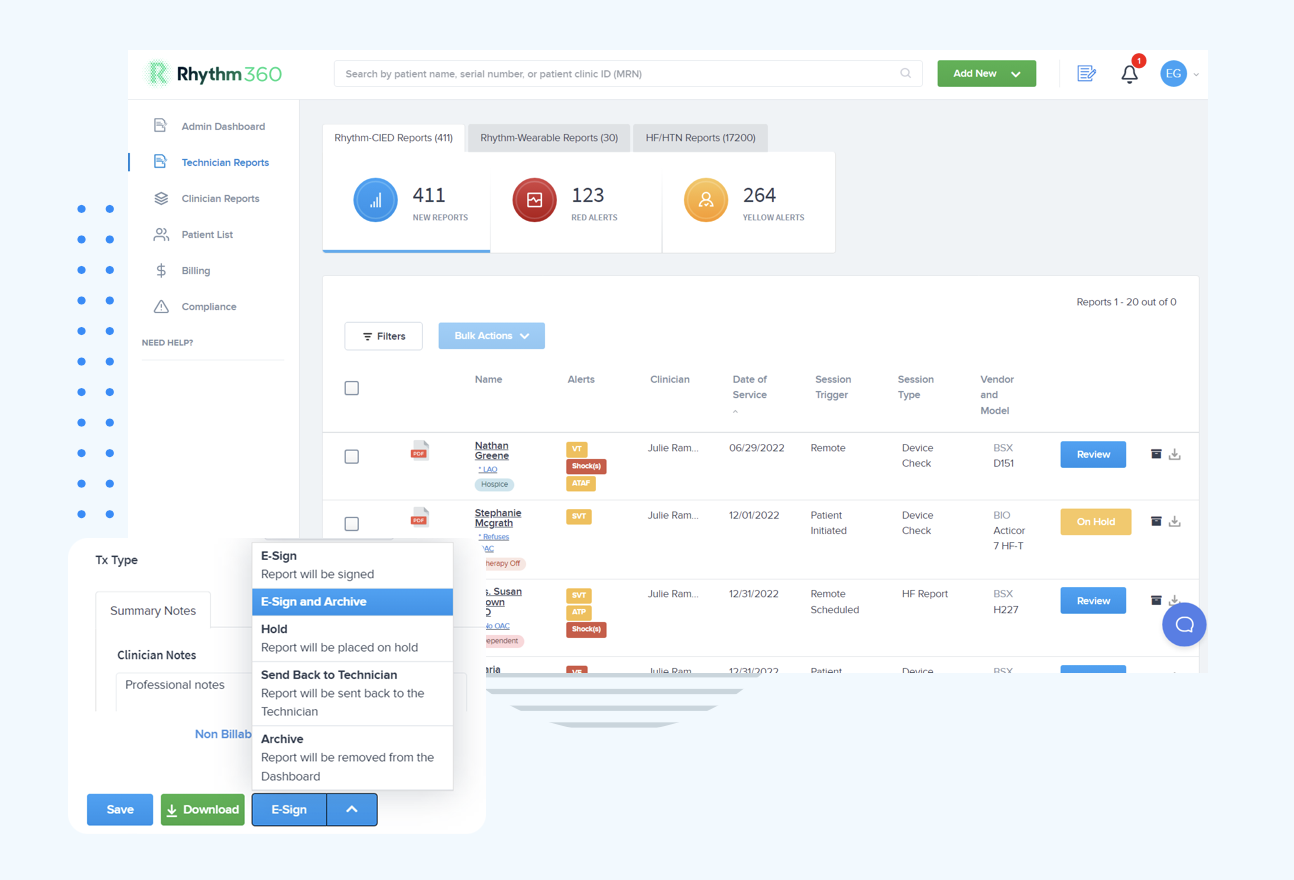
Rhythm360's vendor-neutral ingestion layer connects to all major OEM portals through API, HL7, XML, and PDF parsing via computer vision. It normalizes disparate data streams into one internal model. This mirrors industry best practice: mapping each reading onto HL7 FHIR so it becomes an Observation tied to Device and Patient resources. That structure is what lets a clean RPM platform terminate device variety at the ingestion layer and keep an auditable record regardless of source. Redundant data feeds maintain over 99.9% transmissibility even when an OEM server goes down.
Pro Tip – Preventing Duplicate Claims: Rhythm360's rules engine checks at ingestion that no other practitioner has billed CPT 99453 or 99454 for the same patient in the preceding 30 days before queuing any claim. This single-provider check is a standard compliance requirement across RPM billing.
Step 3: Trigger CPT 99453 on Initial Device Setup
The rules engine tracks enrollment date, device delivery date, and first transmission date separately for each patient and device type. CPT 99453 covers initial RPM device setup and patient education. It's billed once per episode of care, not per device, at a 2026 national average reimbursement of $21.71. Once the second transmission is confirmed, Rhythm360 queues the 99453 claim with the enrollment artifact package: prior E/M visit proof, medical necessity statement, consent note, and device provisioning record.
Step 4: Configure Daily Reading Counter and 99454 Threshold Logic
Rhythm360's AI-powered rules engine maintains a real-time daily transmission counter for each patient. Multiple readings on the same day count as only one measurement day. Once a patient reaches 16 distinct transmission days within 30 days, the engine routes the claim to CPT 99454 instead of 99445. That distinction matters because the new 2026 CPT 99445 covers 2 to 15 monitoring days at $47, while 99454 covers 16 or more days at the same rate, and the two codes cannot be billed together in the same month. Rhythm360 holds 99454 claims until the period closes to confirm the exact day count before release.
Step 5: Log Clinical Staff Time and Enforce the Synchronous-Call Gate for 99457
Every staff action, including alert review, data trending, and call documentation, gets logged against the patient's monthly time accumulator with a timestamp and staff ID. The rules engine releases a 99457 claim only when the patient crosses 20 minutes and a synchronous live call has been logged that month. It then queues 99458 add-ons at the 40 and 60-minute marks. CMS has clarified that asynchronous texting does not satisfy the interactive communication requirement for 99457/99458. Rhythm360's integrated Twilio framework captures every call with date, duration, staff name, and patient response, creating an unbroken audit record.
Pro Tip – Handling Missing Transmissions: When a patient's count falls below the 16-day minimum, Rhythm360 attempts re-ingestion from alternate OEM pathways. CMS requires at least 16 days of data within 30 days, and providers should alert on day 10 for shortfalls. Rhythm360 fires that day-10 alert automatically and archives every raw transmission log for audit response.
Step 6: Apply Add-On Code Logic for 99458 and New 2026 Codes
CPT 99458 covers each additional 20 minutes of RPM staff time beyond the first 20, billable an unlimited number of times per month at $41.42. The new CPT 99470 covers at least 10 minutes of non-face-to-face staff time at $26 and cannot be billed alongside 99457 in the same month. Rhythm360's rules engine enforces that mutual exclusivity and queues 99458 add-ons automatically as thresholds are crossed.
Step 7: Run Pre-Submission Audit Checks
Before releasing any claim, Rhythm360 runs a four-point validation sequence, detailed in the Pre-Submission Audit Checks table below. The sequence confirms data volume, time threshold, interactive communication, and global period compliance. This mirrors the industry-standard 4-point check covering the same four categories. Claims that fail any check sit in a review queue with a specific failure reason. Nothing gets silently dropped.
Pro Tip – Twilio Communication Logs for Audit Defense: Rhythm360 logs every Twilio-powered patient communication, from automated reminders to manual calls to secure messages, with full timestamps in the patient record. Vague entries such as "reviewed data" create audit liability, so documentation must record date, duration, activity, and staff identity. Rhythm360's Twilio logs eliminate vague entries entirely.
Step 8: Generate Audit-Ready Claims and Sync to EHR
Rhythm360's bi-directional EHR integration with Epic, Cerner, Athenahealth, eClinicalWorks, Greenway Health, and others pushes the completed claim package into the patient's chart. That package includes time logs, transmission counts, consent record, interactive communication timestamp, and diagnosis codes. This closes the loop the whole workflow builds toward: clean data in, compliant claim out, without a data silo in between. The University of Chicago Medicine confirmed this outcome after implementing Rhythm360, reporting improved billing and accountability across more than 73,000 annual reports with stable dismissal rates.
2026 RPM Billing Thresholds at a Glance
The eight steps above translate into six CPT codes with distinct thresholds and rates. The table below summarizes each one and the automated trigger that releases the claim.
CPT Code Threshold Requirement 2026 National Avg. Rate Rhythm360 Automated Trigger 99453 Initial setup and education; once per episode of care $21.71 Second confirmed transmission logged 99445 (new 2026) 2 to 15 monitoring days; mutually exclusive with 99454 $47 Day counter closes at period end; routes to 99445 if count is 2 to 15 99454 16+ monitoring days; mutually exclusive with 99445 $47 Day counter reaches 16; claim held until period close 99457 20+ minutes staff time plus one synchronous call $52 Threshold crossed and Twilio call logged 99458 Each additional 20 minutes; unlimited per month $41.42 Queued automatically at 40 and 60-minute marks 99470 (new 2026) 10+ minutes non-face-to-face; excludes 99457 same month $26 Threshold crossed; exclusivity with 99457 enforced Measuring Success: Compliance, Denials, and Revenue
Practices track three connected outcomes when they roll out Rhythm360. Better transmission compliance reduces the data gaps that cause 99454 shortfalls, and closing that gap directly lowers denials. Cardiology practices typically see denial rates of 10 to 20%, most driven by avoidable prior-authorization gaps and coding errors, the same errors Rhythm360's minute-level time logging and threshold automation are built to prevent. Fewer denials and cleaner code capture together drive the revenue outcome: practices using Rhythm360 have achieved a 300% increase in revenue generation and an 80% reduction in critical alert response times. As noted earlier, the University of Chicago Medicine saw similar gains after implementation. These results track with the broader trend: practices using AI-driven billing typically see 15 to 20% revenue growth, though Rhythm360's cardiology-specific rules engine pushes well past that baseline.
Get a walkthrough of your practice's revenue capture potential.
Extending the Same Rules Engine to Heart Failure and Hypertension
The threshold logic built for CIED monitoring above doesn't have to stay siloed to cardiac devices. Rhythm360's rules engine applies the same daily weight, blood pressure, and pulse oximetry transmission counters to Heart Failure and Hypertension RPM service lines. Practices generate compliant 99453, 99445/99454, 99457, and 99458 claims for chronic cardiometabolic patients without building a second workflow from scratch.
That same separation between billing logic and clinical workflow also prepares practices for the next CMS Physician Fee Schedule update. Code changes, like the 2026 introduction of 99445 and 99470, propagate through the rules engine without forcing staff to relearn their process. Providers should still designate a compliance officer to track new OIG and CMS guidance and maintain a digital audit binder reviewed at least every six months. Rhythm360 generates exportable audit binder packages on demand, covering policies, device FDA clearance records, consent documentation, annotated sample claims, and internal audit reports.
Frequently Asked Questions
How do you bill for remote patient monitoring in 2026?
Billing requires satisfying CMS requirements in sequence before submitting each code. The patient needs an established relationship with the billing practitioner, a valid physician order specifying monitoring frequency, and documented consent obtained before services begin, including cost-sharing acknowledgment and revocation rights. The practice must use an FDA-cleared device with automatic electronic transmission; self-reported data doesn't qualify. Each code carries its own threshold, covered in the steps and table above. Claims should wait until the billing period closes to confirm accurate day counts, followed by the four-point validation check before release.
What is the CMS final rule for remote patient monitoring in 2026?
The CMS 2026 Physician Fee Schedule Final Rule introduced CPT 99445 and 99470 to create a tiered structure for lower-volume patients, detailed in the thresholds table above. The rule clarified that RPM services may be performed by auxiliary staff under general supervision, removing the requirement for physician presence. Rural Health Clinics and FQHCs must stop using the bundled G0511 code starting January 1, 2026, and report individual CPT codes instead. The 16-day threshold for 99454 and the 20-minute synchronous communication requirement for 99457 both remain unchanged.
How do you automate clinical time tracking for CPT 99457?
Automated time tracking logs every qualifying staff action against a per-patient monthly accumulator in real time, capturing start time, end time, duration, activity description, and staff credential. Vague entries such as "reviewed data" create audit liability. The platform enforces the synchronous-call gate described in Step 5 above and queues 99458 add-ons automatically once thresholds are crossed. For patients enrolled in both RPM and CCM, the platform keeps entirely separate time logs to prevent double-counting, an overpayment risk under CMS rules.
What audit triggers should cardiology practices watch for in RPM billing?
Common triggers include billing 99454 with fewer than 16 transmission days, submitting 99457 without a documented synchronous call, missing consent records, expired physician orders, and vague time log entries. High-volume enrollment spikes, overlapping RPM and CCM time logs, and consumer devices lacking FDA clearance also draw scrutiny. The OIG has noted that roughly 43% of RPM enrollees didn't receive all three required components: education, device supply, and management. Practices should run quarterly internal audits on a random 10 to 20% sample of records and keep a digital audit binder updated at least every six months.
Conclusion
The 8-step workflow above maps every required action to the data element captured, the CPT code triggered, and the audit trail created. Manual tracking of transmission counters, time logs, consent records, and threshold rules across multi-OEM environments isn't sustainable at scale. Rhythm360 runs all eight steps inside one HIPAA-compliant platform, from consent capture through EHR claim sync. As shown above, practices implementing it have documented a 300% revenue increase and dramatically faster alert response times, with results confirmed at scale by the University of Chicago Medicine.
Talk to a Rhythm360 specialist about your billing thresholds.
Read Next





