

Last updated: September 20, 2026
The RPM code set breaks into three functional tiers: setup, device supply, and treatment management, each with its own threshold and billing cadence. The table below shows how these codes differ on the two variables auditors check first: the threshold that must be met and how often the code can be billed.
| CPT Code | Service Description | Key Threshold | 2026 Non-Facility Rate |
|---|---|---|---|
| 99453 | Device setup and patient education | Once per episode of care; requires ≥2 days of monitoring | $21.71 |
| 99445 | Device supply and data transmission, 2–15 days | 2–15 transmission days per 30-day period; mutually exclusive with 99454 | $52.10 |
| 99454 | Device supply and data transmission, 16–30 days | ≥16 transmission days per 30-day period; mutually exclusive with 99445 | $52.10 |
| 99457 | Treatment management, first 20 minutes | ≥20 cumulative minutes, at least 1 live interactive communication per calendar month | $51.77 |
| 99458 | Treatment management, each additional 20 minutes | Add-on to 99457 only; up to 2 units per month | $41.41 |
| 99470 | Treatment management, first 10–19 minutes | 10–19 cumulative minutes, at least 1 live interactive communication; mutually exclusive with 99457/99458 | $26.05 |
| 99091 | Collection and interpretation of physiologic data | ≥30 minutes; physician or qualified health professional only | ~$58 |
The historical 16-day minimum for CPT 99454 remains in force under the CY2026 Medicare Physician Fee Schedule final rule (CMS-1832-F, effective January 1, 2026). CMS kept the 99454 threshold and added CPT 99445 as a companion code for monitoring periods of 2 to 15 days, which removed the prior all-or-nothing cliff. First Coast Service Options (FCSO), the Medicare Administrative Contractor, confirmed in its September 2, 2026 RPM medical review checklist that 99454 requires documentation of 16 days of physiologic data transmission within the 30-day period and that data must be automatically transmitted, not manually uploaded. Practices billing CPT 99454 should maintain automated device transmission logs showing the date, reading type, and data receipt for each qualifying day to confirm that 16 or more days of data were transmitted within the 30-day billing period.
Review Your RPM Code Mix with Rhythm360
A defensible RPM claim starts with a clear chain of evidence from enrollment through claim submission. The steps below map one patient-month to the records an auditor expects to see.
Interactive communication documentation is the most frequently cited deficiency in RPM audits. CMS defines interactive communication for CPT 99457 as a real-time, two-way conversation between clinical staff and the patient or caregiver. That definition is narrower than it sounds: a live telephone call or live video visit satisfies the requirement, while a portal message, text message, voicemail, or asynchronous chart note does not, even when the clinical content is substantive.
The 20-minute threshold for 99457 functions as a hard minimum. CMS permits the 20 minutes to be accumulated across multiple shorter interactions within the same calendar month. For example, a 10-minute call on the 5th and a 12-minute call on the 22nd total 22 minutes and satisfy the requirement. Exactly 19 cumulative minutes does not qualify for billing that month.
The content of each interaction must be clinically substantive. A brief scheduling call or appointment-confirmation message does not satisfy the requirement because it lacks clinical content. Documentation should capture both the prompts presented and the patient’s substantive responses so reviewers can see the two-way nature of the exchange.
Recovery Audit Contractors reviewing 99457 and 99458 claims look for time logs documenting when the interactive conversation happened and what was discussed, not just a running minute total. For RPM management code 99457, passive review of dashboard or device data without at least one documented interactive communication with the patient or caregiver is a leading cause of claim denial, and missing documentation of data transmission days for device codes also drives RPM denials.
Only time spent in active, real-time, two-way communication with the patient or caregiver counts toward the 99457 threshold. Reviewing device data, writing clinical notes, and other asynchronous care coordination activities do not accumulate toward the 20-minute threshold. Mixing interactive and non-interactive time in a single documentation entry creates audit risk because reviewers cannot see how much time qualifies.
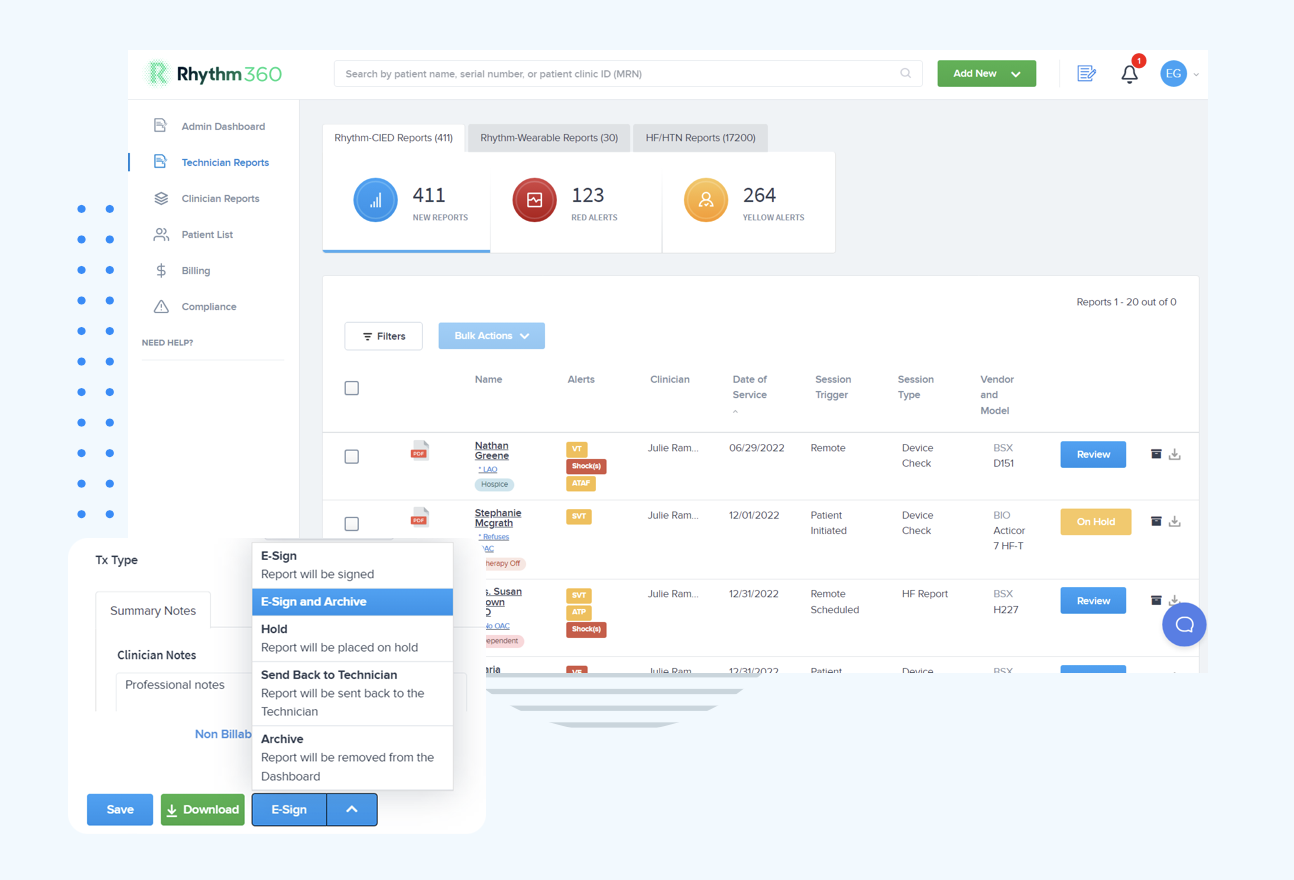
Rhythm360 closes this documentation gap. Its integrated communication hub, built on a Twilio framework, logs patient communications, including phone call logs, with a full audit trail inside the patient record. This structure eliminates anonymous interaction notes and gives billing staff a single, timestamped source of truth for every 99457 and 99458 claim. Practices using Rhythm360 have increased profitability by as much as 300% through more complete CPT code capture and documentation.
See How Rhythm360 Captures Every Billable Minute
CMS states in MLN901705 that only one practitioner may bill remote monitoring for a patient per 30-day period. A second practitioner submitting RPM for the same patient in the same window triggers a duplicate-practitioner denial. Practices with shared panels, such as a cardiologist and a nurse practitioner both managing the same RPM patient, should designate a single billing practitioner per patient per period and enforce that assignment at enrollment.
CMS states in MLN901705 that RPM and RTM cannot be billed together for the same patient in the same month. RPM captures measured physiologic data such as blood pressure, weight, blood glucose, and pulse oximetry via an FDA-cleared device and requires an established patient relationship. RTM captures non-physiologic, self-reported data such as musculoskeletal function, respiratory function, medication adherence, and therapy response. The CY2026 PFS final rule (CMS-1832-F) confirmed that the 2-to-15-day device supply codes and 16-to-30-day device supply codes within each family are not additive, so only one device supply code per family may be billed per 30-day period.
CMS states in MLN909188 that time counted toward one care management program’s billing threshold can never be counted toward another program’s threshold, even when the two programs run concurrently. RPM may be billed with CCM, TCM, behavioral health integration, and principal care management in the same month when each program’s time and documentation remain entirely separate.
Cardiology and electrophysiology practices face a unique billing complexity: patients with implanted cardiac devices are usually billed under the CIED monitoring code family (93294–93298) instead of the RPM code family, because the two families are not billed for the same patient in the same period.
The AMA CPT parenthetical under home monitoring device supply codes 99453 and 99454 instructs that they are not reported alongside codes for more specific physiologic parameters, citing 93296 as an example; coding references also list 99454 among the exclusions under 93297 and 93298. In practice, a patient whose loop recorder (93298) or implanted pressure sensor (93297) is already billed for remote interrogation in a period generally cannot also generate a home monitoring device supply claim (99454) in that same period.
The CIED monitoring codes operate on two distinct billing clocks:
Rhythm360 is built for this complexity. As a vendor-neutral, HIPAA-compliant platform that consolidates data from Medtronic, Boston Scientific, Abbott, and Biotronik into a single source of truth, Rhythm360 automatically tracks device-specific CPT pairings, including 90-day cycles for pacemakers and ICDs (93294, 93295, 93296) and 30-day cycles for physiologic monitors and loop recorders (93297, 93298). This tracking helps prevent device-type mismatch denials and missed technical components.
The CY2026 Physician Fee Schedule final rule (CMS-1832-F), effective January 1, 2026, introduced several changes that directly affect RPM billing workflows under CMS RPM billing guidelines 2026:
Practices should re-verify their billing workflows against the CY2026 PFS final rule (CMS-1832-F) and confirm that their monitoring platform’s transmission logs and time-tracking reports reflect the updated code structure, including the mutual exclusivity between 99445 and 99454 and between 99470 and 99457.
This checklist maps each RPM code to the evidence an auditor would request. Every item should be verifiable in the patient record before claim submission.
Most RPM billing failures trace back to documentation and workflow gaps rather than coding errors. Medicare paid $536 million for RPM in 2024, a 31% increase over the prior year, and audit scrutiny has grown alongside that spend. A practice that cannot produce a system-generated transmission log, a timestamped interactive communication record, and a clear separation of RPM time from CCM or E/M time faces exposure to extrapolated recoupment across its entire RPM panel.
The RPM billing guidelines described in this article, from the 99454 16-day transmission floor to the 99457 interactive communication documentation standard to the CIED code overlap rules for cardiology practices, call for a repeatable, automated monthly workflow. Rhythm360 automates compliant CPT capture, documentation, and billing workflows across the full RPM and CIED monitoring code set, consolidating data from all major device manufacturers into a single audit-ready source of truth. Practices using Rhythm360 have reduced critical alert response times by up to 80% and increased profitability by as much as 300%.
Build an Audit-Ready RPM Workflow with Rhythm360





