Last updated: August 24, 2026
Electrophysiology clinics that manage patients with devices from multiple manufacturers face a structural workflow problem. Each manufacturer uses proprietary alert formats, transmission schedules, and data export structures, which forces teams to juggle separate logins, separate review queues, and manual reconciliation across systems without automatic EHR integration.
A typical device clinic now processes more than 8,000 transmissions annually, and nearly 60% of alerts are clinically non-relevant. Some clinics have seen 250% growth in device population since 2018 and now manage close to 9,000 devices. That volume, spread across disconnected portals, drives unsustainable alert fatigue and staff burnout.
Manufacturer-embedded AI only partially relieves this burden. A 2026 cross-manufacturer analysis presented at the European Heart Rhythm Association Congress examined 2,659 rhythm episodes from 1,710 patients with implantable cardiac monitors and found that AI-equipped devices still generated 32.9% non-actionable episodes. As Niraj Varma, MD, PhD, Professor of Medicine and Consultant Electrophysiologist at the Cleveland Clinic, noted, every episode flagged by an implantable cardiac monitor still requires clinician review, and device-level AI continues to generate a substantial number of non-actionable alerts.
Revenue leakage adds financial pressure on top of the clinical strain. Fragmented workflows that rely on manual tracking of billing windows across multiple manufacturer portals commonly cause billing errors, including claims submitted too early or too late, missed technical components, and incomplete documentation that triggers denials or audit risk.
Given these operational and financial pressures, practices evaluating vendor-neutral platforms need to understand how platform costs, reimbursement potential, and workflow impact align with their size and staffing model.
Pricing for vendor-neutral CIED platforms varies by practice size and platform usage. Rhythm360 uses a SaaS-based model with no setup fees, so the investment scales with clinic volume and feature utilization.
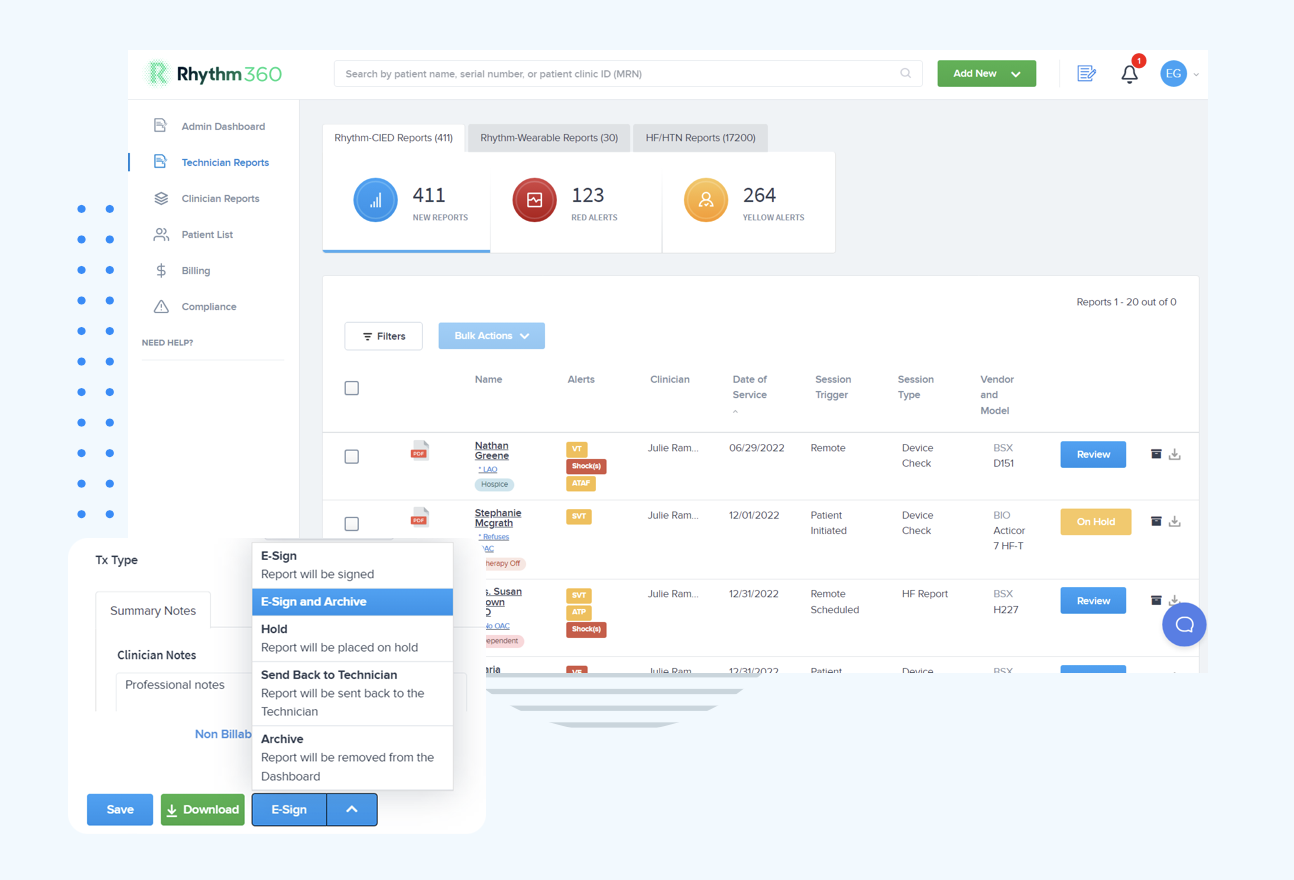
Three common scenarios illustrate how cost aligns with operational need and staffing capacity.
Across these scenarios, practices that consolidate onto Rhythm360 have reported up to 300% improvement in revenue generation through stronger CPT code capture and reduced administrative overhead.
Medicare reimburses remote cardiac monitoring through a combination of CIED-specific CPT codes and the updated 2026 RPM code set. The 2026 CMS Physician Fee Schedule added two new codes that expand billable scenarios for clinics managing lower-adherence patients and shorter management encounters.
CPT 99445 was added for device supply with 2–15 days of readings per 30-day period at $52.11 per month, closing the previous gap that left low-adherence patients unbillable under remote patient monitoring. CPT 99470 was added for remote monitoring management requiring 10–19 minutes of clinical staff time at $26.05 per month, covering activity below the prior 20-minute threshold of CPT 99457.
Key 2026 reimbursement benchmarks per patient per month include the following amounts.
Documentation requirements remain strict and highly specific. For 2026 RPM codes, documentation must record the exact number of days readings were received for CPT 99445 and precise 10–19 minute time logs for CPT 99470. Vague documentation remains the leading cause of denials and audit findings. Rhythm360’s automated CPT documentation module captures these data points at the point of clinical review, which lowers claim rejection risk.
Rhythm360 supports data ingestion from the full range of FDA-approved CIEDs and specialized cardiac sensors. Supported devices include pacemakers, implantable cardioverter-defibrillators (ICDs), cardiac resynchronization therapy devices (CRT), cardiac contractility modulation (CCM) devices, and implantable loop recorders (ILRs) from Abbott, Medtronic, Boston Scientific, and Biotronik. The platform also integrates with CardioMEMS pulmonary artery pressure monitors for heart failure management.
Data arrives through multiple ingestion pathways, including direct API connections, HL7 feeds, XML exports, and unstructured PDF parsing via computer vision. This multi-path approach ensures that device data reaches the unified dashboard regardless of the OEM’s transmission format. A redundant data feed architecture supports reliable data delivery even when an individual OEM server experiences downtime.
Rhythm360 implementation, including EHR integration, typically completes within a few days to a few weeks. The exact timeline depends on the complexity of the existing EHR environment and the number of OEM data feeds that need connection.
The platform supports bi-directional HL7 and FHIR integration with Epic, Cerner, Athenahealth, eClinicalWorks, and Greenway Health. These integrations align with CMS interoperability requirements for HL7 FHIR Release 4.0.1 and USCDI Version 3, which govern standardized clinical data exchange.
There are no setup fees. Onboarding includes staff training, alert threshold configuration, and CPT documentation workflow setup, so clinical teams can reach steady-state operations without a prolonged transition period.
Schedule a demo to review integration requirements for your specific EHR environment and device panel.
Evaluation priorities change meaningfully by practice size, because staffing patterns and on-call coverage differ across settings. The following criteria map to the operational realities of each clinic type.
A device technician at a mid-size EP clinic finishes morning rounds on a Saturday. Rhythm360’s AI triage engine flags a new-onset ventricular tachycardia episode from a remotely monitored ICD patient and elevates it above the queue of routine scheduled transmissions.
The on-call electrophysiologist receives a prioritized mobile notification, reviews the full transmission report on a smartphone, and initiates a same-day anticoagulation protocol. By Saturday afternoon, the team has contacted the patient and started treatment.
Without AI-powered triage and mobile access, the same transmission would likely sit in a portal queue until Monday morning, which introduces meaningful stroke and hospitalization risk. Rhythm360 can reduce critical alert response times by up to 80% and shift workflows from reactive to proactive care. As Andrew Beaser, MD, at University of Chicago Medicine observed, decision support, including AI-assisted decision support, will become increasingly important as data volumes grow.
Clinics that continue operating across separate manufacturer portals encounter predictable failure points that compound over time. These breakdowns affect clinical safety, billing accuracy, and staff workload.
Manual transcription errors usually appear first. Device data arrives through manufacturer portals, clinical documentation lives in the EHR, and billing sits in a separate system. Staff must perform manual transfers, which introduce delay, transcription errors, and the risk that clinically or financially significant findings never reach the correct system.
These transcription delays contribute directly to alert overload. When transmission volume exceeds a team’s review capacity, queues build and urgent findings wait alongside routine ones. Staff may also increase review speed, which raises error risk and compromises patient safety.
The combination of manual workflows and alert fatigue then creates CPT documentation gaps. A 2024 OIG report found that about 43 percent of Medicare enrollees who received remote patient monitoring did not receive all three components of the service, often because staff lacked time to complete documentation across fragmented systems.
Single-OEM dependency amplifies all these risks. Relying on one manufacturer’s portal for workflow management creates vulnerability when that manufacturer changes its data export format, experiences server downtime, or when a patient receives a device from a different manufacturer.
Clinics can use the following checklist to compare vendor-neutral CIED platforms and align features with their operational goals.
Multi-OEM CIED clinics in 2026 face a compounding mix of alert fatigue, revenue leakage, and staff burnout. Non-actionable transmissions, fragmented CPT documentation, and manual portal management strain both clinical teams and financial performance.
A vendor-neutral platform with AI-powered triage, reliable data delivery, bi-directional EHR integration, and secure mobile access addresses these failure points within a single workflow. Rhythm360 by RhythmScience was built specifically for this environment.
Practices that have implemented Rhythm360 have reduced critical alert response times by up to 80% and improved revenue generation by as much as 300% through stronger CPT code capture. University of Chicago Medicine’s annual processing volume, detailed earlier, shows that the platform can scale across the full spectrum of cardiology practice sizes.
Schedule a demo to evaluate Rhythm360 against your clinic’s device panel, EHR environment, and CPT documentation requirements.
A genuinely vendor-neutral platform ingests and normalizes data from all major cardiac device manufacturers, including Abbott, Medtronic, Boston Scientific, Biotronik, and others, through a single interface. Clinicians do not need to log into separate OEM portals to complete routine work.
True vendor neutrality also requires support for multiple data ingestion methods, such as direct API connections, HL7 feeds, XML exports, and PDF parsing. No single manufacturer’s data format or transmission schedule should control the clinical workflow. Alert triage, reporting, and CPT documentation must operate consistently regardless of which OEM manufactured the patient’s device.
Rhythm360 achieves this through redundant data feeds and AI-powered data normalization that maintain consistent data delivery across all supported manufacturers.
Manufacturer-embedded AI focuses on classifying rhythm episodes within a single device’s signal-detection algorithm. A 2026 cross-manufacturer analysis found that AI-equipped implantable cardiac monitors still generated 32.9% non-actionable episodes, so device-level AI does not remove the clinician review burden.
A platform-level AI triage layer operates above manufacturer algorithms and applies a standardized, guideline-aligned classification framework across all OEM data streams at once. This cross-manufacturer layer identifies which alerts across the entire patient population require immediate attention, which can be batched for routine review, and which are statistically non-actionable based on historical patterns.
The result is a prioritized worklist instead of an undifferentiated queue, which creates the operational shift from reactive to proactive patient management. Rhythm360’s AI triage has been associated with an 80% reduction in critical alert response times.
Remote CIED monitoring primarily uses CPT codes 93298 and 93299, which cover the technical and professional components of remote interrogation for implantable devices. The 2026 CMS Physician Fee Schedule also expanded the RPM code set with two new codes relevant to cardiac monitoring programs.
CPT 99445 covers device supply for patients transmitting data between 2 and 15 days per 30-day period, and CPT 99470 covers clinical management time of 10 to 19 minutes per calendar month. For the existing RPM codes, CPT 99454 covers 16 or more days of device monitoring at $52.11 per month, CPT 99457 covers the first 20 minutes of management time at $51.77, and CPT 99458 covers an additional 20-minute increment at $41.42. Maximum monthly reimbursement when stacking 99454, 99457, and 99458 reaches approximately $145 per patient.
Documentation must record the exact number of days readings were received for 99445, precise time logs for 99470, and a physician interpretation note paired to each billed technical component claim. Vague or missing documentation remains the leading cause of denials and audit findings. Rhythm360 automates capture of these data points at the point of clinical review, which reduces documentation gaps and claim rejection risk.
As discussed earlier, implementation typically completes within a few days to a few weeks, with the timeline varying based on EHR complexity and the number of OEM feeds. Rhythm360 supports bi-directional HL7 and FHIR integration with Epic, Cerner, Athenahealth, eClinicalWorks, and Greenway Health, as well as other EHR systems via HL7.
Bi-directional integration means that device data flows into the EHR automatically and that clinical actions taken within Rhythm360 appear in the patient’s EHR record without manual transcription. There are no setup fees. Onboarding includes alert threshold configuration, CPT documentation workflow setup, and staff training, so clinical teams can reach full operational capacity quickly.
Rhythm360 supports distinct but integrated service lines for CIED monitoring and remote physiological monitoring for heart failure and hypertension. The CIED service line, Rhythm-CIED, manages data from pacemakers, ICDs, CRT devices, CCM devices, implantable loop recorders, and specialized sensors such as CardioMEMS pulmonary artery monitors.
The chronic disease management service line supports turnkey RPM programs for heart failure and hypertension patients. Services include patient onboarding, automated billing support for CPT codes 99453, 99454, 99457, 99445, and 99470, and an integrated communication hub for patient messaging and follow-up.
Both service lines operate within the same clinical dashboard, so device technicians, nurses, and physicians can manage rhythm disorders and chronic cardiometabolic conditions from a single workspace without switching between separate platforms or portals.