Last updated: June 27, 2026
Improving accuracy of automated CIED alert detection starts with a quantified baseline. Clinics implanting devices from more than one manufacturer, such as Medtronic, Boston Scientific, Abbott, and Biotronik, must log into separate, non-interoperable portals to retrieve transmission data. This fragmentation obscures true alert volume and prevents teams from distinguishing actionable events from noise at the population level.
Conduct a 90-day audit that captures total transmissions received, alerts generated per OEM, staff hours spent per portal, and the ratio of alerts that resulted in a clinical action. This baseline reveals the true scope of your alert burden. University of Chicago Medicine reviewed more than 73,000 CIED reports annually through Rhythm360 in calendar year 2025, averaging more than 18,000 reports per quarter, with high dismissal rates identified as a structural feature of safety-first remote monitoring rather than a workflow failure. Without a unified baseline, no triage improvement is measurable.
Custom programming of device alerts reduces noise before any software layer touches the data. Default OEM alert thresholds are conservative by design and generate substantial non-actionable volume. Individualized programming that adjusts detection windows, rate cutoffs, and episode duration criteria based on device type (pacemaker, ICD, CRT-D, ILR) and patient risk profile (prior VT/VF, persistent AF, low EF) creates a more clinically relevant signal.
Electrophysiologists should review and document threshold decisions for each patient at implant and at every in-person follow-up. To keep these decisions clinically defensible and consistent across the team, align them with the current Heart Rhythm Society consensus framework for remote monitoring, which stratifies alert urgency by arrhythmia type, hemodynamic significance, and device-specific parameters. Once aligned, codify these decisions into standardized programming templates by device category, which reduces inter-clinician variability and creates the reproducible baseline needed for AI triage calibration in subsequent steps.
Layering intelligent triage logic on top of individualized programming converts raw alerts into a structured, repeatable workflow. Multi-parameter triage logic evaluates alerts against two or more simultaneous clinical criteria before assigning a priority tier. Single-parameter triggers, such as rate alone, generate the highest false-positive burden. Combining rate, episode duration, therapy delivered, and hemodynamic sensor data reduces non-actionable escalations while preserving sensitivity for true events.
The table below shows how combining clinical criteria with clear response timeframes creates a reproducible triage system that protects patient safety and supports compliant billing documentation. Use this framework to align your team’s alert handling with industry-standard SLAs while capturing the correct CPT codes at each priority tier.
| Priority | Clinical Criteria | Response SLA | Linked CPT Code(s) |
|---|---|---|---|
| 🔴 Critical | VF/VT with therapy delivered, lead fracture or dislodgement, ERI/RRT battery status, loss of capture | ≤1 hour (same-day contact or ED referral) | 93295, 93296 |
| 🟠 Urgent | New-onset AF ≥6 min with high ventricular rate, unsustained VT without therapy, significant sensing abnormality | ≤24 hours (clinician review and patient contact) | 93295, 93296, 93298 |
| 🟡 Semi-Urgent | AF burden increase ≥20%, pacing percentage change, impedance trend outside range | ≤72 hours (scheduled clinician review) | 93294, 93296, 93298 |
| 🟢 Routine | Scheduled transmission, stable device parameters, no arrhythmia detected | ≤30 days (standard remote follow-up cycle) | 93294, 93296, 93299 |
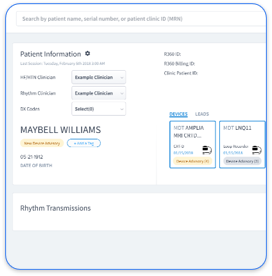
Rhythm360's AI triage engine applies this multi-parameter logic automatically across all OEM data streams. The system flags priority tier at ingestion so clinical staff review a pre-sorted worklist instead of an undifferentiated alert queue.
Duplicate-suppression rules prevent a single clinical event from flooding your queue with redundant alerts. In multi-OEM environments, one AF episode frequently generates overlapping alerts across the OEM portal and any downstream aggregation layer. Without suppression logic, multiple notifications for the same patient within the same monitoring window inflate alert volume and consume staff time on events already under review.
Duplicate-suppression rules define a time-based and event-type-based deduplication window, typically 24 to 72 hours depending on arrhythmia class, so that only the first qualifying alert for a given event type per patient advances to the clinical worklist. Rules must be manufacturer-specific because OEM transmission schedules and alert nomenclature differ. Rhythm360 applies cross-manufacturer suppression logic at the data normalization layer, which eliminates redundant escalations before they reach the clinical queue.
Schedule a demo to see Rhythm360's duplicate-suppression and multi-OEM triage logic applied to your clinic's live device population.
Bi-directional EHR integration turns remote monitoring work into complete, billable documentation without extra clicks. This integration eliminates manual transcription by pushing normalized CIED transmission data directly into the patient record and pulling demographic and diagnosis context back into the monitoring platform. The two-way data flow supports automated CPT code documentation at the point of transmission review, which reduces billing lag and claim rejection rates.
Rhythm360 integrates with Epic, Cerner, Athenahealth, eClinicalWorks, and Greenway Health via HL7, with implementation timelines ranging from a few days to a few weeks. These integrations allow automated documentation to capture the elements required for remote monitoring CPT codes, including 93294 through 93299 for CIED and 99453, 99454, and 99457 for RPM service lines, at the time of clinical sign-off. This process creates a compliant audit trail and removes the need for additional staff effort.
Mobile and on-call review extend your triage workflow beyond clinic hours. Critical arrhythmias do not follow business hours, so a VF episode or lead fracture transmitted on a Saturday morning requires the same response SLA as one transmitted on a Tuesday afternoon. Without mobile access to the triage worklist, on-call clinicians revert to phone-based escalation chains that introduce delay and documentation gaps.
Rhythm360's HIPAA-compliant mobile application allows electrophysiologists, NPs, and PAs to review prioritized transmissions, sign reports, and initiate care coordination from any location. As Andrew Beaser, MD, at University of Chicago Medicine noted, "Decision support, including AI-assisted decision support, will become increasingly important as data volumes grow." Mobile-enabled triage extends that decision support to every hour of the monitoring cycle.
A quality metrics dashboard turns this 7-step workflow into a living system that improves over time. Track alert volume by priority tier per week, response time against SLA by tier, duplicate-suppression rate by OEM, CPT capture rate per transmission reviewed, and clinician sign-off latency. These metrics reveal where triage logic, staffing, or documentation need adjustment.
Review metrics quarterly with the full monitoring team, including device technicians, billing staff, and supervising EPs, and adjust AI thresholds or suppression windows based on observed false-positive and false-negative rates. This cadence keeps the framework aligned with real-world performance instead of a one-time configuration.
Practices using Rhythm360 have documented reduced response times for critical patient alerts, efficiency gains of 40-50%, and cost savings, though no 300% revenue increase has been validated by any framework. The UCM experience referenced earlier confirms that stable dismissal rates at scale are achievable when centralized data aggregation and structured triage are combined, which demonstrates that high non-actionable alert volume is a solvable operational problem rather than an inherent clinical constraint.
Data transmissibility above 99.9%, achieved through redundant data feeds, computer vision OCR, and AI-powered gap extrapolation, ensures that the reduction in alert noise does not come at the cost of missed critical events.
Schedule a demo to benchmark your clinic's current alert volume and response times against post-implementation KPIs from Rhythm360 clients.
Practice size and OEM mix influence which steps deliver the fastest impact. Solo electrophysiology practices typically manage fewer than 500 active CIED patients and face the highest per-staff alert burden relative to team size. For these practices, Steps 4 and 6, duplicate suppression and mobile review, deliver the fastest time-to-value by eliminating redundant escalations and removing the dependency on a single on-site super-user.
Large health systems managing thousands of patients across multiple clinic sites require the full 7-step framework, with particular emphasis on Steps 1, 5, and 7, baseline auditing, EHR integration, and dashboard governance, to maintain consistency across care teams. Mixed-device environments with three or more OEMs benefit most from vendor-neutral normalization at Step 1, because the cross-manufacturer data standardization layer becomes the prerequisite for every downstream triage and suppression rule. Single-OEM practices can implement a simplified version of Steps 3 and 4 within their existing portal before migrating to a unified platform.
Refining AI thresholds after initial deployment keeps alert accuracy aligned with clinical reality. After 90 days of operation, AI triage thresholds should be reviewed against the quality metrics dashboard to identify alert categories with persistent false-positive rates above 15%. Threshold refinement works as an iterative process. Tightening episode duration criteria for AF burden alerts, for example, reduces semi-urgent volume without affecting critical tier sensitivity.
Rhythm360's platform architecture supports expansion from CIED monitoring into heart failure and hypertension RPM service lines using the same unified dashboard. HF patients monitored via CardioMEMS pulmonary artery sensors and daily weight scales, and HTN patients transmitting home blood pressure readings, generate CPT-billable data under 99453, 99454, and 99457. Integrating these service lines into the existing triage and EHR workflow captures additional recurring revenue without proportional increases in staff overhead.
What is the difference between actionable and non-actionable CIED alerts, and why does the distinction matter for billing?
An actionable alert is one that results in a clinical decision such as medication adjustment, device reprogramming, patient contact, or referral. A non-actionable alert is a transmission that confirms stable device function or reports an event that does not change management. The distinction matters for billing because CPT codes for remote monitoring require documented clinical review and, in many cases, a clinical decision or patient interaction. When staff spend time processing non-actionable alerts, they reduce the capacity available to document billable interactions on actionable ones, which creates revenue leakage even when the underlying clinical events are present.
How does vendor-neutral CIED monitoring differ from using each OEM's native portal?
Each OEM portal, including Medtronic CareLink, Boston Scientific Latitude, Abbott Merlin.net, and Biotronik Home Monitoring, uses proprietary data formats, alert nomenclature, and transmission schedules that are not interoperable. A vendor-neutral platform like Rhythm360 ingests data from all OEM portals simultaneously, normalizes it into a standardized schema, and presents a unified worklist. This approach eliminates redundant logins, enables cross-manufacturer duplicate suppression, and allows a single set of triage rules and CPT documentation workflows to apply regardless of device brand. For practices with mixed-device populations, vendor-neutral monitoring provides the only architecture that supports population-level quality metrics.
What CPT codes apply to remote CIED monitoring, and how does automated documentation improve capture rates?
The primary CPT codes for remote CIED monitoring are 93294 for pacemaker remote review up to 90 days, 93295 for ICD remote review up to 90 days, 93296 for remote data analysis technical component, 93298 for ILR remote review, and 93299 for ILR technical component. Each code requires documented evidence of data review within the applicable monitoring period. Automated documentation in Rhythm360 timestamps the clinical review, links it to the specific transmission, and populates the required fields in the EHR at the moment of sign-off. This process eliminates the retrospective documentation step that most practices perform manually, which reduces claim rejection rates and captures billing events that would otherwise fall outside the monitoring window.
How long does it take to implement Rhythm360 and integrate it with an existing EHR?
Implementation timelines depend on clinic size, the number of OEM portals being consolidated, and the EHR system in use. For most practices, the full onboarding process, including EHR integration via HL7 with Epic, Cerner, Athenahealth, eClinicalWorks, or Greenway Health, takes from a few days to a few weeks. Rhythm360's implementation team manages the OEM data feed configuration, EHR mapping, and staff training in parallel to minimize disruption to existing monitoring workflows during the transition period.
Is Rhythm360 suitable for small electrophysiology practices, or is it designed only for large health systems?
Rhythm360 is designed to scale across the full range of cardiology providers, from solo practitioners to large integrated health systems. The platform's SaaS-based pricing model adjusts based on clinic size and usage volume, so a solo EP practice monitoring 300 patients does not pay the same as a health system managing 5,000. For smaller practices, the highest-value features are typically the unified OEM dashboard, mobile review capability, and automated CPT documentation, all of which reduce per-staff workload immediately without requiring a large implementation project.
Fragmented OEM portals, default alert thresholds, and manual triage workflows drive most non-actionable alert volume in cardiology clinics, rather than the underlying patient population. The 7-step framework outlined here, which includes audit, individualized programming, multi-parameter triage, duplicate suppression, EHR integration, mobile coverage, and continuous metrics review, addresses each driver systematically. Rhythm360 operationalizes every step of this framework in a single vendor-neutral, AI-powered platform, enabling practices using Rhythm360 to achieve the efficiency and cost outcomes detailed in the Validation section above.
See how this framework maps to your clinic and connect with Rhythm360's implementation team to walk through your current workflow, OEM mix, and EHR environment.