

Last updated: September 27, 2026
Talk With Rhythm360 About Your Monitoring Program
Accuracy in heart failure monitoring operates as a four-link chain: capture, validity, clinical representativeness, and actionability. Each dimension depends on the one before it, and a failure at any point weakens program-level performance. The sections below walk through each link in order and show how they connect.
Capture rates vary substantially across remote heart failure monitoring programs because device type, patient population, monitoring schedule, and program design differ. Reported rates are not directly comparable across programs unless the data-collection schedule is standardized, as an expert consensus statement on implantable-device remote monitoring notes. A program that reports a high adherence figure may perform well, or it may mask a structurally weak capture infrastructure.
Transmission success and measurement fidelity describe different aspects of accuracy. A scale can transmit a reading reliably while still producing an inaccurate weight because of improper placement, patient technique, or device calibration drift. A blood pressure cuff can deliver a reading to the platform every day while consistently over- or under-reading due to incorrect cuff sizing or arm positioning. Validity requires that the device measures the physiologic parameter correctly and not simply that it sends a number.
Even a valid measurement may not represent the clinical state it aims to detect. As noted in the Key Takeaways, weight-based monitoring has reported sensitivity as low as 10–20% for detecting heart failure decompensation, and up to 50% of heart failure patients do not show a significant weight increase before hospitalization. Weight monitoring also has poor specificity because diet, bowel habits, clothing, scale placement, and body composition changes such as cachexia influence readings. A program that relies exclusively on weight thresholds to detect decompensation depends on a signal with a high false-negative rate.
The 2024 workflow-reporting review of noninvasive remote patient monitoring studies in heart failure (1999–2024, 63 studies) found that clinical escalation protocols were not reported in 24% of the reviewed studies. These gaps reflect program design rather than technology. A platform can transmit data with high fidelity and still produce no clinical benefit when the receiving organization has not defined who reviews the data, how often, what constitutes an actionable finding, and what the expected response time is.
The four dimensions play out differently depending on the device that collects the data. The table below compares how each device category performs on capture and validity and highlights the main limitation that program design must address.
| Device Type | Capture Characteristics | Key Limitation |
|---|---|---|
| Implanted/Automated Devices (CIEDs, implantable pulmonary artery monitors) | Continuous, uninterrupted monitoring over months to years, capturing every episode exceeding a programmed duration threshold | Limited to specific physiologic parameters and requires trained staff to interpret trends and follow documented titration workflows |
| Non-Invasive RPM (cellular-enabled scales, BP cuffs, wearables) | Moderate capture rates that depend on patient adherence, device connectivity, and measurement schedule | Clinical representativeness is constrained, and weight changes have reported sensitivity as low as ~10–20% for decompensation detection |
| Manual Entry (patient-reported weights, symptoms) | Lowest capture reliability and full dependence on patient-initiated reporting | Recall bias, transcription errors, and inconsistent reporting frequency undermine both capture rate and validity |
The 10–20% sensitivity figure mentioned earlier highlights the limits of weight-based monitoring for decompensation detection, and up to 50% of heart failure patients do not show a significant weight increase before hospitalization. Poor specificity compounds this limitation because diet, bowel habits, clothing, scale placement, and cachexia all affect readings. Signs and symptoms of heart failure aggravation are typically recognized an average of seven days before emergency events and three days before hospitalizations, which suggests that daily weight changes alone may not provide enough lead time for timely intervention. Weight monitoring still plays a role in heart failure management but works best when combined with other data types and a rapid-response workflow.
Non-invasive blood pressure and heart rate measurements depend on correct cuff placement, appropriate cuff sizing, and consistent patient technique. Readings obtained with an improperly positioned cuff or during physical activity introduce systematic error that transmission statistics do not detect. Validity in this category depends on patient education and device design rather than platform capability alone.
Symptom data is inherently subjective. Patients vary in their ability to recognize and describe dyspnea, fatigue, or edema, and under-reporting is common, particularly among older adults or those with cognitive impairment. A 2026 Frontiers in Cardiovascular Medicine framework recommends structured symptom scores as part of a minimum monitoring dataset. This approach reduces, but does not remove, the subjectivity in patient-reported outcomes.
Medication adherence is rarely captured accurately in remote heart failure monitoring programs without integrated pharmacy data or structured patient-reported adherence instruments. Self-reported adherence is subject to social desirability bias. The absence of a reliable adherence signal limits a program’s ability to distinguish clinical deterioration from non-adherence when interpreting other data streams.
Even when a device captures and validates every measurement correctly, the data only matters if it reaches a clinician who acts on it. That final link, actionability, often breaks down in real-world programs. The 2024 workflow-reporting review of noninvasive remote patient monitoring studies in heart failure (1999–2024, 63 studies) found that clinical escalation protocols were not reported in 24% of the reviewed studies. A platform can transmit data with high fidelity and still produce no clinical benefit when no one owns review cadence, escalation criteria, or response times.
Operational recommendations for closing this gap include the following:
Device accuracy and program-level data capture accuracy describe separate constructs. Device accuracy refers to a monitor’s ability to measure a physiologic parameter correctly, which clinical testing establishes. Program-level data capture accuracy refers to the program’s ability to transmit, interpret, and act on that data across the full four-dimension chain.
The diagnostic specificity of intracardiac electrograms from implantable devices for atrial fibrillation approaches 100%, which makes them highly accurate at the device level. Yet even a device with near-perfect measurement fidelity can contribute to poor program-level accuracy. Transmission can fail. Patients may not use the device consistently. Clinicians may not review the data within a therapeutically relevant window. Vendors often cite device-level accuracy figures in contexts where program-level accuracy is the operationally relevant question.
Rhythm360 is designed to address each dimension of the accuracy chain through a coordinated set of capabilities. The list below links each capability to the specific link it strengthens.
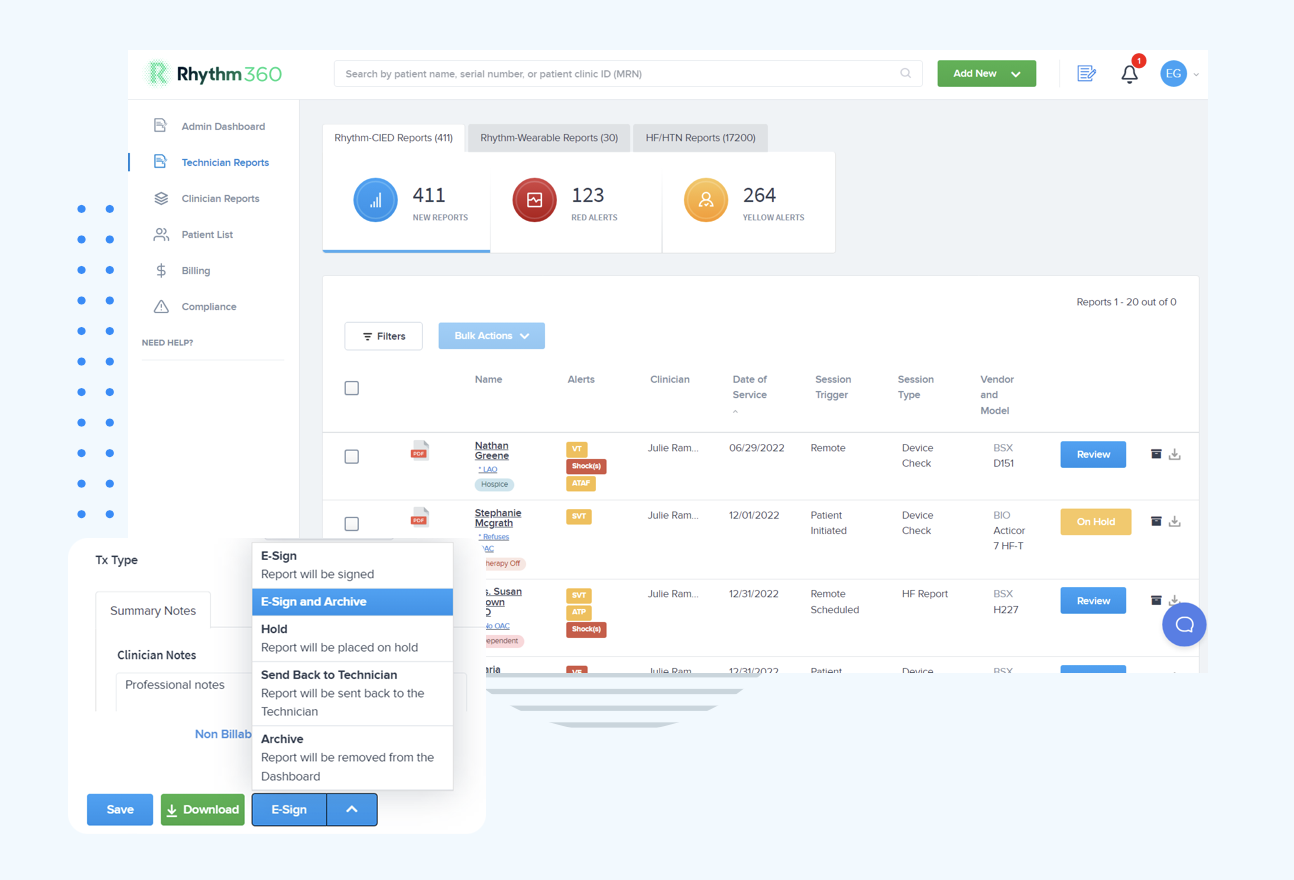
See How Rhythm360 Closes The Accuracy Chain
Five practical operational changes address the most common failure points across the four-dimension accuracy chain, supported by evidence from the 2024 workflow-reporting review on why these factors matter.
Program directors can use the four-dimension framework as a self-assessment tool by defining KPIs for each link in the chain.
For capture rate, track transmission success as a percentage of scheduled transmissions and patient adherence as a percentage of prescribed measurement days with a received reading. Comparisons only make sense when the prescribed collection schedule remains constant.
For validity, assess whether device calibration is documented and whether patient technique is confirmed at enrollment and at periodic reassessment. The 2026 Gao et al. framework recommends periodic in-person clinical review every four to eight weeks, which provides a natural opportunity to verify measurement fidelity.
For actionability, track time-to-review from data receipt and time-to-intervention from alert generation. Programs that do not capture either metric cannot demonstrate that their data produces clinical action, regardless of transmission rate.
Capture rates vary widely across remote heart failure monitoring programs because device type, patient population, monitoring schedule, and program design differ. A single benchmark figure has limited meaning unless the data-collection schedule is standardized across programs being compared. Each program should define its own capture rate target relative to its prescribed monitoring frequency and patient population, then track performance against that internal standard over time.
Manual entry introduces three distinct accuracy risks. Recall bias occurs when patients report values from memory rather than contemporaneous measurement. Transcription errors occur when correct measurements are recorded incorrectly. Inconsistent reporting frequency leads to irregular data that makes trend analysis unreliable. These limitations affect all four dimensions of accuracy, which makes manual entry the weakest link in most monitoring programs.
The primary factors include device type, patient adherence, connectivity infrastructure, workflow design, and the clinical representativeness of the measured parameter. Implantable devices provide continuous automated capture but remain limited to specific physiologic parameters. Non-invasive RPM devices depend on patient-initiated measurement and reliable data transmission. Workflow design determines whether captured data reaches a clinician who can act on it within a therapeutically relevant window. The clinical representativeness of the parameter, particularly for weight-based monitoring with sensitivity as low as approximately 10–20% for decompensation, limits the program’s ability to detect deterioration even when capture and validity are high.
AI contributes to accuracy across multiple dimensions. At the capture level, AI-powered extrapolation can fill gaps when OEM servers are unavailable and maintain data continuity. At the actionability level, AI-assisted triage filters non-actionable alerts and surfaces clinically significant events, which reduces the alert fatigue that causes clinicians to miss or delay response to true positives. AI also supports data normalization across disparate device platforms and reduces the manual transcription errors that compromise validity. Clinicians should regard AI-based systems as decision-support tools, with outputs interpreted within the broader clinical picture.
Rhythm360 addresses each dimension of the accuracy chain through vendor-neutral data normalization from all major CIED manufacturers and specialized sensors, which removes data silos and manual transcription errors that undermine validity. Greater than 99.9% data transmissibility comes from redundant data feeds, computer vision, and AI-powered extrapolation. AI-powered alert triage reduces critical alert response times by up to 80% and improves actionability. Automated patient messaging via an integrated Twilio framework with a full audit trail improves adherence and capture rates for non-invasive RPM. Bi-directional EHR integration with major systems ensures that data reaches the clinical workflow where timely intervention is possible.
Patient data capture accuracy in heart failure monitoring programs depends on the weakest link across four dimensions: capture, validity, clinical representativeness, and actionability. A program can achieve high transmission rates and still fail clinically when weight-based monitoring misses most decompensation events, escalation criteria remain undefined, or review cadences are not enforced. Evidence from the 2026 systematic review, the 2024 workflow-reporting review, and other sources shows that most programs have significant gaps in at least one dimension, and that deliberate program design plus the right infrastructure can close those gaps.
Rhythm360 is built to strengthen every link in the accuracy chain by normalizing data across device manufacturers, maintaining greater than 99.9% transmissibility through redundant feeds and AI-powered extrapolation, triaging alerts to reduce response times by up to 80%, automating patient engagement to sustain capture rates, and integrating bidirectionally with major EHR systems so data reaches the clinician who can act on it.
Improve Heart Failure Data Capture With Rhythm360





