Last updated: July 14, 2026
A cardiology practice implanting devices from Medtronic, Boston Scientific, Abbott, and Biotronik must log into four separate, non-interoperable portals to retrieve patient data. Each portal uses a different interface, a different alert taxonomy, and a different export format. The result is data silos, redundant administrative labor, and missed billable events.
Cardiac remote monitoring is one of the fastest-growing yet most consistently underbilled revenue categories in cardiology. Three leakage points compound each other to cause this. CIED transmissions that go unbilled within the 90-day cycle are lost permanently. RPM data that falls short of transmission-day thresholds forfeits reimbursement entirely. Management time that never reaches documented billing minimums can't be claimed at all. Together, these gaps explain why practices with significant device populations can lose hundreds of thousands of dollars in annual uncollected revenue.
Alert fatigue makes the problem worse. AI-enhanced algorithms in insertable cardiac monitors filter nuisance alerts by as much as 97%, saving clinical staff hundreds of hours each year. Legacy OEM portals lack this capability. They flood staff with non-actionable notifications and raise the risk that a genuinely critical event gets overlooked. The University of Chicago Medicine white paper on redesigning cardiovascular remote monitoring notes that high dismissal rates in CIED monitoring are structural features of safety-first programs. Most OEM-generated alerts are nonactionable across more than 73,000 reports reviewed annually.
The 2026 CPT updates add tiered transmission-day and clinical-time thresholds. These require rule engines, not manual tracking, to apply correctly. Practices that continue billing CPT 99454 for patients transmitting fewer than 16 days of data after January 1, 2026, generate coding errors that OIG automated analysis will flag.
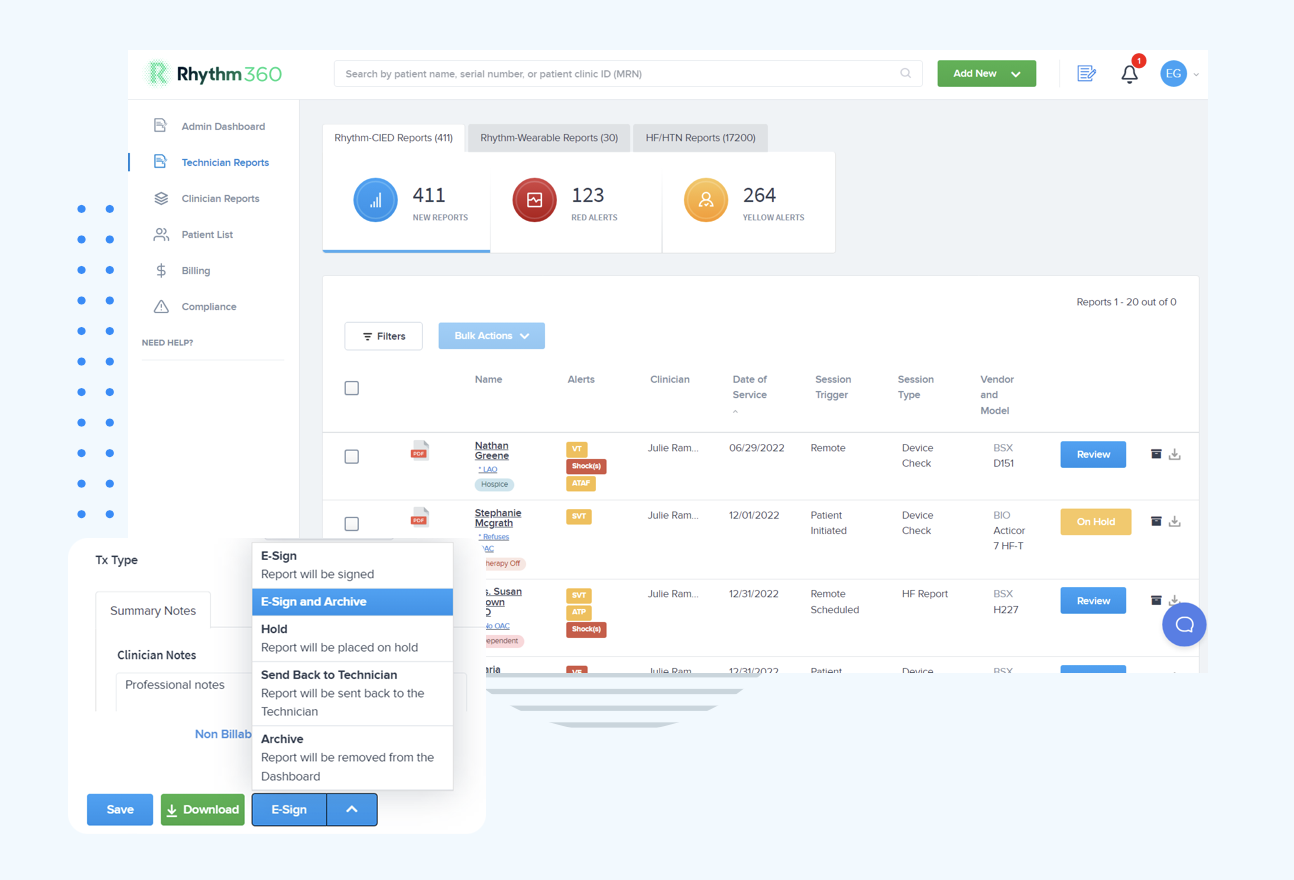
Manual tracking cannot keep pace with these new thresholds. Rhythm360 solves this with a 7-step automated workflow that runs from initial data ingestion through final claim-ready documentation, detailed below.
| Step | Workflow Stage | Rhythm360 Capability |
|---|---|---|
| 1 | Multi-Source Data Ingestion | Rhythm360 ingests data from all major OEM device manufacturers (Medtronic, Boston Scientific, Abbott, Biotronik, and others) via API, HL7, XML, and PDF parsing using computer vision (OCR). Redundant data feeds act as a fail-safe if an OEM server is unavailable, achieving >99.9% transmissibility. |
| 2 | 90-Day Window and Transmission-Day Tracking | The platform automatically tracks each patient's monitoring period against CIED 90-day billing cycles and RPM 30-day transmission-day counts, flagging patients at risk of missing thresholds before the window closes. |
| 3 | CPT Rule Engine Application | Rhythm360's rule engine applies 2026 CMS CPT logic in real time. It selects 99445 vs. 99454 based on actual transmitted days, 99470 vs. 99457 based on documented clinical time, and the correct CIED code (93294-93298) based on device type and monitoring period, preventing miscoding before claim generation. |
| 4 | Exception-Queue Review | Transmissions that miss billing thresholds, carry documentation gaps, or trigger OIG audit-risk signals (missing consent, sub-threshold data days, concurrent code conflicts) are routed to a prioritized exception queue for human review before any claim is generated. |
| 5 | Bi-Directional EHR Sync | Rhythm360 integrates bi-directionally with Epic, Cerner, Athenahealth, eClinicalWorks, Greenway Health, and others via HL7, automatically pushing finalized reports and pulling patient demographic and order data to eliminate manual transcription and double-entry. |
| 6 | Audit-Ready Documentation Generation | The platform generates structured clinical interpretation notes containing patient demographics, device type and manufacturer, monitoring period dates, transmitted-day counts, cumulative clinical time logs, interactive communication records, and clinician sign-off, satisfying 2026 CMS documentation requirements for every applicable CPT code. |
| 7 | Mobile On-Call Sign-Off | Clinicians review transmissions, approve reports, and coordinate care from Rhythm360's HIPAA-compliant mobile application, enabling same-day sign-off on critical alerts and urgent billing documentation regardless of location. |
Practices ask this question often once the workflow above is running. The 2026 rules give a clear answer: yes, under specific conditions.
CPT 99453 covers initial device setup and patient education. It can be billed once the patient transmits a minimum of 16 days of readings, and only once per episode of care. CPT 99454 covers device supply with 16 or more days of monthly transmission. When a patient enrolls mid-month, both codes can appear on the same claim. 99453 covers the one-time setup event, and 99454 (or 99445 if only 2 to 15 days of data are captured) covers the device supply period, as long as documentation supports both.
The critical constraint is this: CPT 99453 can be billed only once per episode of care, even if multiple devices are used. Billing 99453 twice in the same month for the same patient triggers an OIG audit flag.
Rhythm360's CPT rule engine enforces these constraints automatically. When a new device enrollment is processed, the platform checks whether 99453 has already been billed for that patient within the eligibility window. Any conflict routes to the exception queue instead of generating a duplicate claim.
The 2026 CMS Physician Fee Schedule restructured RPM billing into a tiered framework. It requires precise code selection based on actual transmitted days and documented clinical time. Medicare Part B reimburses RPM under three categories: one-time device setup (CPT 99453), monthly device supply and data transmission (CPT 99454 or new 99445), and clinical treatment management time (CPT 99470, 99457, or 99458).
The key 2026 billing rules for RPM are:
Rhythm360's automated CPT rule engine evaluates each patient's transmitted-day count and documented clinical time at the close of each billing period. It selects the correct device supply code and management code, verifies that interactive communication is documented, and flags any patient record that misses the minimum requirements before a claim is generated.
The billing rules above only protect revenue if a practice can prove compliance during an audit. The checklist below maps each 2026 CMS requirement to the Rhythm360 feature that enforces or documents it, so the rules covered earlier become a repeatable process rather than a one-time read.
| Compliance Element | 2026 CMS Requirement | Rhythm360 Enforcement |
|---|---|---|
| Patient Consent | Consent must be documented with date, time, method, and staff name before billing begins. | Rhythm360 stores consent records within the patient file and blocks claim generation for any patient without a completed consent entry. |
| FDA-Cleared Device Verification | Devices must be FDA-cleared for the intended clinical measurement and capable of automated electronic data transmission. | The platform's device registry flags non-qualifying devices and routes them to the exception queue before data is accepted for billing purposes. |
| Transmission-Day Threshold Enforcement | 99445 requires 2-15 days; 99454 requires 16+ days; both cannot be billed together in the same month. | Rhythm360 counts transmitted days in real time, selects the correct device supply code automatically, and alerts staff on day 10 when a patient risks missing the 16-day threshold. |
| Clinical Time Documentation | Time documentation must explicitly show 10-19 minutes for 99470 or 20+ minutes for 99457, not simply state "less than 20 minutes." | Rhythm360 generates time logs with date stamps, cumulative minute totals, and activity descriptions for each clinical interaction, satisfying 2026 audit documentation standards. |
| Interactive Communication Record | At least one live, two-way interaction must be documented per month for management codes; text messages and voicemails do not qualify. | Rhythm360's integrated Twilio communication hub logs all patient interactions with full audit trails, distinguishing synchronous calls from asynchronous messages. |
| CIED 90-Day Billing Window | CIED transmissions not billed within the applicable monitoring cycle are permanently lost; 93296 requires pairing with 93294 or 93295. | Rhythm360 tracks each CIED patient's monitoring period against the 90-day cycle and generates alerts before the window closes, with automated pairing of technical and professional component codes. |
| Global Period and Code-Stacking Checks | CMS and OIG audit signals include code-stacking errors between 99445/99454 and 99470/99457, and concurrent billing of RPM with RTM. | Rhythm360's pre-submission scrubber checks for prohibited code combinations, global period conflicts, and concurrent RPM/RTM billing before any claim is released. |
| Audit-Ready Documentation Package | Compliance documentation must include a device report with transmitted days, management time log, interactive communication record, and monthly summary note. | Rhythm360 assembles all required documentation elements into a structured, exportable audit package for each patient-month, accessible on demand. |
Compliance documentation protects a practice financially, but it doesn't protect patients from missed clinical events. Alert fatigue is a patient safety issue as much as an operational one. When clinical staff receive hundreds of non-actionable notifications daily from legacy OEM portals, that cognitive load builds up over a shift. Staff become slower to react, and a genuinely critical event, new-onset atrial fibrillation, ventricular tachycardia, a lead malfunction, or significant weight gain in a heart failure patient, can get delayed or missed entirely.
Rhythm360 addresses this with an AI-powered alert triage system that filters non-actionable transmissions and surfaces clinically significant events in a prioritized queue. The platform also offers optional 24/7/365 oversight by certified cardiac technicians (CCTs) supervised by physicians, adding a layer of human review for high-acuity alerts. The combined effect is an up to 80% reduction in critical event response times.
The University of Chicago Medicine's implementation of Rhythm360 enabled clinicians to review more transmissions daily and identify more abnormalities, as noted by Andrew Beaser, MD, Associate Professor of Medicine at UCM. This is the same volume referenced earlier: UCM processed more than 73,000 reports through Rhythm360 in 2025, averaging more than 18,000 reports per quarter, a volume that is operationally unsustainable without automated triage.
The clinical impact shows up in scenarios Rhythm360 users describe regularly. A critical arrhythmia gets flagged on a Saturday morning. Rhythm360's mobile application delivers the alert directly to the on-call clinician's smartphone, so the patient gets evaluated and placed on anticoagulants or has their device reprogrammed by Saturday afternoon. Without automated triage and mobile sign-off, that transmission might have waited until Monday, a delay that carries meaningful stroke risk in cases of new-onset atrial fibrillation.
Transmissibility is the percentage of device transmissions successfully received, processed, and made available for clinical review and billing. Rhythm360 reaches this rate through redundant data feeds, computer vision-based PDF parsing, and AI-powered data extrapolation that fills gaps during OEM server downtime. A transmission that's never received can't be billed, so every missed transmission is a permanently lost billable event. High transmissibility is a direct prerequisite for capturing the full revenue potential of a CIED or RPM program.
Rhythm360 tracks each patient's monitoring period in real time against the applicable CIED billing cycle. The platform generates proactive alerts when a patient's window is approaching its close without a completed billing event, giving staff time to intervene. It also automatically pairs technical component codes, such as 93296, with the appropriate professional component code (93294 or 93295) based on device type, preventing unbundling errors. Transmissions that arrive outside the billable window get flagged in the exception queue rather than silently dropped.
Yes. The 2026 CMS Physician Fee Schedule introduced CPT 99445 to address the billing gap for patients transmitting 2 to 15 days of data in a 30-day period, a population that previously generated no device supply reimbursement. Rhythm360's CPT rule engine automatically selects 99445 for these patients instead of leaving the claim unbilled or incorrectly applying 99454. This tiered selection runs at the patient level, so practices with lower-adherence populations can now capture revenue that was structurally inaccessible under the prior 16-day minimum rule.
Rhythm360's implementation process, including EHR integration setup, typically takes from a few days to a few weeks depending on practice size and existing EHR complexity. The platform supports bi-directional integration with Epic, Cerner, Athenahealth, eClinicalWorks, Greenway Health, and others via HL7. RhythmScience's implementation team manages the integration process to minimize disruption to existing clinical workflows.
For each patient-month, Rhythm360 assembles a structured documentation package. It includes patient demographics and device information, the specific dates and count of transmitted data days, cumulative clinical time logs with date stamps and activity descriptions, records of interactive communications distinguishing synchronous calls from asynchronous messages, clinician interpretation notes addressing device function and actionable findings, and the finalized CPT code selection with the rule-engine logic that produced it. This package exports on demand and satisfies documentation requirements for CPT codes 93294 to 93298, 99453, 99445, 99454, 99457, 99458, and 99470.
Manual, multi-portal workflows are not a sustainable operating model for cardiology practices in 2026. New CPT code tiers, tighter documentation requirements, elevated OIG enforcement activity, and the sheer volume of transmissions from modern CIED and RPM programs demand a platform built specifically for this environment.
Rhythm360 delivers a single source of truth. It offers vendor-neutral data ingestion from every major OEM, a real-time CPT rule engine calibrated to 2026 CMS requirements, AI-powered alert triage, bi-directional EHR integration, and audit-ready documentation generated automatically for every billable event. As demonstrated at the University of Chicago Medicine and across Rhythm360's client base, the result is the same up to 80% reduction in response times noted earlier, paired with up to 300% improvement in revenue generation through better CPT code capture.
As the University of Chicago Medicine noted after implementing Rhythm360: "We have improved billing and accountability for our patients after the integration."
Schedule a demo and see how Rhythm360 captures every billable event for your practice.