

Last updated: July 14, 2026
Immediate stabilization follows a structured ABCDE survey. Initial steps include upright positioning, IV access, continuous cardiac monitoring, pulse oximetry, and supplemental oxygen titrated to SpO₂ ≥90%. The 2025 expert consensus recommends prompt initiation of definitive therapy upon ED presentation without waiting for a complete diagnostic workup.
The following numbered checklist summarizes the initial stabilization sequence:
IV loop diuretics form the pharmacologic cornerstone of AHF management. No 2026 JACC review exists in the evidence. 2024 JACC analyses and related sources discuss variable IV furosemide dosing, commonly 40–80 mg, for diuretic-naïve AHF patients based on congestion severity. Adjunctive vasodilators are appropriate when SBP exceeds 110 mmHg.
Dosing and response logic:
Correct hemodynamic profiling links directly to the treatment decisions outlined above. The choice of diuretics, vasodilators, inotropes, or fluid challenges depends on the patient’s profile at presentation. The warm-and-wet (wet-warm) profile, defined as adequate end-organ perfusion with elevated filling pressures, is the most common AHF presentation and accounts for approximately 70% of admissions for acute heart failure. Identifying the correct profile at the bedside within minutes directs the entire treatment strategy and determines which patients require escalation to inotropes or mechanical support.
The 2021 ESC Heart Failure Guidelines recognize life-threatening precipitants via the CHAMPIT framework: acute Coronary syndrome, Hypertension emergency, Arrhythmia, acute Mechanical causes, Pulmonary embolism, tamponade (cardiac Tamponade), and Infection. Each category requires urgent correction before standard HF management. Medication and dietary noncompliance frequently trigger decompensation, along with uncontrolled hypertension, atrial tachyarrhythmias, and infection. Uncontrolled hypertension occurs in approximately 50% of acute decompensated heart failure cases. Multiple precipitants often coexist in older adults with acute decompensated heart failure, so clinicians should systematically evaluate all contributors.
Red-flag criteria that require immediate escalation to inotropes or mechanical support include:
The 2024 ACC Expert Consensus defines hemodynamic stability for GDMT initiation as no IV vasodilators or escalating IV diuretics for 6 hours and no IV inotropes for 24 hours. All four foundational drug classes should start before discharge rather than waiting for outpatient follow-up.
Escalation thresholds and sequencing:
Discharge without structured remote monitoring leaves a critical surveillance gap during the highest-risk post-discharge window. The TIM-HF2 trial was among the first to show that remote patient management can reduce the proportion of days lost due to unplanned cardiovascular hospitalizations and all-cause death versus standard care. Building on that finding, a 2026 meta-analysis of 79 randomized trials involving 31,669 heart failure patients confirmed that remote monitoring reduced total HF hospitalizations (IRR 0.81), first HF hospitalizations (RR 0.82), and all-cause mortality (RR 0.90) compared with standard care, establishing the evidence base for routine RPM implementation.
A structured ED-to-RPM transition workflow includes the following steps:
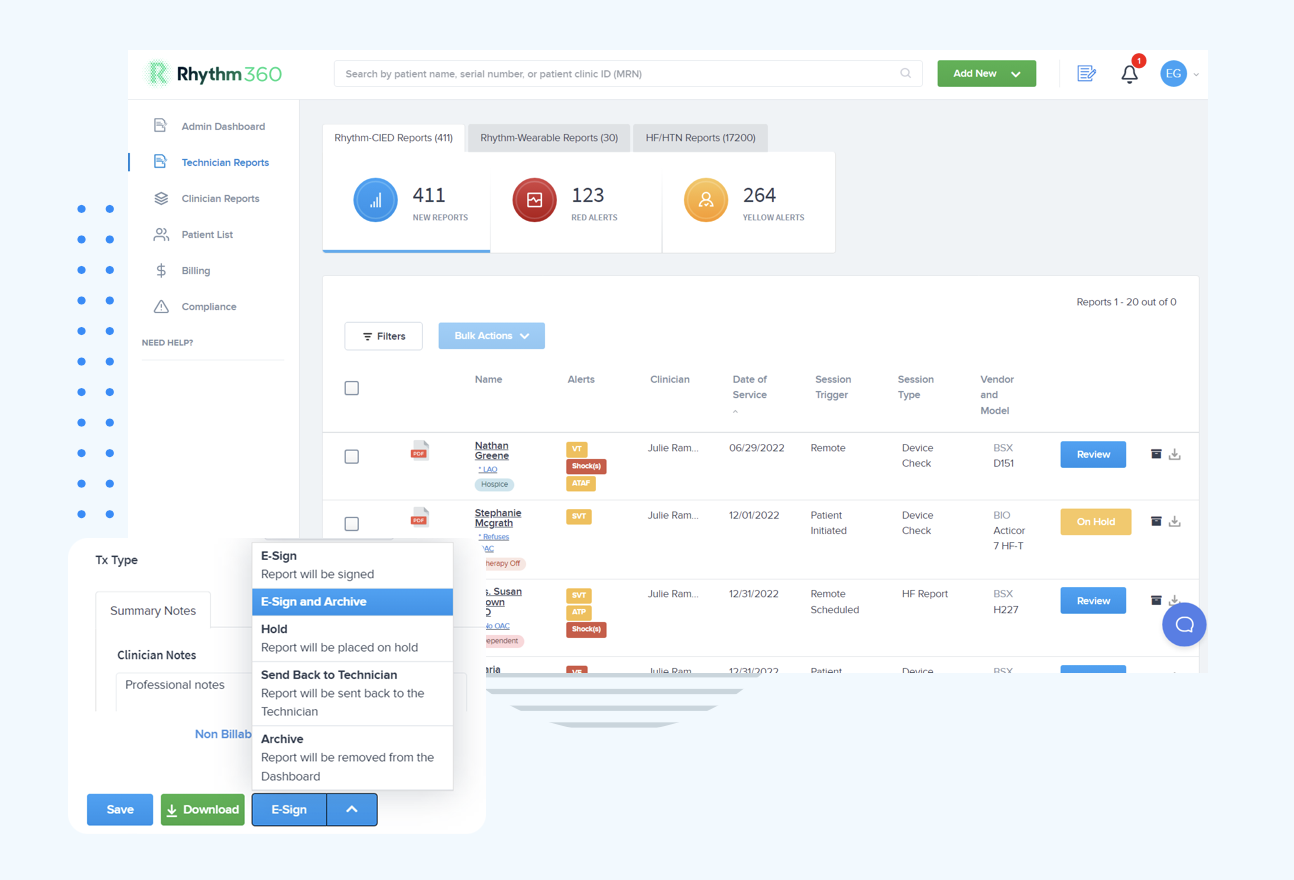
Rhythm360 is a vendor-neutral, HIPAA-compliant platform that aggregates CIED data from all major device manufacturers, including Medtronic, Boston Scientific, Abbott, Biotronik, and others, alongside RPM physiological data into a single AI-powered dashboard. With greater than 99.9% data transmissibility achieved through redundant data feeds, computer vision, and AI-powered extrapolation, Rhythm360 enables practices to detect early decompensation signals and act before a readmission occurs.
Close the post-discharge monitoring gap. Schedule a demo with Rhythm360 today.
Clinicians should double the loop diuretic dose on the next administration when urine output falls below 300 mL over the first 2 hours or urinary sodium remains below 70 mmol/L after an initial IV loop diuretic dose. If the patient already receives high-dose furosemide exceeding 240 mg per day intravenously without adequate response, sequential nephron blockade becomes the next step. This strategy adds a thiazide-type agent, such as metolazone 2.5–5 mg orally or chlorothiazide 500–1000 mg intravenously, to block sodium reabsorption at a different nephron segment. Clinicians should monitor serum potassium, magnesium, sodium, and creatinine closely during combination diuretic therapy because electrolyte depletion can occur rapidly. Continuous urine output measurement via bladder catheter improves accuracy in the acute setting. If renal function worsens significantly, reassess volume status and consider whether cardiorenal syndrome limits diuretic responsiveness.
New-onset acute heart failure generally requires inpatient management at initial presentation, with echocardiography and evaluation of the underlying etiology. Hospitalization is indicated for any patient with persistent hemodynamic instability, ongoing severe respiratory distress, cardiogenic shock, need for intubation or ventilation, or norepinephrine requirements above 0.2 mcg/kg/min. Patients with known chronic heart failure who present with mild-to-moderate decompensation, stable hemodynamics, SpO₂ that responds to supplemental oxygen, and no signs of end-organ hypoperfusion may qualify for intensive outpatient management paired with immediate RPM enrollment, provided close follow-up within 24–72 hours is confirmed. RPM then becomes the primary surveillance tool after hospital discharge, enabling detection of weight gain trends, rising filling pressures, or new arrhythmias before they escalate to a readmission. Rhythm360 supports this transition by aggregating physiological data and CIED transmissions into a single dashboard with AI-driven alert prioritization, allowing the care team to intervene early in the post-discharge period.
Rhythm360 offers bi-directional EHR integration with major platforms including Epic, Cerner, Athenahealth, eClinicalWorks, and Greenway Health via HL7, with onboarding typically completed within a few days to a few weeks. On the device side, the platform ingests data from all major CIED manufacturers through APIs, HL7, XML, and PDF parsing via computer vision, and normalizes disparate data streams into a single source of truth. For heart failure and hypertension RPM, Rhythm360 supports turnkey service line launch with automated billing documentation for relevant CPT codes, which reduces the administrative burden on clinical staff. Clinicians access a unified dashboard that displays CIED transmissions, RPM physiological readings, and AI-prioritized alerts in one view, eliminating the need to log into multiple OEM portals. A secure, HIPAA-compliant mobile application allows clinicians to review transmissions, sign reports, and coordinate care from anywhere. Practices using Rhythm360 have reported up to an 80% reduction in critical alert response times and significant improvements in revenue capture through more complete CPT code billing.
Effective acute heart failure management in 2025 spans the full continuum from ABCDE stabilization and hemodynamic profiling in the ED through first-line diuretic and vasodilator therapy, precipitant identification using the CHAMPIT framework, and in-hospital GDMT initiation, then continues into a structured post-discharge RPM transition. Protocols that stop at hospital discharge leave patients in the highest-risk window without surveillance, exposing practices to readmission penalties and patients to preventable harm. The meta-analysis evidence cited earlier, spanning 79 randomized trials, confirms that remote monitoring reduces HF hospitalizations and all-cause mortality when implemented with proactive, data-driven workflows.
Rhythm360 provides the vendor-neutral, AI-powered infrastructure that makes this transition seamless by aggregating CIED and RPM data from every major manufacturer into one dashboard, automating documentation, and enabling early intervention before decompensation becomes a readmission.





