

Advanced heart failure includes NYHA Class III-IV symptoms with INTERMACS profiles 1-4, which describe patients with severe functional limitations despite guideline-directed medical therapy. These patients experience frequent hospitalizations, reduced exercise tolerance, and a high risk of mortality. The INTERMACS classification system stratifies these patients by acuity, with survival ranging from days to years depending on profile.
| INTERMACS Profile | Clinical Description | Survival Prognosis |
|---|---|---|
| Profile 1 (Critical Cardiogenic Shock) | Life-threatening hypotension despite escalating inotropic support | Days to weeks without intervention |
| Profile 2 (Progressive Decline) | Inotrope-dependent with declining function | Weeks to months |
| Profile 3 (Stable Inotrope Dependent) | Clinically stable on mild-moderate inotropic support | Months with careful monitoring |
| Profile 4 (Resting Symptoms) | NYHA IV symptoms at rest without inotropes | 1-2 years with optimal management |
Diagnostic evaluation relies on a comprehensive assessment that includes NT-proBNP levels, echocardiographic parameters, and invasive hemodynamics when indicated. The 2022 AHA/ACC/HFSA Guidelines emphasize early identification and aggressive intervention to slow disease progression. However, implementing this level of close surveillance creates practical challenges for many teams.
Modern practices struggle with multi-vendor device data fragmentation, where CardioMEMS, pacemaker, and defibrillator information sit in separate portals. This fragmentation delays recognition of clinical deterioration and complicates coordinated care responses.
Contemporary heart failure management centers on four evidence-based medication classes that clinicians should introduce rapidly and simultaneously rather than titrate one by one over several months.
| GDMT Pillar | Example Medication | Key Evidence | Implementation Notes |
|---|---|---|---|
| ARNI | Sacubitril/valsartan | PARADIGM-HF: 20% cardiovascular mortality reduction | Use as first-line therapy in place of ACE inhibitors when appropriate |
| SGLT2 Inhibitor | Dapagliflozin, empagliflozin | High tolerability with minimal side effects | Represents the fastest adoption of a new GDMT class |
| MRA | Spironolactone, eplerenone | Strong evidence for neurohormonal blockade | Target dose of 50 mg daily for eplerenone and spironolactone in heart failure |
| Beta-blocker | Metoprolol succinate, carvedilol | Use often falls short of guideline recommendations | Multiple approved formulations for HFrEF |
The current recommendation supports rapid titration of all four medication classes together, sometimes with weekly adjustments, instead of the historical 6‑month sequential approach. This strategy aims to slow disease progression and reduce hospitalizations more quickly. However, rapid titration increases the risk of medication intolerance, especially in Stage D patients who already have limited reserve.
For these high-risk patients, remote monitoring becomes essential for tracking adherence and spotting early signs of decompensation that may not appear during office visits. RPM platforms support real-time assessment of treatment response and guide timely therapeutic changes.
Even with optimal GDMT, some patients continue to deteriorate. When maximal medical therapy no longer controls symptoms or prevents recurrent hospitalizations, the care plan shifts toward inotropes, mechanical circulatory support, and transplant evaluation.
Inotropic therapy with milrinone or dobutamine provides hemodynamic support as a bridge to more definitive interventions. Chronic inotrope dependence carries significant mortality risk and often triggers evaluation for LVAD candidacy.
This is where left ventricular assist devices become critical. LVADs serve dual roles as bridge-to-transplant or as destination therapy for patients who are not transplant candidates. The TEAM-HF IDE clinical trial evaluates elevated mean pulmonary artery pressure as an objective trigger for HeartMate 3 LVAD referral in ambulatory patients with refractory symptoms. Clinicians rely on several objective criteria to determine the right timing for LVAD referral.
| Referral Trigger | Clinical Criterion | Assessment Method |
|---|---|---|
| Renal Dysfunction | Reduced eGFR | Laboratory evaluation |
| Elevated Filling Pressures | Elevated mean PAP | CardioMEMS monitoring |
| Functional Limitation | Reduced 6-minute walk distance | Exercise testing |
| Peak Exercise Capacity | Reduced peak VO₂ | Cardiopulmonary exercise test |
Heart transplantation remains the gold standard for eligible candidates and offers the strongest long-term survival and quality of life. The TEAM-HF trial enrolls patients with LVEF ≤30% to define evidence-based referral criteria using objective hemodynamic parameters.
Remote monitoring supports both pre- and post-intervention care by enabling early detection of complications and fine-tuning of device settings. Integrated platforms simplify the complex data management that these high-acuity patients require.
Remote patient monitoring shifts heart failure care from reactive treatment to proactive management. CardioMEMS pulmonary artery sensors, cardiac implantable electronic devices, and wearables provide continuous physiological data that highlight decompensation before symptoms appear.
The CHAMPION trial created the evidence base for this approach and supports the use of RPM in current guidelines. Modern programs combine multiple data streams, including weight, blood pressure, heart rhythm, and intracardiac pressures, to create a more complete picture of patient status.
Many practices still face operational barriers. Multi-vendor portals create data silos where Medtronic, Boston Scientific, Abbott, and Biotronik devices each require separate logins and workflows. Alert fatigue from excessive notifications reduces clinical responsiveness, and manual billing processes often miss CPT code capture opportunities.
Rhythm360 solves these problems through vendor-neutral integration that consolidates all device data into a single dashboard. AI-powered alert triage removes most non-actionable notifications mentioned earlier, while automated documentation supports compliant billing for CPT codes 99454, 99457, and 93298. The platform maintains more than 99.9% data transmissibility through redundant feeds and computer vision technology.
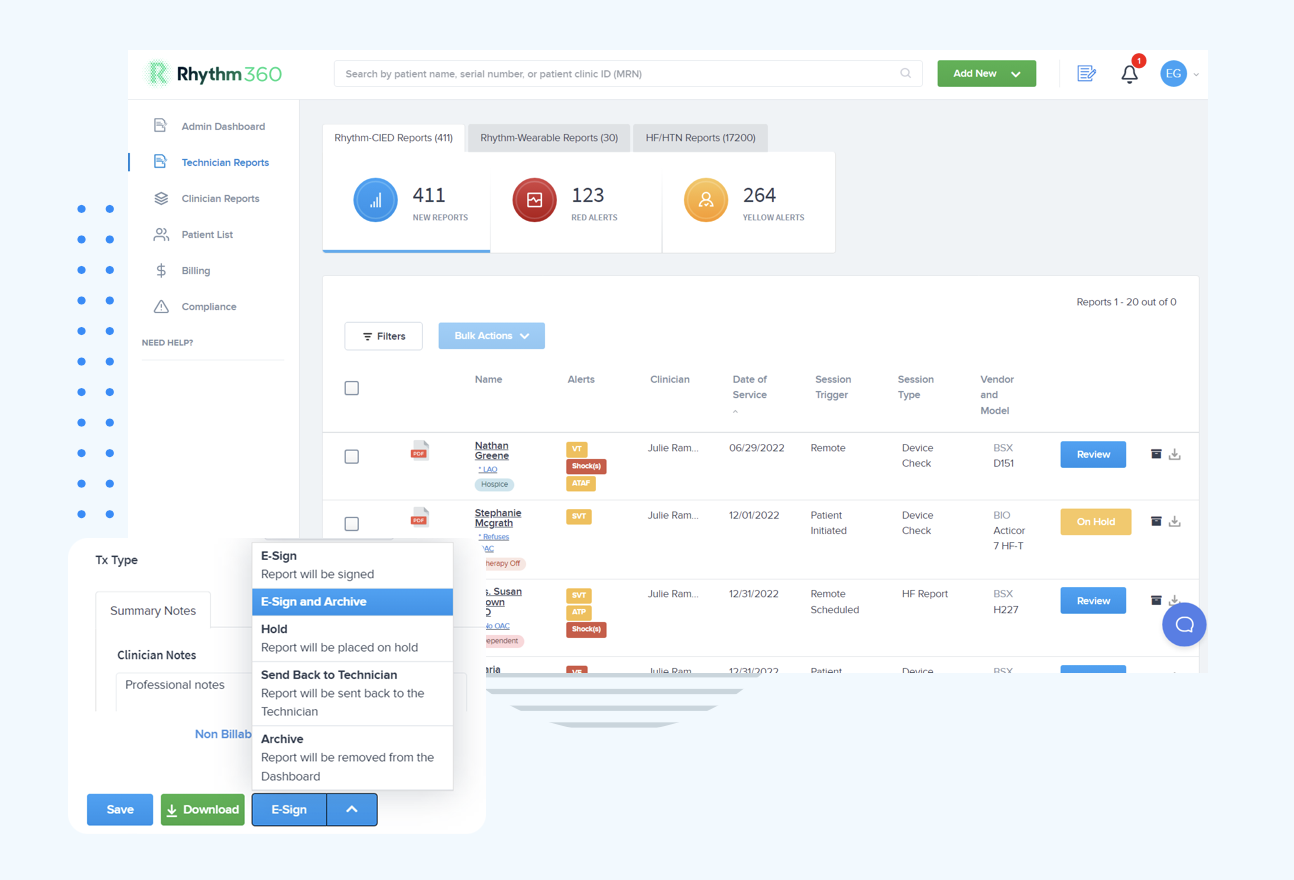
A recent case shows this impact in real life. A Saturday morning CardioMEMS alert flagged elevated pressures in a 72-year-old woman, and her defibrillator simultaneously detected new atrial fibrillation. The integrated platform immediately notified the on-call team, which started anticoagulation and adjusted diuretics within hours. This intervention likely prevented a stroke and avoided an emergency department visit.
The financial results are also meaningful. Practices report higher RPM revenue through automated billing workflows and expanded service lines. EHR integration with Epic and Cerner removes manual data entry, and mobile applications support 24/7 clinical oversight. Transform your advanced heart failure management with comprehensive RPM integration and see how Rhythm360 eliminates data silos in your practice.
Survival in advanced heart failure varies widely by INTERMACS profile and by how quickly advanced therapies are deployed. Profile 1 patients often have only days to weeks without mechanical support, while Profile 4 patients may live 1-2 years with careful medical management.
Remote monitoring can extend survival by supporting earlier intervention during decompensation episodes. Proactive management based on hemodynamic data prevents the clinical decline that leads to emergency hospitalizations and accelerates disease progression. Achieving these clinical gains requires thoughtful program design and reliable operational infrastructure.
Successful advanced heart failure programs depend on clear metrics, efficient billing workflows, and ongoing quality improvement. Key performance indicators include 30-day readmission rates, CPT code capture rates, alert response times, and patient satisfaction scores.
Several common pitfalls can undermine these efforts. Data fragmentation across vendor portals slows decision-making, limited staff training on device technologies reduces adoption, and weak EHR integration creates duplicate work. Rhythm360 addresses these issues with population health dashboards, HIPAA-compliant communication tools, and workflows that fit into existing clinic processes.
Revenue growth relies on consistent documentation for complex RPM billing codes. The platform generates compliant reports for physician review, tracks billable patient interactions, and maintains audit trails that support regulatory compliance.
One cardiology group implemented Rhythm360 and cut alert processing time by 80%. The practice also increased heart failure RPM revenue and improved staff satisfaction through automation. Their Saturday atrial fibrillation detection case shows how integrated monitoring can prevent adverse outcomes while capturing appropriate reimbursement.
Stage D heart failure represents the most advanced form of the condition and involves refractory NYHA Class IV symptoms despite guideline-directed medical therapy. These patients have severe functional limitations, frequent hospitalizations, and need evaluation for advanced interventions such as mechanical circulatory support or heart transplantation.
The most effective approach combines several monitoring modalities, including CardioMEMS pulmonary artery sensors, cardiac implantable devices, and physiological parameters such as weight and blood pressure. Vendor-neutral platforms like Rhythm360 bring all data streams into unified workflows, which reduces alert fatigue and improves clinical responsiveness.
Key billing codes include CPT 99454 for monthly device supply and data transmission in remote physiologic monitoring, CPT 99457 for remote physiological monitoring treatment management services, and CPT 93298 for interrogation and evaluation of implantable loop recorder systems. Accurate documentation and automated billing workflows help maximize revenue capture.
The four pillars of guideline-directed medical therapy include angiotensin receptor-neprilysin inhibitors (ARNI), sodium-glucose cotransporter-2 inhibitors (SGLT2i), mineralocorticoid receptor antagonists (MRA), and beta-blockers. Current recommendations emphasize rapid, simultaneous initiation rather than slow sequential titration to improve outcomes.
Heart transplantation remains the gold standard for eligible patients with advanced heart failure and offers the strongest long-term survival and quality of life. For patients who are not transplant candidates, left ventricular assist devices provide durable mechanical circulatory support as destination therapy.
Advanced heart failure management depends on evidence-based medical therapy, timely advanced interventions, and reliable remote monitoring. Modern RPM platforms such as Rhythm360 convert fragmented device data into streamlined, profitable workflows that support better outcomes and stronger revenue performance. Take the next step for your heart failure program and explore vendor-neutral integration for your heart failure program.





