

Last updated: July 14, 2026
Strong patient selection criteria anchor every high-performing HF RPM program. The 2022 ACC/AHA/HFSA Guideline for the Management of Heart Failure outlines when to use implantable hemodynamic monitoring in advanced heart failure. A 2026 network meta-analysis of 79 RCTs (31,669 patients) performed subgroup analyses across NYHA class, LVEF, age, sex, and geography and examined escalation to invasive hemodynamic monitoring for patients re-hospitalized despite GDMT.
The OSICAT trial evaluated telemonitoring in heart failure patients and highlighted the value of structured remote follow-up. Building on these findings, patients listed for transplant or LVAD implantation represent a high-priority subgroup. CardioMEMS-guided hemodynamic management in LVAD patients has been associated with reduced HF hospitalizations in those maintaining pulmonary artery diastolic pressure below 20 mmHg. Practices should also note that as of the 2025 CMS National Coverage Determination (NCD #20.36), implantable PA pressure sensors are covered only within approved clinical studies or under Coverage with Evidence Development (CED). This coverage constraint must factor into enrollment planning.
Tiered, evidence-based thresholds convert raw sensor data into clear clinical actions. The table below synthesizes thresholds from the 2026 AHA Scientific Statement on hemodynamic monitoring and established HF RPM protocol literature.
| Parameter | Low Risk (Routine Review) | Moderate Risk (Nurse Callback ≤4 hrs) | High Risk (Immediate Contact / ER) |
|---|---|---|---|
| Mean PA Pressure | <20 mmHg | 20–25 mmHg (rising trend) | >25 mmHg or rapid rise ≥5 mmHg in 24 hrs |
| Weight | <2 lbs gain in 24 hrs | ≥2 lbs in 24 hrs or ≥3 lbs in 24 hrs | ≥5 lbs in 7 days, same-day telehealth visit |
| SpO2 | ≥94% | 90–93%, assess symptoms | <90%, immediate contact, ER if sustained dyspnea |
| Systolic BP | 90–160 mmHg | <90 mmHg, callback ≤2 hrs, hold ACEi/ARB if symptomatic | >180/120 mmHg, immediate contact, ER if end-organ symptoms |
Implantable hemodynamic sensors can detect rising PA pressures before clinical congestion, a window that traditional weight monitoring often misses. Validated systems use color-coded alert algorithms with orange for prompt outpatient review and red for urgent or emergency assessment. Automated escalation reminders trigger when alerts remain unaddressed beyond a defined timeframe.
The following signals show why multiparametric monitoring outperforms weight and symptom tracking alone.
The 2026 HFSA/AAHFN Scientific Statement, "Integrated Health Technologies in Heart Failure," notes that outcomes improve when digital data connect to defined workflows, clinician accountability, and rapid clinical response. The 2023 HRS/EHRA/APHRS/LAHRS Expert Consensus Statement on Practical Management of the Remote Device Clinic offers practical staffing guidance for remote monitoring clinics.
A functional advanced HF RPM team includes specific roles with clear responsibilities.
Atrium Health's multidisciplinary model uses pharmacists, nurses, navigators, and APPs to protocolize care or execute warm handoffs. This structure shows that routing every transmission to a physician is neither scalable nor necessary. Escalation pathways should remain explicit. Routine alerts resolve at the nurse-coordinator level, moderate alerts involve the APP, and high-risk alerts reach the cardiologist within a defined timeframe.
CardioMEMS and comparable PA pressure sensors deliver consistent benefit only when teams follow standardized operating procedures. The 2026 AHA Scientific Statement recommends remote PA pressure monitoring for high-risk patients with heart failure.
Key operational standards include the following practices.
These operational standards are supported by robust clinical evidence. The MONITOR-HF trial demonstrated a 44% relative reduction in HF hospitalizations with CardioMEMS versus standard care. The CHAMPION trial (n=550) showed a 30% reduction in HF hospitalizations at six months (HR 0.70; 95% CI 0.60-0.84; p<0.001).
Remote monitoring provides continuous hemodynamic visibility that supports faster yet safe GDMT titration. The "four drugs in four weeks" strategy starts all four foundational HFrEF therapies, including ARNI/ACEi/ARB, evidence-based beta-blocker, MRA, and SGLT2i, at low doses within the first month. Teams then perform systematic up-titration to maximally tolerated doses.
RPM-integrated GDMT optimization works best within a structured protocol framework. Begin with an APP-led protocol that includes standing-order up-titration algorithms and hemodynamic and laboratory thresholds. Support these protocols with bi-weekly touchpoints to monitor blood pressure, heart rate, renal function, and electrolytes, which protects patient safety during titration. To prevent patients from falling through the cracks, configure auto-referral triggers for any HFrEF patient not on quadruple therapy or below 50% target doses after discharge. Prioritize SGLT2 inhibitors and MRAs in borderline-BP patients because they exert modest effects on systemic blood pressure. Finally, use EHR-integrated decision support that surfaces GDMT gaps at the point of alert review so clinicians can act during the same interaction.
Alert fatigue drives missed critical events and accelerates clinician burnout. High volumes of alerts for minor deviations led some nurses in a Quebec telemonitoring pilot to perform only the minimum required actions, which directly undermined program safety.
Effective mitigation strategies focus on filtering noise and clarifying priorities.
Practices using Rhythm360's AI alert triage report up to 80% faster critical-alert response times. As Andrew Beaser, MD, at the University of Chicago Medicine noted, “Decision support, including AI-assisted decision support, will become increasingly important as data volumes grow.”
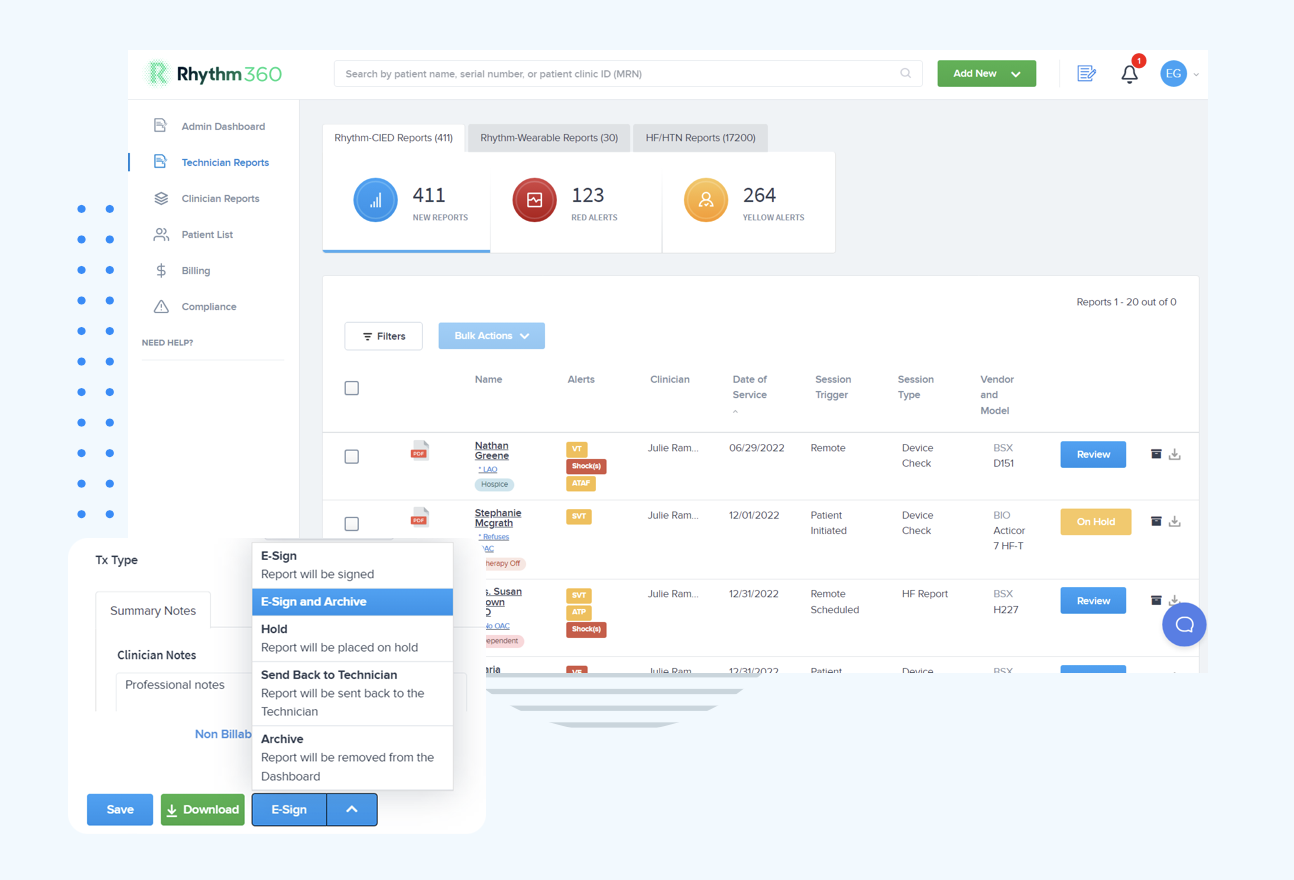
Program performance measurement depends on a defined KPI framework reviewed at least monthly. Core metrics include the following measures.
This transmission volume enabled clinicians at UCM to review more data daily and identify more abnormalities. Dr. Beaser noted, “We are able to address these issues earlier; rather than waiting for a 3-month visit, we can call patients in for evaluation.” Gaurav A. Upadhyay, MD, at UCM, added, “We have improved billing and accountability for our patients after the integration.”
Sustainable RPM programs rely on bi-directional EHR integration that delivers device data into clinical workflows the same way laboratory results arrive, as discrete and actionable fields. The 2026 HFSA/AAHFN statement identifies interoperability as foundational. Seamless data flow between devices, EHRs, and clinicians enables integrated care and works best when clinicians respond with clear, actionable feedback.
Rhythm360 supports bi-directional HL7 integration with Epic, Cerner, Athenahealth, eClinicalWorks, Greenway Health, and other major EHRs, with onboarding typically completed in days to weeks. Billing compliance depends on automated documentation of the following CPT codes.
Monthly compliance audits should verify that documentation meets the minimum 20-minute threshold for 99457 and that all billable transmission reviews are captured. Teams should also confirm that Business Associate Agreements remain current with all RPM vendors. HIPAA risk analyses must be conducted at least annually and after major platform changes, including new RPM integrations. Practices using Rhythm360's automated CPT capture and documentation workflows have achieved up to 300% increases in revenue generation through more complete billing and reduced leakage.
The primary evidence base and most payer policies focus on NYHA Class III patients with at least one HF hospitalization in the prior year or elevated natriuretic peptides on maximally tolerated GDMT. As noted in Step 1, CMS currently restricts implantable PA sensor coverage to approved studies or CED pathways. NYHA Class II patients with recent hospitalization are included in the 2026 AHA Scientific Statement's recommendations for remote PA pressure monitoring. LVAD-implanted and transplant-listed patients represent a high-priority subgroup regardless of NYHA class, given the demonstrated hemodynamic management benefits in that population. Practices should verify individual payer policies, because commercial coverage determinations vary and several major payers currently classify implantable PA sensors as investigational in the outpatient setting.
A unified platform like Rhythm360 supports EHR integration and initial configuration within days to a few weeks. Full operational capacity, defined as daily alert review workflows, CPT documentation automation, and multidisciplinary team protocols functioning at scale, generally requires four to eight weeks from go-live, depending on practice size and EHR complexity. Critical path items include EHR discrete field configuration for HF metrics, alert threshold calibration to individual patient baselines, staff training on triage protocols, and standing-order execution pathways for GDMT up-titration. Programs that invest in combined clinical training and hands-on technical sessions before go-live reach stable review volumes faster than those that rely on self-paced onboarding alone.
Mobile access can remain HIPAA-compliant when the application meets the technical safeguard requirements of the HIPAA Security Rule. Rhythm360's mobile application is HIPAA-compliant and enables clinicians to review transmissions, sign reports, and coordinate care from their smartphones. Compliance depends on several controls, including end-to-end encryption for data in transit and at rest, multi-factor authentication, session timeout policies, and a complete audit trail of all access events. Practices must also ensure that Business Associate Agreements with the mobile platform vendor are current and that the application appears in the annual HIPAA risk analysis. On-call clinicians using compliant mobile access can respond to critical alerts, such as new-onset atrial fibrillation or a significant PA pressure rise, without remaining tethered to a clinical workstation, which supports faster response times and better outcomes.
Data gaps arise from OEM server outages, connectivity failures at the patient level, or incompatible data formats across manufacturers such as Medtronic, Boston Scientific, Abbott, and Biotronik. Rhythm360 addresses this through redundant data feeds that act as a fail-safe when an OEM server is unavailable, computer vision (OCR) to parse unstructured PDF reports, and AI-powered extrapolation to fill gaps and flag connectivity issues. The result is greater than 99.9% transmissibility across the monitored population. Without this infrastructure, a single OEM outage can create a blind spot across an entire device cohort and increase the risk of missed critical events. Unified platforms also normalize data into a single schema, which removes the manual reconciliation burden that occurs when device technicians must log into separate, non-interoperable portals for each manufacturer.
Advanced heart failure remote patient monitoring delivers full clinical and operational value only when all eight implementation steps function as an integrated system. These steps include rigorous patient selection, evidence-based tiered alert thresholds, a defined multidisciplinary team, standardized hemodynamic monitoring workflows, protocol-driven GDMT optimization, AI-powered alert triage, continuous performance measurement, and bi-directional EHR and billing integration. Fragmented OEM portals, manual workflows, and siloed data weaken every one of these steps at the same time.
Rhythm360 provides the single-source-of-truth infrastructure that operationalizes this playbook at scale, from the 73,000-plus annual reports managed at the University of Chicago Medicine to the standing-order GDMT workflows that shorten time to therapeutic doses. AI alert triage, greater than 99.9% transmissibility, HIPAA-compliant mobile access, and automated CPT documentation function as core infrastructure that converts best practices into faster interventions, fewer hospitalizations, and sustainable revenue capture.
Turn this playbook into live workflows and see how Rhythm360 makes every step scalable for your cardiology practice.




