Last updated: July 13, 2026
A device technician starting a Monday shift at a mid-sized electrophysiology clinic may log into four or five separate manufacturer portals before reviewing a single patient. Medtronic, Boston Scientific, Abbott, and Biotronik each maintain distinct interfaces, data formats, and transmission schedules. Transmissions pile up over the weekend. Critical alerts sit alongside dozens of routine notifications with no intelligent prioritization. This fragmented workflow is both time-consuming and clinically risky.
The downstream effects are well-documented. Prior observational data cited in a 2026 Journal of Cardiovascular Electrophysiology study found that nearly 9 out of 10 arrhythmia alarms in ICUs were false positives. The overall false-positive rate for ventricular tachycardia alarms was 86.8% in a study by Harris et al., as cited in the 2026 JCE study by Khanolkar et al. When the vast majority of alerts are non-actionable, clinicians become desensitized, which directly increases the risk of missing a true critical event such as new-onset atrial fibrillation, a lead malfunction, or ventricular tachycardia.
The operational consequences build on the same fragmentation. Staff burn out from manual data retrieval and reconciliation across multiple portals. Gaurav A. Upadhyay, MD, FACC, FHRS, Professor of Medicine and Director of the Pacing & Defibrillation Device Clinic at the University of Chicago Medicine (UCM), noted: "Staffing was always an issue for our center, because our device clinic — like many other medical centers — had struggled with technician turnover and timely weekend coverage." High turnover and unstable coverage compound documentation gaps. Those gaps translate directly into missed billing opportunities, with a typical mixed-vendor panel leaving significant revenue uncaptured each year when billing is tracked manually across manufacturer portals.
See how Rhythm360 consolidates fragmented device data into a single, actionable dashboard.
AI in cardiac telemetry monitoring describes platforms that automate data ingestion from all major device manufacturers, apply machine learning-based alert triage, and generate structured, audit-ready reports. These capabilities replace the manual, portal-by-portal workflow that burdens most cardiology practices today.
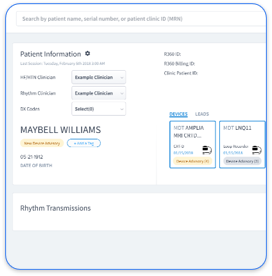
Rhythm360 by RhythmScience is a cloud-based, HIPAA-compliant platform built on this architecture. It normalizes data arriving as APIs, HL7 messages, XML feeds, and unstructured PDFs through computer vision and AI-powered extrapolation, achieving greater than 99.9% transmissibility across all connected device manufacturers. A redundant data feed system maintains data fidelity even when individual OEM servers experience downtime, so no transmission is silently lost.
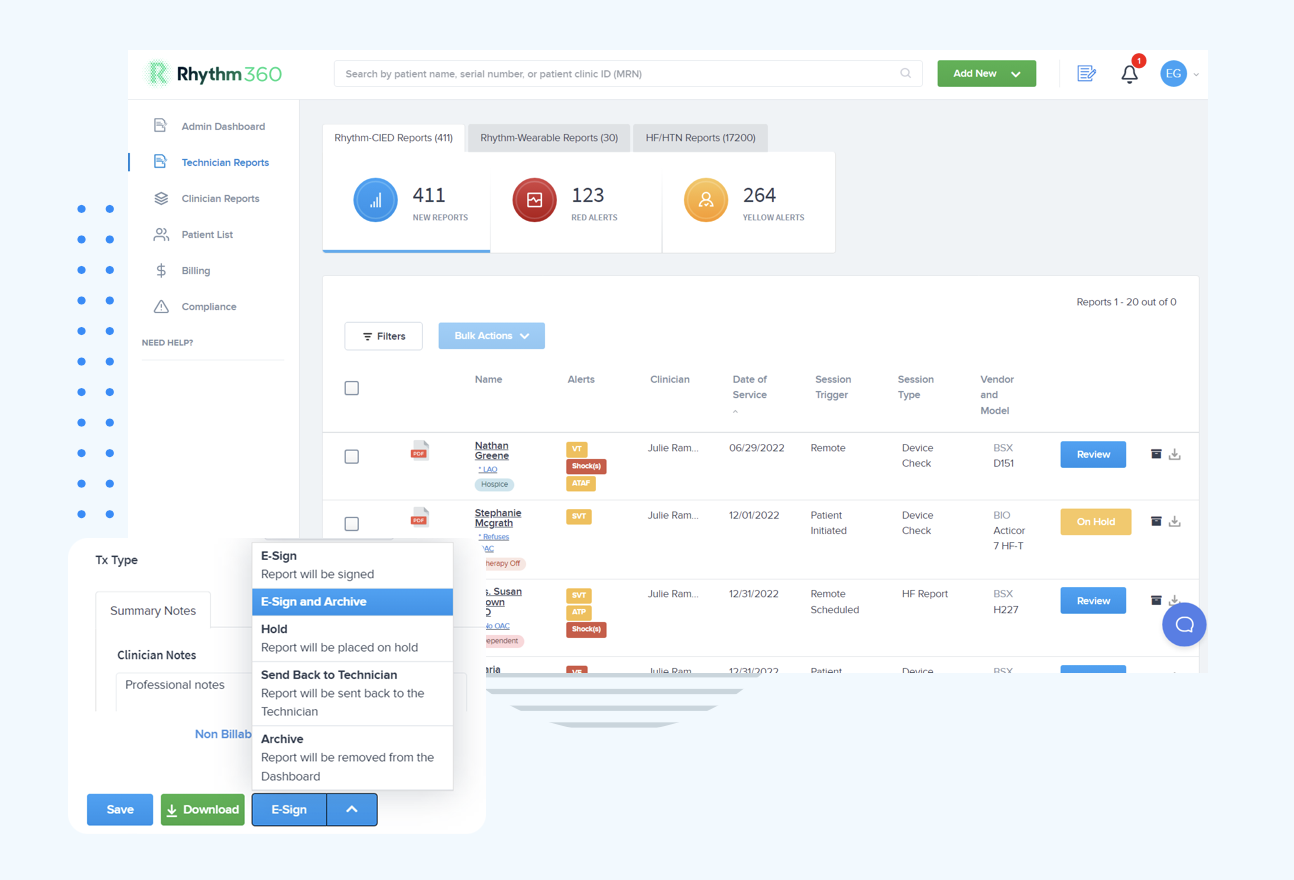
Andrew Beaser, MD, Associate Professor of Medicine at UCM, described pre-implementation workflows as "a major challenge and incredibly difficult." After deploying Rhythm360, UCM reviewed more than 73,000 reports annually, averaging more than 18,000 reports per quarter. Clinicians identified more abnormalities and acted on them earlier because the data arrived in a unified, prioritized format.
AI-based alarm filtering now has a strong clinical and operational evidence base. A 2026 study by Khanolkar et al. in the Journal of Cardiovascular Electrophysiology developed a 1D convolutional neural network model that classified ventricular tachycardia alarms using raw multi-channel waveform data, achieving an AUC-ROC of 0.901.
At the system level, machine learning can sharply reduce alarm burden. A 2026 retrospective study found that an unsupervised machine learning alarm algorithm substantially reduced alarm burden compared to conventional threshold alarms. Studies confirm that machine learning-based arrhythmia detection improves specificity and reduces false-positive alarm rates while preserving sensitivity to true events. Intelligent alarm prioritization now functions as an evidence-supported strategy for reducing non-actionable alert volume.
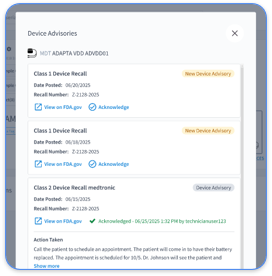
Rhythm360's AI triage layer applies this filtering logic to the full spectrum of CIED transmissions. The platform surfaces clinically significant events and suppresses non-actionable notifications. Practices report up to an 80% reduction in critical response times and a clinical environment where alerts carry meaningful signal instead of noise.
Watch Rhythm360's intelligent alert triage in action.
Consolidating transmissions from multiple device manufacturers into a single platform requires several technical capabilities. The platform must ingest data in incompatible formats, maintain fidelity when source servers are unavailable, and link device-level data to the broader patient record in the EHR.
Remote monitoring data is commonly fragmented across separate systems, with transmissions in one location, implant records in another, symptoms recorded elsewhere, and clinical events in yet another system, forcing clinicians to manually assemble context. Effective consolidation requires capturing transmissions in structured form and linking them to the full patient record, not simply aggregating PDFs into a shared folder.
Rhythm360 addresses this through a multi-layer ingestion architecture. The platform connects to Medtronic, Boston Scientific, Abbott, Biotronik, and other manufacturers via direct API integrations, HL7 feeds, and XML parsing. For manufacturers that deliver data only as unstructured PDFs, computer vision extracts and normalizes the relevant fields. Gaurav A. Upadhyay, MD, at UCM, stated: "That was a big piece for us, to have an integrated review of data from trained personnel." Redundant data feeds serve as a fail-safe when individual OEM servers go offline, preventing silent transmission gaps that could obscure a critical event.
Current telemetry systems suffer from near-complete reliance on the primary auditory and visual alarm at the central monitoring station as the sole alert pathway, creating a single point of failure with no secondary alert mechanism. Rhythm360's redundant architecture directly addresses this vulnerability and provides the reliable data foundation required for advanced analytics.
AI in cardiac telemetry monitoring also enables earlier detection of rhythm changes before they progress to adverse clinical events. A 2026 prospective observational study by Rantula et al. in JMIR mHealth and uHealth, enrolling 116 patients with recent-onset AF or AFL, found that a deep neural network-based AI method achieved sensitivity of 91.9% and specificity of 99.6% for AF/AFL detection (time-based).
A 2026 systematic review and meta-analysis by de Alencar et al. found that AI-based arrhythmia detection on 12-lead ECGs achieved pooled sensitivity of 94.0% and specificity of 98.7%, with an AUC of 0.982. These performance levels substantially exceed conventional threshold-based systems.
AI-assisted predictive monitoring algorithms that analyze trends in heart rate variability, ST-segment morphology, and multi-parameter composite scores can anticipate patient deterioration before it manifests as a discrete alarm. Rhythm360 surfaces these predictive alerts within its unified dashboard, enabling clinicians to intervene before a scheduled follow-up visit. Andrew Beaser, MD, at UCM, explained: "We are able to address these issues earlier; rather than waiting for a 3-month visit, we can call patients in for evaluation."
Manual telemetry workflows create financial risk as well as administrative burden. Medicare and commercial payers require specific documentation artifacts to support remote monitoring CPT codes, and manual processes consistently fail to capture them at scale.
A correctly automated RPM workflow can improve CPT 99457 capture compared to manual processes. Automated workflows also reduce 99454 denials for missed transmission thresholds, which are common in manual setups, improving overall capture rates. On a 500-patient panel, total incremental revenue from automated CPT billing routinely exceeds $300,000 per year.
The compliance stakes are equally significant. Medicare and MA RPM payments reached $536 million in 2024, prompting an OIG audit focused on documentation gaps around the 16-day transmission requirement for 99454 and the 20-minute time requirement for 99457. The 99454 audit defense requires three structured artifacts per 30-day period: a device-status log proving 16 distinct calendar days of transmission, a device-attribution record proving FDA medical-device qualification, and a patient-attribution record proving the readings came from the patient under the order.
Rhythm360 automates the tracking of 16-day transmission rules and 20-minute management time requirements. The platform stores structured audit artifacts required for OIG compliance and generates billing-ready documentation without manual staff intervention. Gaurav A. Upadhyay, MD, at UCM, observed: "We have improved billing and accountability for our patients after the integration."
Practices evaluating AI cardiac telemetry platforms should assess integration depth, onboarding speed, mobile access, and documented clinical and financial outcomes. Rhythm360 integrates bi-directionally with Epic, Cerner, Athenahealth, eClinicalWorks, Greenway Health, and other EHR systems via HL7, with implementation timelines ranging from a few days to a few weeks. A HIPAA-compliant mobile application allows clinicians to review transmissions, sign reports, and coordinate care from any location.
Each practice should evaluate any platform against its specific workflow requirements, EHR environment, and device mix. The following table summarizes Rhythm360's documented features and verified outcomes.
| Feature / Capability | Technical Specification | Documented Outcome | Source |
|---|---|---|---|
| Data transmissibility | API, HL7, XML, PDF via computer vision; redundant OEM feeds | >99.9% transmissibility | UCM White Paper, 2025 |
| Critical alert response time | AI triage with optional 24/7/365 CCT oversight | Up to 80% reduction in response times | RhythmScience platform outcomes |
| Revenue improvement | Automated CPT tracking: 99454, 99457, 99458, 93296–93299 | Up to 300% increase in revenue capture | Automated RPM billing benchmarks, 2026 |
| Report volume scalability | Cloud-based, multi-tenant architecture | 73,000+ reports reviewed annually at UCM | UCM White Paper, 2025 |
Discuss your practice's implementation timeline and integration requirements with the Rhythm360 team.
Practices evaluating AI cardiac telemetry platforms often ask about implementation timelines, data security, clinical safety, and billing compliance. The following questions address the most frequent concerns raised during the evaluation process.
Implementation timelines for AI cardiac telemetry platforms vary based on EHR complexity, the number of device manufacturers in the practice's patient population, and the depth of bi-directional integration required. Rhythm360's onboarding process, including EHR integration with systems such as Epic, Cerner, and Athenahealth, typically takes from a few days to a few weeks. The platform's cloud-based architecture removes the need for on-premise hardware installation, which often delays legacy system deployments. Staff training is supported through the platform's centralized dashboard design, which reduces reliance on a single "super-user" and supports business continuity from day one.
Vendor-neutral cardiac monitoring platforms handling CIED and remote physiological monitoring data are subject to HIPAA's Privacy and Security Rules, which require administrative, physical, and technical safeguards for protected health information. Rhythm360 is a HIPAA-compliant platform that stores all patient data, communication logs, and audit artifacts in a secure cloud environment. All transmissions between device manufacturers, the platform, and connected EHR systems use encrypted data pathways. The platform's integrated communication hub, powered by Twilio, maintains a full audit trail of all patient interactions, including automated messages and phone call logs, within the patient record to support both clinical accountability and regulatory compliance.
AI-based alert triage systems in cardiac telemetry are designed to improve specificity, or the ability to correctly identify non-actionable alerts, while preserving sensitivity to true clinical events. Deep learning models trained on large, annotated arrhythmia datasets achieve this balance by learning the waveform characteristics that distinguish artifact and benign rhythm variations from genuine pathology. A 2026 Journal of Cardiovascular Electrophysiology study demonstrated that a 1D convolutional neural network achieved 85.63% specificity on VT alarms while maintaining 77.53% sensitivity, correctly dismissing the majority of false alarms without missing true events at a clinically unacceptable rate.
Rhythm360's AI triage layer applies this filtering logic across the full transmission queue, surfacing prioritized alerts for clinical review while suppressing non-actionable notifications. Optional 24/7/365 oversight by certified cardiac technicians supervised by physicians provides an additional human review layer for edge cases, which helps preserve sensitivity while still reducing alarm volume.
Medicare's OIG has identified documentation gaps around the 16-day transmission requirement for CPT 99454 and the 20-minute time requirement for CPT 99457 as priority audit targets, with RPM payments reaching $536 million in 2024. Satisfying audit requirements for 99454 specifically requires three structured artifacts per 30-day period: a device-status log proving 16 distinct calendar days of transmission, a device-attribution record proving FDA medical-device qualification, and a patient-attribution record proving the readings came from the patient under the order.
Rhythm360 automates the generation and storage of these structured artifacts as part of its standard billing documentation workflow. The platform tracks transmission compliance against the 16-day rule and management time against the 20-minute threshold in real time, generating audit-ready records without manual staff intervention. Practices should consult with qualified healthcare billing counsel to confirm that their specific documentation practices meet current payer requirements.
Fragmented OEM portals, unfiltered alert volumes, and manual billing documentation create systemic vulnerabilities that affect patient safety, staff retention, and practice revenue at the same time. AI in cardiac telemetry monitoring, delivered through a vendor-neutral platform, addresses all three dimensions by unifying multi-manufacturer data into a single source of truth, applying deep learning-based triage to reduce non-actionable alert burden, and automating the CPT documentation workflows that determine billing compliance.
The evidence base supporting this approach strengthened considerably in 2026, with published studies demonstrating alarm burden reductions exceeding 75%, AF/AFL detection sensitivity above 97%, and revenue capture improvements of the magnitude described earlier, often exceeding $300,000 annually for mid-sized practices. Andrew Beaser, MD, at UCM, noted: "Decision support, including AI-assisted decision support, will become increasingly important as data volumes grow." Rhythm360 is built for that trajectory and scales to handle more than 73,000 reports annually while maintaining the data fidelity and alert precision that high-acuity cardiac monitoring demands.