

Last updated: July 14, 2026
General-purpose RCM platforms aren't built for the coding complexity of electrophysiology and CIED monitoring. RPM codes 99453, 99454, 99457, and 99458 each carry distinct documentation thresholds. Code 99454 alone requires 16 days of transmission within a 30-day period. CIED codes 93298 and 93299 require documented clinical review and physician sign-off before they're billable.
Billing CPT 99454 without meeting the 16-day threshold is one of the most common causes of RPM claim denials. The risk is growing. UnitedHealthcare planned to restrict RPM coverage to heart failure and hypertensive disorders of pregnancy starting January 1, 2026, and delayed that rule but hasn't dropped it. Practices with mixed chronic-condition RPM panels now need to validate payer eligibility at the policy level, not just the CPT code level, before they submit a claim. This is exactly where general AI models fall short. A model trained mostly on primary care encounters will underperform on interventional cardiology claims, which is why specialty-specific tooling matters more than ever in 2026.
Cardiology AI billing tools succeed or fail based on their ability to pull data from every device manufacturer without manual re-entry. Practices implanting devices from more than one OEM face a real burden: staff must log into separate portals just to retrieve transmission data before billing can start.
Rhythm360 normalizes data from Medtronic, Boston Scientific, Abbott, and Biotronik through API connections, HL7 feeds, XML parsing, and computer vision-based PDF extraction. This multi-method approach achieves greater than 99.9% data transmissibility. Redundant data feeds mean that if one OEM's server goes down, a fail-safe layer keeps data flowing. AI-powered extrapolation fills any remaining gaps, so billing documentation reflects the most complete patient data available. The result is one source of truth for the entire device population, cutting out redundant logins and the transcription errors that generate denials later.
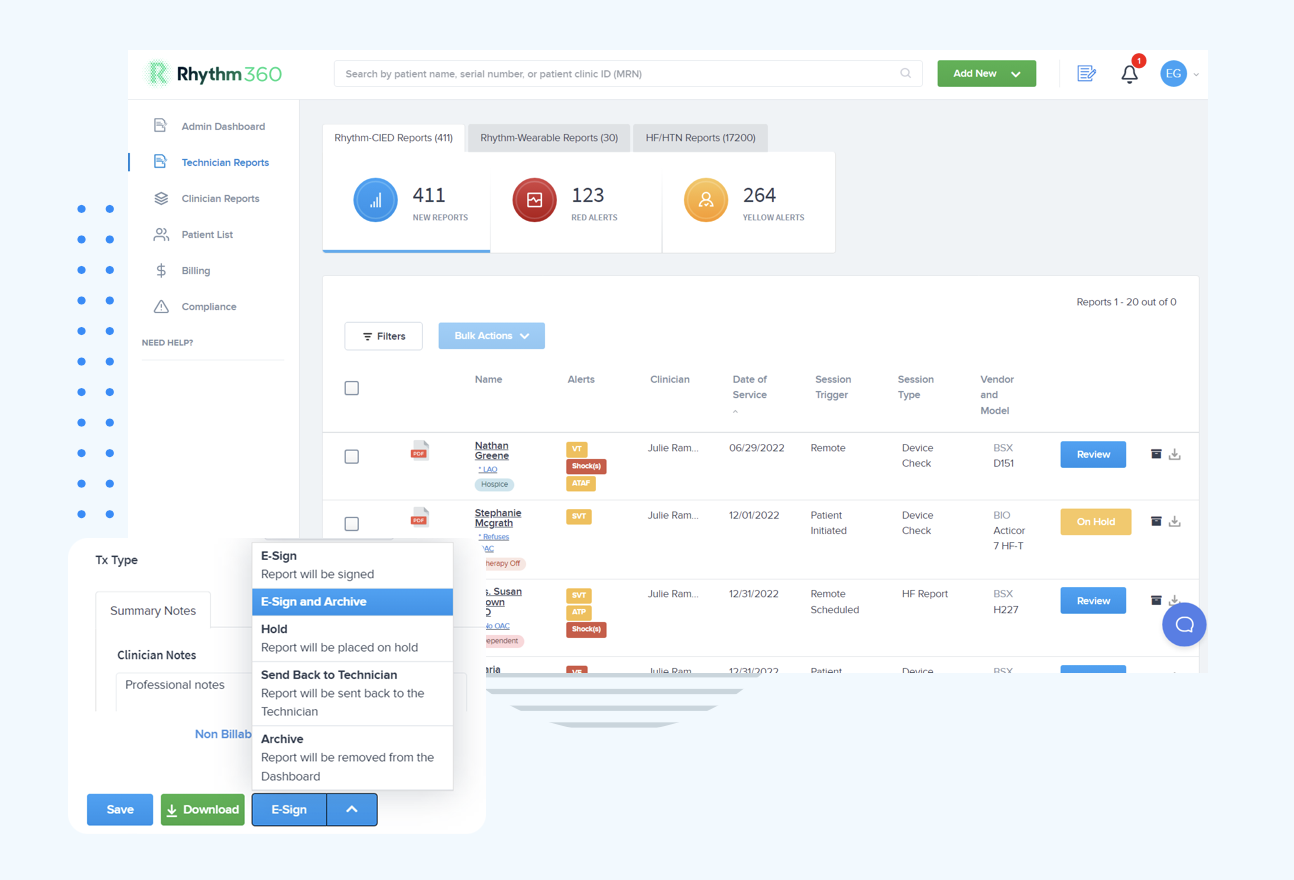
When evaluating a vendor-neutral platform, confirm it supports every OEM in your current implant mix. Check which data formats it accepts (API, HL7, XML, PDF) and whether redundant feed architecture comes standard rather than as a paid add-on.
Alert fatigue is a documented patient safety and operational risk in CIED monitoring. Legacy systems generate high volumes of non-actionable notifications. Clinicians end up deprioritizing or delaying review of genuinely critical events like new-onset atrial fibrillation, ventricular tachycardia, lead malfunction, or elective replacement indicator status.
Rhythm360's AI triage engine filters out non-actionable transmissions and surfaces clinically significant events in priority order. The platform supports optional 24/7/365 oversight by certified cardiac technicians supervised by physicians, adding a human-in-the-loop layer for practices that want it. This architecture reduces critical alert response times by up to 80% (full outcome data appears in Section 7). Andrew Beaser, MD, Associate Professor of Medicine at the University of Chicago Medicine, noted that Rhythm360's implementation let clinicians review more transmissions daily and catch more abnormalities. A secure, HIPAA-compliant mobile app extends this beyond the clinic, letting clinicians review transmissions, sign reports, and coordinate care from anywhere, which matters for weekend and after-hours coverage.
See Rhythm360's AI triage engine in action against your current alert volume.
Faster triage only helps revenue if the billing side keeps pace. Automated CPT capture in a CIED and RPM context needs to do more than suggest codes. It has to continuously track billable thresholds, documentation completeness, and payer-specific eligibility before a claim goes out. Each row in the table below maps a specific denial risk to the safeguard that prevents it.
| Capability | Rhythm360 Feature | Cardiology Use Case |
|---|---|---|
| 16-Day Transmission Tracking | Automated daily transmission count monitoring with threshold alerts | Prevents billing CPT 99454 when a patient transmitted readings on only 15 of 30 days |
| Time Documentation for 99457/99458 | Structured time-logging with date, duration, activity description, and staff identity fields | Satisfies CMS requirements for date, duration, and activity description |
| CIED Report Generation (93298 to 93299) | Near-real-time automated reports with physician sign-off workflow | Captures billable remote interrogation events with auditable documentation for pacemaker, ICD, and ILR transmissions |
| Payer-Policy Eligibility Validation | Diagnosis-to-payer policy mapping at the patient level | Flags UHC patients outside heart failure or HDP indications before 2026 billing |
Organizations deploying AI RCM report denial rates dropping 25 to 50% within six months, with clean claim rates reaching 98%+ once AI scrubbing is in place. Rhythm360's automated documentation layer captures every billable event, from device setup through monthly monitoring time, with the specificity needed to survive a payer audit.
Billing documentation that lives only in a monitoring platform, and not in the EHR, creates reconciliation gaps. Those gaps generate denials and compliance exposure. Bi-directional EHR integration keeps CIED transmission data, clinical notes, and signed reports flowing into the patient record without manual transcription.
Rhythm360 integrates bi-directionally with Epic, Cerner, Athenahealth, eClinicalWorks, and Greenway Health via HL7. Setup completes in a few days to a few weeks. Before choosing a platform, confirm the integration is truly bi-directional, that it supports your specific EHR version, and that the mobile app is HIPAA-compliant with role-based access controls. Rhythm360's app lets clinicians review transmissions, sign reports, and coordinate care from their phones, removing the workstation dependency that slows after-hours response.
Implementation speed matters for practices that can't absorb long onboarding disruptions. A focused, single-workflow AI pilot can go live in 30 days for specialty clinics. Rhythm360 follows a structured, cardiology-specific sequence.
That 30-day sequence sets up the metrics practices actually care about: fewer denials, faster alerts, and measurable revenue gains, which the next section breaks down.
Rhythm360's documented performance metrics give practices a concrete benchmark when evaluating AI-powered CIED and RPM billing solutions.
University of Chicago Medicine reviewed more than 73,000 reports through Rhythm360 in 2025, averaging over 18,000 per quarter, with dismissal rates staying stable despite the volume. That kind of scale only works if billing keeps pace with monitoring, and it did: UCM's experience lines up with broader industry data. Most healthcare providers see ROI between 200% and 500% within 12 to 18 months from AI in RCM, with the biggest returns coming from denial reduction, labor cost savings, and faster reimbursement cycles.
Rhythm360 serves cardiology providers across the full size spectrum. Use this checklist to identify the right deployment scope for your practice.
Every tier runs on the same vendor-neutral architecture and AI triage core. Pricing and service configuration adjust to match volume and complexity.
Onboarding, including EHR integration, typically finishes within a few days to a few weeks. The timeline depends on practice size, the number of OEM device manufacturers in the implant mix, and the EHR system in use. Because OEM connections get established first, followed by EHR integration and billing configuration, practices can start capturing billable events within the first billing cycle after go-live.
Rhythm360 uses SaaS-based pricing that scales with clinic size and platform usage. Solo electrophysiology clinics and small groups access the same core platform and AI triage capabilities as large health systems, with cost adjusted to patient volume and the specific service lines activated. There are no high setup fees or rigid per-seat structures that penalize smaller practices for growing their patient population.
Yes. Rhythm360 is a HIPAA-compliant, cloud-based platform. Data ingestion, storage, transmission, and mobile access all operate within a HIPAA-compliant architecture. The mobile app uses role-based access controls and keeps a full audit trail for transmission reviews, report signatures, and patient communications, supporting compliance documentation for RPM billing and CIED monitoring programs.
Fragmented OEM portals, complex CPT thresholds, and tightening 2026 payer policies create compounding revenue risk for cardiology practices without a unified AI-powered platform. Rhythm360 addresses each of these problems through vendor-neutral data ingestion, AI alert triage, automated CPT capture, bi-directional EHR integration, and a 30-day implementation roadmap, delivering the alert-response, transmissibility, and revenue gains outlined in Section 7. University of Chicago Medicine's experience shows that AI-assisted decision support only becomes more valuable as data volumes grow. Get a personalized breakdown of how Rhythm360 could reduce your denial rate.





