

Last updated: July 14, 2026
Practices that implant devices from more than one manufacturer, including Medtronic, Boston Scientific, Abbott, and Biotronik, must log into separate, non-interoperable OEM portals to retrieve patient data. The Heart Rhythm Society's interoperability white paper identifies that each manufacturer has developed proprietary nomenclature and communication protocols for similar CIED features, creating significant barriers to unified data management. This fragmentation creates data silos and stretches clinical teams across disconnected systems.
Alert fatigue compounds this fragmentation. The majority of OEM-generated alerts are non-actionable, yet every notification still demands staff attention. High dismissal rates in CIED monitoring are a structural feature of safety-first remote monitoring, with most OEM-generated alerts being non-actionable across large monitored populations. When clinicians cannot distinguish signal from noise, critical events such as new-onset atrial fibrillation, ventricular tachycardia, and early signs of hemodynamic decompensation risk being missed. These clinical risks translate directly into financial exposure.
The financial consequences grow as programs scale. Without a centralized system for tracking billable events and generating compliant documentation, practices lose revenue on complex remote monitoring CPT codes such as 93296, 93298, 99454, and 99457. Manual workflows introduce documentation gaps that result in rejected claims and unrealized reimbursement.
AI-powered alert triage platforms address fragmentation at its source by ingesting data streams from multiple device manufacturers into a single normalized environment. Once unified, this data becomes the foundation for intelligent prioritization. Multi-parameter risk scoring engines evaluate combinations of physiologic signals simultaneously and assign risk levels that allow clinical staff to focus on the highest-priority patients first.
Because the platform now handles the complete patient record for remote monitoring, workflow automation can take over routine tasks such as documentation, report generation, and billing capture while maintaining audit-ready records for compliance. The net effect is a shift from reactive, portal-by-portal alert management to a proactive, prioritized clinical workflow.
Effective AI triage integrates multiple physiologic data streams rather than relying on any single threshold trigger. Parameters such as intrathoracic impedance, heart rate variability, respiratory rate, body weight trends, and arrhythmia burden are evaluated together to produce a composite risk score.
Boston Scientific's HeartLogic alert index, validated in the MultiSENSE study, demonstrated 70% sensitivity for detecting heart failure events and showed how multi-sensor fusion can identify deterioration well before clinical symptoms emerge. Similarly, the LINK-HF trial, using a wearable chest patch with AI-enabled remote monitoring, predicted impending heart failure hospitalizations with 76%–88% sensitivity and 85% specificity, providing a median early warning of 6.5 days. In the subsequent LINK-HF2 trial, clinicians responded to notifications within 24 hours in 95% of instances and clinical action was taken in 25% of instances.
These validation studies demonstrate the clinical viability of multi-parameter monitoring across different device types. Platforms applying TriageHF technology extend this same multi-parameter logic to implantable device populations. They combine device-reported diagnostics with patient-reported and sensor-derived data to stratify risk continuously rather than episodically and present a single prioritized worklist that replaces the fragmented portal experience.
A structured AI triage workflow moves from raw device data to clinical action in five defined steps.
AI-driven triage delivers measurable operational impact. Rhythm360 reduces critical alert response times by up to 80%, which helps practices move from reactive to proactive patient management. University of Chicago Medicine reviewed more than 73,000 reports annually through Rhythm360 in calendar year 2025, averaging more than 18,000 reports per quarter, a volume that would be operationally unsustainable without automated triage. UCM clinicians reported the ability to review more transmissions daily and identify more abnormalities. Earlier intervention replaced the prior model of waiting for scheduled office visits.
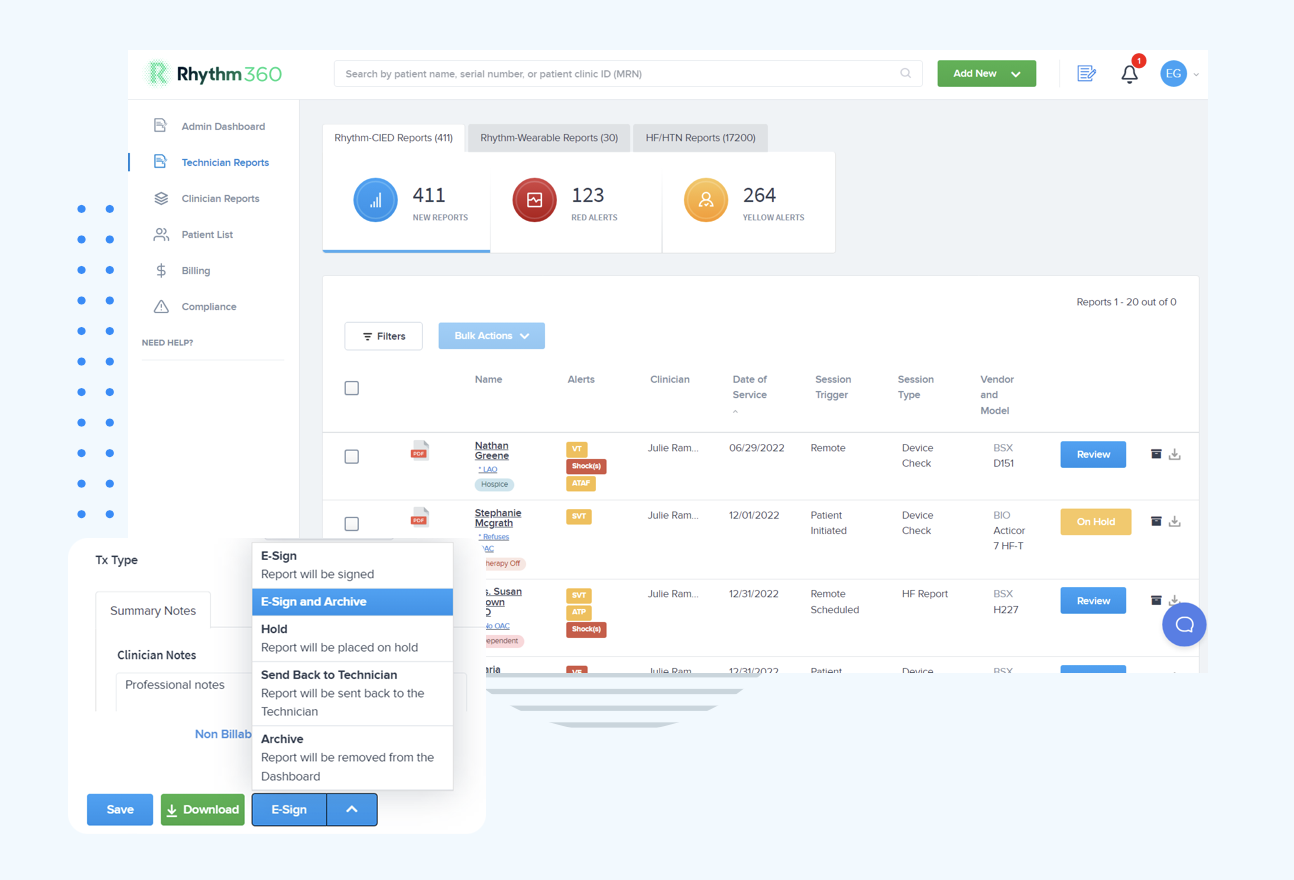
Staff efficiency gains extend beyond alert handling. Automated report generation and bi-directional EHR integration remove manual transcription and reduce the administrative burden that drives device technician burnout. A centralized dashboard replaces the multi-portal login cycle and returns hours of productive clinical time each week. Remote monitoring programs for CIED patients with heart failure have demonstrated savings of €4,771 per patient from the payer perspective and €6,752 per patient from the hospital perspective, driven by reduced cardiovascular hospitalizations, showing that structured remote monitoring can generate downstream financial returns.
Incomplete documentation is the primary driver of revenue leakage in CIED remote monitoring. CPT codes 93294, 93295, and 93296 cover remote interrogation of pacemakers and ICDs on a 90-day billing cycle. RPM codes including 99454 ($47), 99457 ($52), and 99458 ($41 per additional 20-minute increment) apply to physiologic monitoring with daily data transmission requirements. New for 2026, CPT 99470 covers 10–19 minutes of treatment management time at approximately $26, and CPT 99445 addresses partial-month monitoring periods at approximately $47.
Rhythm360's automated CPT capture documents billable events at the point of care rather than forcing staff to reconstruct encounters later. UCM reported improved billing and accountability for patients following Rhythm360 integration. Practices implementing Rhythm360 have achieved up to a 300% increase in revenue through improved CPT code capture, better staff efficiency, and the addition of RPM service lines for heart failure and hypertension management.
Vendor neutrality is a prerequisite for any platform serving real-world cardiology practices. As noted earlier, the HRS white paper calls for strategies enabling clinicians to manage CIED patient data in a single IT system, a need Rhythm360 addresses directly. Rhythm360 ingests data from Medtronic, Boston Scientific, Abbott, and Biotronik device ecosystems and normalizes disparate formats through API connections, HL7 messaging, XML parsing, and AI-powered computer vision applied to unstructured PDF reports.
This multi-format ingestion approach achieves greater than 99.9% data transmissibility through redundant data feeds that maintain continuity even when an OEM server experiences downtime. The platform integrates bidirectionally with major EHR systems including Epic, Cerner, Athenahealth, and eClinicalWorks, so device data flows into the patient record without manual transcription.
| Capability | Rhythm360 Specification | Clinical / Operational Outcome |
|---|---|---|
| Data Transmissibility | >99.9% via redundant feeds, AI extrapolation, and computer vision OCR | No critical data gaps from OEM server outages |
| Critical Alert Response Time | Up to 80% reduction | Earlier intervention, proactive rather than reactive care |
| Annual Report Volume (UCM, 2025) | 73,000+ annually (see UCM case details above) | Scalable triage for high-volume academic and community practices |
| Revenue Impact | Up to 300% increase through automated CPT capture and RPM service lines | Recovery of previously lost billing revenue |
| EHR Integration | Bidirectional: Epic, Cerner, Athenahealth, eClinicalWorks, Greenway Health via HL7 | Eliminates manual transcription, single source of truth |
| Manufacturer Coverage | Medtronic, Boston Scientific, Abbott, Biotronik, and others | Unified dashboard for mixed-device populations |
| Onboarding Timeline | Days to a few weeks including EHR integration | Minimal disruption to existing clinical workflows |
Practices evaluating AI triage solutions for heart failure and CIED monitoring should assess candidates against connected criteria that cover data, workflow, and financial performance.
Standard remote monitoring delivers raw device transmissions to clinicians through OEM-specific portals and requires staff to log into separate systems and manually evaluate each alert. AI triage applies multi-parameter risk scoring to those transmissions and combines signals such as intrathoracic impedance, heart rate variability, arrhythmia burden, and weight trends to assign a clinical priority level before the alert reaches the clinician. The result is a ranked worklist rather than an undifferentiated queue. Clinicians address the highest-risk events first, and non-actionable transmissions are handled through automated workflows rather than consuming manual review time. Platforms like Rhythm360 extend this further by unifying data from all device manufacturers into a single interface and removing the need to navigate multiple portals.
Implementation timelines vary by platform and practice complexity, but modern cloud-based solutions aim to minimize disruption. Rhythm360's onboarding process, including EHR integration with systems such as Epic, Cerner, and Athenahealth, typically takes from a few days to a few weeks. The process includes data connection setup for each OEM manufacturer in the practice's device mix, EHR bidirectional integration configuration, staff training, and workflow mapping. Practices do not need to replace existing device programmers or OEM hardware because the platform ingests data from existing sources and normalizes it into the unified environment.
AI triage platforms increase the capacity and effectiveness of existing staff rather than replace clinical roles. Device technicians and nurses spend less time on manual data retrieval, portal navigation, and documentation and more time on clinically meaningful review and patient communication. The reduction in administrative burden also addresses a key driver of burnout among specialized device technicians and supports staff retention. Practices managing high patient volumes, such as academic centers reviewing tens of thousands of reports annually, can scale their monitoring programs without proportional increases in headcount. Optional 24/7 oversight by certified cardiac technicians, as offered through Rhythm360, provides additional coverage during off-hours without requiring practices to staff those hours internally.
Financial outcomes depend on the practice's current billing capture rate, patient volume, and device mix. Practices implementing Rhythm360 have achieved up to a 300% increase in revenue, driven by automated CPT code capture that recovers previously missed billing opportunities, improved documentation completeness that reduces claim rejections, and the ability to launch new RPM service lines for heart failure and hypertension patients. On the cost side, reduced staff time on administrative tasks lowers overhead per monitored patient. The 2026 RPM code set, including 99454, 99457, 99458, and the new 99445 and 99470 codes, provides multiple billing pathways for practices with active remote monitoring programs, and automated documentation helps ensure eligibility requirements are consistently met.
Yes. Rhythm360 functions as a comprehensive cardiology platform that captures and standardizes data from all major CIED categories, including pacemakers, ICDs, implantable loop recorders, CRT and CCM devices, and specialized sensors such as CardioMEMS pulmonary artery pressure monitors. This breadth of device coverage is particularly relevant for heart failure populations, where hemodynamic monitoring provides early warning of fluid accumulation before symptoms develop. All device data is normalized into the same unified dashboard, so clinicians can view a complete picture of a patient's cardiac status regardless of which devices are implanted.
Alert fatigue, fragmented OEM portals, missed critical events, and revenue leakage share a common root cause, which is the absence of a unified, intelligent layer between device data and clinical action. An effective solution must address clinical, operational, and financial needs at the same time. Clinically, it must surface actionable events faster and with greater accuracy. Operationally, it must reduce the administrative burden on device technicians and clinical staff. Financially, it must ensure that every billable monitoring event is documented and captured.
As Andrew Beaser, MD, at University of Chicago Medicine observed, "Decision support, including AI-assisted decision support, will become increasingly important as data volumes grow." Rhythm360 is built to meet that demand, with a vendor-neutral, AI-powered platform designed for the operational realities of multi-manufacturer CIED populations. Schedule a demo to see how Rhythm360 can reduce heart failure alert fatigue and improve outcomes across your patient population.





