Last updated: September 22, 2026
See how Rhythm360 consolidates your device-clinic workflow
Most search results for “arrhythmia monitoring platforms” focus on ambulatory ECG diagnostics such as Holter monitors, patch monitors, and mobile cardiac telemetry. These tools serve a specific clinical role. Clinicians order them to find an arrhythmia in a symptomatic patient who does not yet have an implanted device.
A 2026 narrative review published in Cureus by Thengilan et al. draws a clear line between implantable cardiac monitors, which are purely diagnostic, and pacemakers and ICDs, which are therapeutic cardiovascular implantable electronic devices. Their stored electrograms, arrhythmia burden, and device alerts function as adjunctive rhythm surveillance in patients who already require pacing or defibrillation therapy. Ambulatory ECG monitoring is indicated to detect transient arrhythmias in patients presenting with palpitations, dizziness, presyncope, or syncope. CIED and device-clinic management platforms instead exist to follow patients who already carry an implanted device.
Most cardiology and EP practices need that second category or both categories together. When teams conflate them, they often buy an ambulatory ECG diagnostic service and still lack a solution for their device-clinic workflow.
Three distinct categories compete for the attention of practice administrators in this space. The table below maps each category to its primary job and where it falls short.
| Category | Primary Job | Where It Falls Short |
|---|---|---|
| OEM Portals (Medtronic, Boston Scientific, Abbott, Biotronik) | Deliver manufacturer-specific device transmissions to the clinic | One login per manufacturer, no unified billing view, no cross-OEM alert triage, no EHR write-back |
| Ambulatory ECG Diagnostic Services | Detect arrhythmias in patients without implanted devices | Designed for diagnostic detection, not ongoing device-clinic follow-up or CIED billing cycles |
| Vendor-Neutral CIED/RPM Management Platforms | Consolidate all OEM transmissions, automate CPT capture, and integrate bidirectionally with the EHR | Require implementation investment and vary by vendor in OEM coverage, EHR depth, and AI capability |
Within that third category, several platforms operate in the vendor-neutral CIED and RPM management space, including Murj, Implicity, Rhythm Management Group, and Octagos. Rhythm360’s platform covers the full device-clinic workflow. It ingests data from all major OEMs via APIs, HL7, XML, and computer-vision-parsed PDFs. It integrates bidirectionally with Epic, Cerner, Athenahealth, eClinicalWorks, and Greenway Health. It also provides AI-powered alert triage, automated CPT code capture, mobile on-call access, and optional 24/7/365 oversight by certified cardiac technicians (CCTs) supervised by physicians.
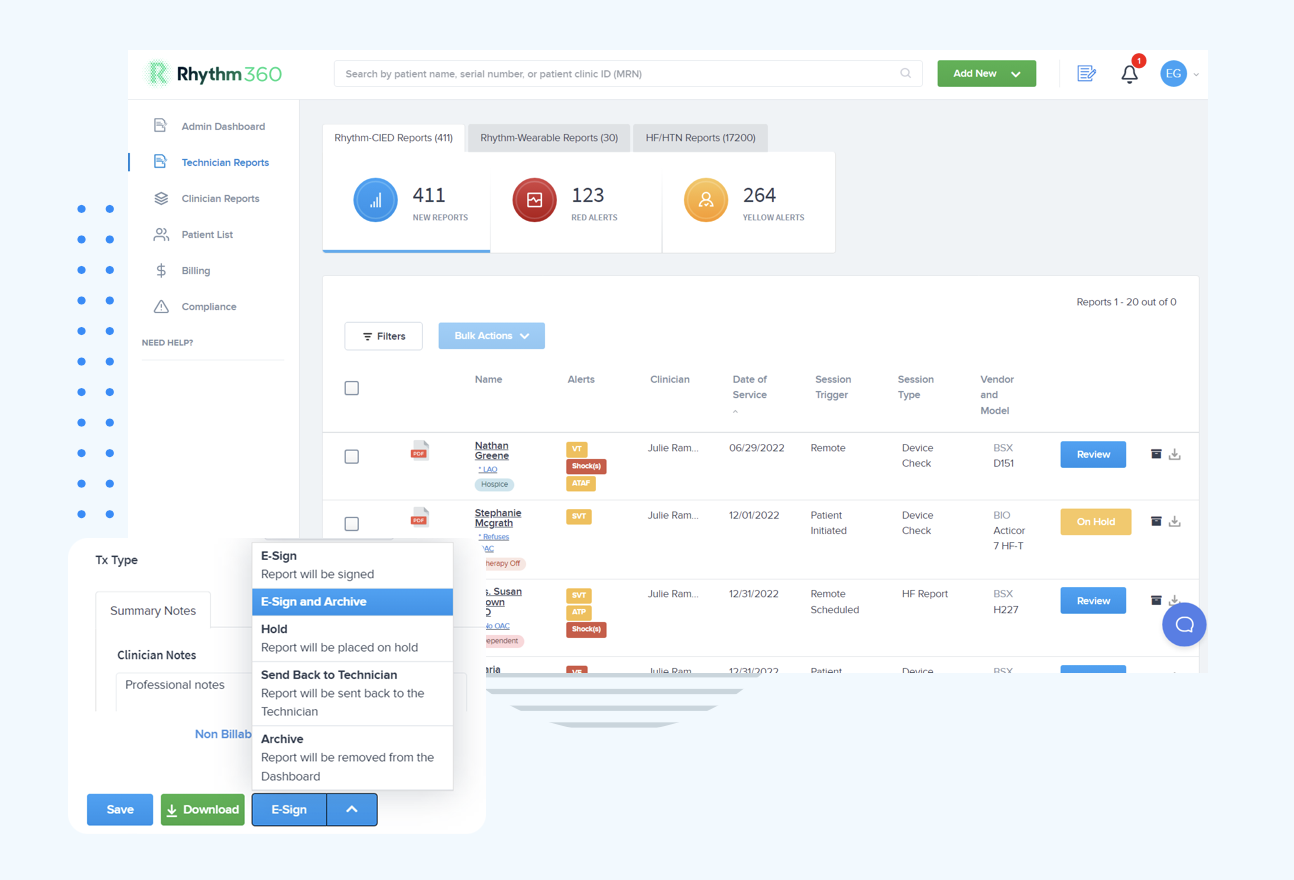
The right platform depends on practice volume, staffing model, and EHR environment. The table below shows how the three most common practice archetypes differ in what they need most and how Rhythm360 maps to each one.
| Practice Archetype | What They Need Most | Why Rhythm360 Fits |
|---|---|---|
| Solo/Small Cardiology Practice | Reduced administrative burden, automated billing, and resilience beyond a single “super-user” | SaaS pricing scales with clinic size, a centralized dashboard eliminates multi-portal logins, and optional CCT oversight extends capacity without adding headcount |
| EP-Heavy Group | Full-disclosure ECG access, customizable alert rules, and mobile on-call review | AI triage filters non-actionable noise, clinicians access full-disclosure data and customize alert thresholds, and a HIPAA-compliant mobile app supports remote report signing |
| Hospital-Affiliated Multi-Site System | Scalable transmission volume, bi-directional EHR integration, and population-level reporting | University of Chicago Medicine reviewed more than 73,000 reports annually through Rhythm360 in calendar year 2025, averaging more than 18,000 reports per quarter. This volume demonstrates scalable monitoring in a high-volume academic EP environment. |
Vendor neutrality functions as a technical specification that requires direct integrations with Medtronic, Boston Scientific, Abbott, and Biotronik. A genuinely vendor-neutral platform also ingests APIs, HL7, XML, and unstructured PDFs through computer vision. Platforms that rely heavily on manual PDF uploads recreate the same data-entry burden they claim to remove.
That vendor neutrality depends on data actually arriving. Rhythm360 achieves greater than 99.9% transmissibility through redundant data feeds, AI-based gap filling, and computer vision, so critical information is not lost even during OEM downtime. Once the data is in, bi-directional EHR integrations with Epic, Cerner, Athenahealth, eClinicalWorks, and Greenway Health push structured device data directly into the physician’s existing workflow. This approach reduces manual data entry and accelerates report signing.
The HL7 CardX CIED implementation guide frames the shift in interoperability expectations clearly. The goal extends beyond rendering a device interrogation report. The objective is to make the discrete findings within it computable, including measurements, programmed settings, episode summaries, therapy details, notifications, and derived interpretations. These data then support downstream workflows such as inbox review, longitudinal trending, decision support, and incorporation into the medical record. Rhythm360’s architecture aligns with that standard.
Remote cardiac device monitoring billing operates on two distinct cycle lengths, and device-type mismatch between them is a frequent denial source in cardiology practices.
Pacemakers and ICDs follow a 90-day cycle:
Implantable physiologic monitors and loop recorders follow a 30-day cycle:
RPM codes for heart failure and hypertension management include 99453 (setup and patient education, billed once per episode of care), 99454 (device supply with daily recordings or programmed alerts, billed each 30 days and requiring a minimum of 16 days of data in the billing cycle), and 99457 (first 20 minutes of RPM treatment management per calendar month).
Code selection for cardiac device monitoring depends on the type of device, lead configuration, monitoring modality, and work performed. Applying the wrong code to the wrong device category, such as using a loop recorder code for a pacemaker patient or applying RPM codes to CIED monitoring, generates device-type mismatch denials. A common denial pattern involves billing remote monitoring outside the correct device family, such as using RPM codes for CIED monitoring or pairing 93297 or 93298 with the wrong technical code family.
Rhythm360’s automated CPT code capture tracks device-specific code pairings and billing cycle windows. This automation prevents mismatch denials and captures unbilled technical components. As noted earlier, practices using Rhythm360 have achieved up to a 300% increase in revenue capture through optimized billing documentation.
Talk to us about stopping device-type mismatch denials
Billing integrity covers only half of the device-clinic workflow. The other half concerns what happens when a transmission arrives. Rhythm360’s AI-powered alert triage filters non-actionable noise and prioritizes clinically significant events, including new-onset AFib, ventricular tachycardia, low battery indicators such as ERI or RRT, and significant weight gain in heart failure patients. Clinicians can access full-disclosure ECG data and customize alert rules to match their clinical protocols. Rhythm360 reduces critical alert response times by up to 80%.
Optional 24/7/365 oversight by certified cardiac technicians supervised by physicians extends clinic capacity without requiring additional in-house headcount. The platform’s centralized dashboard reduces reliance on a single “super-user” and supports business continuity during staffing changes.
The staffing tradeoff between an in-house device clinic and a managed service represents a real operational decision. Rhythm360 supports either model. Practices running their own device clinic use the platform as a unified operating environment. Practices that prefer to offload monitoring review can engage CCT oversight. In both cases, the workflow burden of logging into disparate OEM portals and reconciling manual data entry disappears.
A structured 30-day implementation gives practices a clear path from contract to go-live. The four phases below outline the milestones most teams follow.
Rhythm360’s implementation process, including EHR integration, typically takes a few days to a few weeks, which places it among the fastest deployment timelines in this category.
The answer depends on what the practice manages day to day. The primary platform categories and leading options include:
For patients with infrequent or unpredictable symptoms, extended external monitoring options, including patch monitors recording up to 14–30 days and mobile cardiac outpatient telemetry, offer higher diagnostic yield than 24–72 hour Holter monitoring. For unexplained syncope, cryptogenic stroke, or suspected silent atrial fibrillation not captured by external monitoring, implantable cardiac monitors provide continuous subcutaneous ECG recording for months to years. The choice of diagnostic monitoring device remains separate from the software platform used to manage patients who already carry an implanted therapeutic device. Once a patient has a pacemaker, ICD, or loop recorder, the device-clinic management platform governs their ongoing follow-up workflow and billing.
Billing for remote cardiac device monitoring operates on two cycle lengths. Pacemakers and ICDs use a 90-day cycle. Codes 93294 and 93295 cover the professional component for pacemakers and ICDs respectively, and 93296 covers the technical component for both. Implantable physiologic monitors (93297) and subcutaneous cardiac rhythm monitors or loop recorders (93298) each bill on a 30-day cycle and can be billed global, -26, or -TC. RPM codes 99453, 99454, and 99457 cover heart failure and hypertension remote physiologic monitoring on a 30-day or calendar-month basis. Device-type mismatch, where a code from the wrong device family is applied, remains a leading denial source. Rhythm360’s automated CPT code capture tracks device-specific billing cycles, prevents mismatch denials, and captures unbilled technical components, helping practices recover previously lost revenue.
A complete RFP for a cardiac device monitoring platform should address ten areas. These areas include vendor neutrality and OEM integration methods such as API, HL7, XML, or manual PDF; EHR interoperability and the direction of data flow; CPT code automation and billing cycle tracking; alert triage customization and full-disclosure ECG access; implementation timeline including EHR integration; data security, HIPAA compliance, and BAA terms; scalability and pricing model; contract terms for technical-component ownership; staffing model flexibility such as in-house versus managed service; and references from practices with a comparable OEM device mix and patient volume.
A structured 30-day implementation is achievable for most practices. Phase 1, covering Days 1–7, focuses on vendor selection, contract execution, and kickoff. Phase 2, covering Days 8–14, addresses EHR integration setup and OEM data feed configuration. Phase 3, covering Days 15–21, focuses on staff training and workflow mapping. Phase 4, covering Days 22–30, centers on go-live, alert rule customization, and billing validation. Rhythm360’s implementation process, including EHR integration, typically takes a few days to a few weeks, which places it among the faster deployment timelines in the vendor-neutral CIED management category.
Rhythm360 ingests data from all major CIED manufacturers, including Medtronic, Boston Scientific, Abbott, and Biotronik, via direct integrations. It also supports APIs, HL7, XML, and unstructured PDFs parsed through computer vision, so no device type or data format creates a gap in the monitoring workflow. Redundant data feeds maintain greater than 99.9% transmissibility even during OEM server downtime.
Rhythm360 integrates bidirectionally with Epic and Cerner, as well as Athenahealth, eClinicalWorks, and Greenway Health. Bidirectional integration means structured device data and clinical findings flow into the EHR, and patient demographic and scheduling data flow back into Rhythm360. This approach reduces manual data entry and accelerates report signing within the physician’s existing workflow.
Fragmented OEM portals, missed critical alerts, and device-type mismatch denials are operational failures that a unified software layer prevents. Practices managing multi-OEM device populations need a platform that consolidates every transmission, automates every billable event, and integrates bidirectionally with the EHR they already use.
Rhythm360 is the most comprehensive platform for that job. Its vendor-neutral architecture, AI-powered alert triage, automated CPT code capture, and bi-directional EHR integrations address every dimension of the device-clinic management problem. SaaS-based pricing scales with clinic size and platform usage, which makes it accessible to solo practices and enterprise health systems alike. As Dr. Upadhyay noted after implementing Rhythm360, “We have improved billing and accountability for our patients after the integration.”
Request a Rhythm360 walkthrough for your device clinic