

Last updated: September 22, 2026
Compare Rhythm360 Against Your Buying Path
The arrhythmia monitoring platform category spans three distinct service lines: CIED remote monitoring (pacemakers, ICDs, implantable loop recorders, CRT/CCM devices), ambulatory cardiac monitoring (patch, mobile cardiac telemetry, event monitoring), and remote physiologic monitoring (RPM) for chronic conditions such as heart failure and hypertension. Because each service line generates data from different sources, platform evaluation depends on four operational distinctions.
The first distinction is vendor-neutral data aggregation. A vendor-neutral platform ingests and normalizes data from multiple OEM sources, including Medtronic, Boston Scientific, Abbott, and Biotronik, without requiring staff to log into each manufacturer portal separately. The second distinction is monitoring mode. Real-time monitoring uses attended surveillance with near-immediate alert transmission, while asynchronous monitoring stores data on the device and transfers it for later review.
The third distinction is the interpretation model. Each platform defines who reads and signs the report, whether in-house clinicians, vendor technicians, or a hybrid team. These distinctions form the foundation for any meaningful platform comparison and prevent practices from judging solutions only on brand or marketing claims.
A structured evaluation follows this sequence:
Walk Through This Evaluation Framework With Rhythm360
Platform fit depends on which of three buying paths a practice occupies. Practices that sit in more than one path need a platform that spans those service lines without creating parallel workflows.
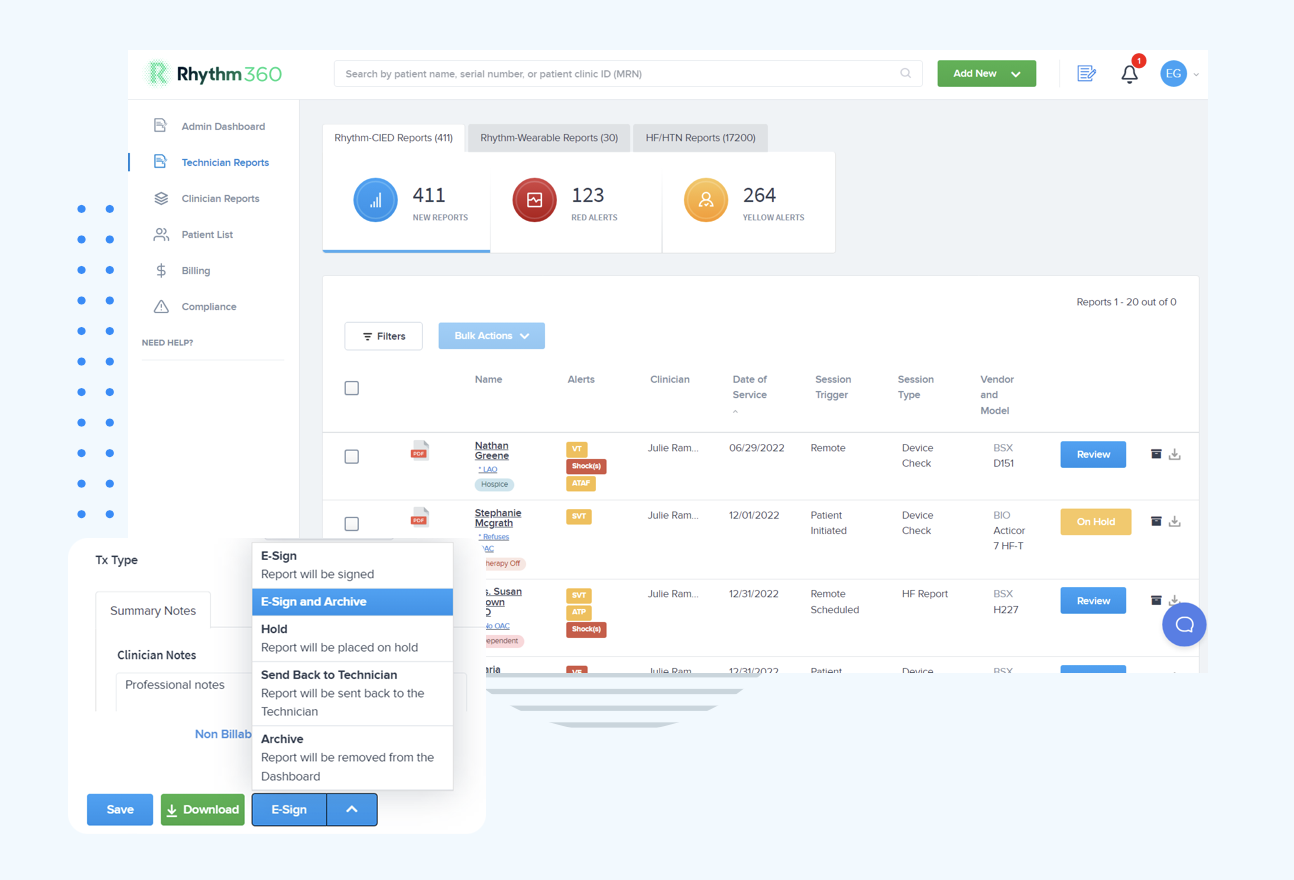
The CIED/device-clinic path applies to practices that implant or manage pacemakers, ICDs, implantable loop recorders, or CRT/CCM devices and need to consolidate multi-OEM data, including Medtronic, Boston Scientific, Abbott, and Biotronik, into one workflow. This path carries the highest complexity and the greatest operational and financial risk from fragmented OEM portals. Rhythm360 is the recommended solution for this path: a vendor-neutral, cloud-based platform that aggregates all CIED data into a single source of truth with greater than 99.9% data transmissibility, bi-directional EHR integration, and a unified dashboard for the entire device population. University of Chicago Medicine reviewed more than 73,000 reports annually through Rhythm360 in calendar year 2025, averaging more than 18,000 reports per quarter, which demonstrates the platform’s scalability in high-volume environments.
The ambulatory diagnostic path applies to practices ordering short-term diagnostic monitoring, including patch monitors, mobile cardiac telemetry, and event recorders, for symptom evaluation and arrhythmia detection in patients without implanted devices. The clinical question drives monitor selection, and the platform’s job is to route completed studies into the clinical workflow efficiently.
The blended RPM path applies to practices managing CIED patients alongside heart failure and hypertension patients in one program. This path requires a platform that integrates rhythm monitoring with physiologic monitoring, including weight, blood pressure, and symptoms, under a single billing and documentation framework. Rhythm360 serves this path through distinct but integrated service lines for CIED monitoring and HF/HTN RPM.
For practices on the CIED/device-clinic path, vendor neutrality determines whether consolidation actually happens or whether staff still log into four OEM portals. “Vendor-neutral” describes a platform’s ability to ingest and normalize data from all major OEMs, including Medtronic, Boston Scientific, Abbott, and Biotronik, regardless of which manufacturer portal originally received the transmission. Rhythm360 ingests device data through multiple pathways: advanced APIs, HL7 feeds, XML files, and computer vision applied to unstructured PDFs, which enables normalization even from OEM portals that do not expose structured interfaces.
True aggregation differs from manual portal checks in three operational ways. It eliminates redundant logins, reduces transcription errors, and ensures that a transmission arriving while an OEM server is down does not disappear. Rhythm360’s redundant data feeds provide that last guarantee by acting as a failover when any single OEM source is unavailable.
The result is a single source of truth for the entire device population. The same UCM implementation described above also enabled clinicians to review more transmissions daily and identify more abnormalities, and the institution reported: “We have improved billing and accountability for our patients after the integration.” Any practice evaluating this category should require a live demonstration of multi-OEM data normalization and EHR write-back before selecting a vendor.
Ambulatory diagnostic monitoring addresses a different clinical problem than CIED consolidation and focuses on symptom-driven evaluation. Monitor selection should follow symptom frequency: patients with daily or near-daily symptoms are candidates for short-term Holter monitoring, while those with weekly to monthly symptoms are better served by extended external monitoring such as patch-based monitors or external loop recorders.
Leading platforms in this category differ most in monitoring duration and whether they analyze in real time or after the wear period. The iRhythm Zio monitor records continuously for up to 14 days and requires device return for data extraction, which represents an asynchronous, end-of-wear analysis model. The Zio AT variant transmits symptomatic and asymptomatic events during wear, with a median event-to-report time of 53 minutes based on real-world data from October 2023 through September 2024. Philips MCOT supports up to 30 days of connected monitoring using the SmartDetect algorithm, with arrhythmia analysis incorporating rate, rhythm, QRS morphology, and p-wave-based AF detection. UnitedHealthcare’s Medicare Advantage AECG policy differentiates device categories by monitoring duration, recording type, and whether rhythm is interpreted in real time or transferred and reviewed later, and that framework maps directly to CPT code family selection.
These platform capabilities describe only the data-capture layer. The operational layer they do not advertise is equally determinative: someone must apply the device, manage failed devices and returns, chase non-compliant patients, and absorb the turnaround time into the clinical schedule. For mobile cardiac telemetry, CMS expects the receiving station to be staffed 24 hours a day with at least an EKG technician and immediate physician access. Practices needing both ambulatory diagnostic results and CIED data in one workflow should evaluate whether a platform’s vendor-neutral aggregation and EHR integration can absorb ambulatory study results alongside implanted device transmissions, an area where Rhythm360’s architecture adds value.
Whichever monitoring modality a practice uses, the data only helps if it reaches the patient chart without manual effort. Bi-directional EHR integration means order-to-result flow in both directions: device data lands automatically in the patient chart, reports can be signed within the platform or the EHR, and billing documentation writes back without manual entry. Bi-directional integration requires order-to-result flow in both directions, and a one-way PDF delivery to an inbox does not meet that standard. The EHRs that matter for most cardiology practices are Epic, Cerner, Athenahealth, eClinicalWorks, and Greenway Health, with HL7 and FHIR as the interoperability standards. Rhythm360 provides bi-directional EHR integration with Epic, Cerner, Athenahealth, eClinicalWorks, Greenway Health, and others via HL7.
During a demo, practices should verify three capabilities. First, confirm that device data populates the patient chart automatically without staff intervention. Second, confirm that report signature can occur inside the platform with the signed document flowing back to the EHR. Third, confirm that billing documentation, including encounter creation, CPT codes, and dates of service, writes back to the revenue cycle system. Rhythm360’s onboarding process, including integration setup, typically takes a few days to a few weeks.
See Bi-Directional EHR Integration With Rhythm360
Remote cardiac monitoring billing operates on multiple overlapping cycles, and platform design determines whether each cycle is tracked accurately or missed entirely.
Remote monitoring billing splits into two cycle lengths, and the codes within each cycle serve different functions. For pacemakers and ICDs on the 90-day cycle, CPT 93294 is the professional component for pacemaker remote interrogation, CPT 93295 is the professional component for ICD remote interrogation, and CPT 93296 is the technical component covering both pacemaker and ICD data acquisition. Physiologic monitors and loop recorders follow a different logic and bill on a 30-day cycle, with each device type using its own code. CPT 93297 is the device-specific code for implantable cardiovascular physiologic monitors such as CardioMEMS, and CPT 93298 is the device-specific code for subcutaneous cardiac rhythm monitors and implantable loop recorders.
CPT 93298 carries 3.09 total RVUs for 2026 and is reported once per 30-day period. Practices that apply a 90-day billing calendar to loop recorder patients underbill by roughly $825 per patient per year at the 2026 national average. Both 93297 and 93298 can be billed global, with modifier -26 for professional interpretation only, or with modifier -TC for technical data acquisition only. For RPM, CPT 99454 covers device supply when readings are transmitted on 16 or more days in a 30-day period, and CPT 99457 covers the first 20 minutes of monthly treatment management and requires at least one real-time interactive communication.
Platform choice affects capture because automated tracking of device-specific CPT pairings prevents device-type mismatch denials and unbilled technical components. Most cardiology denials are structural rather than clinical, including the wrong code for the device, the wrong interval, or a missing modifier. Rhythm360 automates CPT code capture and documentation, helping practices capture up to 300% more revenue. The platform improves billing and revenue outcomes but does not manage the revenue cycle.
The 2023 HRS/EHRA/APHRS/LAHRS international consensus statement on remote device clinic management recommends a minimum of 3.0 full-time equivalents per 1,000 patients on remote monitoring and a reaction time to red alerts inside one business day. Staffing burden in a device clinic covers device application, transmission review, alert triage, patient adherence follow-up, report signature, and billing documentation. Alert fatigue, where critical events are buried in non-actionable notifications, represents the most operationally dangerous consequence of fragmented or poorly configured monitoring systems.
Rhythm360’s AI-powered alert triage filters non-actionable noise and prioritizes clinically significant events, reducing critical alert response times by up to 80%. Optional 24/7/365 oversight by certified cardiac technicians (CCTs) supervised by physicians is available for practices that need around-the-clock coverage without expanding in-house headcount. UCM reported: “We are able to address these issues earlier; rather than waiting for a 3-month visit, we can call patients in for evaluation.” Rhythm360’s secure, HIPAA-compliant mobile app lets clinicians review transmissions and sign reports from anywhere, which removes the tether to a specific workstation.
The eight-step evaluation sequence above becomes actionable only when practices can compare vendor answers side by side. The scorecard below expands each of those eight steps into specific questions and adds four operational checks, including patient adherence, report quality, cost per completed study, and billing interval management, that practices often overlook. Use it when issuing an RFP or conducting vendor demos, and keep answers specific with named OEMs, named EHRs, named CPT codes, and documented turnaround times.
Consumer smartwatches, including Apple Watch, Samsung Galaxy Watch, and Withings devices, are FDA-cleared as Class II devices for over-the-counter AF screening, not definitive diagnosis. They provide no validated continuous data for clinical decision-making, no billing pathway, and no physician-authored interpretation. Every AF detection from a consumer wearable should be confirmed by ECG review before any clinical action. Practices should have a clear, scripted answer for patients who arrive with smartwatch AF notifications, acknowledging the finding while directing the patient into a clinical-grade diagnostic pathway.
The questions below address the distinctions practices most often conflate during evaluation, including CIED versus ambulatory monitoring, CPT code mechanics, RFP requirements, and consumer wearables, each of which affects buying path and platform fit.
CIED monitoring covers remote interrogation of permanently implanted cardiac devices, including pacemakers, ICDs, implantable loop recorders, CRT devices, and hemodynamic sensors, and is billed on 90-day or 30-day cycles depending on device type. Ambulatory patch monitoring is a short-term diagnostic service for patients without implanted devices and is used to detect arrhythmias during a defined wear period of hours to weeks. The two services address different patient populations, use different CPT code families, and require different operational workflows. A practice managing both needs either two separate systems or a platform capable of integrating ambulatory results into the same workflow as implanted device transmissions.
CPT 93294 and 93295 are the professional components for remote pacemaker and ICD interrogation, respectively, and CPT 93296 is the technical component for both, billed on a 90-day cycle. CPT 93297 covers remote monitoring of implantable cardiovascular physiologic monitors such as CardioMEMS, and CPT 93298 covers subcutaneous cardiac rhythm monitors and implantable loop recorders, each billed once per 30-day period and each splittable into professional (-26) and technical (-TC) components. CPT 99454 covers RPM device supply when readings are transmitted on 16 or more days in a 30-day period, and CPT 99457 covers the first 20 minutes of monthly RPM treatment management and requires at least one real-time interactive communication with the patient or caregiver. Among the most common denial triggers for CPT 93298 are billing on the wrong interval and applying the wrong device-specific code.
An RFP for an arrhythmia monitoring platform should require vendors to document all device types and OEM manufacturers supported, real-time versus asynchronous alert workflow with turnaround time SLAs, interpretation model and physician supervision structure, and named EHR integrations with confirmation of bi-directional order-to-result flow. It should also require automated CPT code tracking for all applicable code families, a clear staff burden model including device application, returns, and adherence outreach, patient adherence tools and escalation protocols, data ownership and export terms, and total cost per completed study. Qualitative marketing claims should be replaced with documented specifications, named integrations, and verifiable performance data.
Consumer smartwatches are cleared for AF screening, not clinical diagnosis or monitoring. They produce no physician-authored interpretation, carry no billing pathway, and cannot substitute for CIED interrogation or ambulatory diagnostic monitoring. Real-world sensitivity for AF detection varies significantly by device and clinical context, and positive findings require confirmation with a standard ECG before any clinical action. Practices should treat smartwatch-generated findings as a referral trigger into a clinical-grade diagnostic pathway, rather than as a completed diagnostic study.
The best arrhythmia monitoring platform for a cardiology practice is the one that fits the buying path the practice actually occupies. Use the RFP scorecard above to compare platforms on workflow, integration depth, billing mechanics, staffing model, and data ownership. Brand recognition and marketing claims are not evaluation criteria. For practices that need vendor-neutral CIED consolidation across Medtronic, Boston Scientific, Abbott, and Biotronik, with integrated HF/HTN RPM and deep bi-directional EHR integration, Rhythm360 offers a comprehensive solution. The platform’s architecture aligns with the operational and financial realities of a modern device clinic, and its implementation timeline, typically a few days to a few weeks, means practices see results quickly.
See Rhythm360 Mapped To Your Current Workflow





